Birth Chart
North Node Meaning: What the Nodes Literally Are, Why Eclipses Made Them "Destiny," and How to Read Yours
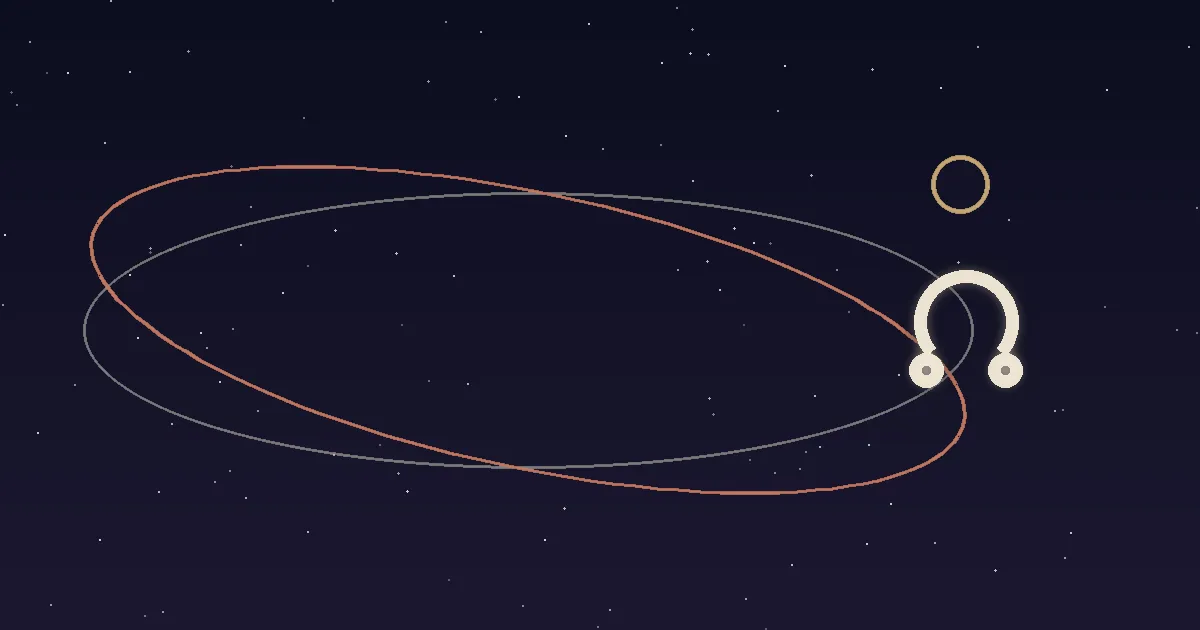
Ask what your sun sign means and astrology answers with adjectives (and when the adjectives never quite fit, the usual reason is that the Sun is one of three — a sun, moon & rising calculator supplies the missing two). Ask what your north node means and it answers with a homework assignment — which is strange enough that most people's first node reading leaves them with three questions the search results answer badly: what is this thing (it's not a planet), why does everyone use destiny-language about it, and why does its advice always point at the exact thing you're worst at?
All three questions have real answers. The astronomy is genuinely elegant — and explains the destiny-mythology better than any mystical claim does. The karmic frame translates into something you can use without buying reincarnation. And a quiet technical detail (true node versus mean node) breaks every "find your node by year" table on the internet, including the ones ranking above this page. Below: all of it, a full birth-date lookup table, and the index of all twelve placements — including the one the sky just switched on when the node entered Aquarius on July 26–27, 2026, depending on time zone, where it stays until March 2028.
If you already know your node and just want your sign's deep dive, jump to the index of all twelve placements below.
Quick answer
The north node is the point where the Moon's orbit crosses the Sun's apparent path — one end of the eclipse axis, not a planet. Astrology reads it as your growth direction: the sign holding it describes qualities you're meant to develop, while the opposite sign (south node) holds the over-practiced skills you fall back on.
| What it is | Orbital crossing point (ascending node) — the Moon's path × the ecliptic |
|---|---|
| Why "destiny" | Eclipses only happen near the nodes — the ancients watched fate cluster there |
| Motion | Retrograde through the zodiac; ~18 months per sign; full cycle ≈ 18.6 years |
| Nodal returns | ~Ages 18–19, 37, 56, 74 — classic course-correction windows |
| Reading it | North node = the assignment; south node = the inheritance you over-use |
| Transit window | North node in Aquarius (south node in Leo), Jul 26 2026 – Mar 26 2028 |
The node changes sign every eighteen months, so your birth date usually settles your node sign — but if you were born on an ingress date, birth time can decide it. ZodiScope computes your true North and South Node signs free.
Try the free North Node calculator →The astronomy: two circles that cross in two places
The Moon doesn't orbit Earth on the same plane the Earth orbits the Sun. Its path is tilted about five degrees relative to the ecliptic — the Sun's apparent track through the zodiac — and two tilted circles can only intersect at two points. Those two intersection points are the lunar nodes: the ascending (north) node, where the Moon crosses heading north, and the descending (south) node directly opposite, where it crosses heading south. They are places, not objects: the two spots where two circles cross.
And they are the reason eclipses exist at all. A new moon lines the Moon up between Earth and Sun every month, but usually the Moon slides above or below the Sun's disc, because it's off-plane. Only when a new or full moon happens near a node — near one of the two crossing points — do the three bodies align sharply enough to throw a shadow: a solar or lunar eclipse. NASA's eclipse resource catalogs every one of them, and every one of them happens on the nodal axis. That's not astrology; that's geometry.
That geometry is where the destiny-mythology was born. To every sky-watching culture, eclipses were the most fate-flavored events the heavens produced — kings deposed, omens declared, dragons blamed. Hindu astronomy personified the nodes as Rahu and Ketu, the severed head and body of a shadow-being who devours the Sun and Moon; Western astrology inherited the caput and cauda draconis — the dragon's head and tail. The points where fate visibly interrupted the sky became, very reasonably, the fate-points of the birth chart. When modern astrologers call your node "destiny," they're echoing that old observation: the nodes are where the lights go out on schedule — the one place in the sky where the ancients could watch something enormous happen and know it had been coming all along.
The reading: assignment and inheritance
The modern interpretive frame is an axis with a direction on it. The south node — the tail — is read as what you arrive with: capacities so practiced they run on autopilot, and precisely because they're effortless, they become the rut you retreat into under stress. The north node — the head — is read as the direction of growth: qualities that feel unfamiliar, mildly threatening, and disproportionately satisfying when you actually practice them. CHANI's framing is the memorable modern version: the dragon's head is hungry — the north node marks where you're insatiable, where no amount of achievement ever quite feels like enough, because it's the muscle you're here to build rather than the one you were born flexing.
The traditional language for all this is karmic: south node as past-life mastery, north node as this life's soul purpose. We won't pretend astrology can verify past lives — nothing can — but the pattern the karmic language points at doesn't need reincarnation to be real. Everyone over-trusts one skill and dodges one direction; the node axis is astrology's formal way of asking which is which for you. Read it as biography instead of metaphysics and it loses none of its usefulness: the south node is your factory setting, the north node is the update you keep postponing.
Before you read your own, calibrate twice. First, the node sign is generational at the sign level — everyone born in the same 18-month window shares it — so the sign gives the curriculum's subject, while the node's house in your chart (which needs your birth time — the houses guide explains why) says where in your life the course is taught, and aspects to the node personalize the difficulty setting. Second, the node is a direction, not a destination: nobody "completes" their north node. The people the tradition holds up as examples aren't finished; they're just facing the right way. (For how the node interacts with the rest of the chart's machinery, the aspects guide and birth chart guide carry the fundamentals.)
Sign is the subject; house is the classroom. ZodiScope computes your node's sign, degree, and house from your birth data, then shows it in the context of the rest of your chart.
See your node in its house →True node vs mean node: the detail that breaks the year tables
One technical detail most node content skips — and every borderline birthday needs. The Moon's orbit wobbles, so the node's position can be computed two ways: the mean node smooths the wobble into an average, gliding backward at a steady rate; the true node tracks the actual oscillating point, which speeds, slows, and even briefly reverses. The two usually sit within about a degree and a half of each other — but near a sign boundary, that's the difference between a Pisces node and an Aquarius node on your birthday.
The wobble produces genuine oddities in the true-node ingress tables: in December 2007 the true node dipped into Aquarius, flicked back into Pisces for a day, then re-entered Aquarius for good; early 1980 and spring 1986 have similar multi-day flickers. If your birthday sits inside one of those windows — or on an ingress date in the tables below — skip the year-range listicles entirely and calculate the real position. Most charts (ZodiScope included) default to the true node; some older sources use the mean. Neither is "wrong"; they're two answers to how you average a wobble — but you should know which one your node came from.
Find your north node by birth date (1941–2028)
Published true-node civil dates, from the standard ephemeris tables. Exact ingress time can place the sign change on the adjacent calendar day in another time zone. Find the span holding your birthday; if you were born on a boundary or inside the 1980, 1986, or 2007 wobble windows, run the real calculation instead of trusting any table, this one included.
| Born between | North node in |
|---|---|
| May 24, 1941 – Nov 21, 1942 | Virgo |
| Nov 21, 1942 – May 11, 1944 | Leo |
| May 11, 1944 – Dec 2, 1945 | Cancer |
| Dec 2, 1945 – Aug 2, 1947 | Gemini |
| Aug 2, 1947 – Jan 25, 1949 | Taurus |
| Jan 25, 1949 – Jul 26, 1950 | Aries |
| Jul 26, 1950 – Mar 28, 1952 | Pisces |
| Mar 28, 1952 – Oct 8, 1953 | Aquarius |
| Oct 8, 1953 – Apr 2, 1955 | Capricorn |
| Apr 2, 1955 – Oct 4, 1956 | Sagittarius |
| Oct 4, 1956 – Jun 16, 1958 | Scorpio |
| Jun 16, 1958 – Dec 15, 1959 | Libra |
| Dec 15, 1959 – Jun 10, 1961 | Virgo |
| Jun 10, 1961 – Dec 22, 1962 | Leo |
| Dec 22, 1962 – Aug 25, 1964 | Cancer |
| Aug 25, 1964 – Feb 19, 1966 | Gemini |
| Feb 19, 1966 – Aug 19, 1967 | Taurus |
| Aug 19, 1967 – Apr 19, 1969 | Aries |
| Apr 19, 1969 – Nov 2, 1970 | Pisces |
| Nov 2, 1970 – Apr 27, 1972 | Aquarius |
| Apr 27, 1972 – Oct 26, 1973 | Capricorn |
| Oct 26, 1973 – Jul 9, 1975 | Sagittarius |
| Jul 9, 1975 – Jan 7, 1977 | Scorpio |
| Jan 7, 1977 – Jul 5, 1978 | Libra |
| Jul 5, 1978 – Jan 12, 1980 | Virgo |
| Jan 12, 1980 – Sep 24, 1981 | Leo |
| Sep 24, 1981 – Mar 15, 1983 | Cancer |
| Mar 15, 1983 – Sep 11, 1984 | Gemini |
| Sep 11, 1984 – Apr 6, 1986 | Taurus |
| Apr 6, 1986 – Dec 2, 1987 | Aries |
| Dec 2, 1987 – May 22, 1989 | Pisces |
| May 22, 1989 – Nov 18, 1990 | Aquarius |
| Nov 18, 1990 – Aug 1, 1992 | Capricorn |
| Aug 1, 1992 – Feb 1, 1994 | Sagittarius |
| Feb 1, 1994 – Jul 31, 1995 | Scorpio |
| Jul 31, 1995 – Jan 24, 1997 | Libra |
| Jan 24, 1997 – Oct 20, 1998 | Virgo |
| Oct 20, 1998 – Apr 8, 2000 | Leo |
| Apr 8, 2000 – Oct 12, 2001 | Cancer |
| Oct 12, 2001 – Apr 13, 2003 | Gemini |
| Apr 13, 2003 – Dec 26, 2004 | Taurus |
| Dec 26, 2004 – Jun 22, 2006 | Aries |
| Jun 22, 2006 – Dec 14, 2007 | Pisces |
| Dec 14, 2007 – Aug 21, 2009 | Aquarius |
| Aug 21, 2009 – Mar 3, 2011 | Capricorn |
| Mar 3, 2011 – Aug 29, 2012 | Sagittarius |
| Aug 29, 2012 – Feb 18, 2014 | Scorpio |
| Feb 18, 2014 – Nov 11, 2015 | Libra |
| Nov 11, 2015 – May 9, 2017 | Virgo |
| May 9, 2017 – Nov 6, 2018 | Leo |
| Nov 6, 2018 – May 5, 2020 | Cancer |
| May 5, 2020 – Jan 18, 2022 | Gemini |
| Jan 18, 2022 – Jul 17, 2023 | Taurus |
| Jul 17, 2023 – Jan 11, 2025 | Aries |
| Jan 11, 2025 – Jul 26, 2026 | Pisces |
| Jul 26, 2026 – Mar 26, 2028 | Aquarius |
Where the node is right now — September 2026
The transiting North Node is in Aquarius (South Node in Leo), from July 26, 2026 until March 26, 2028 — then it backs into Capricorn. Anyone born under an earlier Aquarius pass is in a nodal return while this one lasts.
All 12 north node signs — the index
Each deep dive carries the full dates table for its sign (every period since the 1940s, from the true-node ephemeris), the birth cohorts and their nodal-return ages, the south-node inheritance read honestly, and the sign's specific assignment:
- · North Node in Aries — the independence assignment (Libra south node)
- · North Node in Taurus — the 'hardest node' claim, examined (Scorpio south node)
- · North Node in Gemini — curiosity over certainty (Sagittarius south node)
- · North Node in Cancer — needing out loud (Capricorn south node)
- · North Node in Leo — being seen on purpose — axis active 2026–28 (Aquarius south node)
- · North Node in Virgo — craft against the drift (Pisces south node)
- · North Node in Libra — the negotiated life (Aries south node)
- · North Node in Scorpio — why it feels hard, answered (Taurus south node)
- · North Node in Sagittarius — a worldview worth staking (Gemini south node)
- · North Node in Capricorn — the late-bloomer node — next transit 2028 (Cancer south node)
- · North Node in Aquarius — the current transit, Jul 2026 – Mar 2028 (Leo south node)
- · North Node in Pisces — the node that just left — surrender assignment (Virgo south node)
The clock built into the nodes: returns at 18, 37, and 56
Because the nodes circle the zodiac every ~18.6 years, the transiting node comes back to your natal node's position at around ages 18–19, 37, and 56 — the nodal return — with a half-cycle "anti-return" (the transiting node crossing your south node) splitting each interval at ~27–28 and ~46–47. The tradition reads these as course-correction windows: chapters where life audits whether you've been living toward the head or coasting on the tail. It's no accident the first one lands at the edge of adulthood and the second in the late-thirties reassessment zone. (The ~29-year Saturn return is the other famous timing gate; the two systems interleave rather than overlap, which is why the late twenties and late thirties both feel like exams.)
From July 2026 to March 2028 the return bell rings for one cohort in particular: with the node in Aquarius through March 2028, everyone born with an Aquarius north node — the 1970–72, 1989–90, and 2007–09 windows — is inside a nodal return at roughly 56, 37, and 18 respectively. And every Leo-node native is getting the anti-return, covered in the Leo node deep dive. If a chapter of your life is currently being graded, the nodes may simply be keeping their schedule. For what the 2026–28 window means sign by sign, the 2027 horoscope tracks it alongside the year's other transits.
Read the axis, not the adjective
Your node's sign, its house, and where today's transiting nodes are moving through your chart — ZodiScope puts the axis in context from your birth data, free to start, in about two minutes.
Pull your full birth chart on ZodiScope →Keep reading
- · The transit everyone's in: North Node in Aquarius — the 2026–2028 guide.
- · Another placement an entire birth cohort shares — and what makes it personal anyway: Neptune sign meaning, the generation audit.
- · The node that just handed over: North Node in Pisces — what the last 18 months were for.
- · The other great timing gate: the Saturn return, explained.
- · The rooms the curriculum is taught in: the 12 houses of the natal chart.
- · Starting from zero: the free sun, moon & rising calculator or all journal articles.
FAQ
What does the North Node mean in astrology?
The north node marks the point where the Moon's orbit crosses the Sun's path heading north — one end of the axis where eclipses occur. Astrologically, it's read as a direction rather than a trait: the sign it occupies describes qualities you weren't issued at the factory and are asked to grow into, while the opposite sign (the south node) describes the competence you arrived with and tend to over-use. Unlike your sun or moon, the node doesn't describe how you already are — it describes the version of you that only exists if you build it. That's why node readings feel less like flattery and more like an assignment.
Can I look up my North Node from a table, or do I need a chart?
You need your birth date; birth time helps but usually isn't critical for the sign, because the node changes sign only every 18 months or so. The fastest route: check the dates table on this page for the period containing your birthday, or pull your full chart on ZodiScope, which computes the node's exact degree along with your sun, moon, and rising. One caution — if you were born within a few weeks of a node sign-change (the table shows the exact ingress dates), the tables alone can mislead, and the true-node versus mean-node difference matters; run the actual calculation rather than trusting a year-range list.
Is the North Node the same as the rising sign?
No — they're unrelated points that beginners often blur together because neither is a planet. Your rising sign (ascendant) is the sign coming over the eastern horizon at your birth minute; it changes every two hours and sets the chart's houses — it describes your interface, how you come across. The north node is where the Moon's orbital plane intersects the ecliptic; it changes sign every 18 months and describes a growth direction shared by everyone born in that window, personalized by its house and aspects in your chart. You can have any rising with any node. The rising is who walks into the room; the node is where the road out of the room leads.
What is the soul purpose of the North Node?
In the language the tradition uses: the node axis is your karmic curriculum — south node as the past-life skill set, north node as this life's purpose. Here's the honest translation, since past lives can't be verified: the south node reads as the competence that comes so easily it functions like a rut, and the north node as the direction that feels unfamiliar, slightly frightening, and strangely satisfying whenever you move toward it. You don't have to buy reincarnation for that pattern to be useful — 'what am I over-relying on, and what am I avoiding because I'm not yet good at it?' is a real question, and the node axis is astrology's way of asking it. Purpose, in this frame, isn't found; it's practiced.