Birth Chart
What Does My Birth Chart Mean? A Practical Guide to Reading Yours
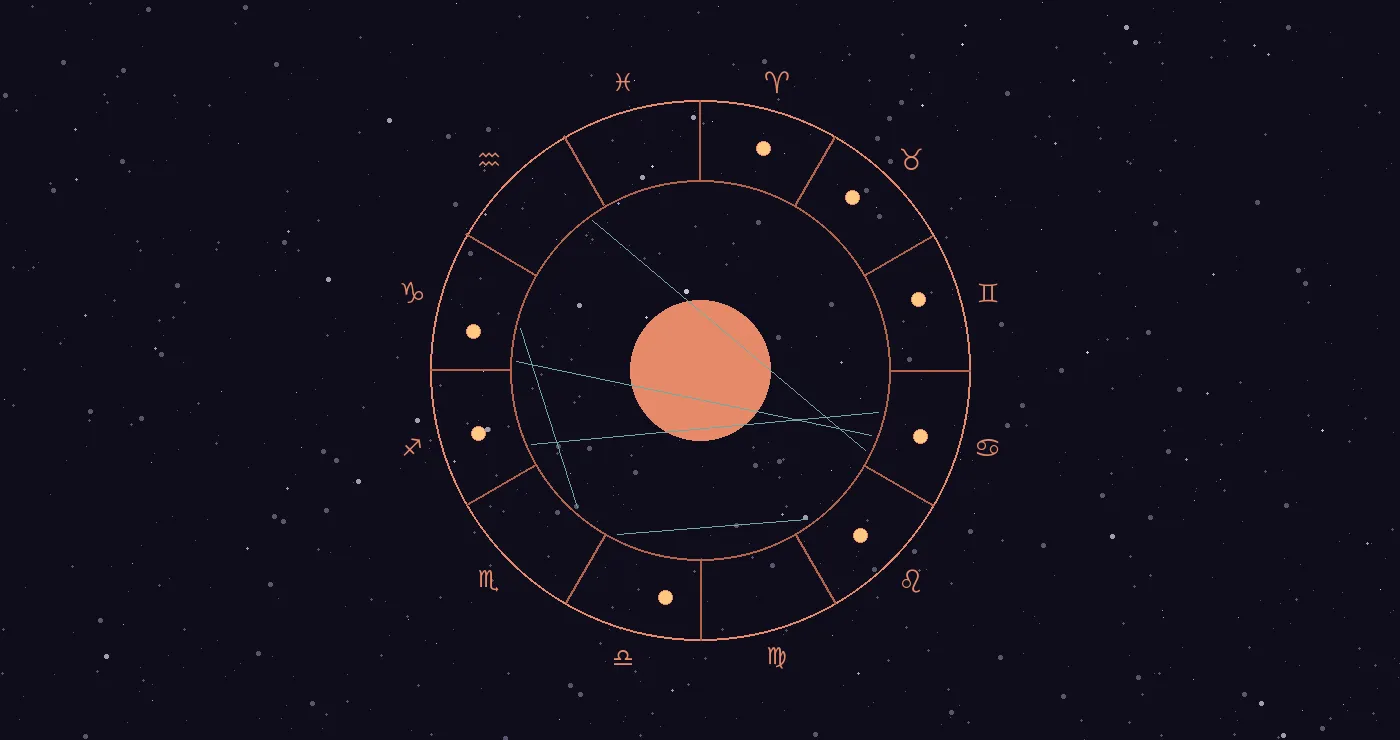
When people ask "what does my birth chart mean?" they're usually really asking two different questions: is this thing accurate? and what does it actually say about me? The answers are simpler than the wheel of glyphs makes them look — and the first one is probably going to surprise you.
This guide cuts straight at both questions. We'll dismantle the most common myth about birth chart accuracy — the one about which site is "most accurate" — and then unpack five placements that almost every beginner reads wrong on the first pass: Saturn in the 7th house, anything in the 12th, empty houses, Chiron, and natal retrogrades.
Don't have your chart in front of you yet? Pull a free birth chart on ZodiScope — full wheel with every planet, house, and aspect, plus plain-English interpretations to read alongside this guide.
Get your free birth chart →The accuracy myth: every site uses the same data
The single most persistent question people ask about birth charts is which site is most accurate. The honest answer is that this question has been moot for at least two decades. Almost every reputable astrology site and app — ZodiScope, Astro.com, Cafe Astrology, AstroSeek, the big mobile apps — runs on the same underlying planetary data: the Swiss Ephemeris, which is derived from NASA's JPL ephemerides and is precise to roughly 0.001 of an arcsecond. For context, that's about a thousand times more precise than the resolution any human astrologer would ever need.
In other words: the math is solved. If you punch the same birth date, time, and city into ten different sites, the planet positions you get back will be identical to the third decimal place. There is no "more accurate" calculator. There can't be — they're all reading the same ephemeris file.
To put a number on it: the Swiss Ephemeris is a compressed version of NASA JPL's DE431 — the same planetary integration NASA uses to navigate spacecraft. Astrodienst compressed it using Chebyshev polynomial interpolation, shrinking the file size by roughly 100× while preserving essentially all of the original precision. DE431 covers years -13,200 through +17,191, meaning your birth chart is computed against the same model that could put a probe on Mars in the year 12,000. The fact that "which calculator is most accurate" is still a marketing battle in astrology is itself a tell — sites that compete on accuracy are competing on something that isn't a real differentiator.
So if the data is identical everywhere, why do readings sound so different from site to site? Two reasons. First, house system defaults vary — Placidus on one site, Whole Sign on another, Equal House somewhere else. Same planets, different rooms. Second, and much bigger: interpretation is where every site actually competes. The data is the same; what one writer calls "a relentless and intense Pluto in the 1st" another might call "a magnetic, transformative presence." Both are reading the same coordinate. Stop asking which site is most accurate — ask which interpretation actually makes you feel seen.
What your birth chart actually is
So what is a birth chart, really? Mechanically, it's a freeze-frame of the sky from your exact birthplace at your exact birth moment — also called a natal chart, since "natal" just means "relating to birth." Every planet was somewhere in the heavens that minute, and your chart records where. The wheel itself is just a 360-degree map flattened into a circle — east is on the left, west on the right, the sky above the horizon at the top, the sky below at the bottom. (Easier to follow with your own wheel open: our free birth chart calculator draws it from your birth date and place, no email needed.)
Every placement on the wheel is doing three things at once:
- A planet — the part of you that's acting (identity, mind, love, drive).
- A sign — the style or tone of that expression.
- A house — the area of life it shows up in.
Hold those three layers in mind and you can read most of what your chart is saying. For the actual step-by-step procedure — Big Three first (if you only know your Sun sign, calculate your Big 3 before going further), then personal planets, houses, and aspects — read our how to read a birth chart guide. This article is the opinionated companion: what the chart actually is, and which placements panic people for no good reason.
Curious how today's transits are landing on your specific chart? See the live transits over your natal placements plus a personalized daily read — same Swiss Ephemeris data as the pros, with interpretations that don't read your 7th-house Saturn as a curse.
See your transits today →Five placements that almost everyone reads wrong
Most chart anxiety isn't about the data — it's about a handful of placements that get described scarily online and panic people on their first read. Here are the five I see misread most often, in roughly the order people google them at 1am.
1. Saturn in the 7th house
This is probably the single most misread placement in modern astrology. The 7th house is committed partnership, and Saturn is the planet of structure, time, and seriousness — so the placement gets reduced online to "Saturn in the 7th means you'll be alone" or "you'll struggle in love." That's a misread.
Saturn doesn't deny — Saturn delays and structures. People with Saturn in the 7th typically partner later, choose much more carefully, and once they commit, the relationships tend to be unusually long and durable. The harder edge of the placement is around fear of being chosen and a perfectionist filter on prospective partners. The growth-edge work is learning to let people meet you at a normal speed instead of testing them for years before letting them in. The reward, when that work happens, is a Capricorn-style commitment that doesn't waver. That's not a curse — it's a long fuse.
2. Anything in the 12th house
The 12th house is the second placement people panic about. It's described online as the house of "self-undoing," "hidden enemies," and "isolation," which makes a 12th-house Mars or Venus look like a death sentence. It isn't.
The 12th house is the part of the chart that lives below conscious awareness — dreams, the subconscious, what you process in private, what you do when no one is watching. Planets here don't disappear; they operate behind the scenes. A 12th-house Venus often loves quietly and privately and processes relationships internally before saying anything out loud. A 12th-house Mars channels its drive into solitary work — writing, training, art, anything that requires you to push against yourself rather than against another person. The 12th house's tradition is mystical and contemplative, deeply themed by Pisces. Read it that way and the supposedly "scary" 12th-house planets often turn out to be the most spiritually generative ones in the chart.
3. Empty houses
If a house has no planets in it, the standard online panic is "I have no career" (empty 10th house) or "I'll never find love" (empty 7th). Wrong frame. Every chart has empty houses — there are ten planetary bodies and twelve houses, so at minimum two of them will be empty in every single chart that has ever existed.
An empty house just means the action there is described by the sign on the cusp and the ruling planet of that sign elsewhere in the chart. If your 7th house is empty and Cancer is on the cusp, your moon is now the landlord of your relationships — wherever your moon sits, the 7th-house story is actually playing out. It's the same logic for any empty house. The lights aren't off; they've just been forwarded to a different address. For the full mechanics, read our 12 houses in your birth chart guide, which walks through each house including how to read it when it's empty.
4. Chiron
Once people get past the planets they recognize, Chiron is the next thing they google in a panic. It's almost always described online as "the wound that never heals" — half-right at best, and a misread of the actual archetype. Chiron is the wound that grants authority. You become the person who knows the territory because you got lost in it first.
A 4th-house Chiron isn't a verdict of a broken childhood — it's the placement that disproportionately shows up in family therapists, parenting coaches, and the people who write the home-life books. A 10th-house Chiron isn't a doomed career — it's the placement that becomes the unconventional expert, the one who works outside the credentialed track and ends up trusted anyway. A Chiron in Scorpio or the 8th house is the friend everyone calls in a crisis, because they've already metabolized the kind of pain other people are still in the middle of. Read Chiron as the doorway to your particular kind of authority, not as a curse.
5. Retrograde planets in your natal chart
Classical western astrology was harsh about natal retrogrades — Bonatti and Lilly called them "debilitated" or "afflicted," basically a broken tool. The modern internet quietly softened that to "weakened" but kept the bad-news framing. They were wrong on both counts. A retrograde planet expresses its function inward first — it revises, internalizes, and second-guesses before it externalizes. The energy isn't damaged; it's just routed through an editor.
A natal Mercury retrograde person is rarely a worse communicator — they typically think a thing three times before saying it out loud, and the third version is usually more honest than what a non-retrograde Mercury would have blurted on the first pass. A natal Venus retrograde isn't "bad in relationships"; it's slow to declare love and unusually loyal once it does. A natal Mars retrograde isn't low-drive; it's drive that runs through deliberation before it acts, which is why so many strategic operators have it.
House systems: pick one and stop second-guessing
If your chart looks subtly different across two sites, this is almost always why. The two most common house systems are Placidus and Whole Sign. Placidus splits the houses into unequal segments based on the time it takes the ascendant degree to rise; Whole Sign assigns one zodiac sign to each house, period.
Most modern western astrology defaults to Placidus. A growing contingent — especially astrologers who lean traditional or Hellenistic — prefer Whole Sign because it's older, simpler, and never produces the weird elongated houses Placidus throws at high latitudes. Both are legitimate. Pick the one that reads truer for your life and don't toggle between them mid-reading.
If your birth time is off by even fifteen minutes, your house cusps can shift by a degree or two, which sometimes pushes a planet into a different house. This is the one place where the data isn't bulletproof — and it's why exact birth time matters so much. If you can find your birth time on a birth certificate, do — you'll lock in the houses for life.
What the chart can and can't tell you
A birth chart describes a tendency, not a destiny. The same Mars-Pluto square can read as a relentless competitive edge in one person's life and as a struggle with anger in another's; the placements describe a structure of energy, not a verdict on what you'll do with it. Your chart will tell you a lot about your temperament, your relational patterns, where you find life easy and where you find it difficult. It won't tell you who you'll marry, when you'll quit your job, or whether you should buy the house.
The most useful thing a chart does is show you patterns you've been living blindly. A 12th-house moon will describe your private emotional life with a precision that feels uncanny on the first read. A Saturn in the 10th will explain a decade of slow career grinding that you assumed was personal failure. The chart isn't predicting; it's labeling what was already there.
Once you've read your own chart, the natural follow-up is watching transits — the live planets in the sky moving over your fixed natal placements. That's where astrology becomes a daily practice instead of a one-time read. Your daily horoscope is the easiest entry point, and the Mercury retrograde 2026 guide shows what a single transit looks like as it moves through real placements.
If you want a clean step-by-step order to work through every layer of your chart in sequence — Big Three, then personal planets, then houses, then aspects, then patterns — that's the procedure laid out in our how to read a birth chart guide. Pair it with this article: the procedure tells you how; this article tells you which placements not to panic about when you get there.
Ready to read your own chart with a more grounded interpretation? Get your free birth chart on ZodiScope — full wheel, every placement labeled, and explanations that don't read your 7th-house Saturn as a curse.
Get your free birth chart →Keep reading
- · The two-chart technique most beginners don't realize is separate from natal reading: synastry chart free — how to read two birth charts side-by-side.
- · Curious about the TikTok degree-theory trend? Read degree theory astrology — what's real, what TikTok got wrong.
- · The most-misread moon placement, explained right: Moon in Pisces — meaning, what it actually feels like, and what most articles get wrong.
- · Comparing chart tools? Read the best birth chart sites in 2026 — an honest comparison of Astro.com, Astro-Seek, Cafe Astrology, CoStar, and ZodiScope.
- · Want the step-by-step procedure? Read how to read a birth chart — the five-step workflow with a worked example on Princess Diana's chart.
- · The deep-dive on the angles between your planets: birth chart aspects explained — the six angles that actually matter and the orb rules almost every beginner gets wrong.
- · Confused by which house your placements are in? Read the 12 houses in your birth chart, explained.
- · Don't know your rising sign? Read what is my rising sign — and why 95% of people read the wrong horoscope.
- · The placement that actually decides your romantic style: Venus sign meaning — Venus through all 12 signs.
- · The Moon sign most people read as "intense and mysterious" and miss the actual nuance on: Moon in Scorpio meaning — the practitioner's read on the most misread Moon sign.
- · See how the current sky is hitting your chart with the Mercury retrograde 2026 guide.
- · The once-in-36-years transit that's already reshaping a house in your chart — read Saturn conjunct Neptune 2026 at 0° Aries.
- · The 14-month Jupiter transit expanding one house of your chart — read Jupiter in Leo 2026 — dates, meaning & per-rising-sign predictions.
- · The 26-month Saturn transit restructuring another house of your chart — read Saturn in Aries 2026 — why the next two years will test your patience.
- · Not sure of your sun sign? Use the Big 3 & Big 6 calculator.
- · The skeptic-vs-practitioner question this is all built on: is astrology real? An honest, data-backed answer.
- · Or browse all journal articles.
FAQ
Is one birth chart site more accurate than another?
No. Virtually every reputable astrology site — ZodiScope, Astro.com, Cafe Astrology, AstroSeek, and the apps you've used — runs on the same Swiss Ephemeris data, which is derived from NASA's JPL ephemerides and is accurate to roughly 0.001 of an arcsecond. The planetary math is essentially solved. What differs between sites is the interpretation: how a given placement is described, which house system is used by default, and how the writers translate the data into prose. If two readings sound contradictory, it's an interpretation difference, not a math error.
Why do some sites show my chart with different houses or signs on the cusps?
Almost always because they're using different house systems. Placidus and Whole Sign are the two most common — Placidus splits the sky into unequal segments based on time, while Whole Sign assigns one full zodiac sign to each house. Your planets and signs don't change, but which house a planet falls in can shift, sometimes dramatically, between systems. Pick one and stick with it; both are valid traditions.
What does it mean if my birth chart has empty houses?
An empty house is normal — there are only ten planetary bodies and twelve houses, so at least two will always be empty in any chart. It does not mean that area of your life is shut down or barren. Read the sign on the cusp of the empty house and find the ruling planet of that sign elsewhere in your chart. That planet is the 'landlord' running the empty house from a different address.
Saturn in the 7th house sounds bad — does it mean I won't have a partner?
No. Saturn in the 7th house is one of the most consistently misread placements in modern astrology. Saturn delays and structures rather than denies. People with this placement often partner later, choose more carefully, and end up in long, durable relationships once they do — Saturn is the planet of commitment, not loneliness. The work is around fear of being chosen and the perfectionism that can show up in partnership, not a verdict that you'll be alone.