Birth Chart
How to Read a Birth Chart: Step-by-Step Natal Chart Interpretation
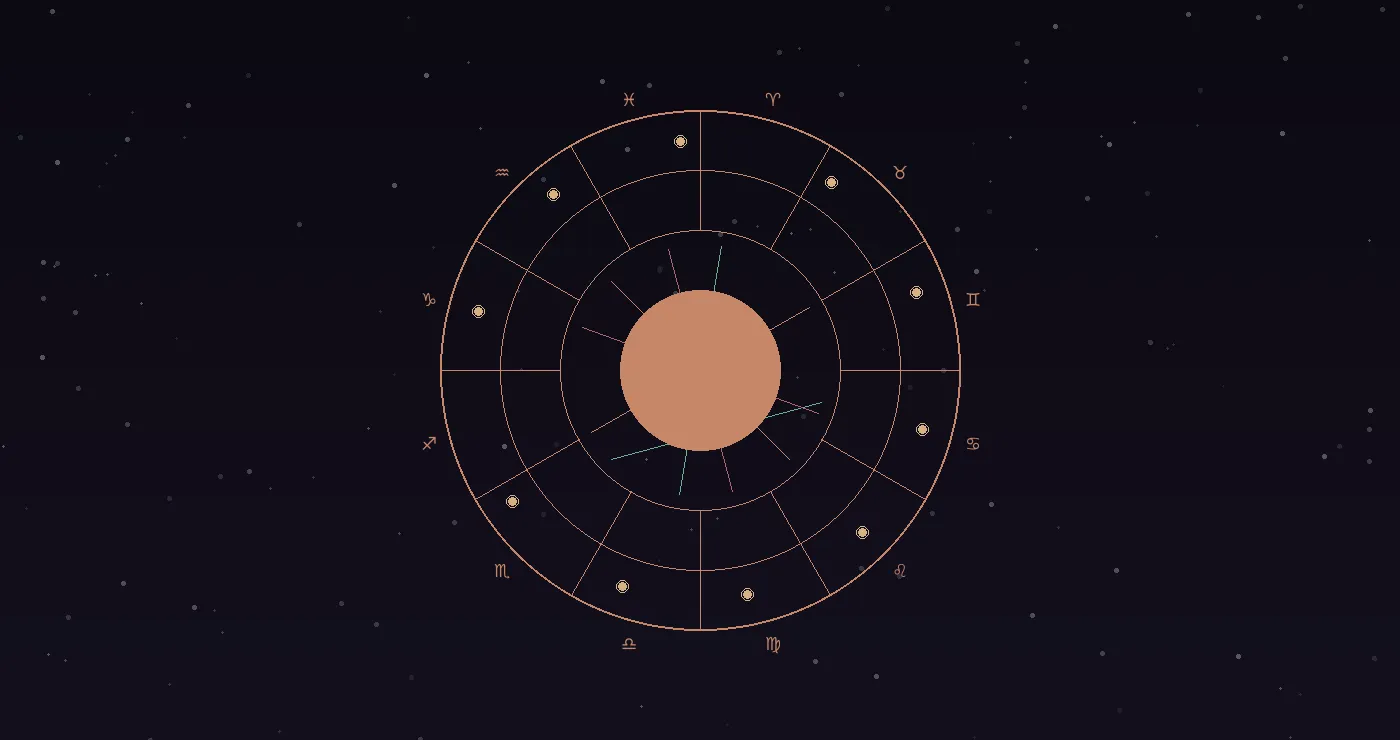
If you've ever pulled up your birth chart and stared at the wheel of glyphs wondering where to even start — you're not alone. A birth chart reading looks intimidating because it's dense: ten planets, twelve signs, twelve houses, and a web of angles between them all. But underneath the symbols, the chart tells a single, very personal story.
Think of your natal chart as the owner's manual you were issued at birth. Most people only ever read the cover (the sun sign) and complain that it doesn't capture them. The real instructions are inside. This guide walks through how to read a birth chart the way astrologers actually do — the order they look at things, what each layer means, and how you can do the same for yourself. By the end, you'll know how to move past "I'm a Libra" and into a real, working interpretation of your own placements.
A birth chart (also called a natal chart) is a freeze-frame of the sky from your exact birthplace at the moment you took your first breath. Every planet sits in one of the twelve zodiac signs and one of the twelve houses, and every aspect describes how those planets are angled to each other. That's the whole framework — planet (who), sign (how), house (where), aspect (how they talk). If you want the longer take on what the chart fundamentally is, including the accuracy-myth side, read our what does my birth chart mean guide.
Open your own chart in another tab and follow along — every step below lands harder when you can see your actual placements. Pull a free birth chart on ZodiScope: full wheel, every planet, every house, every aspect.
Pull up your free birth chart →Step 1: Start with the Big Three
Every birth chart reading begins with the sun, moon, and rising sign — what astrologers call the Big Three. These are the headline placements, the ones that shape the texture of everything else.
Your sun sign is the one most people know — based on your birthday, it's your core identity, your ego, the "I am." Your moon sign is your inner world: how you feel, what soothes you, what you need to feel safe. Your rising sign (or ascendant) is your social mask — the version of you that other people meet first, and the lens you look at the world through.
A useful shorthand: the sun is who you are, the moon is what you need, and the rising is how you seem. When the three line up, you feel coherent; when they pull in different directions, you feel like several people at once. Don't know your three yet? Use the sun, moon & rising calculator to get all three from your birth date, time, and place. Read each one's full sign profile — for example, Aries, Taurus, or Gemini — and see how they layer.
Step 2: Read the personal planets
After the Big Three, the next layer is what astrologers call the personal planets: Mercury, Venus, and Mars. These move quickly through the zodiac, so they describe the textures of your daily personality rather than your generational themes.
Mercury — how you think and communicate
Mercury in Cancer talks in feelings; Mercury in Virgo talks in lists. The sign and house tell you how you process information and what you actually mean when you're "thinking out loud."
Venus — how you love and what you find beautiful
Venus describes your love language, your taste, and the kind of attention you crave. A Venus in Leo wants to be adored publicly; a Venus in Scorpio wants depth, secrets, and total commitment.
Mars — how you act and what you want
Mars is your drive, your fight, and your sex drive. Mars in Aries is direct and impatient; Mars in Libra wants to win the room without ever raising its voice.
Your personal planets aren't static — every transit hitting them changes the day-to-day weather. See how today's planets are landing on your Mercury, Venus, and Mars in the ZodiScope app, with a personalized daily read.
See today's transits on your chart →Step 3: Layer in the houses
A planet in a sign tells you how it acts. A planet in a house tells you where. If you have your birth time, run the free birth chart calculator now so the house numbers below are yours rather than hypothetical. The twelve houses cover the major arenas of life: identity, money, communication, home, romance, daily work, partnership, intimacy, philosophy, career, friendship, and the unconscious.
Take Venus in Aries as a worked example. Aries makes Venus bold, fast, and a little impatient — you fall hard and chase what you want. But that same Venus reads completely differently depending on the house. In the 7th house (partnership), it's a relentless pursuit of the right partner — you propose first, you push for definition. In the 10th house (career), it's a passionate love of the work itself, romance with ambition. In the 4th house (home), it's a fierce devotion to family and the people you build a life with. Same planet, same sign, three different lives.
Houses are also why two Sagittarius suns can lead lives that look nothing alike — same expansive identity, completely different stage to express it on.
A note on empty houses
Most charts have houses with no planets in them. This is normal — there are only ten planets and twelve houses, so at least two will always be empty. An empty house doesn't mean that area of life is missing or broken. It just means the action there is described by the sign on the cusp (the sign at the start of that house) and the planet that rules that sign. For example, an empty 7th house with Cancer on the cusp means partnerships are read through your moon — wherever your moon sits is where the 7th house story is actually happening.
Step 4: Pay attention to the aspects
Aspects are the angles between planets — the lines you see crossing the middle of the chart wheel. They describe how the different parts of you talk to each other, or fail to. Most readings use a 6–8° orb (so a "conjunction" can be exact or within 8° and still count). Five major aspects to know:
Conjunction (0°)
Two planets sitting on top of each other in the same sign, fused into a single unit. They lose the ability to operate independently and start showing up together everywhere. Because Mercury never strays more than 28° from the Sun, a Sun-Mercury conjunction is essentially the factory setting for a large slice of the population — your identity and your thinking are inseparable, and you say what you are without an internal translator. A Mars-Pluto conjunction is rarer and more intense: drive welded to power, often producing someone who shouldn't be picked a fight with.
Sextile (60°)
An angle of supportive friction. Two planets in compatible elements (fire-air or earth-water) that work together when you ask them to, but don't act on their own. Sextiles describe latent talents you have to consciously develop — they don't deliver themselves. A Venus-Jupiter sextile gives you natural charisma and generosity, but only if you actually walk into a room and use it. The square does the work for you; the sextile waits to be invited.
Square (90°)
Two planets in the same modality (cardinal, fixed, or mutable), at right angles to each other. The classic "growth aspect" — friction that won't resolve on its own. A Sun-Saturn square typically grinds your sense of self against your sense of duty, and the resolution usually arrives in your 30s once you stop trying to please both at once. Squares are the placements you can't ignore; they pinch until you address them, and they produce the most durable results once you do.
Trine (120°)
Two planets in the same element, 120° apart — pure harmony. So easy you stop noticing the gift. A Mercury-Jupiter trine often shows up as effortless storytelling or persuasion; the person doesn't know it's a skill because it's never been hard. The trick with trines is that you have to consciously use them, or they atrophy. An unused trine becomes "the thing you always could have done if you'd tried."
Opposition (180°)
Two planets in opposite signs, 180° apart. A push-pull dynamic that almost always plays out through other people first. You see the opposition externally before you see it in yourself — it's the colleague who has the trait you suppress, the partner who lives the other half of your psyche. Sun-Moon oppositions describe a tension between identity and emotional need that often gets projected onto important relationships. Working with an opposition is mostly the work of pulling that projection back into yourself.
Step 5: Synthesize the patterns
A real birth chart reading isn't a list of facts — it's a synthesis. Single placements are puzzle pieces; the patterns are the picture. Three things to look for once you've mapped the basics:
- Element balance. Count your planets across fire, earth, air, and water. A chart with five planets in earth signs reads as grounded and practical even if the rising is theatrical. Missing an element entirely (no fire, say) usually shows up as a quality you have to consciously cultivate rather than one that comes naturally.
- Hemisphere dominance. The chart is split into halves: upper/lower (above the horizon vs. below) and east/west (self vs. others). A chart with everything stacked in the upper hemisphere reads as outward-facing and public, even if the moon is shy. A chart loaded in the lower half is more inward and private. Heavy on the eastern (left) side tends toward self-direction; heavy on the western tends toward defining yourself through relationships.
- Stelliums. A stellium is three or more planets clustered in the same sign or house. It concentrates an enormous amount of energy in one area and usually overrides the Big Three on the topic it covers. A 10th-house stellium will turn almost any chart career-driven; a stellium in Scorpio intensifies everything regardless of what the sun is doing.
These patterns are usually more telling than any single placement. When a placement seems to contradict your lived experience, look at the patterns first — you'll often find the answer there.
A worked example: Princess Diana's chart
Theory is one thing. Let's actually run the five steps on a real chart you can verify yourself. Princess Diana's birth time is one of the few celebrity charts rated A on the Rodden scale — the gold standard for birth-time reliability — which is why her chart is one of the most analyzed in modern astrology. She was born July 1, 1961, at 7:45 PM in Sandringham, England. Here's the read.
Step 1 — The Big Three.
Sun in Cancer (the "people's princess" identity — emotional, family-coded, protective), Moon in Aquarius (an emotional life that needed freedom and community more than intimacy), Sagittarius rising (the optimistic, outward-facing mask that walked into a room and lit it). The headline contradiction of her life is sitting right there in the Big Three: a core identity built around caring for others, paired with an inner emotional life that wanted unconventional freedom. You don't need decades of biography to feel that — the Big Three already say it.
Step 2 — Personal planets.
Mercury in Cancer — she thought how she felt, instinct over logic. Venus in Taurus — loved beauty, comfort, and ritual, which tracks straight into her relationship with style and aesthetics. Mars in Virgo — her drive was service-oriented, exacting, and precise. The AIDS hospital visits and the landmine campaigning fit Mars-in-Virgo to the letter, not the broad-stroke "Mars in Aries warrior" default most people picture.
Step 3 — Houses.
Diana's Sun and Mercury both sit in the 7th house — committed partnership. Her entire identity (sun) and how she communicated it (mercury) ran through the lens of partnership. Compare that to someone with the same Cancer sun in the 10th house, who would read as career-and-public-image first. Same sun, completely different life. Saturn in her 1st house (in Capricorn, no less) gave her the composed, dignified public face she became famous for — Saturn rising tends to do that. The 8th house (shared resources, taboo, transformation) holds Mars, Pluto, and Uranus — basically everything she became globally famous for sits in that house.
Step 4 — Aspects.
A few stand out. Sun conjunct Mercury (about 6° orb) fused her thinking and her feeling — she said what she felt without an intermediate filter, which is exactly how she came across in every interview. Mars conjunct Pluto in Virgo (5° orb) in the 8th house is the transformative-service signature: her late-1980s work touching AIDS patients, when public-figure contact was still seen as taboo, was a textbook Mars-Pluto-in-8th expression. And Moon opposite Uranus (2° orb) is one of the tightest aspects in her entire chart — arguably the one that most defined her: a constant emotional pull between needing freedom and being the most-watched figure on the planet.
Step 5 — Patterns.
Element balance is earth-heavy (Venus, Mars, Saturn, and Pluto all in earth signs), which surprises people who read her as a "Cancer water type." Her chart was practical, grounded, and embodied underneath the surface; the public emotionality was the Cancer sun and Sagittarius rising, but the operating system was earth. There's also the clear 8th-house emphasis already mentioned — Mars, Pluto, and Uranus all clustered there is essentially a stellium, and it points at the precise life themes (intimacy, taboo, transformation, premature death) that the chart actually delivered. Reading a chart isn't memorizing 600 isolated rules. It's noticing the cardinal facts, layering in the texture, catching the conversation between parts, and stepping back for the gestalt. Diana's chart works as a teaching example because the patterns are unusually clean — but the procedure is the same on every chart, including yours.
Common mistakes to avoid
A few traps people fall into when they're starting out:
- Reading placements in isolation: A "harsh" Mars-Pluto square doesn't mean what it says on the tin if your moon and Venus are gentle. The whole chart modifies every part.
- Skipping the time of birth: Without an exact time, you can't lock down your rising sign or houses. If you don't know your time, treat any house-based reading as provisional.
- Treating the chart as a verdict: Your birth chart describes potential, not destiny. The same Saturn placement can be heavy or grounding depending on how you work with it.
Birth chart reading is a skill that compounds. The more charts you read — yours, friends', historical figures' — the faster you'll see the patterns. Start with your own, work through it slowly, and let it stay in your peripheral vision while life happens. The chart often makes more sense in retrospect than it does on the first pass.
Step 6: Practice on three more charts
The fastest way to internalize chart reading isn't to keep reading articles — it's to read more charts. Once you've worked through your own, pick three more and run the same five steps. A short suggested progression:
- A historical figure with a verified birth time. Astro-databank curates birth data with Rodden ratings (A or better means the time is well-documented). Princess Diana's chart in this article is rated A. Pick someone whose biography you already know — the chart will make sense in real time as you map the placements to the life.
- A friend or family member who'll let you read theirs. Real charts of real people you know beat famous-people charts, because you can verify the placements against the person sitting across from you. The first three friend-charts you read will teach you more than the next ten articles.
- A chart you can compare to a known transit cycle. Pick someone (yours, a friend's) whose chart you already understand, and watch how a single current transit lands on their placements over a month. The Mercury retrograde 2026 guide is a useful pairing — short, contained, easy to track.
Around the third or fourth chart, the cheat sheets stop being necessary — you'll pattern-match a Venus-in-the-7th before you've consciously named what you're looking at. That's the point where chart reading actually becomes useful instead of homework.
Ready to read your own chart? Get your free birth chart on ZodiScope — full wheel with planets, houses, and aspects, plus plain-English readings of your placements.
Get your free birth chart →Keep reading
- · The planet of drive, sign by sign, with the dates it sat in each: the Mars sign guides.
- · The two-chart technique that builds on single-chart reading: synastry chart free — how to read two birth charts side-by-side.
- · Curious about the TikTok degree-theory trend? Read degree theory astrology — what's real, what TikTok got wrong.
- · If your chart has a cluster of three or more planets in one sign or house, that's a stellium. What is a stellium — plain definition, the count disagreement, and how to find yours.
- · The moon-sign deep-dive most articles get factually wrong: Moon in Pisces — meaning, real testimony, and the dignity correction most sites miss.
- · Picking which site to use? Read the best birth chart sites in 2026 — an honest comparison from someone who built one.
- · Want the opinionated take? Read what does my birth chart mean — the accuracy myth and 5 placements people read wrong (Saturn 7th, 12th house, empty houses, Chiron, retrogrades).
- · Want a deeper dive on the wheel? Read the 12 houses in your birth chart, explained.
- · The step-4 expansion you didn't get here — every aspect, orb rules, applying vs separating, and the patterns: birth chart aspects explained.
- · Reading your rising sign before your sun? Read what is my rising sign — and why most horoscopes are built on the wrong placement.
- · The placement that actually decides your romantic style: Venus sign meaning — what your Venus placement says about how you love.
- · The Moon placement that flips the read for half the people who have it: Moon in Scorpio meaning — the hardest moon placement, explained.
- · The Mars-ruled Moon Saturn touches all 2026: Moon in Aries meaning — the action-first Moon and the 2026 Saturn transit.
- · Check your daily horoscope to see how today's transits are activating your chart.
- · Not sure of your sun sign? Try the sun, moon & rising calculator.
- · Tracking the current cycle? Read Mercury retrograde 2026.
- · The bigger 2026 transit? Read Saturn conjunct Neptune 2026 — the once-in-36-years reset.
- · The 14-month Jupiter transit running alongside it: read Jupiter in Leo 2026 — dates, meaning & per-sign predictions.
- · The 26-month Saturn transit restructuring another house of every chart: read Saturn in Aries 2026 — why the next two years will test your patience.
- · The bigger frame around all of this: is astrology real? An honest, data-backed answer.
- · Or browse all journal articles.
FAQ
What do I need for an accurate birth chart reading?
You need three things: your date of birth, your exact birth time (down to the minute, ideally from your birth certificate), and the city where you were born. The time is what determines your rising sign and the house placements — without it, you can still read the planets and signs, but the houses and the rising will be missing or unreliable.
What's the difference between a birth chart and a natal chart?
Nothing — they're the same thing. 'Natal' simply means 'relating to birth.' Both refer to the snapshot of the sky at the moment you were born. Some astrologers prefer 'natal chart' in formal writing and 'birth chart' in conversation, but the document is identical.
Where should I start reading my chart?
Start with the Big Three: your sun, moon, and rising sign. The sun is who you are at the core, the moon is how you feel and self-soothe, and the rising sign is where you meet the world. Once those three are clear, layer in Mercury, Venus, and Mars — your communication, love, and drive — and then work outward to the houses and aspects.
Does my birth chart change over my lifetime?
No. Your natal chart is fixed at the moment of your birth and never changes — it's a snapshot of the sky that will only ever exist once. What changes is the sky above. The current planets keep moving, and as they form angles to your fixed natal placements, you experience what astrologers call transits. The chart is the static map; transits are the live weather running over it.