Birth Chart
North Node in the 7th House: The "Hard" Placement, Divorce and Soulmates
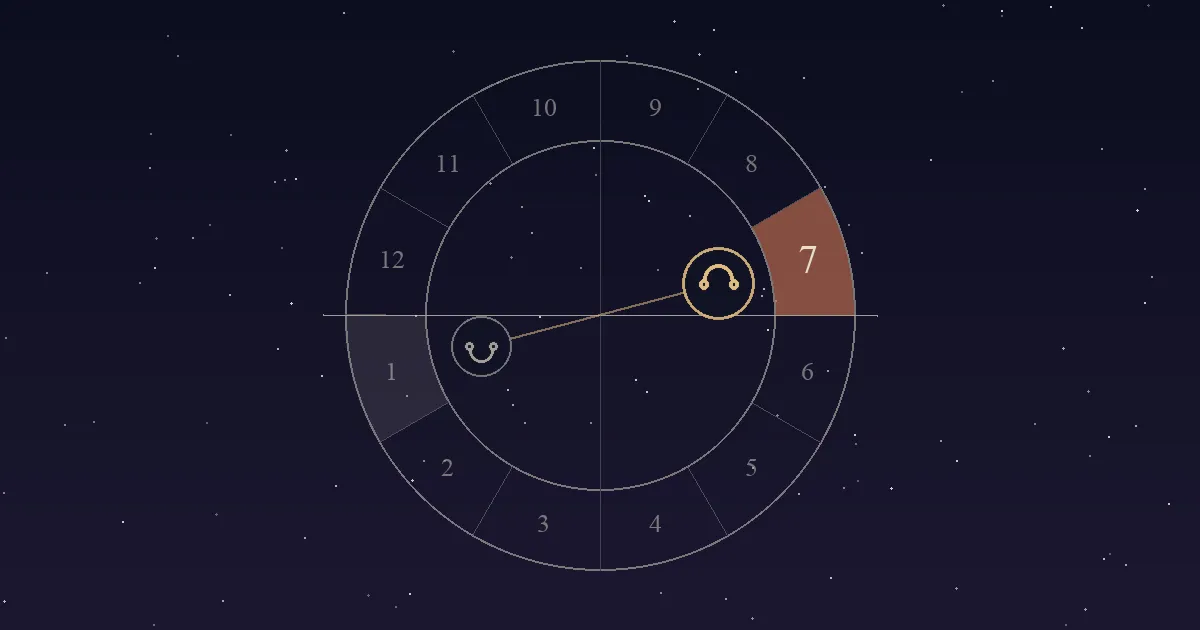
The North Node in the 7th house has a reputation as the hard one, and the worries attached to it are specific. Will a first marriage fail? Does it explain always getting cheated on? Does it mean ending up alone?
The difficulty astrologers describe starts at the other end of the axis: a South Node in the 1st, which makes doing things alone feel like the safe default. Divorce is a separate question: one modern book and one Vedic text link this placement to separation, and neither offers evidence for it.
Quick answer
With the North Node in the 7th house, the growth runs through partnership: sharing decisions, relying on other people and letting them change your plans. Self-reliance, the South Node's end of the axis in the 1st, is the comfort zone. It's called hard because the growth depends on people you can't control.
| South Node | Always in the 1st house, in Placidus and in whole-sign houses |
| Where the node was at birth | Low in the western sky, setting within about two hours (Placidus) |
| Natural sign of the house | Libra |
| Life areas | Marriage, business partners, contracts, anyone you deal with one to one |
| Lilly's verdict on the point | The Dragon's Head is "of himself a Fortune" |
| Our data point | Shirley Temple's node sits 4.7 degrees from her Descendant and still holds the 7th under every check we ran |
Check one thing on your chart: is the North Node in the same sign as your Descendant? If it is, whole-sign houses agree it's in the 7th. If it's in the next sign, whole-sign houses count it in the 8th, as they do for about half of Placidus 7th-house nodes.
Check the node's house against your birth time →Why do astrologers call the North Node in the 7th house hard?
Because you can't practice partnership on your own. This one needs another person, and other people don't keep to your schedule, don't always want what you want and can let you down. Martin Schulman's Karmic Astrology (1975) opens the section like this: "Here the individual has many lessons to learn in areas of partnerships, marriage and cooperation with others. In past incarnations he had to account only to himself for all his thoughts and actions" (p. 79).
Leave the past lives aside, since nobody can check them, and look at his picture of the person: someone with too much self-sufficiency, not too little. He calls this native "the individual who wishes to be 'King of the Mountain'" (p. 80), and he sums up the job as "to learn consideration for others" (p. 81). The astrologer Donna Cunningham put the modern version more simply on her blog in 2010: the placement is "challenging you to put your partner's needs ahead of yours."
In daily life it looks like the person who moves the couch alone rather than ask a neighbor, or plans the whole trip and presents it finished. At work it's the freelancer who turns down a good business partner because sharing the decisions sounds worse than doing twice the work, or the manager who would rather fix a problem alone than negotiate it with a peer. Independence like that gets a lot done. The trouble comes when a relationship needs both people to steer.
The medieval sources point the same way, by inference. Guido Bonatti read the Dragon's Tail by house, and with the Tail in the 1st he saw "expenses, and loss of gain to the Querent, from or by reason of his person" (Consideration 139, Coley's translation, 1886 reprint, p. 61). His mirror case, the Tail in the 7th with the Head in the Ascendant, was the one he called "prosperity to the Native" (Consideration 111). So in his scheme, which he applied to lawsuits and horary questions as well as birth charts, this is the less comfortable way round for the axis to fall.
A free account lists today's transit aspects to the planets in your birth chart, so you can see when one is touching your Venus, your Moon or your Sun.
See what's touching your chart today →Does a North Node in the 7th house mean divorce?
There's no evidence that it does, though two sources link it to separation. Start with the Western tradition, where the classical marriage warnings were aimed at harmful planets. In his horary aphorisms (no. 40) William Lilly wrote that an unfortunate planet in the 7th "threatens ill agreement in Marriage," but he counted the Dragon's Head among the fortunes, calling it "of himself a Fortune" (Christian Astrology, 1647, p. 83). By his own rules, his warning doesn't reach a 7th-house North Node.
In modern writing, the divorce idea goes back to one sentence in particular. Schulman wrote that people with these nodes are "either single, divorced or at least separated in consciousness from their spouse" (p. 80). He offered no evidence for it. Our own model can't settle it either way: it calculates placements and holds no marriage records. The same goes for the cheating question: nothing in this placement explains why a partner cheated, and nothing in it predicts that the next one will.
Vedic astrology, where the North Node is called Rahu, is harsher. Mantreswara's Phaladeepika says that with Rahu in the 7th the native will "suffer separation from his beloved" and "become self-willed" (VIII.26, Sastri's translation, 1950, p. 95). The same book softens it elsewhere: Rahu in an angular house such as the 7th can become "instrumental in bringing about good to the native" when it's connected with the lord of an angle or a trine (XX.52, p. 217). A Vedic chart also uses a different zodiac, so it may not put your node in the 7th at all.
Doing it yourself: the South Node in the 1st house
Modern astrologers read a South Node in the 1st, the house of the self and the body, as a habit of handling things yourself. You fix it, book it or decide it before it occurs to you to ask anyone.
The habit to watch is treating every offer of help as a debt you'd rather not owe. People with this axis can come across as easy company and hard to reach, friendly but self-contained. Your partner hears about decisions after you've made them. The 1st-house North Node has the opposite problem: fluent in other people and slow to say what it wants.
Libra is the 7th house's natural sign, so some writers read this placement as if it were a Libra node, and the Libra North Node by sign covers that version of the assignment. If your node is in another sign (look up your node sign from your birth date), that sign colors how you go about partnering. To read it in your own chart, astrologers usually look next at the sign on the Descendant, the planet that rules that sign, and Venus. With Aries on the Descendant, for example, Mars rules the 7th, so Mars's house and aspects add detail about how you deal with partners.
Low in the west at birth: where a 7th-house node sits
In Placidus houses the 7th is the slice of sky just above the western horizon. A North Node there, an invisible point in the Moon's orbit, was in the last sixth of its time above the horizon when you were born (the last third of its path down from the Midheaven) and due to set within about two hours. It's the same patch of sky that makes a 7th-house Sun a late-afternoon birth, though the node, unlike the Sun, has no link to the time of day. Not every astrologer reads the house as partnership homework: Alice Sparkly Kat, for one, sets the grow-through-relationships reading aside and reads the 1st and 7th as times of day and phases of life.
About 11% of 7th-house North Nodes (11.1%) sat in an intercepted sign, one with no house cusp in it. That can happen in unequal house systems such as Placidus, and never in whole-sign houses. The figure comes from 400,000 simulated U.S. births from 1960 to 2024, built from CDC birth-time data and real U.S. counties, with the true North Node's house computed in each; these are modeled births, not real records. A Placidus 7th-house node was never in the whole-sign 6th; it stayed in the 7th on a whole-sign chart 48.6% of the time and moved to the 8th in 49.3%.
The Sun sat within 10 degrees of the South Node in only 4.5% of these births, against 5.9% across all houses. A Sun that close to a 1st-house South Node usually means a birth in the last hours before sunrise, and fewer U.S. babies arrive then than later in the morning.
In about half of modeled births (50.2%) the node sat within 30 minutes of a house change, so a recorded time that's half an hour out in one direction moves it in about 1 in 4 (25.1%). A date one day off, with the clock time right, moves it in only about 3% (3.4%), because the node barely moves in a day while the houses turn all the way round. For why the house lines move so fast, see how house cusps are set in the houses guide.
Shirley Temple and four other 7th-house nodes that pass every test
Every birth time here comes from a birth certificate or record, rated AA at Astro-Databank. Switch to the mean node or to whole-sign houses, or move the time 15 minutes, and each node still lands in the 7th.
- Barack Obama (AA), born 7:24 p.m., August 4, 1961, Honolulu: North Node at 27°18′ Leo in the 7th.
- Katy Perry (AA, birth certificate), born 7:58 a.m., October 25, 1984, Santa Barbara: North Node at 27°32′ Taurus, more than 12 degrees from the next cusp.
- Renée Zellweger (AA), born 2:41 p.m., April 25, 1969, Baytown, Texas: North Node at 29°41′ Pisces in the 7th.
- Kendall Jenner (AA), born 3:38 p.m., November 3, 1995, Los Angeles: North Node at 26°31′ Libra, the house's own natural sign.
- Shirley Temple (AA), born 9:00 p.m., April 23, 1928, Santa Monica: North Node at 9°59′ Gemini, 4.7 degrees from her Descendant.
Their love lives aren't evidence for or against any reading of the placement. Shirley Temple is the rare case of a node within 5 degrees of the Descendant that still passes every test we ran; most famous charts with a node that close to an angle change house under one method or another.
The node's transit through your 7th house
A 7th-house node in your birth chart and the transiting node crossing your 7th are different readings. The transiting node takes about 18.6 years to back through all twelve houses, roughly a year and a half per house in whole-sign houses, and astrologers watch its pass through the 7th for questions about partners and agreements. Its 2026 to 2028 pass is covered in the North Node in Aquarius guide.
Transit note, October 2026
The transiting North Node has been in Aquarius since July 26, 2026 and moves on into Capricorn on March 26, 2028 (US Eastern dates). In whole-sign houses that puts it in the 7th house for Leo risings, with the South Node in their 1st. From March 26, 2028 the same transit passes to Cancer risings. Each rising sign gets about a year and a half of this once every 18.6 years. It is a passing transit, not the birth placement this page is about.
Your node or their planet on it? Synastry, composite and the soulmate question
Which house tells you who your soulmate is? None of them. The 7th is the traditional house of marriage and partners and the 5th covers romance, but neither house can point to a specific person. Your North Node is a direction of growth, and a 7th-house node says the growth runs through partnership. It doesn't say with whom, or when.
The soulmate idea comes from a different technique. In synastry, astrologers lay one person's chart over another's, and a partner's Sun, Moon, Venus or Ascendant falling on your North Node is the contact people call fated. That's a two-chart question. A contact to your partner's Ascendant needs their birth time and place, because the Ascendant moves by the minute; your side needs only your birth date, because the node moves a fraction of a degree in a day. Your own birth time matters only when the contact sits at the edge of the orb. It also works in both directions at once, which is why reading two charts side by side starts with the contacts each way rather than one person's placements. A partner's North Node landing in your 7th house is a third thing again, an overlay, read through the partnership themes of your 7th; because it uses your houses, it needs your birth time and place.
Composite charts add one more layer. A composite is a single chart built from the midpoints between two people's placements, so a composite North Node in the 7th describes the couple and treats the partnership itself as the growth project. None of these three is the same as your natal node in the 7th, and none of them can promise how a relationship turns out.
Start with two birthdays
The free compatibility check needs only two birth dates. It compares your Sun, Mercury, Venus and Mars signs with a partner's, so node contacts aren't part of it.
Compare two birthdays in the compatibility check →Keep reading
- · How late is "late marriage," and what Lilly actually said about finding a spouse: Saturn in the 7th house.
- · The marriage-age claims checked against real numbers: Moon in the 7th house.
- · Why the benefic in the marriage house gets called dangerous: Jupiter in the 7th house.
FAQ
Does a 7th-house North Node mean I'm fated to meet one particular partner?
No. A placement in your own chart describes a direction of growth, and it can't name a person. The 'fated partner' idea comes from comparing two charts: someone else's Sun, Moon, Venus or Ascendant landing on your North Node, which is a synastry question that needs the other person's chart as well as yours. The karmic-partner language is modern too, and it grew out of Schulman's past-life framing rather than the medieval texts.
What does a composite North Node in the 7th house mean?
A composite chart is a third chart built from the midpoints between two people's placements, so its North Node is the halfway point between your two nodes. When that point lands in the composite 7th house, astrologers read the relationship itself as the growth project: commitments, fair dealing and learning to act as a pair. It describes the couple, not either person. Composite charts are a modern technique, and there's no classical source for them.
Does a North Node in the 7th house say what my spouse will look like?
There's no reliable way to read that from the node. The Vedic verse on Rahu in the 7th describes the native's own fortunes, not a partner's face, and the Western texts give the Dragon's Head no appearance rules for the 7th at all. Astrologers who try to describe a partner's looks usually start from the sign on the Descendant and planets in the 7th, and even they treat it loosely.
Will a North Node in the 7th house make me lose myself in a partner?
It's a common fear, and Martin Schulman's 1975 reading points the other way: the person arrives too self-sufficient and has to learn consideration for others. The real risk is overcorrecting, swinging from doing everything alone to deferring on everything. The South Node in the 1st is still yours to use, so keep the independence and add the habit of deciding with someone.