Birth Chart
Moon in the 7th House: Built for Two
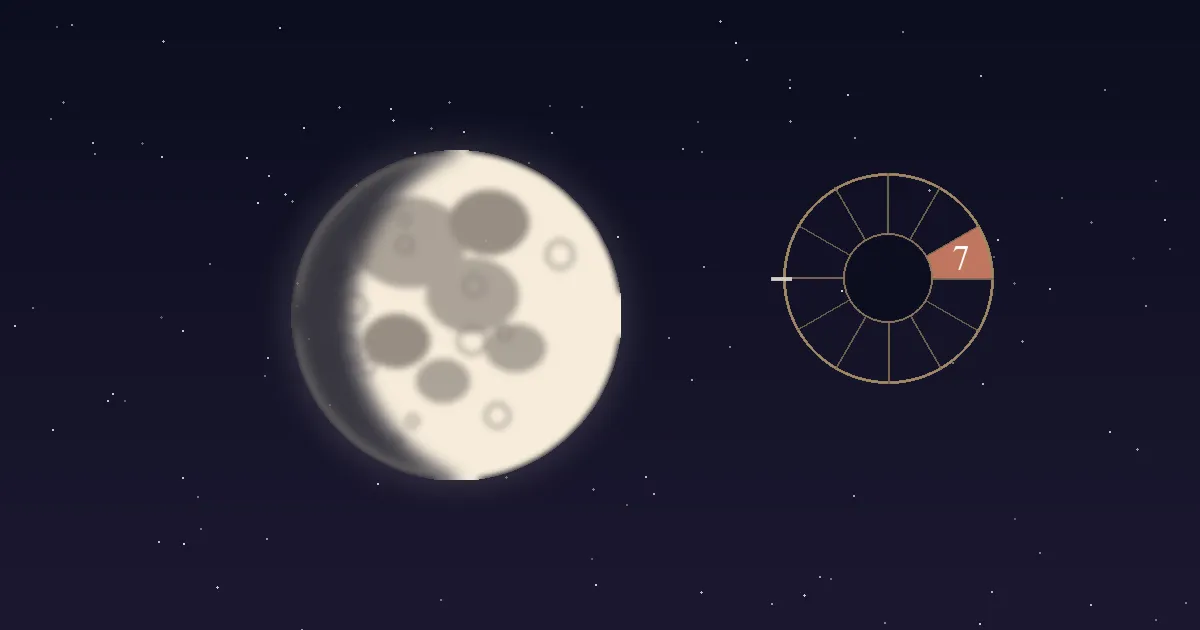
The searches that land on this placement are blunt: when do I marry, who is the spouse, what do they look like. Fair questions, and they get direct answers below, with real numbers where numbers exist and honest "the chart can't say" where they don't.
The psychology gets equal time, because it's the interesting part: this is the most partnership-hungry Moon placement on the wheel, with a genuine skill and a genuine trap inside it. House basics live in our walk through all twelve natal houses if you need the map first.
Quick answer
Moon in the 7th house seeks emotional home in partnership. Feelings stabilize in company and wobble alone, a partner's mood lands as your own, and one-to-one bonds are where this person becomes fully themselves. The placement names a priority and a talent for attunement, never a wedding date.
| Arena | Angular 7th house: marriage, committed bonds, open rivals |
| Core pattern | Emotional regulation through a counterpart; the "we" reflex |
| The gift | Attunement: reading and matching a partner precisely |
| The trap | Losing track of which feelings started as yours |
| Marriage timing | Not chart-readable; median first marriage now ~30.8 (men) / 28.8 (women) |
| Descendant note | A Moon on the Descendant sits exactly opposite your Ascendant |
The 7th house begins at the Descendant, a point that only exists once your birth time fixes the horizon. One minute with the free calculator confirms whether your Moon actually lives here.
Confirm your Moon is in the 7th →What Moon in the 7th house means
The 7th is the house of the other: directly across the wheel from the 1st house of self, opening at the Descendant where the sky meets the western horizon. It governs marriage and the serious one-to-one bonds built on agreement (business partners and, in modern practice, any relationship with a counterpart shape), plus, in the old texts, your open rivals, the people who oppose you to your face. A Moon here means the emotional center of gravity sits in that space between self and other. Feelings make sense in dialogue and blur in solitude; the day doesn't feel processed until it's been told to someone.
People with this placement are natural partners in the structural sense: they think in "we," track a relationship's temperature continuously, and adjust to the person across the table without noticing they're doing it. One caveat about the record: Firmicus's fourth-century Moon chapter is missing its 5th-through-8th house pages, so the fullest early Latin source is silent on this exact placement, and any "the ancients said" quote for it comes from somewhere else.
The marriage-age claims vs. the numbers
Ask the ranking pages when a 7th-house Moon marries and you'll collect suspiciously precise windows, most often 22 to 28. Two problems. First, no chart-based timing method has ever survived testing; astrologers themselves disagree about which technique would even apply. Second, the calendar moved: per Census ACS data compiled by Bowling Green's family research center, U.S. median age at first marriage reached about 30.8 for men and 28.8 for women in 2024, up nearly three years in a decade and a half. The median now sits at the top of that promised "early" window and past it, which suggests what those windows were probably tracking all along: the marriage norms of the era the manual was written in, not your chart.
What the placement legitimately says about timing is a posture, not a date. Partnership ranks high enough here that these people tend to take pairing seriously early, whether or not paperwork follows, and astrologers read prolonged singleness as costing this placement more comfort than most. If that pressure is currently yours, the FAQ below has the honest version of living with it.
The spouse question, answered straight
"What does the spouse look like" is this SERP's favorite promise. Traditional logic does read partner qualities from the 7th: a Moon there gets you adjectives like nurturing, emotionally responsive, family-oriented, sometimes "moon-faced" in the old physiognomy, and Jyotish adds that the spouse may be a homemaker type or emotionally changeable. Hold all of it loosely. A single placement describing another whole human being is astrology at its most overextended, and the same tradition immediately adds modifiers: the Moon's sign, its aspects, the 7th ruler, the Sun and Venus for good measure. By the time the modifiers are in, the description could be anyone.
The defensible version is about what you need, not what they'll look like: a 7th-house Moon needs a partner who does feelings, full stop. Emotional availability isn't a preference here, it's the load-bearing wall, and this placement paired with someone emotionally shut costs more than it costs other Moons. That's the spouse information actually in your chart: the requirement, not the face.
Around two days a month, the transiting Moon crosses your 7th house, and this placement tends to feel those days relationally: conversations that need having, closeness that needs tending. ZodiScope shows the live Moon against your chart, plus a partner's chart beside yours.
See your chart with today's sky →Attunement you can measure in a lab
The core talent of this placement, feeling what the partner feels, is usually written off as poetry. It has a measurable cousin. In a study that sampled 47 married couples' saliva seven times a day across working days, Papp and colleagues found spouses' cortisol levels significantly linked even after accounting for the hormone's daily rhythm (with the linkage strongest for husbands who spent more time with their spouse). The study has nothing to say about Moon houses. What it shows is that partners' stress systems track each other: two nervous systems in a long relationship don't run fully independently.
Everyone does this to some degree. Astrology's claim is that the 7th-house Moon does it loudest, which is why the placement's experience is so double-edged. A steady partner is the best regulation this Moon will ever have, better than any technique. An unsteady one becomes weather you live inside. It's the strongest astrological argument there is for this placement choosing partners by nervous system rather than by resume.
Moon in the 7th house synastry
The overlay version of this placement gets searched almost as much as the natal one: their Moon falls in your 7th house. In synastry that's classically one of the marriage signatures: their emotional self occupies your partnership sector, so the bond skips the audition phase and feels domestic early, in the "why does this already feel like home" way. Practitioners usually read it as tilting commitment-ward, with the Moon person the more invested of the two early on; schools differ, and no overlay is a rule.
One overlay never decides a relationship; the full two-chart picture does. The synastry walkthrough shows how to read the whole exchange, and the guide to how two Moon signs pair up emotionally covers the sign-to-sign fit that underlies any overlay.
Partnership or codependency
Here's the placement's real question, the one under all the marriage searches. Attunement and self-loss run on the same wiring, and a 7th-house Moon spends its life on the line between them. The attuned version reads a partner precisely while knowing which feelings are its own. The codependent version outsources its entire inner state: happy when they're happy, gutted when they're distant, unable to locate a preference that wasn't negotiated first.
Which side of the line you start on has a lot to do with the sign. A Venus-ruled Libra Moon here leans hardest into the please-them reflex; a Mars-ruled Aries Moon in the 7th argues its way to closeness and keeps its self intact almost too well; a Cancer Moon, the Moon in its own sign, makes the marriage itself the home it tends. The guide to all twelve Moon signs has your edition, and the Sun, Moon and rising finder below gives you the sign if you don't know it.
For contrast, Venus in the 7th house is the classic marriage placement, at ease in the house's territory, and Jupiter in the 7th house carries the famous "late marriage" folklore this site has already put on trial. The Sun gets the same accusation, and the 7th-house Sun traces it to a line in Ptolemy about women's charts that covers six houses, not one. The Moon's version is neither charm nor luck. It's need, and need handled well cuts deepest.
The Moon you bring to a partnership
The house says where this Moon looks for closeness; the sign says how it asks for it. Enter your birth date, time and place to get your Moon sign with your Sun and rising, free and with no account.
Find your Moon, Sun and rising signs →Keep reading
- · When the partner is the one you spar with rather than lean on: Mars in the 7th house.
- · Across the wheel, the self this house mirrors: Moon in the 1st house.
FAQ
Does Moon in the 7th house mean early marriage?
Vedic pages circulate specific windows for this placement, usually 22 to 28, sometimes 'early and to a nurturing spouse.' No study has ever validated chart-based marriage timing, and the numbers themselves have drifted out from under the claim: U.S. median age at first marriage now runs around 30.8 for men and 28.8 for women per Census survey data, so the promised 'early' window now sits at and below the ordinary median. What the placement does support: partnership sits high on this person's priority list, they tend to pair seriously rather than drift, and being unpartnered rarely feels neutral to them. Priority, not timetable.
What does Moon in the 7th house mean in a woman's chart?
The 'female horoscope' searches trace back to older manuals, mostly in the Jyotish lineage, that read charts differently by gender. Modern Western practice reads this placement identically for everyone: emotional fulfillment is sought through partnership, the partner's moods register as your own, and relationships function as the primary mirror for self-knowledge. If a page gives you a gendered doom-or-blessing version, you're reading a medieval convention repackaged, not a fact about your chart.
Is Moon in the 7th house hard if you're single?
It's the placement most likely to experience singleness as an ache rather than a neutral state, and pretending otherwise doesn't help. The workable approach isn't forcing detachment; it's widening the definition of partnership the house responds to. The 7th covers all one-to-one bonds: the best friend you talk to daily, the business partner, the close collaboration. A 7th-house Moon with two or three real one-to-one bonds in active rotation tends to be far steadier single than one waiting for romance to supply all of it. The house wants a counterpart, not necessarily a spouse.
Can Moon in the 7th house make you codependent?
It supplies the raw material: feelings that stabilize in company, a partner's mood arriving as your own, and unease when there's no 'we' to consult. Whether that matures into attunement or slides into codependence depends on one skill, knowing which feelings started as yours. The practical tests are unglamorous: can you name your own preference before asking theirs, spend a weekend alone without unraveling, disagree without feeling the bond is ending? Yes to all three and this placement is a gift; the mirror stays a mirror instead of becoming the face.