Free Birth Chart Calculator
Get your free natal chart from your birth date and place, with planetary degrees, aspects and personal readings. Add your birth time to include your Rising sign and all 12 houses.
Planet positions come from NASA JPL data. Our calculation service runs on Lx Ephemeris, built on JPL's DE440 ephemeris. Updated .
Your chart at a glance
Sun
Moon
Rising
Rising
Needs a birth time
Your Rising sign and houses need a birth time. Add yours above and recalculate to see them.
Your birth chart wheel
Tap a sign, planet or house to explore it.
Saving needs a free account: Google, Apple or an email address. No card, ever.
Anyone with the share link can see this chart and the birth details you entered.
Your readings
Placidus housesWritten from your whole chart.
All your readings are open below.
Save this chart and see today's transits for it.
See today's transits for my chartFree account, no card. This chart stays saved, with today's transits and a personalized daily horoscope for it.
FULL REPORT
Why you are the way you are: the full reading
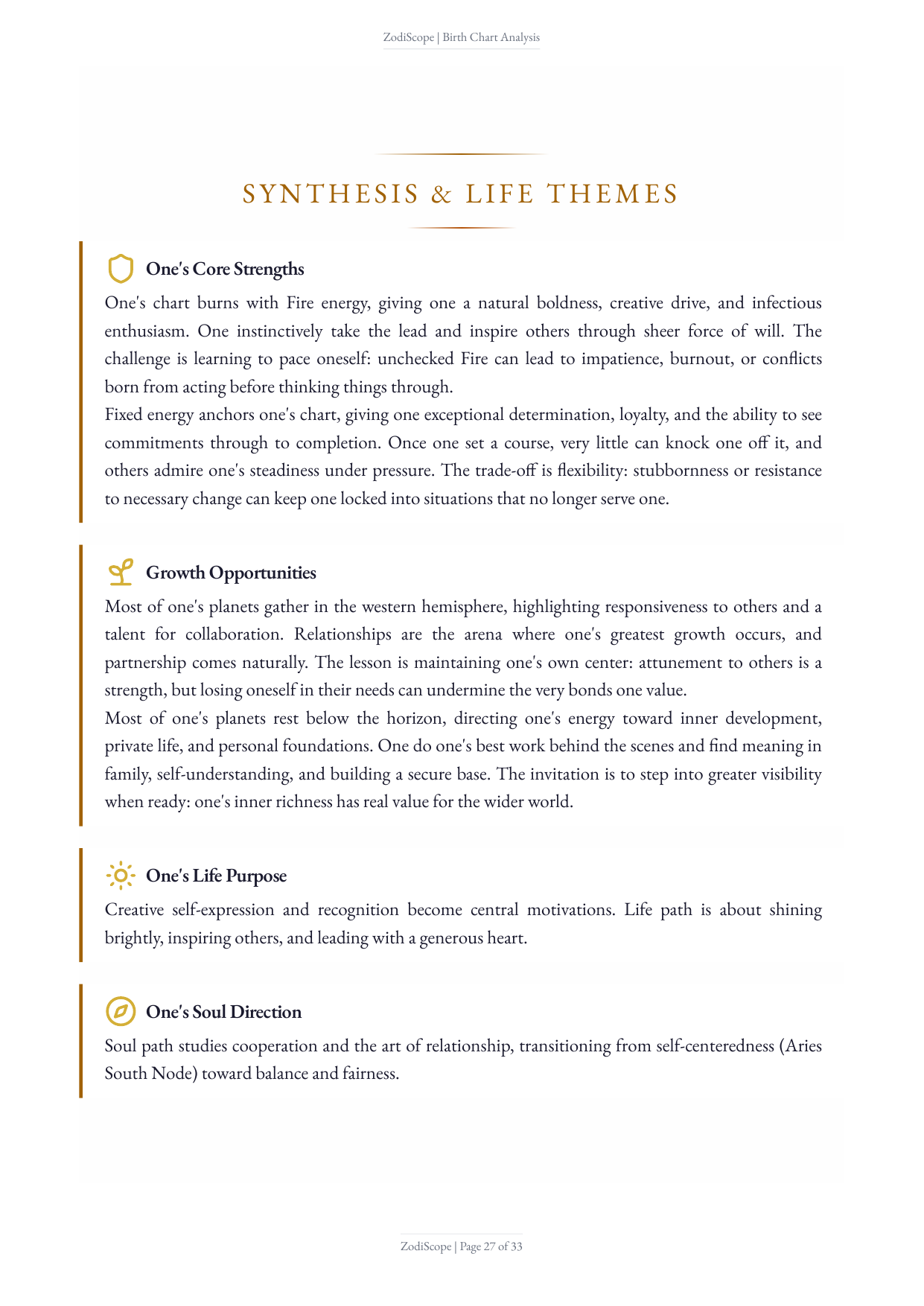
The free result reads each placement and aspect on its own. The report puts those pieces together: your life themes, your strengths and challenges, and your purpose, in a PDF you keep.
$19 $9.50 · Black Friday sale · 50% off · one-time · no account needed · 30-day money-back guarantee
Chart highlights
Planets and points
| Planet | Sign | Degree | House | Notes |
|---|
℞ = retrograde. Dignity tags (domicile, exaltation, detriment, fall) show where a planet works with ease or with strain.
House cusps (Placidus)
Aspects, tightest first
What this free birth chart calculator shows
This free birth chart generator shows all of this on the page. Nothing waits behind an email or an account.
- · The wheel. The 12 signs, every planet at its degree, the house cusps and lines for the major aspects.
- · Every planet, with degrees. Sun through Pluto, the North Node, Chiron and Black Moon Lilith, each with its sign, degree and minute (for example 24°11′) and house, plus a retrograde mark where one applies.
- · 12 house cusps. Placidus, with the sign and degree on each, or Whole Sign houses if you switch to them. These need a birth time.
- · Aspects with orbs. Sorted from the tightest outward.
- · Every reading. Each planet in its sign, the main aspects and any aspect pattern. With a birth time, each planet's house and your chart ruler too.
- · A plain-text copy. The Copy for ChatGPT button copies the whole chart for a note or an AI chat.
Only want your Sun, Moon and Rising? The Big 3 calculator gives those three, plus Mercury, Venus and Mars, in a shorter result.
How to read your natal chart wheel
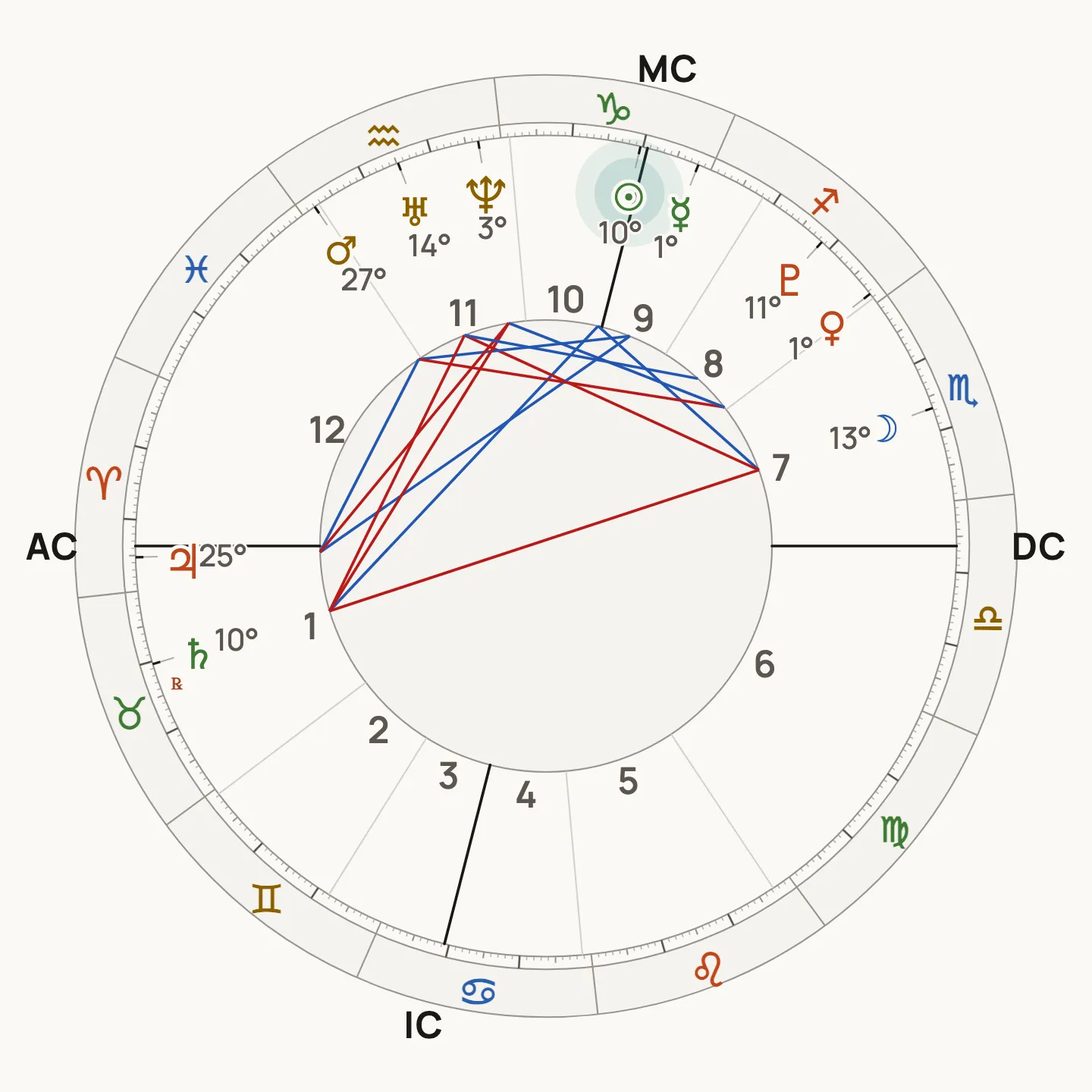
- 1. The outer ring is the zodiac. Twelve signs of 30 degrees each run counterclockwise. Each sign's symbol takes its element's color: orange for fire, green for earth, gold for air and blue for water.
- 2. AC, at nine o'clock, is your Ascendant. It is the degree that was rising in the east when you were born. The line from AC across to DC is the horizon.
- 3. The small numbers are the houses. House 1 starts at AC and they count counterclockwise to 12. MC, near the top, starts the 10th. (In Whole Sign houses, each house starts at 0° of a sign instead. AC then falls inside the 1st house, and MC can land outside the 10th.)
- 4. The symbols inside the ring are planets and points. ℞ marks a retrograde planet. The table under the wheel names each one in words, with its exact degree. Each symbol takes the color of the sign it sits in.
- 5. The lines in the middle are aspects. Blue lines join planets in a trine or sextile, red lines a square or opposition. Conjunctions get no line; check the aspect list for those.
New to astrology charts? Start with the birth chart guide for beginners. Then read the Sun, Moon and Ascendant first, your chart ruler next and the tightest aspects after that. Three or more planets in one sign form a stellium, and the result flags it, along with a Day chart or Night chart tag for whether the Sun was above or below the horizon. For what each house covers, see the 12 houses explained.
Example: a natal chart for the J2000 moment
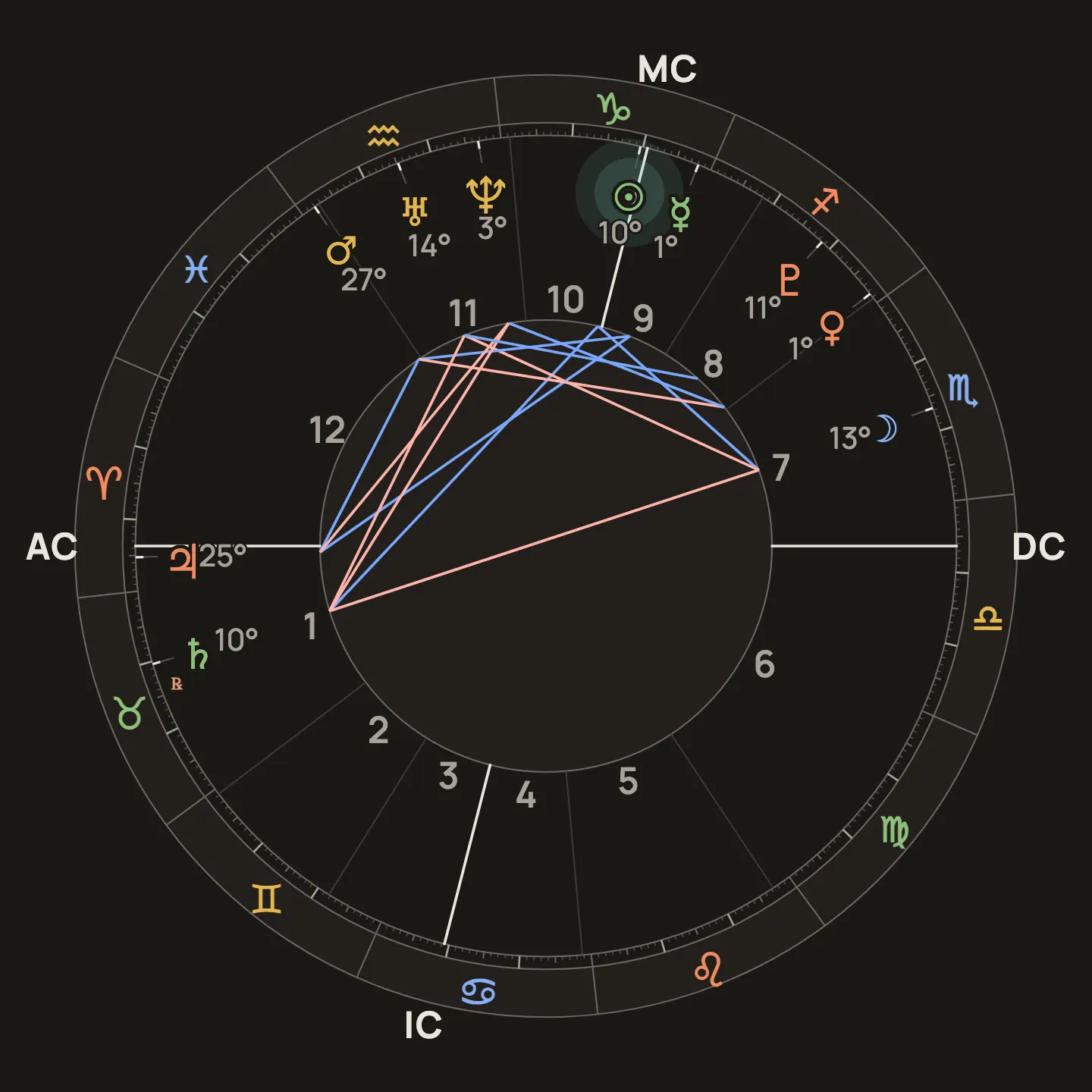
Astronomers date their star catalogs from one instant, J2000: noon Terrestrial Time on January 1, 2000, which was 11:58:56 UTC. Here is that moment as a birth chart for the Royal Observatory in Greenwich, the same way the calculator above lays out a result.
| Planet | Sign | Degree | House |
|---|---|---|---|
| Sun | Capricorn | 10°22′ | 10th |
| Moon | Scorpio | 13°19′ | 7th |
| Mercury | Capricorn | 1°53′ | 9th |
| Venus | Sagittarius | 1°34′ | 8th |
| Mars | Aquarius | 27°58′ | 12th |
| Jupiter | Aries | 25°15′ | 1st |
| Saturn ℞ | Taurus | 10°24′ | 1st |
| Uranus | Aquarius | 14°49′ | 11th |
| Neptune | Aquarius | 3°12′ | 11th |
| Pluto | Sagittarius | 11°27′ | 8th |
| Ascendant | Aries | 23°41′ | · |
| Midheaven | Capricorn | 9°22′ | · |
The Sun sits 1° from the Midheaven in the 10th house, because it was a few minutes before local solar noon. Mars, Uranus and Neptune share Aquarius, a stellium.
In New York the same instant was 6:58:56 a.m. EST. Every planet keeps the sign and degree in this table. The houses don't. The Ascendant moves to 3°59′ Capricorn, and the Sun drops from the 10th house to the 1st, about 21 minutes before sunrise.
Which house is each planet in your birth chart?
A birth chart with houses needs a birth time: enter one and your result names the house of every planet. Switching from Placidus to Whole Sign moves six of this example's ten planets into different houses; the Moon goes from the 7th to the 8th.
| House | Starts at (Placidus) | Planets in it |
|---|---|---|
| 1st | Aries 23°41′ | Jupiter, Saturn |
| 2nd | Gemini 0°49′ | |
| 3rd | Gemini 21°46′ | |
| 4th | Cancer 9°22′ | |
| 5th | Cancer 28°47′ | |
| 6th | Leo 27°17′ | |
| 7th | Libra 23°41′ | Moon |
| 8th | Sagittarius 0°49′ | Venus, Pluto |
| 9th | Sagittarius 21°46′ | Mercury |
| 10th | Capricorn 9°22′ | Sun |
| 11th | Capricorn 28°47′ | Uranus, Neptune |
| 12th | Aquarius 27°17′ | Mars |
Birth chart aspects, tightest first
These ten planets form 13 major aspects within 8° of exact (6° for a sextile). Here are the five tightest.
| Aspect | Orb |
|---|---|
| Sun trine Saturn | 0°02′ |
| Moon square Uranus | 1°30′ |
| Venus sextile Neptune | 1°38′ |
| Mars sextile Jupiter | 2°43′ |
| Moon opposition Saturn | 2°55′ |
How much does birth time change a birth chart?
The numbers show why an accurate birth time matters.
11.0%
A chart cast for noon showed the wrong Moon sign for this share of minutes in New York, 2020 to 2026. The Moon changed sign on 44% of those days.
87.4%
Share of the 2,333 chart calculations our analytics recorded on this page in September 2026 that included a birth time.
Some charts are far more time-sensitive
A new sign rises about every two hours on average, but the signs don't take equal time. The farther from the equator you were born, the bigger the gap.
| City | Fastest (min each) | Slowest (min each) |
|---|---|---|
| London | Aries, Pisces: 52 | Leo through Scorpio: 170 |
| New York | Aries, Pisces: 71 | Leo, Scorpio: 153 |
| Los Angeles | Aries, Pisces: 80 | Leo, Scorpio: 145 |
| Sydney | Virgo, Libra: 80 | Taurus, Aquarius: 145 |
In London a 15-minute error is more than a quarter of the time Aries spends rising and less than a tenth of Virgo's. South of the equator the fast and slow signs swap. If your time is rounded, say "3 pm", calculate the chart for 2:45 and for 3:15 and compare the Ascendant.
Birth chart without a birth time
Tick "I don't know my birth time" or leave the time blank. You still get every planet's sign and degree and the aspects between them, cast for noon. The Ascendant, Midheaven and houses are left out, because a guessed time gives a made-up answer, so the wheel has no house numbers and 0° Aries sits at nine o'clock. If the Moon changed sign on your birthday, the result names both signs and the estimated time of the change. In the US the long-form birth certificate, the "vault" copy from the state, usually has the minute: in the CDC's 2025 records, all but 514 of 3,619,990 US births carry a time, and very few of those times look rounded.
Method: our own run on October 1, 2026 with pyswisseph 2.10 (the Swiss Ephemeris), tropical zodiac, at New York 40.71°N 74.01°W, London 51.51°N 0.13°W, Los Angeles 34.05°N 118.24°W and Sydney 33.87°S 151.21°E. Ascendant sign checked at every minute of 2026 (UT); figures count minutes of sky time, not people. Rising times measured over one passage of each sign from January 1, 2026 and rounded to the minute. Moon sign compared with local noon at every minute of 2020 to 2026. The September figure is from this page's analytics; a chart calculated twice counts twice.
Free chart vs Full Report
| Included | Free chart (this page) | Free account | Full Report ($9.50) |
|---|---|---|---|
| Wheel, planets, degrees, houses, aspects | Yes | Yes | Yes |
| Readings for each planet, its house, the main aspects and any patterns | Yes | Yes | Yes |
| Saved chart, today's transits, and a personalized daily horoscope | No | Yes | No |
| The whole chart read together: life themes, strengths and challenges, life purpose | No | No | Yes |
| Designed PDF you keep | No | No | Yes |
| Charts you can run | Unlimited, not saved | Unlimited; yours plus five others kept | One chart per report |
So: the chart and its readings are free. An account keeps the chart and adds a daily horoscope for it. The report connects your placements in one PDF: your strengths, the challenges that come with them, and your life purpose. It's $9.50, 50% off the regular $19 price, and needs no account.
Saves this chart. Today's transits and a personalized daily horoscope for it. Google, Apple or email. No card.
Birth chart calculator FAQ
What is a birth chart?
A birth chart is a diagram of the sky at the minute and place you were born. It shows each planet's sign, degree and house, plus the angles between planets, called aspects. Astrologers read it for personality, relationships and life direction. It's also called a natal chart, an astrology chart or a zodiac chart.
Do I need to give my email to get my birth chart here?
No. There is no email step and no account step. Enter your birth date, your birth place and, if you know it, your birth time, and your chart shows on this page. Every reading is free to read. A free account is for keeping the chart. It adds today's transits and a personalized daily horoscope for it, and works with Google, Apple or an email address.
Is a natal chart calculator the same as a birth chart calculator?
Yes. Natal means relating to birth, so a natal chart and a birth chart are the same map of the sky for the minute and place you were born. This free birth chart calculator draws a Western (tropical) natal chart. A Vedic birth chart, often called a kundli, uses the sidereal zodiac, which sits about 24 degrees behind the tropical zodiac today, shifting most placements one sign earlier. The calculator does not cast sidereal charts.
Which house system does this calculator use, and can I change it?
It uses Placidus, the usual default in Western chart software. To see Whole Sign houses instead, switch Chart houses to Whole Sign, just above the wheel (houses need a birth time). Then the sign on your Ascendant is the 1st house and each sign after it, counterclockwise, is the next house, whatever a planet's degree. The wheel, the House column and the cusp list switch; the written readings keep Placidus houses. A planet's sign and degree stay the same in every house system; only its house can change.
Why does my birth chart look different on another site?
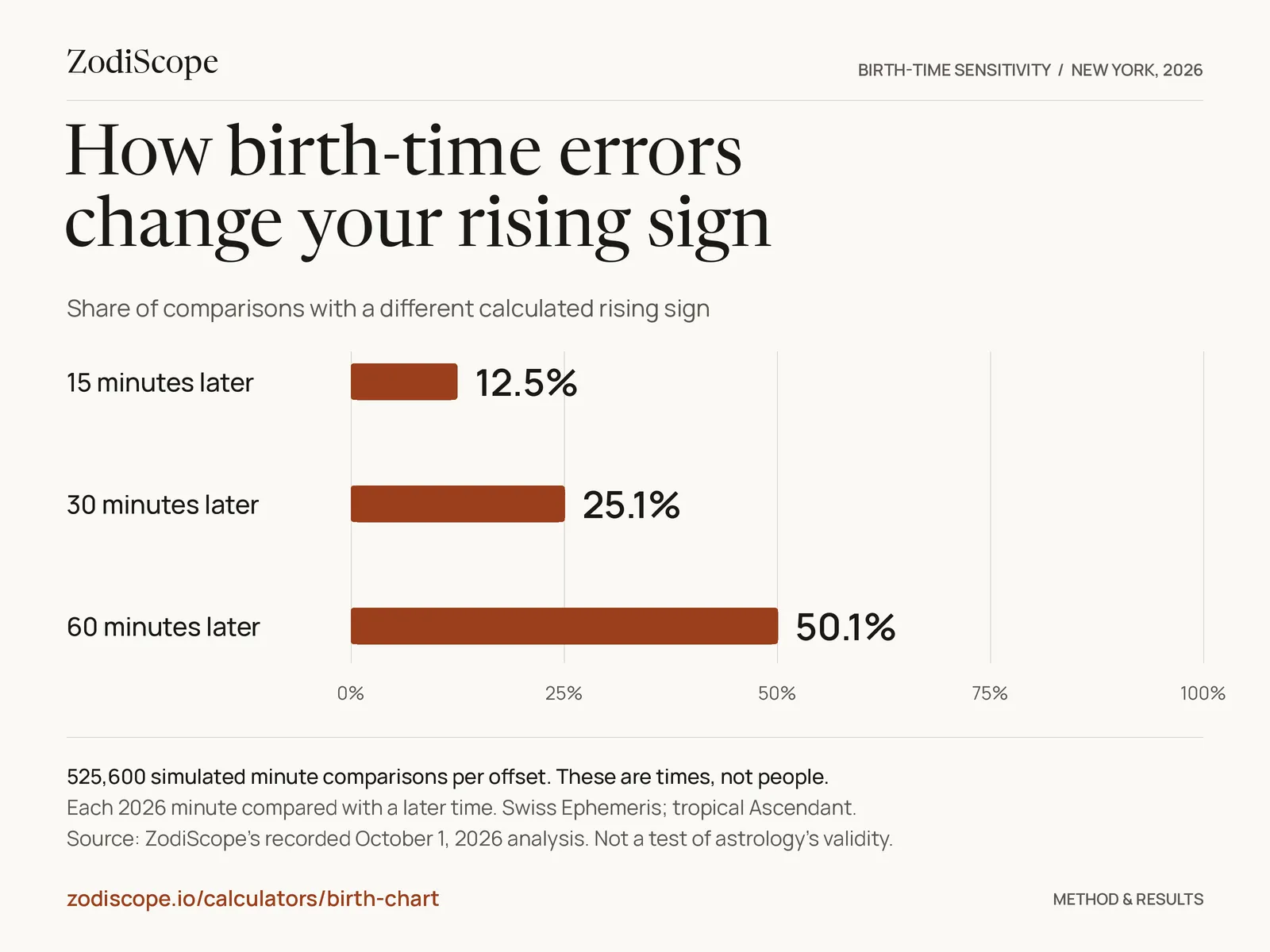
Check three things in this order. First, the birth details: a time off by an hour, or AM entered as PM, moves the Ascendant and every house. In our own run, one hour put the Ascendant in a different sign for about half of all minutes. Second, the zodiac: Vedic sites usually use the sidereal zodiac, which shifts most placements one sign earlier. Third, the house system: Placidus, Whole Sign, Koch and Equal can put a planet in a different house, though they all share the same Ascendant degree.
How accurate is this birth chart calculator?
The planet positions come from NASA JPL data and are printed to the arc-minute. The time zone and daylight-saving offset are looked up for your birth place and year, so you enter the local clock time from your certificate. For births before about 1970, or in places with wartime clock changes, the historical record has gaps, so check the offset if the chart looks off. In practice the main source of error is an imprecise birth time: the Ascendant moves about one degree every four minutes on average.
Does the chart include Black Moon Lilith or asteroids such as Juno?
It includes Black Moon Lilith but not Ceres, Pallas, Juno or Vesta. Lilith is not an asteroid: it is the apogee of the Moon's orbit, the point farthest from Earth. The chart lists mean Lilith (the averaged position, not the true or osculating one) with its sign and degree, and its house when you enter a birth time. It has no aspects or written reading here. The chart also shows the Sun, the Moon, the eight planets from Mercury to Pluto, Chiron and the North Node, and with a birth time the Ascendant, the Midheaven and the Part of Fortune.
Can I save or print my birth chart from this page?
Yes. Without an account, take a screenshot of the wheel, or press Copy for ChatGPT, which copies every planet, house cusp and aspect as text. Print the screenshot, or paste the text into a document. The Share my chart button makes a link that reopens this chart; the link holds the birth details. A free account saves this chart and up to five others.
Can two people born on the same day have different birth charts?
Yes. A different birth time or place gives different houses. The Ascendant moves about one degree every four minutes on average, so a new sign rises about every two hours. The Moon moves about 13 degrees a day and can change sign within the day.
Can I calculate a chart for someone else?
Yes. Enter their birth date, time and place the same way. There is no daily limit, and every reading is free to read for their chart too. To compare two people, use the zodiac compatibility calculator.
Keep reading
- · What each placement in your result means: the 12 houses and aspects and orbs.
- · Just the three headline signs, fast: the Sun, Moon & Rising calculator.
- · How you love, from the same birth details: the Venus sign calculator.
- · Where your chart says you're headed: the North Node calculator.
- · Adulthood's famous transit, dated exactly: the Saturn return calculator.
- · Two people, two charts: the zodiac compatibility calculator and how a synastry chart works.
- · Every free tool we make: the calculator index.