Birth Chart
Mars in the 7th House: Is Your Marriage Really Late, Loud or Doomed?
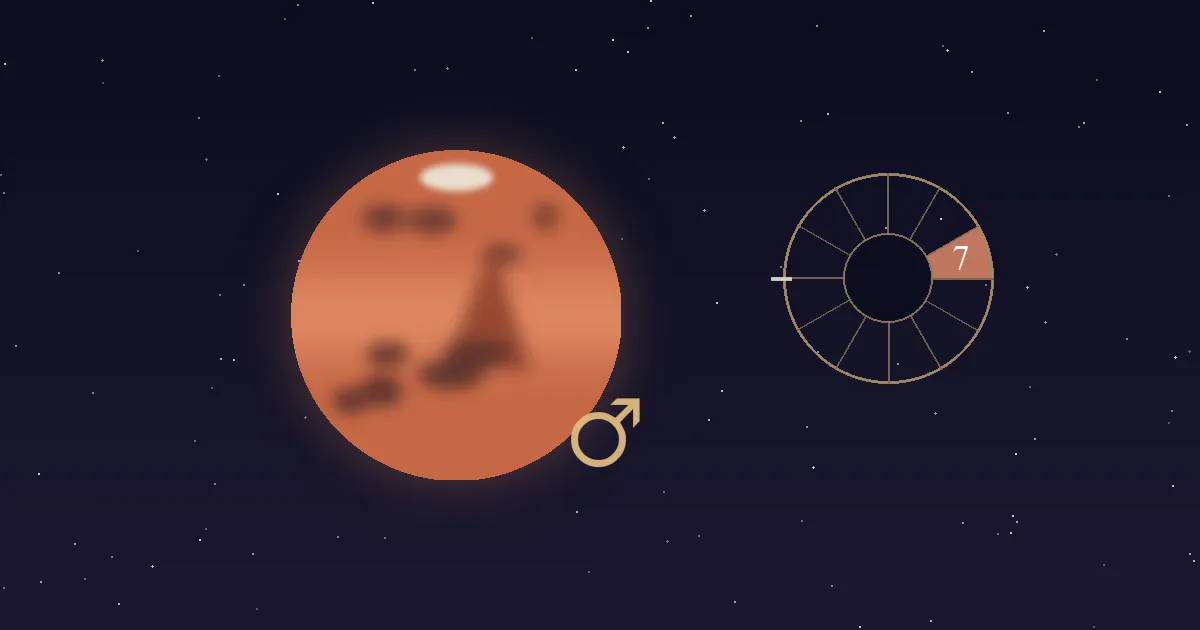
Most people who search this placement were told something first: that the marriage would come late, or turn violent, or not happen at all. The pages waiting for them mostly confirm it. The Vedic sites say Manglik. The Western essays say you'll attract fighters. A meme on r/Nakshatras sums up the genre: "You have mars in 7th house you are manglik.. your marriage will be problematic.. lol."
The marriage question comes first, from the verse itself rather than the matrimony site. Then Firmicus and Lilly, then what this Mars does in a relationship once the fear is out of the way. And underneath all of it, the question that matters most: is the fighter your partner, or you? The 7th house is the house of the other person, which is the whole problem.
Quick answer
Mars in the 7th house puts your drive, temper and desire into partnership. You want a partner with a will of their own, you'd rather argue than go quiet, and you tend to meet your own assertiveness in the other person first. It does not schedule a late marriage, guarantee divorce, or make a Western chart Manglik.
| Arena | Angular 7th: marriage, partnership, open rivals, the other side of the table |
| Partnership style | Direct, competitive, engaged; conflict as contact |
| Lilly, 1647 | "Saturn or Mars unfortunate herein, shew ill in Marriage" |
| Vedic status | Named in the Manglik verse (sidereal chart only), which cancels itself twice in the same breath |
| The fear | Late, violent or absent marriage: folklore, sorted below |
| What it's good at | Negotiation, advocacy, partnerships with teeth, choosing an equal |
The 7th cusp is the Descendant, and it moves about a degree every four minutes, so a Mars a few degrees before it is in the 6th and a few degrees after it is in the 7th.
Check which side of the Descendant →The Manglik question, answered from the verse instead of the matrimony site
The verse the word comes from, since the matrimony sites never print it. The Brihat Parashara Hora Shastra, chapter 80, verse 47, in the Santhanam translation: "The woman born becomes a widow, if Mars be in the 12th, 4th, 7th or 8th from the Ascendant un-aspected by or associated with any benefice." Verses 48 and 49: "The yoga which causes the woman to become a widow also causes a male native to become a widower. If the man and woman possessing this yoga join in wedlock, the yoga ceases to have any effect."
Three things the matrimony sites leave out are in those two sentences. The verse names four houses (the 1st and 2nd on the modern six-house list came later). It cancels itself when Mars has any benefic aspect or conjunction. And it cancels itself when both partners have it, which is the origin of the matching custom. Later texts, Jataka Parijata and Muhurtha Chintamani among them, added the rest of the modern cancellation list: Mars in Aries or Scorpio (its own signs) or Capricorn (exalted), Mars with Jupiter, Moon or Mercury, and the Cancer or Leo ascendant for which Mars is the chart's best planet. Even a practising Jyotish astrologer, Parminder Chahal, writes that a rule covering almost half of all charts "cannot simultaneously be a severe marital warning sign" (jagannathhora.com). The age-28 rule you'll see everywhere: we couldn't find a verse behind it.
Now the part that matters for a Western reader. The dosha is computed on a sidereal, whole-sign chart from the Lagna. Your Western chart is tropical, and on this site and nearly every other, Placidus. The zodiacs differ by about 24 degrees and the house grids by the Ascendant's degree. So the house number can move, but not in every direction. The whole-sign 6th runs out where the whole-sign 7th sign begins, and a Placidus 7th-house Mars is already past the Descendant, which comes later, so a tropical Placidus "Mars in the 7th" never converts to a sidereal 6th. It converts to the sidereal 8th about half the time and the 7th nearly as often, with a thin tail in the 9th, and the 8th is on the same six-house list, so the switch clears very few people. The two readings measure different things. If the label matters to you or your family, get the sidereal chart cast and the cancellations applied by someone who does it properly. On the Western chart, the verse doesn't apply, and the placement's meaning is the rest of this page.
What the Western sources actually said about Mars and marriage
The Western tradition wasn't gentle either, but it was specific. William Lilly's Christian Astrology (1647) gives the 7th house "judgment of Marriage ... all manner of Love questions, our publique enemies; the Defendant in a Law-suit, in Warre the opposing party; all quarrels, Duels, Law-suits," and adds the one line every later page paraphrases: "Saturn or Mars unfortunate herein, shew ill in Marriage." Note the condition. Unfortunate: badly placed by sign, badly aspected. Not simply present.
Firmicus, thirteen centuries earlier, is the harsh one, and worth reading for exactly that. In the Mathesis (III.4) he opens with "Mars in the seventh house, that is, on the descendant, indicates the greatest evils and enormous perils" and closes with "Mars in the seventh house most violently persecutes the house of wife and of children." But in between he writes something the fear pages never quote: if Mars on the descendant "aspects his own house in opposition, he will not make a violent death (for Mars never attacks his own house)." Read literally, that exempts a Mars that faces its own sign across the wheel: Mars in Libra on the Descendant looking back at Aries rising, or Mars in Taurus facing Scorpio. The detriment placement, of all things, is the one Firmicus lets off his own worst sentence. He then hedges the rest on sect, sign and Jupiter. What he wrote was a set of conditions. What survived into the search results is the verdict.
Valens has one more line worth knowing, because it gets misquoted as natal: "Mars: the third, the fourth, and the ninth are good; the seventh and the tenth are rotten." That's his rule for Mars transiting the seventh place, from the transits list in Book I of the Anthologies (Riley's translation), and it is a verdict on a passing sky, not on a birth chart. Transiting Mars through the 7th is the relationship-argument season.
Transit note, September 2026
Transiting Mars is in Cancer from August 11, 2026 until September 28, 2026. In whole-sign houses that is the 7th house for Capricorn risings, who get a live preview of what this natal placement feels like for about six weeks. When Mars moves on into Leo, the 7th-house transit passes to Aquarius risings. If your chart uses Placidus, the timing can differ by a week or two either side; the free birth chart prints your Placidus cusps so you can check.
Valens's "rotten" transit is the six to eight weeks every two years when Mars crosses your natal 7th house, or up to seven months if it retrogrades there. ZodiScope's overlay shows the dates on your own chart, with your partner's chart alongside if you add it.
Track Mars through your 7th house →The fighter is you: projection, and how to test it
The 7th house is other people. A planet there shows up in your partners before it shows up in you. So this Mars picks people with strong wills, watches them start the fights, and feels like the reasonable one. Then, if it's honest, it notices it chose all of them, and that the agreeable ones never held its attention for a month.
The test, from a 2016 AstrologyWeekly thread that still gets replies: "Mars in 7th often attracts partners/mates who are competitive or combative ... There is an element of transference." If every partner in your history has been "too intense," the constant in the sample is you. A projected Mars runs your relationships from outside; an owned one gives you ambitions of your own, wants stated early, and a partner who no longer has to carry your assertiveness for you. The same thread's happiest report is a woman with Mars in Aries in the 7th, four years in with a boyfriend, "not at all aggressive." That's what calm looks like with this placement.
The sign decides the flavour of the fight
- · Mars in Libra in the 7th is the detriment placement in Libra's own house, and, read literally, the one Firmicus exempted: it argues for fairness, resents having to, and wins by making the other side feel unreasonable.
- · Mars in Aries here is fast and forgetful, done before the plates are cleared; the recovery time is the signature, and partners learn not to take the first ten minutes personally.
- · Mars in Cancer in the 7th has trouble saying no: the fight goes underground and comes out as withdrawal.
- · Mars in Scorpio in the 7th stores the argument rather than having it, then settles it all at once, and remembers the settlement for years.
- · Mars in Capricorn, exalted, partners like it plans: patiently, with a long horizon, and with a cold, delayed anger when the other side breaks the plan. Buffett's Cancer Mars is the warmer cousin.
- · Mars in Taurus, the other detriment and the other sign Firmicus's exemption covers, is the slowest fuse in the house: years of tolerance and then a rupture the partner never saw building.
- · Mars in Gemini or Virgo fights in sentences, sharp and specific, and the partner who can argue back in kind is the one who lasts.
What kind of partner this Mars attracts
What does this Mars go for in a partner? Energy: people with a job that has stakes, a body that moves, an opinion they'll defend. One r/Nakshatras reply sums the partners up as "active, chatty, resilient, protective," and a widely shared Tumblr observation post has them drawn to "military, firefighting, or emergency services." A partner who never pushes back reads as absent. That's also why "rarely stay single for long" follows the placement around: these people can be alone fine. They just find partnership compelling and won't do it with someone dull. And partnership isn't only marriage. Lilly's 7th covers "the Defendant in a Law-suit, in Warre the opposing party; all quarrels, Duels, Law-suits," and that's where this Mars is often at its best: business partnerships with teeth, litigation, sales, a negotiation where you're one side of the table facing the other. Buffett's chart, below, is the placement run as a fifty-year business partnership rather than a fight.
The way this goes wrong is a relationship where fighting is the only closeness, and there's good research on exactly that. In 1999 Gottman and Levenson reported that after following couples for four years they could predict divorce with 82.6% accuracy from a single conflict conversation, and with 92.7% from the conversation that followed it, the one where the couple tries to recover. Arguing didn't predict it. How they argued did, and whether they could come back. That's the job with this Mars. Argue if you like. Come back every time. The other planet that lives in this house wants the opposite thing: Venus in the 7th house seeks harmony where Mars seeks engagement.
Verified charts: the placement in people whose birth time is on record
Celebrity lists for this house circulate freely and almost none of them state a birth-time rating or a house system. We used only Astro-Databank AA (certificate) or A (from the person or family) times and computed the Placidus house from the recorded UT ourselves. Tina Turner (AA, birth certificate) has Mars at 4°48' Pisces in the 7th: the marriage to Ike Turner and then the legal fight to keep her own name is the placement's classic delineation and its classic recovery. Whitney Houston (AA) has Mars at 8°30' Libra in the 7th, sixteen degrees short of the 8th cusp, Mars in its detriment in the house of marriage; her marriage was the most public 7th-house conflict story of its decade. Warren Buffett (A) has Mars at 1°30' Cancer in the 7th, and his entire method was partnership: the Buffett Partnership, then the fifty-year Munger partnership. Business partners belong to this house as much as spouses do.
Also verified into the 7th: Chris Pratt, Kevin Costner, Greta Garbo and Adam Levine (all AA) and Jimmy Page (A). Barack Obama (AA) computes into the late 7th, 3.3 degrees from the 8th cusp, close enough that we'd call it "late 7th" rather than lean on it. And note that Houston, Turner and Buffett all sit in the 8th under whole-sign houses, which is the caveat every house page owes you: in about half of all charts (53.6% of 20,000 random birth times in our own count, not a published study) Mars changes house between Placidus and whole sign. Your chart here states the house system on the result so you know which page you're reading.
Synastry: their Mars in your 7th house, and yours in theirs
"Mars in the 7th house synastry" is searched almost as much as the natal placement, and it deserves its own answer. Their Mars in your 7th means the Mars person's drive lands in your partnership house: they energise it, they challenge you in it, and they tend to be the one who starts things, from the first move to the first argument. The one-line summary that circulates for the overlay is "open enemies or frenemies," which is the tradition's name for the 7th (Lilly's "publique enemies") showing through. In practice it makes a sparring, sexually direct connection. It works if you like being met. It's exhausting if what you wanted was to be soothed.
Three things decide which way it goes. First, the house person's own Mars: a natal 7th-house Mars meeting a partner's Mars in the same house gets its own projection handed back to it, which is either the most honest relationship it has had or the loudest. Second, the Venus and Moon contacts between the two charts, which decide whether the sparring reads as play or as war, which is where the two-chart method starts. Third, the reverse overlay: your Mars in their 7th makes you the initiator in their relationship house, and the same rule applies with the roles swapped. Mars in the 7th of a solar return is a smaller, steadier search: it flags a year where partnership is the arena, and it passes.
Across the wheel sits Mars in the 1st house, the same planet owned instead of projected: that person knows they're the fighter and everyone else does too. The 7th-house version finds out later, from the pattern of who it chose. The Moon in this house needs the partner to feel anything at all, and Jupiter in the 7th house carries its own "dangerous for marriage" folklore.
Your Mars against theirs
Add a partner's chart and see where their Mars falls in your houses and yours in theirs, with the dates Mars crosses your 7th on the same wheel.
Compare your Mars with theirs →Keep reading
- · The romance stage before the contract: Mars in the 5th house.
- · The home the two of you fight in: Mars in the 4th house.
- · Mars in Taurus is the other detriment, and in this house it takes years to start a fight and longer to end one.
- · Whose Moon needs what, two charts at a time: Moon sign compatibility.
FAQ
Can someone with Mars in the 7th house have a calm marriage?
Yes, and plenty do. The placement describes how you engage in a partnership. Whether it survives is a different question, and the answer depends mostly on who you picked: someone with their own will, who can take a direct disagreement and come back from it, tends to do well with this Mars; someone who needs calm at any price tends not to. The couples who struggle are the ones for whom a fight is the only time they feel close. Choose for the recovery, not for the absence of argument.
Is Mars in the 7th house the same as being Manglik?
The word names a Vedic yoga, so only a sidereal chart can answer it. If a family astrologer has told you that you're Manglik, ask three things: whether Mars has any benefic aspect (the founding verse cancels the yoga on that alone), whether your partner has it too (the verse cancels it then as well), and which house list they used, since the verse names four houses and the popular list six. A Western app can't settle it either way. It draws a tropical, Placidus chart, and the dosha isn't computed on that.
Does Mars in the 7th house mean I'll never marry?
No. The "no marriage" reading is a Vedic extreme case that needs several other afflictions stacked on top of Mars, and even then it reads as a delay. The verified charts on this page make the point both ways: Greta Garbo, whose Mars sits in the 7th on a certificate-grade time, never married, while Tina Turner, Warren Buffett and Kevin Costner each married more than once. The placement doesn't set the count. What it describes is a person who won't settle for a partner who bores them, which from the outside can look like a long single stretch.
Does Mars in the 7th house make you attract fighters, or make you the fighter?
Usually both, and there's a quick way to tell which is running the show this year. Notice who raises the stakes first when you disagree. If you only ever respond, and every partner in your history was somehow the intense one, the fight is being outsourced and the Mars is theirs by delegation. If you're the one who says what you want before it turns into a grievance, and who reopens the conversation the next morning, the Mars is yours. The partners look less like fighters the year you get ambitions of your own; that isn't them changing.