Birth Chart
Sun in the 7th House: Born Before Sunset, and Where the "Late Marriage" Idea Really Comes From
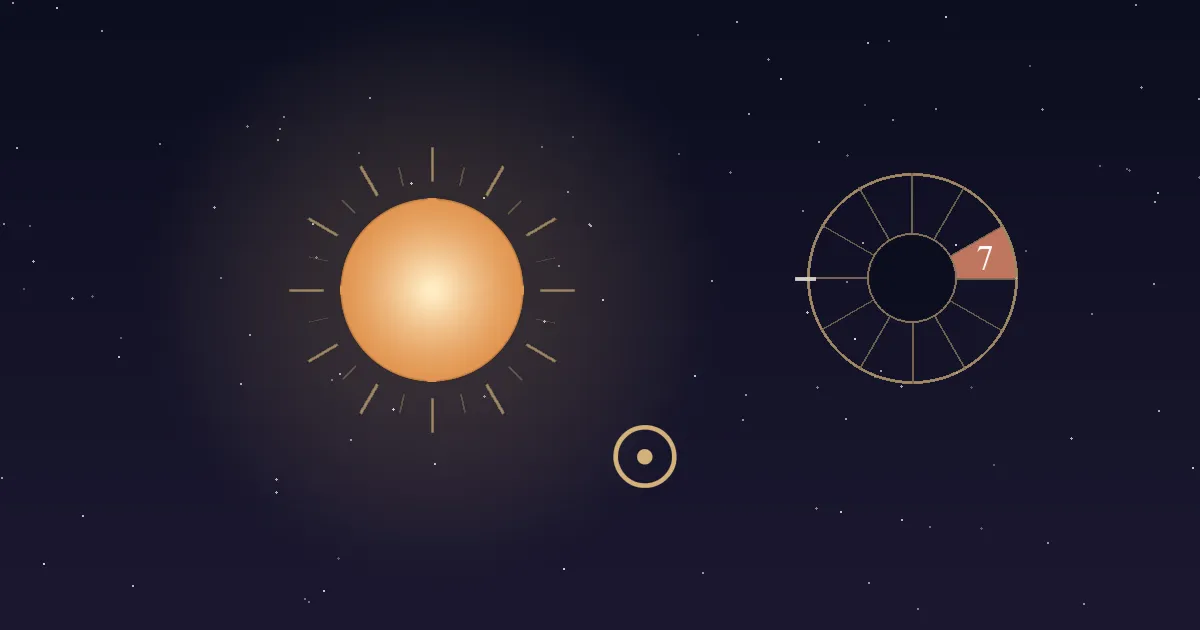
In Placidus houses, a Sun in the 7th means you were born late in the day. The Sun sets on the Descendant, the line that opens the 7th, so a 7th-house Sun is a Sun in its last stretch of daylight. Most people who look this placement up don't ask about the clock, though. They ask whether it means a late marriage, a divorce, or a partner who runs the show.
We went looking for where those answers come from. The oldest "late marriage" line we found is Ptolemy's, and it covers six houses, the 7th only one of them. The one Vedic verse that times marriage for this placement gives an early age. And the charts of people born with the Sun here look like anyone else's love lives: some married young, some never did.
Quick answer
In Placidus houses, the Sun in the 7th means you were born in the last sixth of daylight, before sunset. Astrologers read it as finding yourself through partners: you shine most with someone across the table. It's often said to delay marriage, but no classical verse we read says so, and Ptolemy's late-marriage rule covers six houses.
| Arena | The Descendant: partners, marriage, contracts, open rivals |
| House type | Angular: one of the four strongest places in the older tradition |
| Time of day | The last sixth of daylight, ending at sunset (Placidus) |
| U.S. births, 2024 | About 9% in our model, most between 4:05 and 7:39 p.m. by the clock (estimated from CDC birth-time data) |
| Vedic note | Directional strength is graded: full at the Midheaven, zero at the IC, partial here; Libra, the 7th sign, is the Sun's sign of fall |
| The folk rule | "Late marriage": traced to Ptolemy's rule for women's charts, not to a 7th-house verse |
Your Descendant is the degree that was setting in the west when you were born. A birth time off by half an hour can move the Sun between the 8th and the 7th, or across sunset into the 6th, so check which side of the line yours is on before reading further.
Check your Sun against the Descendant →Does the Sun in the 7th house delay marriage?
That's the question on almost every forum thread about this placement, and Vedic pages often answer it with a flat yes and an age. We read the texts those pages usually rely on. None of them says a 7th-house Sun delays marriage.
The oldest timing rule we found is in Ptolemy's Tetrabiblos (IV.5), from the second century, and it's narrower than the modern version. Ptolemy says that in a woman's chart, a Sun in the "western quadrants" makes her "marry late or marry husbands older than themselves", while a Sun in the eastern quadrants means marrying young. His western quadrants are six houses: the 7th, 8th and 9th, and the 1st, 2nd and 3rd. So the rule was never about the 7th house alone, it only applied to women, and it offered an older husband as the alternative to a late wedding.
The Vedic side goes the other way. The Brihat Parashara Hora Shastra (18.23, in R. Santhanam's translation, p.125) has a marriage-age verse for this exact placement: "If the Sun is in 7th while his depositor is conjunct Venus, there will be marriage at 7th or 11th year of age." That's a child marriage in its historical setting, and nobody should read it as advice. But it's the opposite of a delay.
The modern "delay" line shows up in Alan Leo's How to Judge a Nativity (1928 printing, p.187), with a condition attached: "If the Sun is much afflicted in the seventh, marriage will be delayed or strong opposition will be experienced." In the same paragraph, after discussing a woman's chart with a void-of-course Sun, he says the position "causes marriage to take place towards middle life, and denotes happiness in the married state," and he ends with "lasting attachments and firm friendships." So Leo's firm word, "delayed," needs a badly afflicted Sun, and the pages that quote it tend to leave that condition out.
Why a 7th-house Sun means a late-afternoon birth
The Sun crosses the houses backwards over the course of a day. It sits on the Ascendant at sunrise, climbs through the 12th, 11th and 10th to the top of the chart at solar noon, then drops through the 9th, 8th and 7th to the Descendant at sunset. In Placidus houses, the Sun's house is simply which sixth of the day or night you were born in, and the 7th is the last sixth of daylight. We checked that rule against Swiss Ephemeris house cusps on 200,000 random charts and it matched every one.
How long that sixth lasts depends on the season. At New York's latitude each daytime house runs about two and a half hours around the June solstice and about an hour and a half in December. Clocks blur it further. To put numbers on it we built a model from the CDC's 2024 birth-time data. The public file gives the hour of birth but no birthplace, so we simulated 400,000 births, spread them across states and counties by birth totals and population, and worked out each Sun's Placidus house. In that model 8.7% of U.S. babies had the Sun in the 7th, and the middle 80% of them arrived between 4:05 and 7:39 p.m. by the clock, typically just after 6 p.m. Daylight saving and time zones put most U.S. clocks ahead of the Sun, which is why the window sits later than a sundial would suggest.
There's one more small detail for people born right at dusk. The Sun's center reaches the Descendant a few minutes before the sunset time printed in an almanac, about four to five minutes at New York's latitude, because the printed time counts the Sun's top edge and the bending of light near the horizon. A birth logged a minute before "sunset" may already have the Sun in the 6th, the first house after dark, where the Roman and Indian readings of the Sun disagree sharply.
The relationship reading: seen most clearly beside someone else
Modern astrologers read the 7th as the house of the other person: a spouse, a business partner, a close friend, and the open opponent too. Put the Sun there and the usual reading is that you come into focus through relationships. You may know what you think by talking it through with someone, work better in a pair than alone, and feel most like yourself with a person you take seriously sitting opposite you.
Howard Sasportas, writing about the 7th in The Twelve Houses (1985, p.74), describes the house as "those qualities hidden in us which we need to consciously integrate," and adds that "a projected image is a potential locked up within the self." Sasportas is writing about the house, not the Sun, but the application is easy to see. If you keep falling for people who seem more confident, more visible or more certain than you, some of that confidence is yours to grow.
Venus in the same house wants harmony and affection from partners (Venus in the 7th covers that). With the Sun there, you want a partner who takes your ambitions seriously, and the relationship itself becomes where you put your energy.
The same reading carries into work. The 7th covers contracts and anyone you deal with one to one, so astrologers link a 7th-house Sun with client work, negotiation, consulting, law, agency work and businesses run with a partner. The house also holds the open rival, and some people with this placement do their sharpest work against a strong competitor.
Ego clashes, the "burning" Sun and the dominant spouse
The darker claims usually arrive in three forms: two strong egos fighting, the Sun "burning" the partnership, and a partner who dominates. We couldn't find a classical source for the ego-clash idea. It's modern psychological language, and it's fair as a description of what can happen when two people both want to lead, but no old text predicts it from this placement.
The Vedic texts do say harsh things. Brihat Jataka (XX.3) has the native "suffer humiliation at the hands of women," and Saravali (30.8) says he "will not be well-disposed to his wife." Firmicus Maternus, in the Latin tradition, is harsher still about health: the Sun in the 7th "indicates great afflictions and illnesses, especially if Mars and Saturn are with him or in any aspect" (Mathesis III.5.20, Jean Rhys Bram's translation, p.91). But he adds that if the Moon is with the Sun, or the Moon is on the Ascendant or the Midheaven, the chart shows "high position and great power", and he says nothing about marriage for the Sun on its own here. Divorce isn't in any of these verses either; Saravali's line about the wife is the closest they come.
The "burning" image probably comes from stacking a few separate facts. In Vedic astrology the Sun counts as a mildly malefic, hot planet. Libra, the 7th sign of the natural zodiac, is where Ptolemy (Tetrabiblos I.19) puts the Sun's "depression", what we'd now call its fall. And the 7th is where the Sun goes down. Put those together and the 7th sounds like a bad place for the Sun. It's a symbolic argument, though, and your 7th house only matches Libra if you have Aries rising, which a free rising sign lookup will settle.
Sartre, Hepburn, Bündchen and Diana: four late-day births
All four births below carry Astro-Databank's top ratings, AA for a birth record or A for the family's own report, and we cast each one with Swiss Ephemeris. Move any of the times by half an hour and the Sun still sits in the Placidus 7th.
Jean-Paul Sartre (AA, birth register) was born at 6:45 p.m. on June 21, 1905 in Paris, late on a midsummer afternoon, with the Sun at 29°40' Gemini in the 7th. His fifty-year partnership with Simone de Beauvoir never became a marriage, and the 7th covers that kind of commitment as fully as a wedding. Katharine Hepburn (AA, birth certificate) was born at 5:47 p.m. on May 12, 1907 in Hartford, Connecticut, with the Sun at 21°02' Taurus in the 7th. She married once, in 1928, divorced in 1934, and never remarried.
Gisele Bündchen (AA, birth certificate) was born at 5 p.m. on July 20, 1980 in Três de Maio, in southern Brazil. That's midwinter there, when the days are short, so 5 p.m. is already near sunset. Her Sun is at 28°13' Cancer in the 7th. Princess Diana (A) was born at 7:45 p.m. on July 1, 1961 at Sandringham, with the Sun in the Placidus 7th but the whole-sign 8th, so a whole-sign astrologer would file her under a different house.
Four charts can't test a rule, and they aren't meant to. Sartre never married; Hepburn married at 21 and divorced in 1934. Same house, two very different stories, before you even get to the other two.
A free account shows today's transits as aspects to your birth chart, so a relationship question can start from what is active now.
Open your chart with today's transits →Has anyone tested the 7th house on real couples?
Someone has, and inside astrology's own journals. In 1995 an astrologer named Tollefson tested the idea that partners show up in each other's 7th house, using 2,825 couples from Michel Gauquelin's heredity data. He checked 18 matches, for example whether one partner's Sun sign was the sign on the other's 7th cusp. Geoffrey Dean's summary reports that none was significant at the usual 5% level.
Note what the study did and didn't test. It looked for partners showing up in each other's 7th, not for marriage age or for who leads, so it can't settle those claims in either direction. They stay interpretations: nobody has shown them in data. If the reading helps you notice a pattern in your relationships, use it. If it's making you anxious about a marriage that hasn't happened yet, there's no evidence behind that worry.
Placidus 7th or whole-sign 7th?
The two systems draw the 7th in different places, so the same birth can give two answers. In whole-sign houses, the Sun is in the 7th when its sign is directly opposite the rising sign, which has nothing to do with sunset. In New York on March 25, 2026, the whole-sign 7th held the Sun from 6:42 to 9:13 p.m. by the clock, while the Placidus 7th held it from 5:06 to 7:09 p.m. They overlap for less than half an hour. In our model of 2024 U.S. births, the two systems agree on the Sun's house only 47% of the time.
So if one app says your Sun is in the 7th and another says the 8th, both can be right within their own system. Diana and Dustin Hoffman are both Placidus 7th and whole-sign 8th. If a whole-sign chart hands you the 8th instead, read the 8th-house Sun and its one old father verse.
Transit note, October 2026
The Sun entered Libra on September 22, 2026 and moves into Scorpio on October 23, 2026 (US Eastern dates). In whole-sign houses that stretch puts the transiting Sun in the 7th house for Aries risings. From October 23, 2026 until November 22, 2026 it is the turn of Taurus risings. Every rising sign gets about a month of the Sun in its 7th house once a year, so this is a yearly season, not the birth placement this page is about. That one depends on the time of day you were born.
When their Sun falls in your 7th house
Of the partnership overlays in synastry, the other person's Sun in your 7th is one of the classics. The Sun person tends to feel like "the one across from you": easy to picture as a partner, sometimes quick to take the lead. Because the 7th also holds open opponents, it can describe a respected rival as easily as a spouse.
A natal Moon in the 7th is a different question: it describes the emotional needs you bring to partnership yourself. Overlays run both ways, so a full synastry reading also checks where your Sun falls in their chart.
You and them
Start with the two of you side by side: signs, elements and the planets your birth dates can already show, free.
Line up your two birthdays →Keep reading
- · Marriage is only part of this house. The houses guide also puts business partners and open rivals in the 7th.
- · The late-marriage number has a second source in Lilly's 1647 text, which Saturn in the 7th house traces line by line.
- · The Descendant is just the Ascendant's opposite point, and how a birth time fixes the rising sign explains why the two always move together.
FAQ
Why do some astrologers say the Sun burns the 7th house?
It's a modern shorthand, and we couldn't find it in any classical verse. It seems to join three older ideas. Vedic astrology counts the Sun as a mildly malefic, hot planet. Libra, the seventh sign of the zodiac, is where the Sun is weakest, which Ptolemy calls its depression. And the 7th house is where the Sun sets. Put together, the 7th sounds like a bad place for a bright planet. The texts themselves are mixed. Firmicus predicts afflictions and illness, worst when Mars and Saturn are involved, but says nothing about marriage for the Sun alone here, and the one BPHS verse that times marriage for this placement gives an early age.
Who leads the relationship when the Sun is in the 7th house?
Astrologers usually say the partner looks like the strong one at first. The 1928 printing of Alan Leo's How to Judge a Nativity says a 7th-house Sun in a man's chart shows 'a proud but honourable partner'. The modern reading adds a twist: you may hand the lead to people who seem sure of themselves while your own confidence grows. That's a pattern to notice, not a rule about who should be in charge, and nothing in the placement stops you leading at work while sharing the lead at home.
What does the Sun in the 7th house say about the partner I'll attract?
It says something about the role, not the face. The 7th house describes what you look for in another person, and the Sun there points to partners who come across as warm, visible or used to being noticed. Some Vedic pages go further and promise a regal-looking spouse, but no text we read describes a partner's appearance from the Sun alone. If you want to look further, the sign on your Descendant and any planets near it say more about who you're drawn to.