Birth Chart
Sun in the 8th House and the Father Question: One Old Verse, a Lot of Conditions
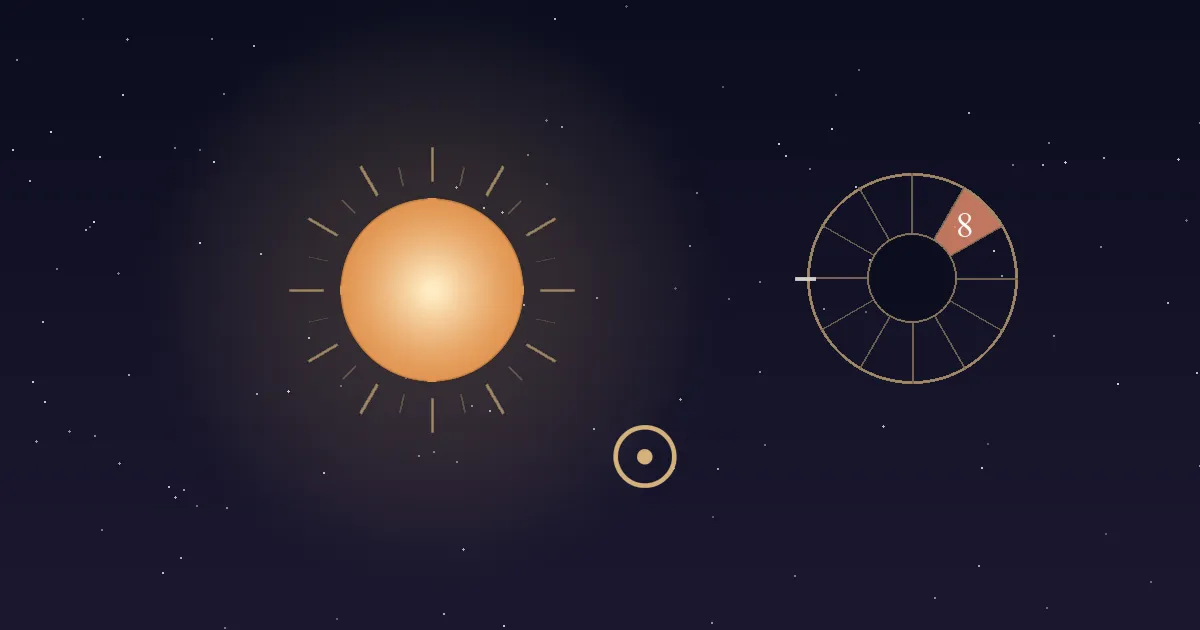
Search this placement and the questions under it get dark quickly. Will my father die young? Does it mean a short life? Why does everything in my life end in a crisis? The Western pages answer with transformation and depth, the Vedic ones state the father risk as a fact, and almost nobody says where the fear came from or how many conditions are attached to it.
One Roman text, Firmicus's Mathesis, does predict a father's early death for this placement, in a single sentence. Ptolemy softens it to injury or illness, and the Vedic father rules add conditions. What an 8th-house Sun tells you for certain, in Placidus houses, is roughly what time of the afternoon you were born.
Quick answer
In Placidus houses, the Sun in the 8th means a birth in the middle third of the afternoon, between solar noon and sunset. Modern astrology reads it as an identity built in private: shared money, intimacy and crisis. One Roman text ties it to a father's early death. The other sources add conditions, and none can forecast a death.
| House type | Succedent, in the day half of the chart (the Sun is above the horizon) |
| Time of birth | Placidus: about 2 to 4 p.m. sun time at the equinoxes; most U.S. births between 2:27 and 5:24 p.m. by the clock |
| Old reputation | A hard place. Firmicus: no planet rejoices here except the Moon, and only at night |
| The father line | Firmicus says "early"; Ptolemy and the Vedic texts attach conditions |
| Vedic view | A dusthana (difficult house); the texts split on long life |
| U.S. births, 2024 | About 9.5% in our model of 2024 CDC birth data |
| House check | A Placidus 8th is whole-sign 8th for 45.9% of U.S. births and whole-sign 9th for 47.5% |
The Sun moves through a house in about two hours of the day, so the house depends on your birth time. Half of U.S. births fall within 30 minutes of a change in the Sun's house. If the father verses below worry you, make sure the 8th is really yours first.
Make sure your Sun is really in the 8th →Does the Sun in the 8th house mean losing your father early?
The bluntest version of the fear is Roman. Firmicus Maternus wrote his Mathesis around 335 CE, and in the chapter on the Sun (III.5, section 29 in Jean Rhys Bram's 1975 translation, p.92) he says it plainly: "The father will die early if the Sun is in the eighth house." That's the whole sentence. He gives no day or night condition for it, which he does for some other houses.
The lines after it turn to the native. Mars or Saturn joining or opposing the Sun in this house makes the natives "hostile, raving, delirious, or suffering from stomach disorders," and Firmicus then adds: "All these afflictions have the possibility of cure if Jupiter and Venus are in any aspect." That cure clause covers the native's illnesses. It doesn't take back the sentence about the father.
Ptolemy is more careful. In Tetrabiblos III.4 (Robbins' Loeb translation, pp.243–245) the Sun signifies the father, and trouble needs Mars or Saturn afflicting it. Even then, when the afflicting planet sits on the setting side of the chart, in the 7th or the 8th, the father is "liable to injury or disease." Ptolemy keeps "short-lived" for a malefic at the rising or culminating angle or the house after it. Ptolemy wrote about two centuries before Firmicus, and his rule never ties an early death to the 8th.
The Vedic side is where most of the father pages come from, and it's stricter about conditions than they suggest. The Brihat Parashara Hora Shastra has a run of combinations for the father's death inside its chapter on the 9th house (20.13–25 in Santhanam's translation). Every rule there that mentions an 8th-house Sun also needs a second factor, like the lord of the 8th placed in the 9th. None of them uses the Sun in the 8th on its own.
The short-life verses, side by side
The second fear, a short life for the native, has two Indian sources and one notable dissent. Mantreswara's Phaladeepika (VIII.3, Sastri's translation, p.84) says the person "will lose his wealth, and friends; he will not be long-lived and will have defective eye-sight." An English translation of Saravali (30.9) is close: "deformed eyes," no wealth or happiness, "short-lived," and separation from relatives.
Varahamihira's Brihat Jataka, older than both, says something narrower. For the Sun in the 8th it gives "only a limited number of issues" (children) and "defective eye sight." No short life. The eyesight line shows up in all three, the lifespan line in two.
The Vedic texts don't even agree on whether a hard planet hurts or helps this house. An old rule credited to Satyacharya, repeated in Brihat Jataka and Phaladeepika, says malefics damage the house they sit in except in the 6th, 8th and 12th, where it works the other way. The Parashara text counts the Sun among the malefics. Read together, a Sun in the 8th would weaken the house of death, which is the opposite of the fear. Other commentators reject the reversal, so there's no single Vedic verdict to quote.
Alan Leo, the astrologer who shaped much of 20th-century Western practice, split the difference in How to Judge a Nativity (1928 printing, p.198). The middle of life "will be critical," he wrote, and only "if malefics afflict" is there "danger of violent or sudden death." Then: "If well aspected, the life is prolonged and vitality increased." The question of a violent or sudden death has its own history with a different planet, and Mars in the 8th house takes that one on.
Born in the middle of the afternoon
Here's the part the texts never mention. In Placidus houses, the system most Western apps use, the Sun's house is a clock. The day from sunrise to sunset is cut into six equal parts, and so is the night. The 12th, 11th and 10th are the three morning sixths, the 9th starts at solar noon, and the 8th is the middle third of the afternoon. At the equinoxes that's about 2 to 4 p.m. by a sundial, at any latitude. In June the day houses stretch (at 40°N each lasts about two and a half hours) and in December they shrink.
Clocks run ahead of the Sun for most Americans, so we modelled real birth times. We simulated 400,000 births from the 2024 birth-time data in the CDC's public natality file (time of day by month, weekday and type of delivery), placed them by state birth totals and county population because the file has no birthplace, and found each Sun's Placidus house with Swiss Ephemeris. In that model 9.5% of U.S. babies had the Sun in the 8th, more than the 8.3% an even spread would give. The middle 80% of them were born between 2:27 and 5:24 p.m. by the clock, with a median of 4:01 p.m. Daylight time is why the window sits later than the sundial says.
Two things push the 8th above average. Long summer days: 11.1% of June and July births had an 8th-house Sun, against 7.8% in December and January. And induced labor. The CDC's own report on birth timing, using 2013 births, found induced vaginal births peak at 3 p.m., and in our 2024 model 11.1% of induced vaginal births had the Sun in the 8th, the highest share of any house for that group.
That also corrects a line you'll see on some astrology sites, that the Sun is "strongest around 3 p.m." because the 9th is its joy. At 3 p.m. sun time the Sun has usually left the 9th already. It's in the 8th, or already in the 7th on a short winter afternoon in the north. The 9th begins at solar noon, and the 9th-house page shows where the 3 p.m. idea went wrong.
The old rules for this house turn on natal Mars, Saturn, Jupiter and Venus. Transits are a separate question, and a free account lists today's aspects to your natal planets.
See today's aspects to your natal planets →What modern astrologers read in an 8th-house Sun
Strip away the death verses and the modern reading is about sharing. The 8th covers what you hold jointly with other people: a partner's income, debt, taxes, inheritance, insurance, and the trust that sex and money both need. Stephen Arroyo's general rule for the Sun (Chart Interpretation Handbook, 1989, p.125) is that "whatever house the SUN is in, it is there that one most immediately experiences one's essential self." For the 8th, the self shows up in decisions about shared money, sex and trust. Tradition put a partner's money and inheritance in this house, and Venus in the 8th house weighs that older reading against the modern focus on sex.
That's why the work readings lean toward finance, research, psychology, investigation and anything that deals with other people's money or secrets. It's also why the placement gets called intense. The intensity is mostly focus. A person who builds their identity in this house tends to go deep on a few things and a few people, and gets impatient with small talk. In a relationship that usually means slow trust and close attention to joint money: who pays, who owns, who decides. Leo's book adds an old money line too: if the Sun is well aspected here, "there may be money inherited" from the father, or from a husband in a woman's chart.
The house shares its themes with Scorpio, its partner in the natural zodiac, but a house isn't a sign. A Gemini Sun in the 8th is still a Gemini: curious, talkative, quick. It just does its talking about things most people avoid, the part of life our houses guide sums up as what you can't control on your own.
The father as an experience, not a forecast
The modern writer who comes closest to the old fear is Arroyo, and he moves it from death to distance. In Astrology, Karma & Transformation (2nd ed., 1992, p.136) he writes that the Sun's natal position in the eighth house "very often" shows "a separation from the father that leaves deep psychological scars." In the lines after, he says the separation may be physical, or psychological, with a father who was there but "very distant and aloof from the child." That's an observation from his practice, not a rule, and it's a heavy one to read about yourself.
Robert Hand gives the frame that makes it usable. In Horoscope Symbols (1981, chapter 4) he writes that the Sun "represents the experience of being fathered, not the objective truth about one's father." That includes everyone who played the role. Hand counts anyone who did the fathering, a stepfather or a teacher included. That widens who the Sun describes. It doesn't make Arroyo's separation fit everyone, and plenty of people with this placement had a close, steady father. The traditional authors agree with Hand on one point: the Sun stands for the father in every chart, whatever its house.
Five rated charts, all born in the afternoon
We took people with birth times rated AA (from a birth record) or A (from the person or family) at Astro-Databank and computed their houses with Swiss Ephemeris. Each of these Suns stays in the Placidus 8th even if the recorded time is off by 40 minutes or more.
Matt Damon (AA, birth certificate) was born at 3:22 p.m. in Boston, with the Sun at 15° Libra. Coco Chanel (AA) was born at 4 p.m. in Saumur, Sun at 26° Leo. Prince Harry (A) was born at 4:20 p.m., the time printed in the Court Circular. John F. Kennedy (A, 3 p.m. from his mother) and Stevie Wonder (A, 4:15 p.m.) complete the list.
Every one of them was born between 3 and 4:20 in the afternoon, which is the clock at work. And four of the five, Damon, Chanel, Harry and Kennedy, have the Sun in the 9th house on a whole-sign chart. Only Stevie Wonder's Sun is 8th in both systems.
Whole-sign 9th, Placidus 8th: checking your own
That split is common. In our model of 2024 U.S. births, a Placidus 8th-house Sun was a whole-sign 8th 45.9% of the time and a whole-sign 9th 47.5% of the time. In whole-sign houses, which most Vedic and Hellenistic astrologers use, the whole rising sign is the 1st house and every later sign is the next house, so the Sun's house depends only on its sign and the rising sign, which the Sun, Moon and rising calculator gives you from a birth time and place. The old authors quoted above counted houses this way, by whole signs, so their "8th" is the eighth sign from the rising sign.
This matters for the father fear in particular. A Vedic reading is also sidereal, about 24 degrees back from the Western zodiac, so a sidereal "Sun in the 8th" and a Western Placidus one may not be the same chart at all. If a reading frightened you, check which system it used before you check anything else. The houses on either side tell different stories too: a 7th-house Sun is a late-afternoon birth read through partnership, and its page traces the late-marriage rule back to Ptolemy.
Other planets in the 8th, for comparison
Firmicus has a line on the house itself (II.19): "no planet rejoices in this house except the Moon, and then only in nocturnal charts." So the old tradition gave the 8th one friend, the Moon by night, and the Moon in the 8th house follows that idea back to Valens. Saturn here carries an early-death worry of its own, from different verses, and Saturn in the 8th traces them.
Transit note, October 2026
The Sun entered Libra on September 22, 2026 and moves into Scorpio on October 23, 2026 (US Eastern dates). In whole-sign houses that stretch puts the transiting Sun in the 8th house for Pisces risings. From October 23, 2026 until November 22, 2026 it is the turn of Aries risings. Every rising sign gets about a month of the Sun in its 8th house once a year, so this is a yearly season, not the birth placement this page is about. That one depends on the time of day you were born.
When someone's Sun falls in your 8th house
The other person's Sun landing in your 8th house is one of the most searched synastry overlays. Astrologers read it as a relationship that goes deep fast: the Sun person lights up the part of your life you keep private, which can feel like being seen clearly or like being exposed. Money and intimacy tend to come up early, and so do questions of control.
It's an overlay, not a verdict on the relationship. Placing their Sun in your houses needs your birth time and place plus their birth date; their exact time matters only if their Sun sits near one of your house cusps.
You and them
Start with what two birth dates can show without a birth time: your Sun, Mercury, Venus and Mars signs side by side, free.
Compare your two birth dates →FAQ
Does the Sun in the 8th house mean your father will die young?
No chart placement can tell you that. The plainest statement of it is Roman: Firmicus Maternus wrote that the father 'will die early if the Sun is in the eighth house.' In Ptolemy's rule for a Sun afflicted by Mars or Saturn from the setting angle or the house after it, the 8th, the stated outcome is injury or disease to the father, not death. Every rule in the Parashara text's verses on the father's death needs a second condition on top of the 8th-house Sun. In our model about 9.5% of U.S. babies born in 2024 had the Sun in this house, and a father's health depends on his own life, not on the hour his child was born.
Does the Sun in the 8th house mean a short life?
Two Indian texts say so (Phaladeepika VIII.3 and an English translation of Saravali, 30.9). The oldest of them, Varahamihira's Brihat Jataka, doesn't: for the Sun in the 8th it gives fewer children and weak eyesight, and nothing about lifespan. The 1928 printing of Alan Leo's How to Judge a Nativity even says a well-aspected Sun here prolongs life. The texts disagree with each other, and none of them is medical evidence. How long you live is a question for doctors and your own health record.
Why do people with the Sun in the 8th house keep so much private?
Modern astrologers tie the 8th to what is shared behind closed doors: joint money, debt, sex, inheritance and the things people only talk about when they trust you. Someone whose sense of self is built in that territory tends to show it to a few people, not to a crowd. It's a habit of trust, and it reads as secrecy from the outside. The traditional view adds that the 8th was never a house of public display.
Why does life feel like one crisis after another with the Sun in the 8th house?
That's how many people with the placement describe it on astrology forums, and the modern reading explains why it gets said: the 8th is the house of endings, debts and other people's resources, so the Sun's story plays out through turning points more than through steady growth. It doesn't predict a crisis-filled life. It describes where you tend to notice change, and how much you learn from it.