Birth Chart
Sun in the 9th House: Why the Old Astrologers Called It the Sun's Joy
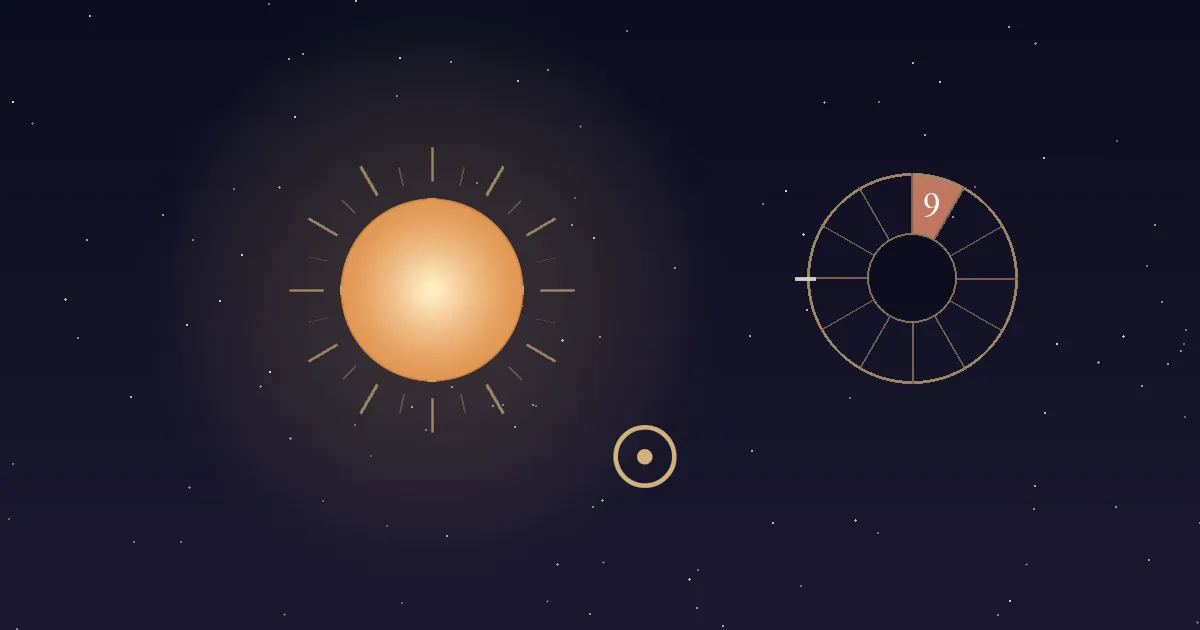
Astrologers tie a 9th-house Sun to belief, study, travel and the father, and the old name for the placement is the Sun's "joy". A popular explanation online goes further and says the Sun is strongest in this house around 3 p.m. It isn't, and the reason it isn't tells you a lot about what the placement actually is.
In Placidus houses, the ones most apps use, a 9th-house Sun is an early-afternoon birth. The Sun had just passed the highest point of its day and started down the western side of the sky. The old texts also gave this house to the Sun ahead of the obvious candidate, the 10th, and they flatly disagree about what it means for the father.
Quick answer
In Placidus houses, the Sun in the 9th means you were born in roughly the first two hours after local solar noon, as the Sun began its afternoon descent. Hellenistic astrologers called the 9th the Sun's joy, the "house of the Sun God". Readings stress belief, study, travel and the father, and the old texts disagree about the father.
| When you were born | About the first two hours after solar noon in Placidus houses (longer in summer, shorter in winter) |
| U.S. births, 2024 | About 10%, most between 12:45 and 3:05 p.m. by the clock (our estimate) |
| House type | Cadent, just past the Midheaven |
| Traditional status | The Sun's joy: Firmicus's "house of the Sun God" |
| Vedic note | Phaladeepika makes the Sun a significator of the 9th; Parashara gives it to Jupiter |
| The disagreement | The father "will be fortunate" (Firmicus) or the native "will lose his father" (Phaladeepika) |
The 9th begins at the Midheaven, the point the Sun crosses at solar noon. Born within a few minutes of noon and your Sun can sit on either side of that line, so a time rounded to the hour can put it in the wrong house.
See which side of the Midheaven your Sun landed →Why the 9th, and not the 10th, is the Sun's joy
The idea is old and well attested. Firmicus Maternus, writing in the 4th century, calls the ninth "the house of the Sun God" and says "it also has to do with religion and foreign travel" (Mathesis II.19, Bram's translation, p.50). Vettius Valens titles a chapter of his Anthology "The IX Place of the God Sun, just before MC" (Riley's translation, Book II, p.28). The opposite house, the 3rd, was "Goddess", the Moon's joy, and what that joy means for a 3rd-house Moon is the other half of the pair.
So why not the 10th, where the Sun stands at noon? The astrologer and historian Chris Brennan worked through this in a 2013 paper on the planetary joys (ISAR Journal 42.1). His answer is that the joys form a pattern. Houses follow the sky's daily turn, and the day planets' joys run "from the Ascendant up to the 9th house": Saturn in the 12th, Jupiter in the 11th, and last the Sun, "the very embodiment of day itself" (Brennan credits Benjamin Dykes with spotting that progression). From the 9th the Sun sits in a sextile to Jupiter's joy and a square to Saturn's, the benefic and the malefic of its own day team. The Moon does the same with Venus and Mars from the 3rd. Put the Sun in the 10th and, as Brennan puts it, "the Sun would not be configured to Jupiter," the two would be "in aversion to each other." The joy is about fit, not about the Sun being at full power.
Power is a different doctrine, and it points somewhere else. In Indian astrology the Sun's directional strength, dig bala, peaks at the Midheaven, where the 10th begins, and falls to nothing at the opposite point, the start of the 4th. So "is the 9th the best house for the Sun?" has two honest answers depending on which tradition you ask, and the strength answer belongs to the 10th, where the Sun peaks at noon.
The "strongest at 3 PM" myth, and what the clock really says
Placidus houses split the Sun's day into six equal parts and its night into six more. The 10th, 11th and 12th share the morning, and the 9th, 8th and 7th share the afternoon, with the 9th first. It starts at the exact moment of local solar noon, when the Sun is highest, and at the equinoxes it lasts two hours: noon to about 2 p.m. by the Sun. In June at 40 degrees north it stretches to about 2:30; in December it shrinks to about 1:30. At 3 p.m. by the Sun, the Sun is in the mid-afternoon 8th, or in winter at higher latitudes already in the 7th. At 40 degrees north the Sun has left the 9th by 3 p.m. on the sundial in every season. Only far north in midsummer does it linger: at 60 degrees north around the June solstice, the 9th runs until about 3:05.
The clock muddies this, which is probably how the 3 p.m. idea got started. Daylight time and time zones push solar noon away from 12 o'clock: in New York it fell at 12:57 p.m. by the clock on June 21, 2026, and at 11:54 a.m. on December 21. To see where real births land, we simulated 400,000 births from the time-of-day patterns in the CDC's 2024 natality data, placed them by state birth totals and county population (the public file has no birthplaces) and worked out each Sun's Placidus house. In that model about 10% of U.S. births (10.3%) have a 9th-house Sun, most of them between 12:45 and 3:05 p.m. by the clock. So a clock reading of 3 p.m. can, now and then, be a 9th-house Sun. At most latitudes a sundial reading of 3 p.m. can't.
Two more things show up in the model. Afternoon is when induced labor tends to deliver: 10.7% of induced vaginal births had a 9th-house Sun, against one in twelve (8.3%) for an even split across the houses. And 9th-house babies were among the least likely to arrive on a weekend, 18.6% against 21.4% of all births. Neither fact says anything about character. They just mean a 9th-house Sun is a weekday sort of birth time.
Is a 9th-house Sun good or bad for the father?
This is where the 9th earns its reputation for worry, because it carries the father theme twice. The Sun stands for the father in both traditions: Ptolemy writes that "the sun and Saturn are by nature associated with the person of the father" (Tetrabiblos III.4), and Valens's list of house names gives the 9th as "The God" and pairs it with the father. Vedic astrology also makes the 9th the father's house. So a 9th-house Sun is a double signature, and the old texts can't agree on what it promises.
Firmicus is generous: "The father will be fortunate, but both the native and his father will have many changes in life" (Mathesis III.5, p.93). Mantreswara's Phaladeepika says the opposite in one line: with the Sun in the 9th the native "will lose his father; he will have children and relations and will revere Gods and Brahmins" (VIII.4, Sastri, p.84). The Saravali sits in between, saying the native will "not be well-disposed towards his father". Varahamihira's Brihat Jataka gives children, wealth and happiness and doesn't mention the father at all, though its translator notes that "according to some astrologers the Sun is bad in the 9th house."
One correction to something you'll see on Vedic sites: the claim that Parashara makes the Sun the significator of the 9th. He doesn't. His list gives the 9th to Jupiter and the Sun only the 1st; the Sun-as-9th-house-significator idea comes from the Phaladeepika (XV.17), which gives the 9th to "the Sun and Jupiter".
The modern reading is gentler and more useful. It treats the Sun as your experience of a father rather than a forecast about him, and in the 9th that usually means a father who stood for an idea: a faith, a profession, a set of rules about how to live, or an absence that left a question you've been answering since. When it goes well, that looks like a father you love arguing with about ideas. It gets harder when disagreeing with him starts to feel like disloyalty.
Once a year the transiting Sun crosses your 9th house, the stretch astrologers like for travel, study and big decisions. A free account shows today's transit aspects to your natal planets.
Follow today's transits to your chart →Faith, travel and teaching: the part every source agrees on
On religion the texts are unanimous, and specific. Firmicus's 9th-house native makes "images of the gods," designs temples or writes hymns, and "gain[s] fame and honor from this activity," and if a benefic sits in the place after the Midheaven, "the good fortune will be derived from journeys." The Indian texts have the native revering gods and Brahmins. In the 1928 printing of How to Judge a Nativity, Alan Leo describes "a very austere mind, firm and self-reliant, inclined to investigate scientific subjects with an unbiassed and clear judgment," and adds "success abroad, or residence in foreign countries" (p.204).
Leo also names the downside: "if orthodox or conventional, the position shows some tendency to become bigoted in religious belief, also to become proud and over confident." That's the shadow of the placement in one sentence. A Sun that identifies with what it believes can mistake its beliefs for itself, and arguing with the idea starts to feel like an attack on the person.
Today the 9th covers higher education, publishing, law, long journeys and anything foreign, and the 9th-house Sun usually gets read as the teacher, the perpetual student or the person who moved countries. The faith part doesn't have to be religious. It's whatever you'd defend in an argument at 1 a.m. Our houses guide sets it against the 3rd, the local house to the 9th's global one. Saturn's 9th, and the fear of losing a faith, is the heavier version of the same theme; Jupiter in the 9th, the big-picture optimist, is the expansive one. Many modern astrologers also pair each house with a sign in what they call the natural zodiac, which matches the 9th with Sagittarius, the ninth sign. That convention is why so many readings of this placement sound a little Sagittarian whatever the Sun's actual sign.
At work and in love
At work a 9th-house Sun tends to want a reason bigger than the job: teaching, research, law, publishing, travel, or any role where you explain how things fit together. The risk is restlessness once the work stops meaning anything, and a habit of lecturing the people around you. In love it usually wants someone to argue ideas with, travel with or learn alongside, and it can chafe in a relationship that feels small. The Sun's sign changes the tone a lot. In Taurus this placement wants its beliefs to be practical; in Gemini it wants to collect them.
Five 9th-house Suns on verified birth times
We only use people whose birth times Astro-Databank rates AA (a birth certificate or record) or A (from the person or family), and we calculated the Placidus houses ourselves. These are placements, not explanations.
- Venus Williams (AA), born 2:12 p.m., June 17, 1980, Lynwood, California: Sun at 26°48′ Gemini, well inside the 9th.
- Uma Thurman (AA), born 1:51 p.m., April 29, 1970, Boston: Sun at 8°59′ Taurus in the 9th.
- Robert Downey Jr. (A), born 1:10 p.m., April 4, 1965, Manhattan: Sun at 14°45′ Aries in the 9th.
- Brigitte Bardot (AA, from the Paris register), born 1:15 p.m., September 28, 1934: Sun at 4°41′ Libra in the Placidus 9th, but the 11th on a whole-sign chart, a good example of how far the two systems can drift.
- Jennifer Lawrence (AA), whose case is worth a paragraph of its own.
Lawrence was born at 3:20 p.m. by the clock on August 15, 1990, in Louisville, Kentucky, a time Astro-Databank takes from her birth certificate. That looks like a 3 p.m. Sun, until you check the sky. Louisville sits far to the west of its time zone's meridian and was on daylight time, so the clock ran about an hour and three-quarters ahead of the Sun. By sundial it was about half past one, and her Sun is at 22°42′ Leo in the 9th. An older time that still circulates online, 8:17 p.m., would have put the same Sun in the 7th. Same person, same day, a different house, which is the whole case for checking where a birth time came from.
When the 9th and the 10th blur together
A Sun near the Midheaven is the most common source of 9th-or-10th confusion. On a Placidus chart the dividing line is solar noon itself, so a Sun one degree into the 9th means a birth a few minutes after noon. Many astrologers read a planet within a couple of degrees of the Midheaven as working like a 10th-house planet, and that habit is reasonable. Rounding is the other trap. In New York on June 21, 2026, solar noon fell at 12:57 p.m. by the clock, so a birth written down as "1 p.m." could really have been 12:50, a 10th-house Sun, or 1:10, a 9th.
Whole-sign houses move the line again. There the 9th is the ninth sign from the rising sign, so it changes when a new sign rises, not at noon. For a New York birth on March 25, 2026, our calculation gives a whole-sign 9th from 1:38 to 4:10 p.m. by the clock and a Placidus 9th from 1:01 to 3:04 p.m. A birth at 1:15 that day is 9th in one system and 10th in the other. If one app says 9th and another says 10th, that's why. This is also where the two systems agree least: in our model, Placidus and whole-sign houses gave a 9th-house Sun the same house only 44% of the time, the lowest of the twelve.
A friend or partner with their Sun in your 9th
In chart comparison, the reading flips around: it's about where another person's Sun lands among your houses. Someone whose Sun falls in your 9th tends to be read as a teacher figure for you, a person who widens your view, argues you into new ideas or takes you somewhere you wouldn't have gone alone. The risk is a lecturing tone, the sense that one of you is always the student. Before reading much into it, look at where their Moon and Venus land in your chart as well. The synastry guide starts with five aspect contacts and only then turns to houses.
The Sun's yearly pass through the 9th
Apart from where it sat at your birth, the Sun moves through every house of your chart once a year. Its month in the 9th is the one astrologers suggest for a trip, a course or a decision you've been putting off.
Transit note, October 2026
The Sun entered Libra on September 22, 2026 and moves into Scorpio on October 23, 2026 (US Eastern dates). In whole-sign houses that stretch puts the transiting Sun in the 9th house for Aquarius risings. From October 23, 2026 until November 22, 2026 it is the turn of Pisces risings. Every rising sign gets about a month of the Sun in its 9th house once a year, so this is a yearly season, not the birth placement this page is about. That one depends on the time of day you were born.
Start with the big three
The Sun's house only makes sense next to your rising sign, and both come from the same three facts: birth date, time and place. The free Sun, Moon and rising calculator works out the Sun, Moon and rising from those.
Find your rising sign and Moon →Keep reading
- · The love planet in the same house, and the old idea that it means marrying someone from abroad: Venus in the 9th house.
- · Why Gauquelin's champions crowded into this house rather than the 10th: Mars in the 9th house.
FAQ
Why is the 9th house, not the 10th, called the Sun's joy?
Because the joys were a pattern, not a strength ranking. The scheme set the day planets' joys above the horizon in order, Saturn in the 12th, Jupiter in the 11th and the Sun last, in the 9th, where it sits in a sextile to Jupiter's joy and a square to Saturn's. Chris Brennan's 2013 paper on the joys points out that a Sun in the 10th would lose that link to Jupiter. Strength in the Vedic sense is a separate idea: there the Sun's directional strength peaks at the Midheaven, where the 10th begins.
My Sun is at the very end of the 9th house. Should I read it as the 10th?
Many astrologers would, if it's within two or three degrees of the Midheaven, though that's a working habit rather than a rule from the old texts. Check the birth time first. On a Placidus chart the 10th/9th line is the moment of local solar noon, so a Sun a degree from it means a birth a few minutes either side of noon, and a time rounded to the hour can put it on the wrong side.
Can you have the Sun in the 9th house and not be religious?
Easily. Every source we read ties the 9th to religion, and the Hellenistic name for it was simply 'God', but the house describes the questions you keep returning to, not a creed. In practice a 9th-house Sun shows up as strong opinions about what's true, a pull toward teaching or study, or a habit of measuring your life against big principles. Plenty of people with it are atheists who argue about meaning more than the believers do.