Birth Chart
Sun in the 10th House: The Noon Birth, Vedic Dig Bala and the Fame Question
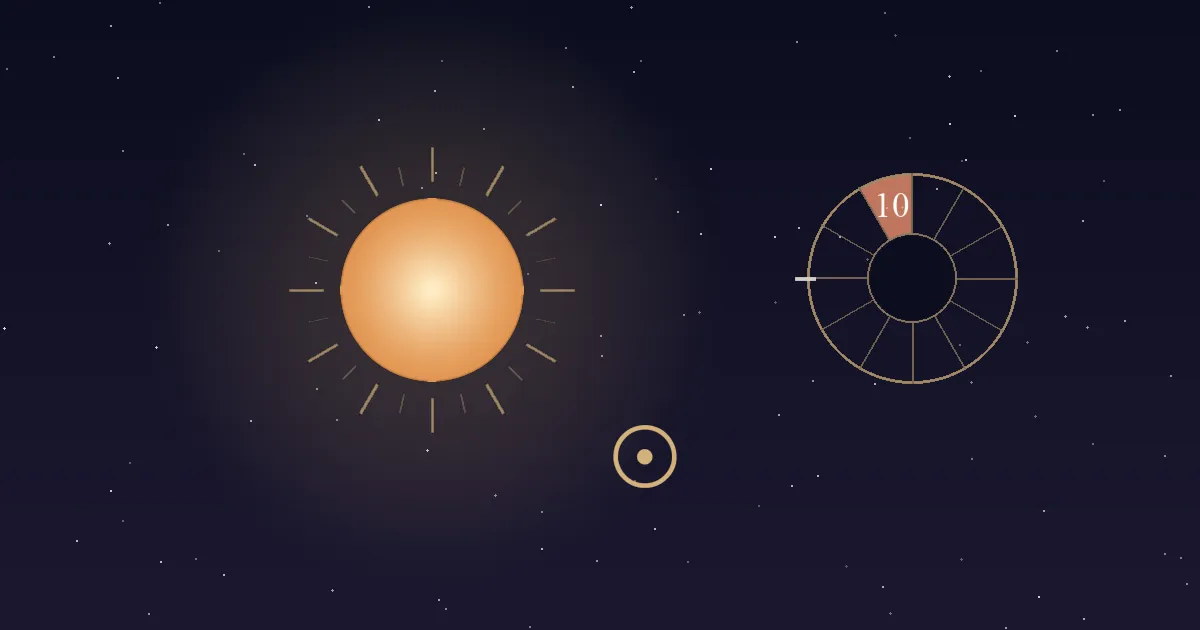
In Placidus houses, the Sun in the 10th is the Sun near the top of the sky. You were born in the late morning, in the last stretch before solar noon, when the Sun climbs to the Midheaven, the highest point of the chart. Astrologers tie it to ambition, a feel for authority, a dislike of taking orders and the wish to be known for your work.
Vedic astrology really does give the Sun its full directional strength here, and the old Latin texts talk about rank and honors. But the same texts attach conditions the modern pages leave out, one of the best-known "stuck career" lines turns out to be a translator's note, and the research on famous people's charts never found a Sun effect at all.
Quick answer
In Placidus houses, a 10th-house Sun means a late-morning birth, as the Sun neared its highest point. It's read as a self defined by work and public role: you want to make something visible of your life. Vedic astrology calls it the Sun's strongest direction. It points to ambition, not a guarantee of fame.
| Arena | The Midheaven: career, reputation, authority, public standing |
| House type | Angular, and the most important angle in the Latin tradition |
| Vedic strength | Dig bala (directional strength): full on the Midheaven, nil on the IC |
| Time of day | The last third of the morning, ending at solar noon (Placidus) |
| U.S. births, 2024 | About 10.5% in our model, most between 10:55 a.m. and 12:55 p.m. by the clock (estimated from CDC birth-time data) |
| Father theme | The Sun signifies the father in both traditions; Firmicus ties this house to inherited position |
A chart made without a birth time often defaults to noon, which drops the Sun into the 10th or 9th by default. Before you read this as your placement, check it with your real birth time and place.
Confirm your Sun's house with a real birth time →Born in the last stretch before noon
The Sun crosses the houses backwards through the day: from the Ascendant at sunrise, up through the 12th and 11th, into the 10th, and over the Midheaven at solar noon, when it enters the 9th. In Placidus houses the Sun's house is exactly which sixth of the day or night you were born in, and the 10th is the third sixth of daylight, the last third of the morning. We checked that rule against Swiss Ephemeris house cusps on 200,000 random charts, and it held on every one.
The CDC's 2024 natality data records the clock hour of each U.S. birth but not where it happened, so we simulated 400,000 births from those hours, placed them by state and county population, and computed the Sun's Placidus house for each. Our estimate is 10.5% for the 10th, against 8.3% if births were spread evenly through the day. The 10th and the 11th come out level at the top of the model, because hospitals deliver a lot of babies in the morning. The middle 80% of 10th-house births happened between 10:55 a.m. and 12:55 p.m. by the clock.
The season matters too. Long summer days stretch the morning houses, so 12.7% of U.S. births in June and July had a 10th-house Sun, against 8.3% in December and January. And clock noon isn't solar noon. Of babies born in the 12 o'clock hour, 71% had the Sun in the 10th and 29% in the 9th, mostly because daylight saving pushes the Sun's real noon past 12:00 on the clock. The moment the Sun crosses the top it moves into the 9th, the house the Greeks counted as the Sun's joy.
Dig bala: why Vedic astrology calls this the Sun's strongest house
In Vedic astrology each planet has a direction where it gains full strength, called dig bala. For the Sun it's the south, which on a chart means the top. The Brihat Parashara Hora Shastra (3.35–38) says "The Sun and Mars are so [strong] in the south," and the translator's note in R. Santhanam's translation spells it out: "The Sun and Mars acquire this strength in the 10th house." Brihat Jataka (II.19) agrees: "The Sun and Mars are powerful in the South or 10th house."
There's a detail the summaries miss. The strength is graded by degree. BPHS 27.7 measures it from the bottom of the chart: in Santhanam's words, the strength is "full on the cusp of the respective house and nil on the cusp of the opposite house." So the Sun gets its full score exactly on the Midheaven and less the further it moves away, and a Sun just past the top, in the 9th, still keeps most of it. A 10th-house Sun near the 11th cusp has less than one sitting right on the Midheaven.
The Vedic effect lines match the reputation. Phaladeepika (VIII.4) promises "sons, vehicles, laudation, intelligence, wealth, strength and fame. He will be a King." Brihat Jataka (XX.3) is shorter: "happy and powerful." Set that emphasis on recognition beside the weight of responsibility read into Saturn in the 10th house, where the same angle becomes a rise-and-fall story.
"Maximum labour and minimum income": whose line is it?
If you have a 10th-house Sun and your career feels stuck, you may have read that the placement means hard work for little pay. That line exists, but it isn't Varahamihira's. It's a note by V. Subrahmanya Sastri, the 20th-century translator of Brihat Jataka, under XX.3 (p.381): "The Sun in the 10th house gives maximum labour and minimum income." He reasons that Varahamihira used the word for wealth for the 9th house and not for the 10th, and that the 10th squares the Ascendant.
The verse itself says "happy and powerful." So the most quoted negative reading is a commentator's inference about a word that's missing. It's a fair point to weigh, since status and salary aren't the same thing, but it's one translator's view.
Modern astrologers frame the 10th as effort more than reward anyway. Liz Greene, in Saturn: A New Look at an Old Devil (1976, p.95), groups the Sun in the 10th with other placements that share "the quality of self-determination. The individual must make something of his life and find his identity by the efforts of his own hands and brain." Robert Hand puts it more plainly in Horoscope Symbols (1981): "An active tenth house does not guarantee fame, but it does usually indicate that one is or tries to be in charge of one's destiny." A stuck stretch is consistent with that. The placement describes the drive, not the job market.
A free account shows today's transits as aspects to your natal planets, so a career question can start from what is active in the sky.
See today's transits to your birth chart →Kings, generals and an inherited position: what Firmicus really said
The Latin tradition is where the "born to rule" image comes from, and it comes with conditions. Firmicus Maternus writes in the fourth century (Mathesis III.5.34, Jean Rhys Bram's translation, p.93) that "the Sun in the tenth house, in his house or the house of Jupiter in a diurnal chart, or in his exaltation, makes kings, generals, governors, consuls or proconsuls", and that all of them "inherit their position from their father."
Read the conditions. The Sun has to be in its own sign, Leo, in one of Jupiter's signs (Sagittarius or Pisces), or in its exaltation, Aries, and Firmicus also requires a day chart. Even then the position is inherited. The next line (III.5.35) adds that these positions come "only after struggles, dangers, or ill-will if Mars is on any angle." A 10th-house Sun in Taurus or Libra doesn't qualify for the king line at all.
Firmicus also separates the Sun in the 10th house from the Sun exactly on the Midheaven. On the Midheaven, he says, the Sun "makes the parent of high rank and honorable," which brings in the father. Ptolemy (Tetrabiblos III.3) uses "the place of the sun for the question about the father," and Hand writes that "the tenth is a house of fathering, but this is not always related to one's biological father." A 10th-house Sun often comes with a strong sense of a parent's standing, as a model or as something to live up to.
Einstein, Ford and Pacino: born in the hour before noon
Every time below is rated AA at Astro-Databank (a birth certificate or record), and the Placidus houses are our own Swiss Ephemeris calculation. Each keeps the Sun in the 10th even if the recorded time is off by more than half an hour.
Albert Einstein was born at 11:30 a.m. local time on March 14, 1879 in Ulm, with the Sun at 23°30' Pisces in the Placidus 10th. In whole-sign houses his Sun is in the 9th, a good example of how the two systems split. Harrison Ford was born at 11:41 a.m. on July 13, 1942 in Chicago, with the Sun at 20°38' Cancer in the 10th in both systems. Al Pacino was born at 11:02 a.m. on April 25, 1940 in Manhattan, Sun at 5°17' Taurus in the 10th. Natalie Wood, the actress of West Side Story, was born at 11:16 a.m. on July 20, 1938 in San Francisco, Sun at 27°23' Cancer in the 10th.
All four were born in the hour before noon. Pacino's Taurus Sun falls outside Firmicus's sign conditions for the king line. Einstein's Pisces Sun, in one of Jupiter's signs on a daytime chart, meets them, though a whole-sign chart files it in the 9th. Nobody would call either career stuck. Eleanor Roosevelt (AA, 11:00 a.m. on October 11, 1884) adds a twist: her Sun is Placidus 10th but whole-sign 11th. These are examples, not evidence. We're not claiming the placement made anyone's career.
What the research found on fame and the Sun
The largest tests of birth position and eminence were Michel Gauquelin's, run on thousands of eminent European professionals from the 1950s on. He found small effects for the Moon, Venus, Mars, Jupiter and Saturn rising or culminating in the charts of eminent people, mostly just after the Ascendant and the Midheaven. As Geoffrey Dean's history of the work puts it, "There was no effect for the Sun." Gauquelin himself wrote in 1988 that he had found "no truth whatever behind" the "reported role of the 'houses.'"
There's also a practical reason the Sun is hard to test this way. Its house is the time of day, and births aren't spread evenly through the day, so any count of 10th-house Suns mostly measures when hospitals deliver babies. That's exactly what our own numbers show. None of this decides whether you find the reading meaningful. It does mean "most famous people have the Sun in the 10th" is not a finding. Jupiter in the 10th house runs into the same fame question from a different direction.
The 10th by Placidus and by whole sign
The two house systems draw the 10th differently. In Placidus, the 10th always starts at the Midheaven degree, so a morning Sun leaves the 10th at the moment it culminates. In whole-sign houses, the 10th is simply the tenth sign from your rising sign, and the Midheaven can fall in the 9th, 10th or 11th sign. Firmicus already knew this: he wrote that the Midheaven "is often found in exact conjunction" with the 11th, and he treated "the Sun in the tenth house" and "the Sun on the MC" as separate cases.
So Einstein's 10th-house Sun becomes a 9th-house Sun on a whole-sign chart, and Eleanor Roosevelt's becomes an 11th. In our model of 2024 U.S. births, the two systems agreed on the Sun's house only 47% of the time. Dig bala is measured from the Midheaven degree, which suits quadrant houses like Placidus better than whole signs. In Placidus the Midheaven is also the cusp of the 10th, which our houses guide calls the most public part of the chart. If a whole-sign chart moves yours to the 11th, read the friends house and the loner who has it.
Transit note, October 2026
The Sun entered Libra on September 22, 2026 and moves into Scorpio on October 23, 2026 (US Eastern dates). In whole-sign houses that stretch puts the transiting Sun in the 10th house for Capricorn risings. From October 23, 2026 until November 22, 2026 it is the turn of Aquarius risings. Every rising sign gets about a month of the Sun in its 10th house once a year, so this is a yearly season, not the birth placement this page is about. That one depends on the time of day you were born.
Relationships, and someone else's Sun in your 10th
In your own relationships, a 10th-house Sun usually wants a partner who respects the work, and the friction astrologers point to is time: a career that eats the evenings, or a partner who feels ranked below it. In synastry, another person's Sun in your 10th is a career overlay. They may feel like a mentor, a boss, a public partner, or the person who makes you think about your reputation. For the wider picture of how this placement sits beside your other planets, try reading a chart from the Big Three outward.
Start with the three placements that shape the rest: your Sun, Moon and rising sign, worked out in one step.
Look up your Sun, Moon and rising sign →Keep reading
- · Mars on the same angle is read as drive with friction, and Mars in the 10th house takes on the ambitious-but-stuck feeling directly.
- · When it's the Moon at the top of the chart, the career has to feel right, and the mother comes into it: Moon in the 10th house.
- · Capricorn rising puts the Sun in the whole-sign 10th every year from late September to late October, while it's in Libra.
FAQ
Which house is luckiest for the Sun: the 9th or the 10th?
It depends on which tradition you ask. Hellenistic astrology gives the Sun its 'joy' in the 9th, the house it calls God, partly because from there it makes a sextile to the 11th, where Jupiter, its fellow day planet, has its joy. Vedic astrology gives the Sun its full directional strength (dig bala) in the 10th, measured from the Midheaven. Both traditions treat the 8th and 12th as hard places; they split on the 6th, which the Vedic texts often rate well for the Sun. So the honest answer is that the 9th and 10th are both strong spots, for different reasons, and the sign and aspects matter more than the ranking.
Does the Sun in the 10th house mean you were born close to midday?
Close to it, but before it. In Placidus houses the Sun is in the 10th during the third sixth of daylight, the last third of the morning, ending at local solar noon when it crosses the top of the chart. On the clock that usually means late morning: in our model of 2024 U.S. births, babies with a 10th-house Sun mostly arrived between 10:55 a.m. and 12:55 p.m. Daylight saving shifts solar noon later on the clock, so a summer birth at 12:30 can still have the Sun in the 10th.
Why don't all famous people have the Sun in the 10th house?
Because fame isn't one placement. The 10th is about reputation and work in public, and astrologers look at the whole chart for prominence, not one house. The research doesn't single it out either: Michel Gauquelin, who tested birth charts of thousands of eminent professionals, found effects for the Moon, Venus, Mars, Jupiter and Saturn but none for the Sun. Plenty of well-known people were born at dawn, at dusk or at night.
Can a chart made without a birth time put my Sun in the 10th by mistake?
Yes, often. Many sites and apps fill a missing time with 12:00 noon. A noon chart puts the Sun at or near the top of the sky, so it lands in the 10th or the 9th almost every time. If you were told you have a 10th-house career Sun but never entered a birth time, the house is a default, not a reading. You need the real time, date and place for the Sun's house.