Birth Chart
Saturn in the 10th House: Lilly's Rise-and-Fall Line, and the Slow Climb It Really Describes
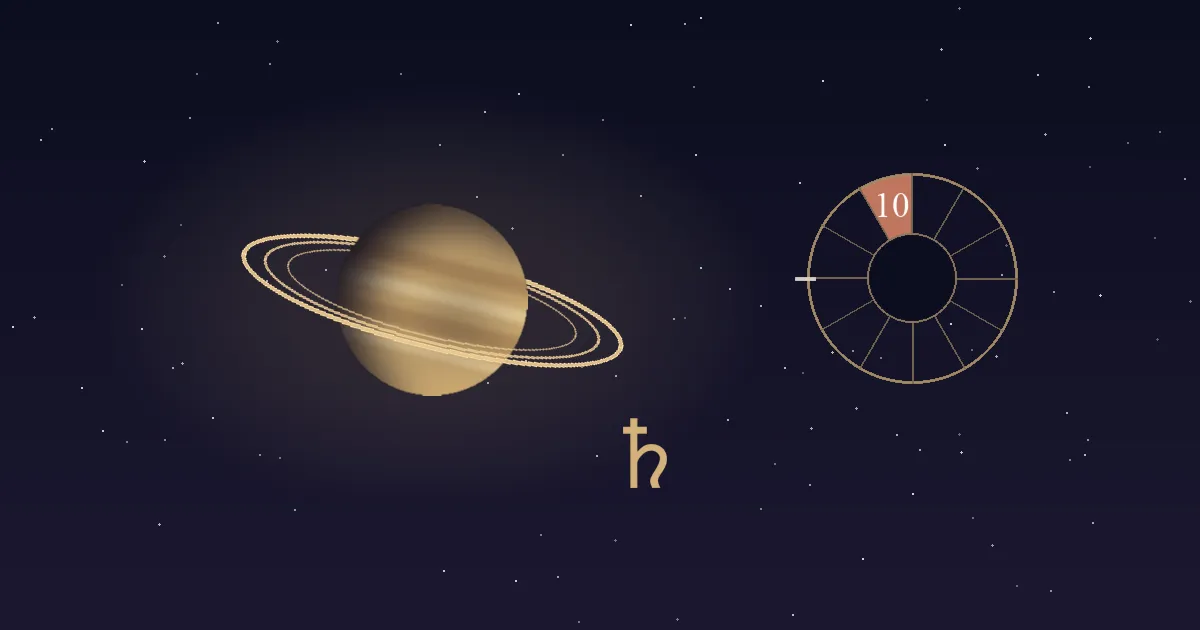
"I hate Saturn in 10th House" is the title of an AstrologyWeekly thread that's been collecting replies since 2011. Its author was young, full of plans, and kept coming "so close to certain goals, which ultimately fail." That's the worry this placement carries: a career that gets built, then comes apart. The famous rise and fall.
The bluntest version of the rise-and-fall line has an author, and it's worth reading him in full, because older authors read this placement as the mark of emperors.
Quick answer
Saturn in the 10th house puts Saturn at the top of the chart, in career, reputation and public role. Astrologers read it as a slow climb, a heavy sense of responsibility and a fear of public failure, with recognition that often feels hard won. The famous "rise then fall" warning is bluntest in one 17th-century author; later astrologers attach it to an afflicted Saturn, and some to ambition that cuts corners. It isn't a fixed fate.
| Where it sits | The Midheaven's house: career, status, the name you make in public |
| The warning | Lilly, 1647: Saturn here "calls him downe headlong" |
| The other verdicts | Firmicus: emperors and generals, with misfortune by night. Phaladeepika: "a king or his minister" |
| Vedic status | An upachaya house, one that improves with time |
| Day or night | In our simulation, retrograde here was a night birth in about 96% of charts |
| What it's good at | Institutions, long careers, rules, earned authority |
The 10th house starts at the Midheaven, and the Midheaven moves with the birth time fast enough that a Saturn a few degrees away can land in the 9th or the 10th. It isn't locked to your rising sign either, which is why this house trips up so many chart readers.
Check whether Saturn is past your Midheaven →Where the rise-and-fall warning comes from
William Lilly, Christian Astrology, Book III, in the chapter asking whether the native shall have dignity or preferment: "Saturn in the 10th, never suffers the Native to enjoy his Honours long, but calls him downe headlong, when it's least expected; and once dejected, the Native rises no more to Preferment." In Book I he's no gentler, saying Saturn in this house tends to "deny Honor, as to persons of quality, or but little esteem in the world to a vulgar person" (Lilly on the 10th house).
That's Lilly's version of the warning, and the bluntest one in print. The same book has a table of accidental fortitudes that gives any planet in the Midheaven +5, the highest score a house can earn. That score measures a planet's power to act, for better or worse, so it doesn't cancel the warning. It does show Lilly saw the 10th as a place of maximum strength, not a hidden or weak one. Older authors went further. Firmicus Maternus opens his 10th-house entry with "Emperors, generals, and praetorian prefects are the indication of Saturn in the tenth house, that is the MC." Mantreswara's Phaladeepika (VIII.24) says the native "will be a king or his minister, will devote himself to agriculture, will be brave, rich and renowned." Neither says a word about losing it.
So the tradition doesn't agree with itself. Liz Greene, in Saturn: A New Look at an Old Devil (1976, p.49), summed up what astrologers had made of it by her time: the placement "is generally considered to symbolise ambition, a slow climb to power with many setbacks and delays, and, if he is afflicted, a subsequent fall from power." Greene makes the fall conditional on an afflicted Saturn, meaning one badly placed by sign or under hard aspects. Some astrology sites go further and turn it into a moral warning: whoever climbs by dubious means is the one who gets pulled down. That condition isn't in Lilly's sentence. It's a later reading, and decent advice with or without a chart.
Is Saturn in the 10th house bad for your career?
Mostly it's slow, and slow feels bad when you're 26 and your friends are getting promoted. The replies in that AstrologyWeekly thread keep landing on the same answer: yes, it's a ton of work, and the disappointments along the way don't cancel out what gets built. Personal accounts, so they can't set a norm, but they describe the same shape: setbacks, rebuilds, and a career that climbs in steps.
Greene is blunt about why it tends to work out: "Professionally the person with Saturn in the tenth house is generally successful, largely because he tries so hard and is so persistent" (p.52). She's equally blunt about the cost (p.51): "An intense self-consciousness and great sensitivity to public opinion are common reflections of Saturn in the tenth house, as well as a fear of failure." Persistence is the part that pays. The fear of failure can cut either way: it keeps some people working and stops others from trying.
And late careers are more normal than they feel. When economists from MIT, Northwestern and the U.S. Census Bureau went through Census data on American business founders, they found that the mean founder age for the fastest-growing one-in-a-thousand new companies was 45.0. The 26-year-old genius founder is the exception that gets the magazine covers.
Saturn's symbolism fits work with formal training and clear responsibilities, the kind of field where the rules are written down: law, medicine, government, engineering, any trade with a real apprenticeship. Howard Sasportas, in The Twelve Houses (1985, pp.88–89), has a nice image for it: "The judge with Saturn in the 10th will more likely follow the letter of the law than the judge with Uranus there." The flip side, in the astrologers' reading, is a harder time in workplaces where the rules keep changing, and a habit of not delegating because nobody else will do it properly.
The app shows today's transits to your chart and dates your Saturn return, the stretch astrologers treat as the career audit.
Follow the transits to your chart →Why Firmicus reads a day birth and a night birth so differently
Firmicus split Saturn's verdicts by sect, and on the Midheaven the split is stark. By day, in the Mathesis (III.2, Bram's translation, pp.77–78), and with Saturn in its exaltation and the Sun on the Ascendant, he promises wealthy landowners and "large income, great glory, and inheritance from important persons." By night: "Saturn by night on the MC indicates misfortunes: loss of inheritance, no marriage, no children, especially if he is in the house or terms of a malefic planet." Then comes the sentence that's easy to miss: if Venus or Jupiter aspects that night Saturn favourably, "those things which were denied will be given in another way."
Day or night in the astrological sense means the Sun above or below the horizon: houses 7 to 12 for a day chart, 1 to 6 for a night chart. If you only have Saturn to hand, there's a shortcut. A retrograde Saturn sits roughly opposite the Sun, so if Saturn is retrograde at the top of the chart, the Sun is usually near the bottom. In our simulation of 240,000 charts (births from 1940 to 2010, between 25 and 55 degrees north, every clock time equally likely), a retrograde 10th-house Saturn went with a night birth 96.0% of the time. A direct 10th-house Saturn was the opposite: only about 18% were night births.
So an R next to a 10th-house Saturn points, in about 96 charts in 100, to a night birth and Firmicus's harder reading, with the Venus and Jupiter clause as his own way out. A direct Saturn points, in about four charts in five, to a day birth, which escapes that night sentence; his wealthy-farmer passage also needs Saturn exalted and the Sun on the Ascendant. Neither is a forecast about your job, your marriage or your children. But it's the kind of detail that explains why two people with "the same" placement get two very different horoscopes from traditional astrologers.
Three 10th-house careers: a fall, a rejection pile, a long wait
We only use people whose birth times Astro-Databank rates AA, from a birth certificate or record, and we worked out their Placidus houses ourselves. All three are 10th-house Saturns under whole-sign houses too. They're illustrations, not proof: an early champion, a late starter and a long wait for one award.
Muhammad Ali has Saturn at 21°40′ Taurus, 9.4 degrees inside the 10th. His career is the rise-and-fall story in real life, followed by the part Lilly didn't allow for: the return. He was world champion at 22. Stripped of his titles in 1967 for refusing the draft, he was kept out of the ring for about three and a half years. Then his Saturn return arrived. On March 8, 1971, at 29, he lost to Joe Frazier, his first professional defeat; transiting Saturn stood at 17°59′ Taurus, 3.7 degrees from his natal Saturn, inside his 10th. On June 28 that year the Supreme Court overturned his conviction 8 to 0, with transiting Saturn still in his 10th house. The loss and the vindication came in the same Saturn season.
Albert Einstein has Saturn at 4°11′ Aries in the 10th, from a birth record the Einstein Archive supplied. After graduating he spent almost two years applying for teaching posts and was offered none, so he took a job at the patent office in Bern. On February 28, 1908, at 28, the University of Bern granted him the right to teach there as a Privatdozent; that day transiting Saturn stood at 27°31′ Pisces, inside his natal 10th and closing on his natal Saturn. His great 1905 papers were written at the patent office, so the recognition came after the work, not before it.
Leonardo DiCaprio has Saturn at 18°48′ Cancer in the 10th. He was first nominated for an Oscar in 1994 and won Best Actor only in 2016, for The Revenant, after four earlier acting nominations, 22 years after the first. Al Pacino (AA) has the same house and a similar story: nominated from 1973, first win in 1993.
The one we didn't use is the one you might expect: Bill Clinton, whose career is the textbook rise, fall and recovery. There are three family-sourced accounts of his birth time, and two of them move Saturn out of the 10th into the 11th. A chart that depends on which relative you believe can't carry a claim.
Why the 10th gets called Saturn's own house
Greene opens her chapter on this placement with "The tenth house is Saturn's own" (p.46). She means it in the modern way: Capricorn is the tenth sign and Saturn rules it, so the 10th house and Capricorn, the sign Saturn rules, share a flavour of ambition, duty and long plans. That pairing is a modern convenience. Most ancient authors put Saturn's joy in the 12th house (Manilius, the odd one out, put it in the 4th), so the 10th as Saturn's home is not an ancient idea.
What the tradition does care about is Saturn's sign. Saturn is counted strongest in Capricorn and Aquarius, its own signs, and in Libra, its exaltation; weakest in Cancer and Leo, its detriment, and Aries, its fall. Two of the three charts above have Saturn in the signs the tradition rates weakest: Einstein in Aries, DiCaprio in Cancer. Both got to the top of their fields, slowly. In Indian astrology, Saturn in its own sign or exaltation in an angle from the Ascendant, the 10th included, forms Sasa yoga, one of the five "great person" yogas of the Brihat Parashara Hora Shastra. That is judged on the sidereal chart, so a Western Saturn in Capricorn may not qualify.
The Indian tradition gets to a friendlier place by another road. The Brihat Parashara Hora Shastra lists the 3rd, 6th, 10th and 11th as upachaya houses, the ones that improve with time, and slow Saturn does well in houses that reward patience. Vettius Valens, for his part, writes that "both benefics and malefics rejoice" at the Midheaven under certain conditions. The one Valens rule that sounds bad, "Saturn: the fourth and the tenth are rotten," comes from a short list of transits in Book I, about Saturn passing through a place, not about the birth chart.
What Gauquelin found just past the Midheaven
In the 1950s the French psychologist Michel Gauquelin reported that eminent scientists and physicians were born more often than chance would predict with Saturn just past rising or just past culmination. Measured in Placidus houses, the culmination zone falls roughly in the 9th house (Gauquelin measured each planet's own daily arc, so the fit isn't exact), and only the widest definition of the zone reaches into the slice of the 10th nearest the Midheaven; the physician counts below come from the narrower zones, which stay out of the 10th entirely. So the "Saturn effect" sits next door to this placement, not on top of it.
It also stands on weaker ground than his Mars finding. A skeptic who went through the data, Jan Willem Nienhuys, writes that the first batch of 576 physicians showed 130 in the key sectors where 96 were expected, but a second batch showed 90 where 85 were expected: "That is nothing special, so the first result was a fluke" (Skepsis). And the psychologist Suitbert Ertel, who defended the Mars effect, found that for Saturn and 1,193 scientists the effect decreased with increasing eminence, the opposite of what Gauquelin claimed. Treat it as a disputed historical footnote. Jupiter's 10th-house page tells the same kind of story for the fame claim, a statistic that came close and then didn't hold.
Saturn crossing the top of the chart
Saturn takes about 29.5 years to go round the zodiac, which is where the "after 30" lines come from. The return comes at the same age whatever the house. Astrologers read it, for a 10th-house native, as a career review, and in our sample transiting Saturn took about three years from first entering the house to leaving it for good. Ali's 1971 is what that can look like.
Transit note, October 2026
Transiting Saturn is in Aries from February 2026 until April 2028. In whole-sign houses that puts it in the 10th house for Cancer risings for the whole stay. It is retrograde from July 26, 2026 (at 14°45′ Aries) until December 10, 2026, going back over ground it already crossed. When Saturn moves into Taurus, the 10th-house transit passes to Leo risings. A transit is a passing season, not the birth placement this page is about. On a Placidus chart the dates can differ by months, sometimes by more than a year, because the house cusps rarely sit at 0° of a sign.
Cancer risings have Saturn crossing their whole-sign 10th until April 12, 2028, and the rising-sign list for the Aries pass reads it as a stretch of proving yourself at work again.
The career audit
Your first Saturn return is the audit this placement has been building toward. The free calculator needs only your birth date and shows the sign-based window for each return, including any retrograde exits and re-entries.
Date your own return →Keep reading
- · Fast to the top and quick to make enemies there: Mars in the 10th house.
- · Saturn already rules the partner side of a Cancer rising chart, with Capricorn on its Descendant, and until April 2028 it's crossing that rising's 10th as well.
FAQ
Does Saturn in the 10th house mean success only comes after 40?
There's no age cutoff in the chart. Astrologers often describe recognition arriving later with this placement, and they tie the turn to the first Saturn return in the late twenties, when many people stop trying other careers and commit to one. Late starts are common anyway: in a large U.S. study, the fastest-growing startups were founded by people whose average age was 45. That says nothing about Saturn, but it does say 40 is not late.
Is a retrograde Saturn in the 10th house worse for your career?
Not in modern astrology, where natal retrograde Saturn is usually read as someone who holds themselves to their own standard before anyone else's. It matters in one old way, though. A retrograde Saturn sits roughly opposite the Sun, so with Saturn retrograde at the top of the chart the Sun is usually below the horizon: in our simulation 96% of these were night births. Firmicus gave 10th-house Saturn by night his harsher reading, and he also wrote that a favourable Venus or Jupiter gives back, in another way, what that reading denies. Check where your Sun actually is before applying either.
Should someone with Saturn in the 10th house start a business or work up through a company?
Either can work, but this Saturn does best where the rules are clear and effort is visible. A company with a real promotion ladder suits it early; running something of your own suits it later, once you've learned the trade and earned the credibility. Whichever you choose, judge it on the training, the runway and how much responsibility you want. Your Saturn house can't make that call for you.
Does Saturn in the 10th house mean a hard boss?
It can be read that way. Lilly's list for the 10th starts with people in authority, "Kings, Princes, Dukes" down to "Officers in Authority", so a modern reading turns Saturn there into strict managers, exacting teachers or a demanding institution, and just as often into you becoming that boss. It describes how authority tends to feel to you. It can't tell you who your next manager will be or whether you'll get on.