Birth Chart
Moon in the 8th House: Every Fear on the Search Page, Answered
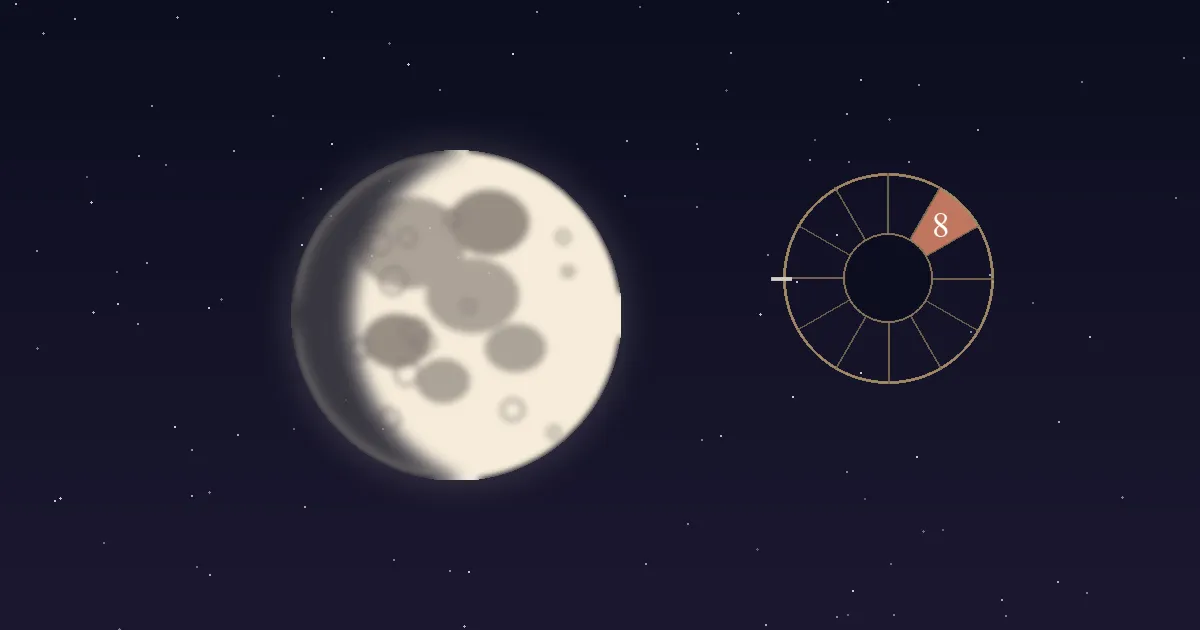
No Moon placement generates scarier searches than this one. People arrive here at 2am asking whether it means their mother will die, whether their child is marked, whether they're psychic, whether the death house has plans for them. And the pages waiting for them either monetize the fear with remedies or dodge the questions entirely.
So let's answer everything, in order of how much it's scaring someone, and add the one piece of ancient testimony about this placement that nobody quotes, which happens to be the kindest line in the whole file. Orientation first if you need it: the guide to the wheel's twelve arenas explains how the houses work.
Quick answer
Moon in the 8th house is emotional depth-seeking: feelings live below the surface, intimacy means full merger, and the taboo topics (death, money, secrets) feel like home ground rather than danger. It predicts no deaths, curses no mothers, and grants no verified powers. It makes crisis-competent, private, perceptive people.
| Arena | Succedent 8th house: shared resources, endings, depth, the taboo |
| Emotional style | Deep-water feelings; slow to trust, total once given |
| The ancient kindness | Valens: only the waxing Moon "rejoices" in this house |
| Money layer | Joint accounts, inheritance, a partner's assets: emotionally charged |
| The fears | Mother, death, doom: folklore, debunked below |
| Superpower | Reads subtext and handles crisis; the friend you call at 3am |
First check whether this placement is even yours: houses require an exact birth time, and half the people fearing an 8th-house Moon turn out to have it in the 7th or 9th. The free calculator answers in a minute.
Confirm your Moon's house free →"Does it mean my mother will die?" Answered first, because it scares people most
No. Here's where the fear comes from and why it doesn't hold. The Moon signifies the mother; the 8th signifies death; medieval and Vedic delineations multiplied the two and wrote sentences like "harm to the mother," and modern content farms republish them verbatim because fear converts. But that multiplication was always the crudest kind of chart reading, the astrological equivalent of diagnosing from a horoscope column, and even the traditions that wrote it hedged it with a dozen conditions on sign, aspect, and phase. Every mother dies eventually; every chart has a Moon somewhere; roughly one person in twelve has it here. If this placement killed mothers, the actuarial tables would have noticed.
What the mother thread actually looks like in practice: intensity and privacy in the bond. 8th-house Moon people often describe a mother relationship with real depths (fierce loyalty, unspoken understandings, sometimes a shared silence around hard family history) rather than an easy, chatty surface. The emotional inheritance runs deep and partly underground. That's the true sentence the scary ones were mangling.
The one thing that rejoices in the house of death
Now the line nobody quotes. Vettius Valens, second century, cataloguing the 8th Place's grim portfolio, pauses for one exception. In the Riley translation: "Only the moon, when its light is waxing, seems to rejoice in this Place."
Sit with how strange and generous that is. Of every planet, in the house the ancients feared most, the single body Valens exempted was a growing Moon. He doesn't say why (and to be precise, this is a passing remark, separate from the formal joys doctrine, where the Moon's joy is the 3rd house). Our best reading of his logic: the 8th is the house of endings, and a waxing Moon is the sky's monthly proof that endings reverse, light returning out of darkness. The one body that dies and is reborn every month has the least to fear from the death house.
Practically, this is also the one placement in this series where checking your lunar phase genuinely changes the classical reading: born under a waxing Moon (between new and full), you hold the exact configuration Valens singled out as the exception. The birth chart calculator linked above shows your Moon's house. It doesn't name the phase, but you can read it from the chart: count forward through the signs from the Sun's degree, and if the Moon is less than 180 degrees ahead, you were born under a waxing Moon.
Merged money, measured
The 8th's daytime job is other people's resources: the joint account, a partner's income and debts, taxes, estates. A Moon here means those flows are never emotionally neutral, and the searches know it ("moon in 8th house money," "inheritance," always near the top). Two datasets put real numbers on the house's daytime job, neither of them astrological. On inheritance scale: Cerulli projects $124 trillion changing hands in the U.S. through 2048, about $105 trillion of it eventually reaching heirs, the largest transfer in history, and still concentrated enough that most households will see little of it. A natal Moon doesn't deal you into that game; it decides how the hand will feel if you're dealt one.
On merged accounts, the placement's home turf, the data is warmer than the folklore: across six studies of 38,534 people, couples who fully pooled finances reported higher relationship satisfaction and lower breakup risk than partial poolers, with fully separate accounts running the highest dissolution risk in the longitudinal analysis. Full merger, the arrangement astrologers say this Moon instinctively wants, turns out to be the statistically resilient one at the population level. That's no license for merging with anyone (the study can't see financial abuse or a partner's hidden debt), but it does mean the all-in wiring isn't recklessness by itself. The bet works when the full-disclosure conversation happens first, which is this placement's actual homework. The self-owned end of the money axis lives across the wheel at the 2nd house.
The transiting Moon spends about two days a month in your 8th house; this placement tends to feel them as the deep-conversation, clear-the-air days. ZodiScope's live overlay shows when, on your own chart.
Track the Moon through your houses →The psychic reputation, sorted into piles
Three piles. Verified: nothing; no placement has demonstrated abilities under test conditions, and this site won't pretend otherwise. Real and impressive: subtext perception. People with this placement describe reading rooms below the waterline: the fight a couple had before the dinner party, a friendship's temperature dropping weeks before the friend says anything. Pattern-recognition on emotional data, running constantly. It can also be wrong, which is worth remembering before acting on a read. Real and costly: the same channel with no off switch. Absorbing a room's undercurrents all day is tiring in a way small talk never is, which is why this placement needs solitude to reset and why its version of social exhaustion confuses extroverted friends.
If the intuitive layer interests you as practice rather than merchandise, the adjacent water-Moon pages cover its textures: Moon in Scorpio shares this house's temperament sign-side, and Moon in Pisces runs the same receptivity oceanward. For the room next door where hidden things live, see the Moon's offstage 12th house.
Intimacy at full depth, and the sign that steers it
In love, this placement has one gear: all the way in, eventually. Trust builds slowly, tested in small increments, and once given is total; casual connection genuinely doesn't feed it. Partners should know the privacy isn't distance (you're in the inner circle precisely because you matter) and that secrets are the one unforgivable, since this Moon tends to sense them anyway. The sign sets the tempo, in the shorthand astrologers use: earth Moons here (Taurus especially, where the Moon is exalted) merge slowest and steadiest, fire Moons crash the depth barrier early, air Moons need the merger narrated, and water Moons arrive already merged. Details per sign in the twelve-sign Moon breakdown, or find yours first with the free Sun, Moon and rising check below.
For calibration against the neighbors, Venus in the 8th house is attraction to the deep end, Jupiter in the 8th house is the quiet-wealth reading of the same territory, and the Sun's version of this house adds the father warnings from the old texts, which disagree about when they apply. What the Moon adds is residence: her whole emotional life happens at this depth, which is why 8th-house Moon people are so often the ones everyone calls when life goes genuinely dark. While other Moons are still processing the shock, this one has made the tea and started the practical list.
Fast or slow to merge
How quickly this Moon lets someone in comes down to its sign. One free lookup turns your birth date, time and place into your Moon, Sun and rising signs, without an account.
Get your Moon sign plus Sun and rising →Keep reading
- · The other planet people fear in this house, and the widow verse it drags in: Mars in the 8th house.
FAQ
Is Moon in the 8th house dangerous?
No. Nothing in a birth chart is dangerous; placements describe temperament, not events. This one describes emotional depth-seeking: feelings that live below the small-talk line, comfort with subjects others avoid, intimacy that merges rather than coexists. The house's traditional association with death made ancient astrologers grade it harshly and makes modern content farms monetize it luridly. Modern psychological astrology reads the house's death mostly as metaphor (endings, transformations, the shedding of old selves), where the old texts meant it more literally; this page uses the modern frame and says so. People with this Moon tend to handle actual crises better than most, not worse.
Does Moon in the 8th house give psychic abilities?
What it reliably gives is subtext-reading at a level that feels psychic to other people. This placement registers the unsaid: the tension under a cheerful dinner, the thing a friend is deciding not to mention, the relationship that ended months before anyone announced it. That's pattern-sensitivity to emotional data, and astrologers credit this Moon with an unusual supply of it. Whether anything beyond that exists is a metaphysical question astrology can't settle, and no placement has ever demonstrated abilities under controlled conditions. Trust the reads; skip the pages selling you a gift with a price tag.
What does Moon in the 8th house mean for inheritance?
The 8th governs what others leave and share: estates, joint assets, a partner's resources. A Moon here often means those flows carry emotional weight in your life story, money and feelings arriving tangled together. It is not a bequest with your name on it. For scale, Cerulli Associates projects about $124 trillion transferring between U.S. generations through 2048, and most households will still receive little or none of it; no natal Moon changes which side of that line you're on. What the placement does predict well: when shared money enters your life, it will never feel like just money.
My child has Moon in the 8th house. Should I be worried?
No, and this question deserves a gentle answer because worried parents genuinely search it. You have a child who feels deeply, notices everything, and asks the big questions early: where babies come from, what happens when pets die, why grownups go quiet in certain rooms. That intensity is a temperament, not an omen, and it flourishes with parents who answer honestly at age-appropriate depth rather than deflecting. The placement's children do badly with secrets (they tend to sense more than adults expect) and beautifully with truth. You weren't handed a shadowed child. You were handed a perceptive one.