Birth Chart
Moon in the 12th House: The Feelings That Live Offstage
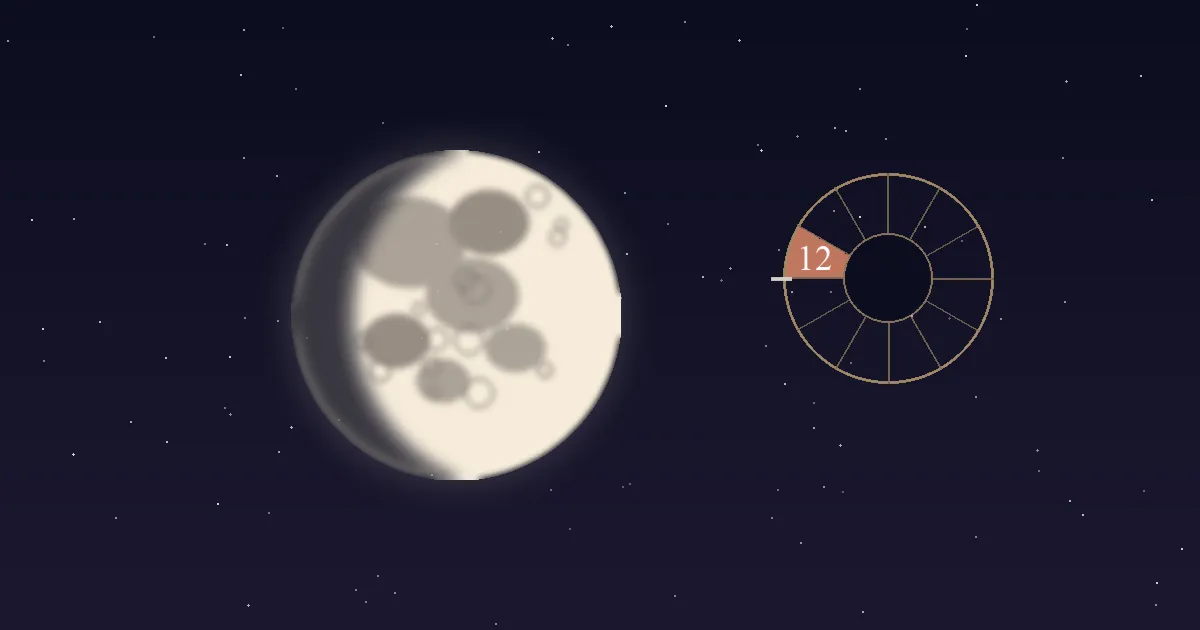
This is one of the most-searched Moon-house placements of the twelve, and the most mythologized: hidden emotions, past lives, psychic sponges, secret sorrows. Some of the mythology earns its keep. Some of it collapses the moment you look at the actual sky, and one piece of it (the "hidden below the surface" image the whole genre leans on) is astronomically backwards in the very house system most sites use.
Three questions organize this page: who feels it more in synastry (the single most-typed question about this placement), what the sleep and dream link actually is, and where the line sits between a 12th-house Moon and something a therapist should hear about. Houses from the top: the twelve houses in order, 1st to 12th.
Quick answer
Moon in the 12th house keeps its emotional life offstage: feelings process in solitude, sleep, and dreams rather than in conversation. It absorbs other people's states easily, needs real alone time to function, and often can't name a mood until the room empties. Private, porous, and far stronger than the doom pages suggest.
| Arena | Cadent 12th house: solitude, sleep, institutions, the unseen |
| Emotional style | Processes offline; feelings surface on a delay |
| Astronomy check | In Placidus, a 12th-house Moon has just RISEN: above the horizon |
| Sleep link | Night is the processing shift; dreams do real work here |
| Synastry note | The Moon person usually feels a 12th-house overlay more |
| Verified example | Mick Jagger, Moon 23° Taurus in the 12th |
Twelfth-house claims are birth-time claims: without the exact time, nobody can tell your 12th from your 1st. The free calculator resolves it in about a minute.
Tell your 12th from your 1st →What Moon in the 12th house means
The 12th is the house of what happens out of view: solitude, sleep, hospitals and retreats, the parts of a life with no audience. A Moon here does its feeling in that space. Emotions don't announce themselves in real time; they tend to register on a delay, surfacing hours or days later, often in the shower, on a walk, or mid-dream. Asked "how do you feel about this" on the spot, this placement honestly doesn't know yet, which colleagues and partners routinely misread as evasion. The delay isn't concealment.
The second signature is porousness. This Moon picks up ambient emotion indiscriminately: the tense coworker, the sad stranger, the room's mood on arrival. It's the placement most likely to describe crowds as physically tiring and most likely to be called an empath, a claim we'll make practical below rather than mystical. The third is the paradox visible in its best biographies: real capacity for public life, with a core that stays genuinely private through all of it. Mick Jagger has fronted the world's most public band for sixty years on a reliably timed 12th-house Moon, his inner life unreadable the entire time. The placement doesn't forbid the stage. It keeps the dressing room locked.
The old texts feared this house; Firmicus's fourth-century entry deals the Moon here "loss of inheritance, miserable occupations, and journeys," and worse for night births (Mathesis III, Bram translation). Read that as the era talking: a world where solitude meant exile and institutions meant prisons graded the house of both accordingly. A century that invented the studio apartment, the writing residency, and the therapist's office has better uses for the same rooms.
The "hidden" house is above the horizon
Here's the astronomy the mythology never checks. The whole "buried in the unconscious depths" image implies a Moon sunk somewhere dark and low. Look at how the standard house systems actually cut the sky: the 12th house sits immediately above the Ascendant. In Placidus (the default system on nearly every chart site, including the free calculator above, which says so on the result), a body in the 12th has already risen; per the Swiss Ephemeris technical definition, at the 12th-house cusp it has covered a sixth of its diurnal arc, the path from rise to set. A 12th-house Moon at your birth was up, climbing the morning side of the sky, whether or not daylight let anyone see it. The Sun follows the same geometry: a 12th-house Sun means a birth after sunrise, with the Sun already up.
Why did the risen sector get the invisibility reputation? The classical logic was relational, and it ran on whole signs: the twelfth sign counted from the rising sign makes no major aspect back to it, so the place was read as "unseen" by the life, whatever its altitude in the sky. And there's a modern irony filed at the same address: Michel Gauquelin's disputed mid-century statistics found the Moon overrepresented exactly there, in the just-risen zone, in the charts of eminent writers (the fuller story is on the 9th-house page, the other zone involved). The sector astrology calls hidden is the one his data flagged for the people who publish their inner lives. Whatever that coincidence is worth, the accurate image for this placement isn't buried treasure. It's a Moon in the sky that nobody at the party has looked up to notice.
Synastry: who feels it more?
The most-typed question about this placement isn't natal at all: someone's Moon falls in someone else's 12th house, and both people want to know who's carrying it. The working answer from synastry practice: the Moon person usually feels it more. Their emotional self has landed in the house-person's blind sector, so they sense currents in the house person that the house person hasn't named yet, care invisibly, and often feel oddly unseen in return: deeply connected, rarely acknowledged. The house person mostly experiences the Moon person as inexplicably comfortable to be around, without quite registering why.
It's a real-intimacy overlay with a real asymmetry cost, and the fix is the unglamorous one: the Moon person has to say out loud what they keep perceiving silently, because the house person rarely thinks to ask about currents they can't see. One overlay never makes or breaks two charts; the step-by-step synastry read shows how to weigh the whole exchange, and how Moon signs pair by element covers the underlying sign-to-sign fit.
Around two days a month, the transiting Moon crosses your 12th house; this placement tends to feel them as the low-battery, cancel-plans, vivid-dream days. ZodiScope shows the live Moon on your chart, so the quiet days stop arriving unannounced.
See today's Moon against your chart →Sleep and dreams: the night shift
Sleep sits in the 12th's portfolio (a modern and Jyotish emphasis more than a Hellenistic one, where the house ran to confinement and hidden enemies), and with the Moon here it stops being trivia. This placement tends to do its emotional processing offline: the day's absorbed material gets sorted at night, dreams run vivid and plot-heavy, and the difference between a protected night and a short one shows up the next day as the difference between clarity and fog. People with this Moon often report knowing how they feel about something only after they've slept on it, literally.
Which makes the population baseline worth staring at: CDC survey data finds 30.5 percent of U.S. adults averaging less than seven hours of sleep. For most charts that's a fatigue problem. For this one it's an emotional-processing outage: cut the night shift and the unprocessed material doesn't vanish, it accumulates as absorbency and overwhelm. If a 12th-house Moon takes exactly one piece of advice from this page, it's this: guard sleep like load-bearing structure, and keep a notebook by the bed, because for you the dreams are often where a feeling first says its name.
The empath claim, made practical
"12th-house Moons are empaths" is this SERP's favorite sentence, usually left as flattery. Made practical: this placement runs high-gain emotional reception with a broken squelch knob. It picks up real signal (the placement genuinely reads rooms and people well) and it picks up everything else too, without labeling whose feeling is whose. The skill that changes the placement's life is attribution: the habit of asking, when a mood arrives, "did this start with me?" Often the honest answer is no, it arrived at the meeting, or with the friend's phone call, and mislabeling it as yours is how this Moon ends up carrying a building's worth of weather.
The supporting practices are mundane on purpose: solitude scheduled daily rather than earned by collapse, transitions between social contexts (the walk home is a filter, not dead time), and fewer open channels during hard seasons. None of it requires believing anything mystical. All of it is just operating instructions for a receiver that never fully powers down. The neighboring deep-water placements make useful comparative reading: the 8th-house Moon reads the room's subtext on purpose, where this one absorbs it by accident, and the Pisces Moon's receptivity is the sign-level version of the same porousness; carrying both at once is the deep end of the deep end.
When it isn't astrology
A necessary line, drawn plainly. A 12th-house Moon describes a private, delayed, absorbent emotional style. It does not describe hopelessness that won't lift, sleep that's broken for weeks, or feelings so distant you can't reach them at all; those are clinical territory, and "it's just my placement" has kept too many people from help that works. One rough signal among several: this placement's solitude tends to restore, while depression's isolation drains. That's a prompt for reflection, not a diagnostic test, and if your alone time has stopped restoring you, a professional will do more for it than any astrology page, this one included. The placement, at its healthy baseline, is one of the chart's quietest gifts: an inner life with actual depth, a rich dream world, and the rare ability to be alone without being lonely.
A private Moon, sign by sign
This page covers the house; the sign decides how a 12th-house Moon handles what it keeps to itself. Enter your birth date, time and place for your Moon, Sun and rising signs, free and with no account.
Get your Big 3, including your Moon sign →Keep reading
- · The Moon feels offstage here; Mars in the 12th house loses its temper and cannot find it.
- · The same room with the benefic in it: Jupiter in the 12th house.
- · Across the axis, the daily world: Moon in the 6th house.
FAQ
Do Moon in the 12th house people need more sleep?
They need better-protected sleep, which often looks like needing more. This placement's emotional processing runs offline: the day's absorbed feelings get sorted at night, which is why its dream life is unusually vivid and why a short night leaves it emotionally unprocessed, not just tired. The population context makes the stakes plain: CDC survey data finds about 30 percent of U.S. adults averaging under seven hours. Most placements pay for that in fatigue. This one pays in mood, absorbency, and fog, so sleep protection is closer to emotional hygiene than to rest.
Does Moon in the 12th house mean past-life karma?
Jyotish reads the 12th as moksha territory and often frames a Moon there as karmic residue from previous lives, which is where the search results get it. Western astrology has no doctrine of literal past lives, and no chart can verify one. What the symbol defensibly describes is inheritance you didn't choose and can't quite see: family emotional patterns absorbed before memory, moods that predate their explanations. You can hold that as reincarnation or as psychology; the practical work is identical either way. Making the invisible inheritance visible is this placement's actual project, whatever cosmology you file it under.
Why do I only know what I feel when I'm alone, with Moon in the 12th house?
Because this placement's emotional receiver picks up everyone in range, and in company the signals mix. A 12th-house Moon in a crowded room is carrying some blend of its own state and everyone else's; only in solitude does the channel clear enough to tell which feelings have your name on them. That's why the placement's need for alone time is non-negotiable rather than preference, and why its people often describe baths, long walks, and empty apartments as where they 'find out how they actually are.' Build the solitude in on schedule and the confusion mostly resolves.
Which famous people have a verified Moon in the 12th house?
The cleanest case is Mick Jagger: born July 26, 1943, in Dartford, England, with the delivering doctor's stated window putting his birth around 2:30 am, and his Moon in the last degrees of Taurus, in the 12th house at any time inside that window. Sixty years fronting the most public band alive, with an inner life he has kept genuinely unreadable throughout: the placement's public-privacy paradox in one biography. Rihanna often appears on 12th-house lists, but her circulating birth time is unverified, so only her Aries Moon is safe to claim, not its house. Verified house placements need documented birth times, and most celebrity lists don't have them.