Birth Chart
Moon in the 9th House: Feelings That Need a Horizon
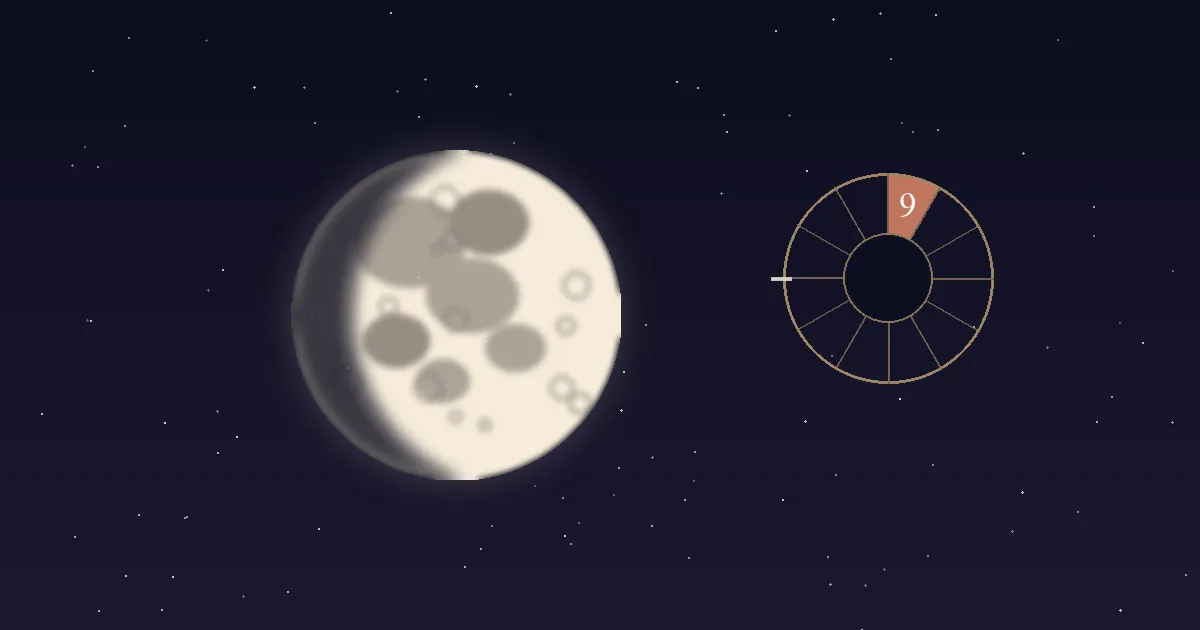
The 9th house holds everything far away: long journeys, foreign cultures, higher study, and the big beliefs that organize a life. A Moon here is homesick in reverse. It feels most itself at a distance from where it started, and it treats questions of meaning the way other Moons treat questions of dinner.
This page covers emigration, faith, and the father question, and one thing besides: the strangest dataset in astrology's brush with science happens to sit partly in this house, and it's about writers. The house-by-house guide to the natal wheel has the full picture if you're new to house logic.
Quick answer
Moon in the 9th house needs meaning and distance: travel, study, faith, and foreign things feed it emotionally. Beliefs are inherited early and renovated over a lifetime, home can be a place not yet visited, and restlessness is the tell that the placement is underfed. The mind here is a pilgrim.
| Arena | Cadent 9th house: long journeys, belief, higher learning, publishing |
| Classical name | "God" (Theos), the Sun's joy; Jyotish's house of dharma |
| Emotional style | Fed by meaning, distance, and the not-yet-seen |
| The odd dataset | Gauquelin's Moon excess for eminent writers (disputed) |
| Old-text line | Firmicus: "rites of the most important religions" |
| Feels like home | Airports, campuses, bookshops, anywhere with departures |
Houses only exist in a chart cast for your exact birth time. The free calculator draws the wheel and marks the Moon's house in about a minute, no email gate.
See if your Moon is in the 9th →A Moon that packs a bag
Every Moon placement names what a person needs to feel emotionally fed. The 9th-house Moon's diet is unusual: it needs elsewhere. Foreign streets, new frameworks, the sensation of understanding something it didn't understand last year. These are the people whose best selves show up abroad, who process a breakup by booking a flight or enrolling in something, whose comfort reading is philosophy or theology and means it.
Firmicus, the fullest early Latin source, catches both poles of it. Firmicus Maternus's fourth-century delineation says this Moon "forces some to cultivate rites of the most important religions," then adds, for day births, "travellers of humble class whose lives are disturbed by dangers and difficulties" (Mathesis III, Bram translation). Religion and rough travel: sixteen centuries later the placement still runs on exactly that axis, minus some of the danger.
The failure mode is chronic elsewhere-ness: a Moon that only feels alive mid-journey can quietly refuse to be fed by any present moment. The mature version of this placement learns that "far" is a direction the mind can travel too, which is where the writers come in.
The writers' Moon: the strangest dataset in the field
Starting in the 1950s, the French statistician Michel Gauquelin tested astrology's claims against birth records at scale, expecting to bury them. Most did get buried. What refused to die cleanly were his "planetary effects": in the birth data of eminent professionals, certain planets clustered in two zones of the sky, the sector just after rising and the sector just after culmination, which overlap the cadent 12th and 9th houses. Mars for champion athletes was the famous one. For writers, the clustering planet was the Moon: his compiled data on 1,352 eminent authors showed roughly a 30 percent excess of the Moon in the two key zones, the largest lunar effect of any profession he tested, with politicians a weaker second.
The scientific status, stated plainly because it matters: disputed and never independently replicated. The writers result specifically was never confirmed by outside researchers, and the flagship Mars claim failed its major independent tests (a 1994 French committee study found nothing, and U.S. committee tests came up negative). The standard critiques (selection bias in which "eminent" names entered the sample, and the sheer number of profession-and-planet combinations tested, which invites chance hits) have real force; the Mars-effect literature covers the whole fight. This series has cited the Gauquelin material before, from the other side of the sky, in Jupiter in the 9th house.
Why include a disputed dataset at all? Because a skeptical investigator's numbers briefly pointed, even if wrongly, at something oddly specific: the Moon, of all bodies, clustering in the sky-zones of the people who turn inner life into books. If it's an artifact, it's the most poetic artifact statistics ever produced. And the temperament claim underneath needs no statistics: a Moon fed by meaning and distance is the emotional engine long-form writing runs on.
A verified chart: Agatha Christie
Since celebrity chart claims online are mostly unsourced, here's one that survives checking. Agatha Christie: born September 15, 1890, in Torquay, England, at 2:14 pm, a time preserved because the midwife's bill quoted it, which earns the chart Astro-Databank's highest reliability rating. Cast the chart and her Moon sits at about 7 degrees Libra in the 9th house (Placidus), well before her Libra Midheaven.
Then the biography does the delineating: history's best-selling novelist, who also happens to have written much of her life at a distance, on the Orient Express, in Middle Eastern dig houses alongside her archaeologist husband, in the memoir she called Come, Tell Me How You Live. A 9th-house Moon that wrote mysteries on the way to Baghdad. One verified chart proves nothing statistically, and it isn't offered as proof; it's offered as a clean example of the placement's themes living in a real, documented life.
The transiting Moon crosses your 9th house for about two days a month, and this placement usually feels them as the itchy-feet days: book the trip, apply for the course, open the atlas. ZodiScope shows the live Moon on your chart so you can catch the window.
See today's Moon against your chart →The emigration question, with real numbers
"Moon in 9th house foreign settlement" is one of this placement's biggest search families, mostly served by Vedic pages reading yogas for settling abroad. The honest answer has two layers. The pull is real: this Moon bonds to elsewhere, and its people are overrepresented among the friends who actually did move, or orbit the idea permanently. The paperwork is not astrological: visas, savings, careers, and partners decide emigration, and no natal Moon overrides them.
For American context, the State Department's count of valid U.S. passports passed 160 million in 2023, roughly one for every two people, a share that has more than doubled since the early 2000s. The distance-hunger this house names has gone mainstream, which is worth remembering when a page treats wanting to leave as a rare karmic signature. What the placement claims for its people is a difference of degree: the abroad experience feeds them rather than entertains them, and a life that never gets any tends to run quietly flat. If a full move isn't available, the placement's minimum effective dose is real: the language kept up, the foreign friendships, work with an international edge, the trip that's booked rather than discussed.
Beliefs: inherited, then renovated
The 9th's deepest layer is belief, and the Moon here makes faith a feeling before it's a doctrine. The common biography: a worldview absorbed whole in childhood (a religion, a politics, a family cosmology), held with real emotional weight, then renovated in adulthood, sometimes gently, sometimes as a full deconstruction. The renovation is the placement working correctly, not failing: a Moon in the house of belief has to make the inherited house its own before it can live there. People with this placement often end up with a faith or philosophy that is recognizably descended from their childhood one and entirely rebuilt, the spiritual equivalent of keeping the foundation and replacing every wall.
This is also where the Vedic father-question belongs for Western readers: what this placement inherits from a parent is usually the worldview itself. The FAQ below has the fuller answer, and the sibling house of everyday mind, where the Moon has her traditional joy, makes an illuminating contrast: the 3rd-house Moon thinks in messages, the 9th-house Moon thinks in maps.
Sign notes, briefly
What "far" means is the sign's call. A Jupiter-ruled Sagittarius Moon here needs literal miles (and shares the house's temperament so completely the two are paired by analogy in modern astrology). A Gemini Moon travels by curiosity and collects languages. A Saturn-ruled Capricorn Moon makes the pilgrimage a career, the degree, the field posting. A water-sign Pisces Moon reads the whole house mystically and is the version most likely to actually join the retreat. All twelve live in the full set of Moon sign readings; the Sun, Moon and rising tool below finds yours from birth details.
And across the wheel sits this placement's counterweight: the 3rd house of the near and familiar. A 9th-house Moon that builds no local life burns out its horizon; the round trip is the sustainable shape.
The Moon sign on the road
Whether a 9th-house Moon wanders toward a degree, a retreat or a long trip depends on its sign. Get that sign free, with your Sun and rising, from your birth date, time and place.
See your full Big 3, Moon included →Keep reading
- · Where the Moon needs a horizon, Mars needs a cause: Mars in the 9th house on beliefs worth fighting for.
- · One house up, the public summit: the private Moon in a public job.
FAQ
Is Moon in the 9th house good for writers?
It's the placement with the strangest claim to the title. Michel Gauquelin's mid-century statistical surveys reported the Moon overrepresented in two zones of the sky (just risen and just past culmination, regions that overlap the cadent 12th and 9th houses) in the charts of eminent writers, a roughly 30 percent excess in his data, larger than for any other profession he tested. Later independent studies failed to replicate his planetary effects, and skeptics attribute them to selection bias, so treat it as a disputed curiosity, not proof. The temperament link is easier to defend: a Moon here feeds on meaning and distance, and that's the writer's diet.
Does Moon in the 9th house mean settling in a foreign country?
It describes the pull, not the paperwork. The 9th governs long journeys and foreign cultures, and a Moon here often feels most itself somewhere else: the semester abroad that rewired everything, the city that felt like home on day two, the recurring plan to leave. Whether the pull becomes emigration depends on money, visas, relationships, and courage, none of which a natal chart controls. Plenty of 9th-house Moons live the placement through travel, foreign partners, languages, or work with international reach. The State Department counts around 160 million valid U.S. passports, about one for every two Americans; the placement doesn't show up in passport statistics, but it names how much having and using one matters to you.
What does Moon in the 9th house say about your father?
The father questions come from Jyotish, where the 9th is the house of the father and dharma, so a Moon there gets read onto him. Western astrology traditionally assigns the father elsewhere (the 4th or the Sun by signification), so the two systems genuinely disagree here, which is worth knowing before you mix answers from both. Where the theme does show up for Western readers: this placement often inherits its worldview from a parent, absorbing a faith, philosophy, or moral frame early and then spending adulthood renovating it. The inheritance is beliefs rather than the man himself.
Is Moon in the 9th house lucky?
The luck reputation borrows from the house, which the Hellenistic astrologers named 'God' and honored as the Sun's joy, and which Jyotish counts as the most fortunate of all twelve as the house of dharma. A Moon there participates in the good reputation without being the classic luck placement (Jupiter and the 5th house own more of that folklore). The honest version: this Moon's fortune is opportunity-shaped. It thrives at distance, so astrologers expect its lucky breaks through the house's own channels: travel, education, publishing, foreigners. Go where the house points and the placement looks lucky; stay put and it just looks restless.