Birth Chart
Moon in Sagittarius Meaning: The Jupiter-Run Moon, and Jupiter Entering Its Detriment in 2027
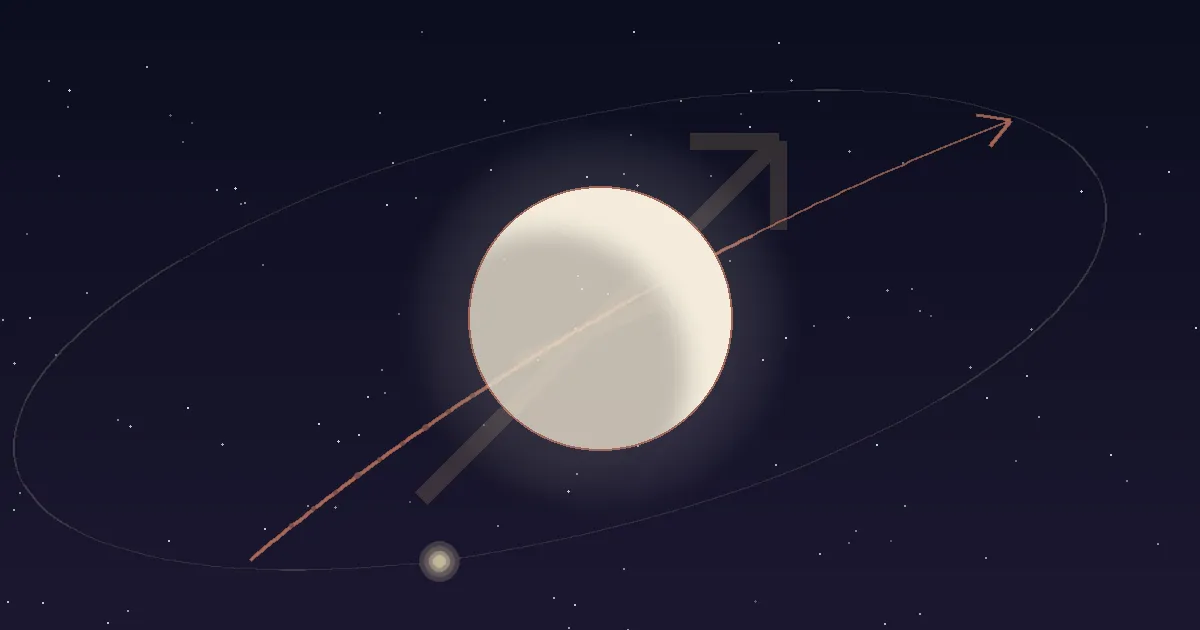
Almost every article on the Sagittarius Moon files it under "optimistic, blunt, freedom-loving, restless" and moves on. That's the surface, and it skips the one fact that explains all four of those words at once: in Sagittarius the Moon is peregrine — it has no essential dignity of its own — so it runs entirely on its dispositor, Jupiter. The most receptive point in the chart is being operated by the planet of meaning, faith, and expansion.
It's the exact structural twin of the Virgo Moon — also peregrine, also running entirely on its dispositor — only there the dispositor is Mercury, so feeling gets routed through analysis. In Sagittarius the dispositor is Jupiter, so feeling gets routed through meaning-making. Two peregrine Moons, identical mechanism, opposite element and opposite planet: earth and Mercury that dissects, fire and Jupiter that expands. A Virgo Moon asks "what is this and what's the fix"; a Sagittarius Moon asks "what does this mean and what's the lesson." Same refusal to just sit in the raw feeling — completely different escape route.
And 2027 puts a sharper shape on that mechanism than 2026 did. Jupiter, the planet this Moon depends on to function, spends the first seven months in Leo, a fellow fire sign that trines Sagittarius, stations direct at 16°59′ Leo on April 12, and then enters Virgo on July 26. Virgo is Jupiter's detriment, the sign opposite Pisces, which Jupiter rules, and it squares Sagittarius. So the dispositor goes from supporting this Moon by trine to squaring it from a sign where it is weak, one degree at a time from August. Below: the dignity correction in full, how the placement actually feels from the inside, what two named astrologers say, the community pattern with the survey data, and the 2027 dates that land on a Sagittarius Moon by degree.
Quick answer
A Moon in Sagittarius is peregrine — no dignity of its own — so it runs entirely on its ruler, Jupiter: feelings get routed into meaning before they finish forming. It needs an open horizon to regulate, tells the truth involuntarily, and its signature blind spot is the reframe deployed before the feeling is felt.
| Placement | Moon in Sagittarius (mutable fire) |
| Ruler of the sign (traditional) | Jupiter |
| Dignity | None — peregrine, leaning entirely on Jupiter |
| Core need | An open door — meaning and movement metabolize moods |
| Instinct under stress | Find the lesson before the feeling has finished forming |
| Shadow | The reframe as anaesthetic; bluntness surprised that it hurt |
Don't know your Moon sign yet? Pull your free birth chart on ZodiScope — Moon, Sun, rising, Jupiter and every other personal planet computed off the same NASA JPL ephemerides every serious astrology site runs on. Takes about a minute, and it tells you the exact degree of Sagittarius your Moon sits at — and where your Jupiter is, which for a peregrine Moon is the number that decides almost everything.
Get your free birth chart →Moon in Sagittarius meaning — the short version
Sagittarius is mutable fire — fire that wanders, learns, and reframes rather than fire that performs (Leo) or fire that ignites (Aries). The Moon here doesn't fight that; it routes your whole emotional life through the act of making meaning. Put together, the placement reads roughly like this:
- Meaning is the first emotional response, not the second. Most Moons feel, then (maybe) interpret. The Sagittarius Moon feels and reframes in the same motion — "what does this mean, what's it teaching me, how does it fit the bigger story" arrives before the feeling has finished forming. The reframing isn't a lie; for this placement it is the feeling's native format.
- Freedom is the regulation mechanism. Where a Taurus Moon self-soothes through the body and a Virgo Moon tidies the environment, a Sagittarius Moon needs a visible exit, an open horizon, a plan to go somewhere or learn something. Confinement isn't an inconvenience for this Moon; it's a genuine dysregulator.
- Honesty is involuntary. The Sagittarius Moon says the true thing, often before deciding whether to. This reads as refreshing to people who want the truth and as bluntness to people who needed a softer delivery — and the Moon is frequently surprised that it landed as the second one.
- The feeling gets a frame fast. "Everything happens for a reason," "it was a growth experience," "honestly this is probably good for me" — sometimes true, but often a reframe deployed before the feeling was actually felt. This is the placement's signature move and its signature blind spot.
- Restlessness is the idle state, not the crisis state. Low-grade "what's next, where could I go, what could I learn" is this Moon at rest. It isn't a malfunction; it's the placement running normally with nothing new on the horizon.
The contrast that makes it click is the mutable axis. A Gemini placement — the sign directly opposite Sagittarius — is also mutable, but it's ruled by Mercury, the planet of data. A hypothetical Gemini Moon collects the pieces; the Sagittarius Moon builds the meaning out of them. Same mutable restlessness, opposite output: data versus meaning, the trees versus the story about the forest. Neither is wiser; they're solving the same problem (what do I do with this feeling?) from opposite ends of one axis — the exact axis the year section below lights up.
Why "peregrine" is the whole story — the dignity correction
The traditional dignity table for the Moon — the system descending from Ptolemy's Tetrabiblos — in full:
- The Moon's domicile is Cancer — the only sign it rules, its strongest placement. (Moon in Cancer — the only home the Moon has.)
- The Moon's exaltation is Taurus, classically 3° Taurus — the second-strongest essential dignity. (Moon in Taurus — the exalted Moon.)
- The Moon's detriment is Capricorn; its fall is Scorpio, at 3° Scorpio. (Moon in Scorpio — the placement in the Moon's fall.)
- Everywhere else — Aries, Gemini, Leo, Virgo, Libra, Sagittarius, Aquarius, Pisces — the Moon is peregrine: neither dignified nor debilitated, with no structural support of its own.
"Peregrine" is the most under-explained word in beginner astrology. It does not mean weak and it does not mean bad. It means a planet is a stranger in the sign — it has no essential dignity, so it can't draw on the sign's strength directly. What it does instead is the part that matters: a peregrine planet leans on its dispositor — the ruler of the sign it's sitting in. The Moon in Sagittarius has no dignity of its own, so its functioning is effectively subcontracted to whatever planet rules Sagittarius.
That planet is Jupiter — the biggest planet in the system and, symbolically, the planet of meaning, belief, growth, the long view, and the benefit of the doubt. So a Sagittarius Moon isn't "the Moon flavored with some optimism." It's the Moon handing its entire emotional operation to Jupiter: the function that's supposed to register what hurt now answers to the function whose whole job is to find what it's for. That is why the placement reframes before it feels. It isn't a personality choice. It's the dispositor doing exactly what Jupiter does, applied to the Moon's raw material. (For what classical degree precision like "15° Cancer" does and doesn't actually support, see our honest breakdown of degree theory.)
This is where the Virgo comparison stops being a metaphor and becomes structural. Line the two peregrine Moons up against the dignified ones:
- Cancer Moon disposits itself — the Moon rules Cancer, so it answers to no one. Full dignity, self-regulating.
- Taurus Moon is exalted, and its dispositor is Venus — a soothing hand-off. Comfort answering to pleasure.
- Virgo Moon is peregrine, and its dispositor is Mercury — emotion answering to analysis. Feeling gets dissected.
- Sagittarius Moon is peregrine, and its dispositor is Jupiter — emotion answering to meaning. Feeling gets reframed.
The Virgo and Sagittarius Moons are the matched pair almost nobody puts side by side: identical dignity status, opposite escape route. And there's a wrinkle that makes the Sagittarius case unusually live. Jupiter doesn't only rule Sagittarius — it also rules Pisces, and Jupiter is exalted in Cancer (classically 15° Cancer). So unlike most dispositors, Jupiter's own condition swings widely depending on where it sits. A peregrine Moon is exactly as steady as the planet it answers to, which means a Sagittarius Moon's functional baseline isn't fixed the way a dignified Moon's is. It moves with Jupiter.
Read that way, every cliché about the placement stops being a personality quirk and becomes a structural prediction. The optimism is Jupiter's benefit-of-the-doubt applied to the Moon's mood. The bluntness is Jupiter's "tell the larger truth" overriding the Moon's instinct to protect the feeling. The restlessness is Jupiter's appetite for more horizon running the function that's supposed to make you feel at home. None of it is decoration. It's all the dispositor.
Want to see which degree of Sagittarius your Moon sits at, and where your Jupiter is and how strong it is, since a peregrine Moon is only as steady as the planet it answers to? ZodiScope reads your Moon, its dispositor and the live sky together, so you can watch Jupiter cross from the Leo trine into the Virgo square across 2027 and see the month it reaches your degree.
See your live transits on ZodiScope →The Moon in Sagittarius in love and at work
If your Venus sign is how you flirt and what you find beautiful, your Moon is how you actually need to be cared for once the flirting stops. The Sagittarius Moon's version of love is honest, mobile, and easy to misread if you're waiting for it to be reassuring:
- You love by telling the truth. Often before you've decided whether the moment could take it. To the right partner this is the most trustworthy love language on the wheel — you genuinely cannot be bothered to perform. To the wrong one it reads as a series of small, surprised injuries.
- You need the relationship to be a vehicle, not a shelter. A water Moon wants safety; a Sagittarius Moon wants somewhere to go together. A partner who experiences the relationship as a place to grow does well. A partner who experiences it as a place to finally stop moving will feel you straining at the leash and won't know why.
- You reframe your partner's pain — fast, and usually too soon. The instinct to find the lesson in their bad day is real generosity routed badly. Delivered before they've finished being upset, "but think what this is teaching you" lands as being managed, not loved.
- You keep an exit visible at all times. Not because you're leaving — usually you're not — but because a foreclosed future is the one thing this Moon can't regulate around. Partners who learn that the visible exit is what lets you stay do far better than partners who try to remove it for reassurance.
At work, the Sagittarius Moon is the one who can see why the project matters when everyone else is lost in the task. Where a Virgo Moon finds the error before it ships and an Aries Moon converts feeling into action in real time, the Sagittarius Moon supplies the narrative — the reason the work is worth doing, the bigger frame that re-motivates the room. Pair a Sagittarius Moon with an earth Moon and you get a real engine: one keeps the meaning alive, the other keeps the meaning shippable. The cost is that this Moon will lose interest the moment the meaning runs out, sometimes well before the work is done, because tolerating a stretch of meaningless execution is the one thing the placement is structurally bad at.
The single behavior that costs this placement the most is the premature reframe — the lesson deployed as anaesthetic. Nobody asked the Sagittarius Moon to find the silver lining at minute three; it does it because an unframed feeling is, for a Jupiter-run Moon, genuinely harder to hold than a framed one. The deliberate skill — the exact one the placement avoids — is letting the feeling stay shapeless long enough to actually be felt before Jupiter arrives to tell you what it was for.
What two named astrologers actually say about it
Most "moon in sagittarius" pages cite no one. Two working astrologers describe this placement in a way that lines up almost exactly with the dispositor read above:
Alice Sparkly Kat, in her "Reparenting Sagittarius Moon" piece, frames this Moon as a placement that sees significance everywhere — "there is nothing that is not also animated by the ceaseless narrative of political learning," to the point that "who makes dinner and what to do with a shattered cupboard becomes, also, a political question." That is the Jupiter hand-off stated as lived experience: nothing is allowed to be just an event; everything is conscripted into a larger meaning. She names the wound precisely too — a deep fear of being overlooked ("you have a deep fear that it will happen again"), which can curdle into chasing the coolest scene or keeping people around out of fear of missing a future opportunity. Her counsel is to trust your own wisdom instead of seeking external validation, and to stop careerizing relationships. Read against the dignity model, that's exactly the failure mode you'd predict: a Moon run by Jupiter over-trusts the frame and under-trusts the raw feeling, so it looks outward for the meaning it should be sitting with.
Chani Nicholas describes Sagittarius itself as "the archer, the rambler, the gambler, the one who bets on hope and runs on faith — Sagittarius moves, Sagittarius seeks," and frames the Moon's sign generally as "the specific flavor of care you crave," where an honored Moon feels emotionally secure and a dishonored one tips into "rootlessness, instability, craving." For a Sagittarius Moon specifically, stack those two statements: the care it craves is motion and faith, and the failure state is rootlessness. That's not a contradiction — it's the exact knife-edge of the placement. The same need for an open horizon that regulates this Moon is the thing that, ungrounded, becomes the rootlessness Nicholas warns about. Freedom is both the medicine and, overdone, the symptom.
There's also a traditional medical-astrology layer worth noting because it's unusually on-the-nose: Sagittarius rules the hips and thighs — the body's locomotion, the part you literally move and travel with. The classical reading of a stressed Sagittarius Moon is restlessness that shows up as a body that needs to move before the mind admits anything is wrong. For a placement that processes everything through meaning, the impulse to walk it off or book the trip is often the first honest signal — the body reaching for motion before Jupiter has finished explaining why the feeling was actually fine.
The honest community pattern (and the data underneath it)
Skip the fake testimonials other sites invent. The genuinely recurring, well-documented description of this placement across astrology communities is remarkably consistent, and it's worth stating plainly because it's the same three points from three independent directions: "I find the lesson before I've finished being upset," "I need an exit visible or I can't relax," and "I'm too blunt and I keep being surprised that it hurt someone." That pattern isn't a vibe — it's the dispositor read, reported back in the first person by people who've never heard the word "dispositor." It also tracks exactly with the documented relationship pattern for this placement: needing a partner who isn't clingy or restrictive, processing feelings by seeking meaning rather than dwelling, and feeling caged by emotional confinement.
The "freedom and meaning regulate me better than reassurance does" half of that pattern also sits on top of real population data. Pew Research's October 2024 survey (9,593 U.S. adults, published May 2025) found 27% of U.S. adults believe in astrology — statistically flat versus 29% in 2017 — and 30% consult astrology, tarot, or a fortune teller at least once a year, most of them, in Pew's own framing, "just for fun," with the heaviest adoption among women aged 18–49 (about four in ten) and LGBTQ+ adults (roughly half, about twice the overall rate). A separate 2024 EduBirdie survey of 2,000 Gen Z and younger millennials put belief near 80%, with 72% letting it guide major life areas and — the detail that matters here — 65% saying it helps reduce anxiety and boost confidence. Read that last number through this placement: the Sagittarius Moon's native coping mechanism is "find the larger frame that makes this bearable." It is, structurally, the placement most fluent in exactly the move 65% of young people report turning to astrology to perform.
That's the honest version of why this article exists, and why it doesn't pad itself with invented Reddit quotes or made-up celebrity birth times the way most of page one does. The pattern is real; the data is real; the dignity mechanism explains both. That's the standard the rest of our data-backed take on whether astrology is real holds to as well.
What happens to a Sagittarius Moon in 2027, when Jupiter leaves Leo for Virgo?
The question that matters for a Sagittarius Moon in any year isn't "what's the Moon doing", it's what's Jupiter doing, because Jupiter is the planet your Moon answers to. 2026 answered it in two halves: exalted in Cancer, then a step down into Leo at the end of June. 2027 splits the same way, and the hinge is harder. Leo trines Sagittarius. Virgo squares it, and Virgo is one of the two signs where Jupiter is in detriment.
The dates that land directly on a Sagittarius Moon:
- Jan 1 to April 12: Jupiter retrograde in Leo, trining this Moon. Jupiter opens the year at 26°26′ Leo, retrograde since its December 13 station at 27°01′, and backs down to 16°59′ Leo, where it stations direct on April 12. A Moon at 17° Sagittarius gets the exact trine on the station itself; the 17° to 27° band gets the trine three times counting the outbound pass in late 2026. This is the dispositor comfortable, in fire, and slowing down on your degree: the best-supported stretch of the year for the find-the-meaning-and-move engine.
- All year: Uranus at 1°41′ to 9°57′ Gemini, opposing 2° to 10° Sagittarius. Uranus stations direct at 1°41′ on February 8 and retrograde at 9°57′ on September 15, so the early-degree Moons take the exact opposition this year. Gemini is the data pole of the axis this Moon lives on, and Uranus there keeps handing over facts that don't fit the story. For a Jupiter-run Moon that is the productive irritant, and in 2027 it has an exact degree.
- January 10 to June 7: the Mars retrograde cycle (retrograde to April 1, shadow to June 7), squaring the early degrees and trining the late ones. Mars stations retrograde at 10°26′ Virgo on January 10, backs into Leo on February 21, stations direct at 20°56′ Leo on April 1 and re-enters Virgo on May 14. The Virgo leg squares Moons at 0° to 10° three times (late 2026, then January 10 to February 21, then May 14 to June 7); the Leo leg trines Moons at 21° to 29° across the same weeks. Same retrograde, opposite experience, decided by degree.
- June 10 to July 4: Mercury retrograde, with the June 19 Full Moon in Sagittarius inside it. The year's Sagittarius Full Moon falls on June 19 at 27°33′, while Mercury is retrograde in early Cancer. Mercury backs into Gemini and stations direct on July 4 at 27°28′ Gemini, five minutes of arc from the degree the Sun held at that Full Moon. A Full Moon on your natal degree with the messenger stalling opposite it two weeks later is the year's Full Moon for the late-degree Moons: the story you had already filed as finished comes back for one more read.
- July 26: Jupiter enters Virgo, its detriment, and starts squaring this Moon. 1°12′ Virgo on Aug 1, 7°51′ Virgo on Sep 1, 14°16′ Virgo on Oct 1, 20°17′ Virgo on Nov 1, 24°49′ Virgo on Dec 1. Read that against your degree: a 5° Moon takes the square in late August, a 15° Moon in early October, a 24° Moon at the end of November. Moons at 27° to 29° wait for 2028. This is the year's real hinge, and it lands on every degree in turn.
- All year: Saturn at 8°20′ to 27°53′ Aries, trining 8°20′ to 27°53′ Sagittarius. The same fire trine that ran under 2026, now reaching the middle and late degrees. Saturn is in its fall in Aries, so the offer is looser than a dignified Saturn's would be. Pluto at 4°21′ to 7°10′ Aquarius sextiles 4° to 7°.
- October 15 to November 25: Mars in Sagittarius, Venus from November 1 to November 24, then the New Moon on November 28 at 5°39′. The autumn stack in the sign itself. Mars on the Moon runs the engine hot; Venus in the sign softens it; the New Moon at 5°39′ falls three days after Mars leaves, with Uranus retrograde in early Gemini across the axis. Venus also passes through Sagittarius early in the year, January 7 to February 2.
The plain-English version, by degree. Early Moons (0° to 10°) have the busiest year: the exact Uranus opposition for 2° to 10°, three Mars squares, and Jupiter's square arriving first, from late July to September. Middle Moons (11° to 20°) split: 17° to 20° get Jupiter's exact trine around its April station, 11° to 16° get no exact Leo trine this year, all of them get Saturn's trine, and the Jupiter square reaches them between late September and November. Late Moons (21° to 29°) get the Jupiter trine in January (21° to 26°) and again in July, the Mars trine in spring, the June 19 Full Moon, and the Jupiter square before the year ends for 21° to 26°; 27° to 29° wait for 2028.
Measured against 2026: Better through July 25: the dispositor is comfortable in fire and trining, with Saturn's trine underneath. Harder from July 26 than any stretch of 2026, because Jupiter in Virgo is Jupiter in detriment, and a peregrine Moon is only as steady as its dispositor. Not a catastrophe. A Jupiter square inflates and then audits, and the placement's job is to make the meaning survive the audit: the lesson that's still true in December is the one that was true in August. (The supportive weather underneath all of it: Saturn in Aries trines this Moon for the whole transit.)
A worked example, and why the celebrity lists are unreliable
A note on the genre first: the "celebrities with a Sagittarius Moon" lists are among the least trustworthy in astrology. The Moon changes sign every ~2.5 days, so it genuinely needs the chart computed — and Sagittarius-Moon lists in particular are notorious for being guessed from a confident, outspoken public persona ("seems blunt and adventurous, must be a Sag Moon") rather than pulled from a verified birth time. The same names appear under three different Moons across three sites. Rather than pad a list with birth data we can't verify, here's the more useful thing — a worked hypothetical that shows how the placement actually reads in a full chart:
Pisces Sun, Sagittarius Moon, Sagittarius rising — a deliberately Jupiter-heavy chart. The Sun is in Pisces (Jupiter-ruled, traditionally). The Moon is in Sagittarius (Jupiter-ruled). The rising is Sagittarius (Jupiter-ruled). In a chart like this, Jupiter isn't one planet among ten — it disposits the Sun, the Moon, and the ascendant, which makes it the effective center of gravity of the entire personality. This person doesn't "have a Sagittarius Moon" as a side trait; they are, structurally, a Jupiter chart wearing a Sun, a Moon, and a rising. Now drop 2027 onto it: their whole chart's ruler trines the Moon and the rising from Leo until July 25, stations direct at 16°59′ Leo on April 12, then enters Virgo, its detriment, on July 26 and squares both, one degree at a time, while Uranus opposes any early-degree Sagittarius Moon or rising from Gemini. In this chart, every major beat of the year routes through the one planet the whole chart depends on. That is what a worked chart buys you that an adjective list never will — it shows you where the year actually lands.
The methodology is the point, and it's the same one our moon sign compatibility guide and full birth chart reading walkthrough are built on: compute the chart, find the dispositor, read the transits against the structure — don't guess from the vibe.
Moon in Sagittarius with the other Big Three placements
A Moon sign read alone tells you the emotional weather; a Moon read against the sun and the rising sign tells you what the person actually looks like in the world. The "Big Three" isn't a beginner trope — it's the minimum viable data set for a personality:
- Sun: the long arc — what you're driving toward over decades.
- Moon: the emotional baseline, the thing running you on a Tuesday. With a peregrine Sagittarius Moon, this is the layer most dependent on the rest of the chart — specifically on wherever Jupiter is and how strong it is.
- Rising: the surface, the way you arrive in a room.
Common Sagittarius-Moon combinations and what they read like:
- Sagittarius sun + Sagittarius Moon. Sun and Moon both answering to Jupiter. Maximally consistent, maximally restless — the placement most likely to mistake its own appetite for the next horizon for a personality and never notice the horizon-chasing is the thing keeping it from arriving anywhere.
- Scorpio sun + Sagittarius Moon. A private identity that goes deep and holds, sitting on an emotional baseline that wants to reframe and move on. The lifelong negotiation between "stay in it until you understand it" and "find the meaning and go" — two completely different relationships to a difficult feeling, in one person.
- Pisces sun + Sagittarius Moon. Both lights ultimately answer to Jupiter (Pisces' traditional ruler). A self that wants to dissolve and merge, regulated by a baseline that wants to expand and roam — enormous faith, enormous scope, and a real risk of never landing because both the Sun and the Moon are built to keep going.
- Virgo sun + Sagittarius Moon. The most instructive one for this article: a Mercury-ruled identity that wants to analyze and correct, running on a Jupiter-ruled baseline that wants to reframe and expand. This is the dispositor split — Mercury versus Jupiter — wired straight into one chart. It often reads as a person who is precise on paper and philosophical in feeling, and who genuinely confuses themselves about which one they are. (The mirror placement: Moon in Virgo — the peregrine Moon that runs on Mercury.)
For a Sagittarius Moon the decisive second data point isn't Sun or rising — it's Jupiter. A peregrine Moon is exactly as functional as the planet it answers to, so the same Sagittarius Moon with Jupiter dignified reads nothing like one with Jupiter in detriment or fall. Find Jupiter's sign, house, and condition and you've found the actual control panel. The full birth chart reading walkthrough covers reading the layers together; the houses guide covers where each placement is happening — a Sagittarius Moon in the 4th (home) behaves very differently from one in the 9th (travel, belief, the higher mind, the house Sagittarius naturally rules, where the placement runs hottest). And because this Moon answers to Jupiter, the same Jupiter logic runs through Sagittarius' co-Jupiter sign, Pisces — a useful companion read for understanding what a Jupiter-run inner life does when it's water instead of fire.
How to actually work with this Moon — three practical moves
If you carry this placement and you're reading practitioner-level work on it for the first time, the three moves that show up across almost every reputable source:
- Feel it before you frame it — on purpose, with the lesson banned for ten minutes. The Sagittarius Moon's instinct is to convert a feeling into a meaning before it's been felt. The deliberate counter-move is to name the raw version with the reframe explicitly off the table ("this hurt, and I am not allowed to tell myself what it's for yet"). You're not abandoning the meaning; you're refusing to let it pre-empt the feeling. The 2027 arc, a fire trine and then a square from Jupiter's detriment, gives you a year of practice at it.
- Say the blunt thing on a half-second delay. The honesty is an asset; the involuntariness is the cost. The practice isn't to lie — this placement can't, comfortably — it's to insert one beat between the true thing and the said thing, long enough to choose the delivery. Alice Sparkly Kat's read applies here: the wound is fear of being overlooked, and unfiltered bluntness is sometimes that wound talking, not the truth.
- Use freedom as regulation deliberately, not compulsively. Chani Nicholas is right that motion and an open horizon genuinely settle this nervous system — that's the real self-soothing route, not a flaw. The line to watch: a trip or an exit that lets you return to the feeling is medicine; a trip or an exit taken so you never have to return to it is the placement fleeing itself. Same action, opposite function. The tell is whether the feeling is still there when you get back.
If you don't yet know which house your Sagittarius Moon falls in — or where your Jupiter is and how strong it is, which for a peregrine Moon decides almost everything — that's the next layer of the read. Sign tells you how; house tells you where; the dispositor tells you how well any of it actually works. And if you don't yet know your Moon sign at all, the fastest way in is the sun, moon & rising calculator.
Stop reading the wrong horoscope. Pull your full birth chart on ZodiScope: your Moon's exact degree in Sagittarius, where your Jupiter is and how strong it is (the planet a peregrine Moon depends on), the house it's in, and live transits so you can watch Jupiter cross from the Leo trine into the Virgo square on July 26 and see the month it reaches your degree.
Get your free birth chart →Keep reading
- · The Mars version of this sign's temperament: the Mars in Sagittarius guide.
- · The house that shares this sign's appetite for distance: Moon in the 9th house: the writers' Moon.
- · Where this series starts: what a moon sign is — and why it runs the show.
- · The element hub this Moon belongs to: What are the fire signs? Aries, Leo, Sagittarius and the year's fire calendar.
- · The exact structural twin, opposite flavor: Moon in Virgo — the peregrine Moon that runs on Mercury (analysis where this one does meaning).
- · The polar opposite on this Moon's mutable axis, also peregrine: Moon in Gemini — the peregrine Moon that keeps the pieces in play (data where this one builds the story).
- · The dignity contrasts that define this placement: Moon in Cancer, the only home the Moon has (domicile, and the sign of Jupiter's exaltation) and Moon in Taurus, the exalted Moon (exaltation).
- · The Moon's fall, the placement people most misread: Moon in Scorpio — the most-misread Moon sign, plus the other Jupiter-ruled Moon, Moon in Pisces, and the fellow fire Moons Aries and Leo.
- · Why 2027 has a hinge for this Moon: Jupiter in Leo (the trine that ends on July 25), with the supportive Saturn in Aries fire trine underneath it.
- · The opposite pole of this Moon's mutable axis: Gemini rising meaning, the Mercury-ruled placement, and the cycle that runs on Mercury: Mercury retrograde 2027, dates and shadow periods.
- · How a Sagittarius Moon pairs with other Moons: moon sign compatibility — the element and dignity framework no listicle covers, and how love really differs from flirtation: Venus sign meaning.
- · The exterior version of the Jupiter signature: Sagittarius rising meaning — the only ascendant whose single chart ruler is the greater benefic (your interior is Jupiter-flavored; if your rising is too, the signature concentrates).
- · The full sign profile: Sagittarius — the mutable fire sign in depth, plus the monthly Sagittarius horoscope for the current sky.
- · Why the dignity table matters at all: is astrology real? — the honest, data-backed answer.
- · The Moon's single hardest placement, for dignity contrast with this peregrine one: Moon in Capricorn — the Moon in detriment, run by Saturn.
- · The two Moons that run on Venus, one planet over: Moon in Libra (peregrine) and Moon in Taurus (exalted).
- · Don't know your sun, moon, or rising? Try the sun, moon & rising calculator, or browse all journal articles.
FAQ
What changes for a Sagittarius Moon when Jupiter enters Virgo in 2027?
The aspect and the dignity change at the same time. Jupiter is this Moon's dispositor, the planet a peregrine Moon borrows all its steadiness from. Until July 25, 2027 Jupiter is in Leo, a fire sign that trines Sagittarius, and it stations direct at 16°59′ Leo on April 12, 2027, an exact trine to a Moon at 17° Sagittarius. On July 26, 2027 it enters Virgo. Virgo squares Sagittarius, and it is one of Jupiter's two detriment signs (the sign opposite Pisces, which Jupiter rules), so the planet the Moon answers to goes from supporting it from strength to squaring it from weakness. It works through the sign at roughly a degree every four or five days: 1°12′ Virgo on Aug 1, 14°16′ Virgo on Oct 1, 24°49′ Virgo on Dec 1. So a 0° Sagittarius Moon takes the square right after the ingress, 1° to 26° take it between August and December in degree order, and 27° to 29° wait for 2028. What it tends to feel like: the explanations that used to close a feeling stop convincing, and the feeling has to sit unexplained for a while before the next story fits.
What does it mean to have your Moon in Sagittarius?
It means the receptive, what-do-I-need-to-feel-safe function of the chart is running on the operating system of the planet of meaning, faith, and expansion. Sagittarius is ruled by Jupiter, and the Moon in Sagittarius is peregrine — it has no essential dignity of its own, so it leans entirely on its dispositor, which is Jupiter. In plain terms: a Sagittarius Moon doesn't feel an emotion and then sit with it; it feels an emotion and immediately routes it into a bigger story — what does this mean, what's the lesson, what does it point to, how does this fit the larger picture. That is not the same move as a Virgo Moon's (which routes feeling through analysis); it's the fire version of the same structural fact. The cost is that the meaning-making can outrun the feeling, so the feeling never actually gets felt — the famous 'I'm fine, it was a growth experience' delivered three hours after something genuinely hurt. The benefit is real resilience and a person who can find a usable thread in almost anything.
Is the Moon in Sagittarius a bad placement?
No — but it isn't a strong one either, and the honest word for it is the technical one: peregrine, exactly like the Virgo Moon, just with the opposite flavor. In the traditional dignity table the Moon rules Cancer (domicile, full strength) and is exalted in Taurus (3° Taurus). It is in detriment in Capricorn and in fall in Scorpio (3° Scorpio). Everywhere else — including Sagittarius — it is peregrine: neither dignified nor debilitated, running without its own structural support. A peregrine planet isn't broken; it has to borrow its strength from the ruler of the sign it's in. For a Sagittarius Moon that ruler is Jupiter, so the placement is only as steady as the person's Jupiter is.
How does a Sagittarius Moon show love?
Through honesty, shared adventure, and meaning — not through reassurance or staying put. A Sagittarius Moon loves by telling you the truth (sometimes more bluntly than you wanted), by wanting to go somewhere or learn something with you, and by treating the relationship as a place to grow rather than a place to be safe. Alice Sparkly Kat's read of this placement is that it sees significance everywhere — even 'who makes dinner' becomes part of a larger narrative — and that its core wound is a deep fear of being overlooked, which can curdle into chasing the coolest scene or keeping people around out of fear of missing out. The failure mode isn't coldness; it's the partner who reframes your hurt into a lesson before you've finished being hurt, and who needs an exit visible at all times. The work of the placement is letting a feeling be a feeling before it becomes a philosophy.