Zodiac Basics
What Are the Fire Signs? Aries, Leo & Sagittarius, and What 2027 Does to Each of Them
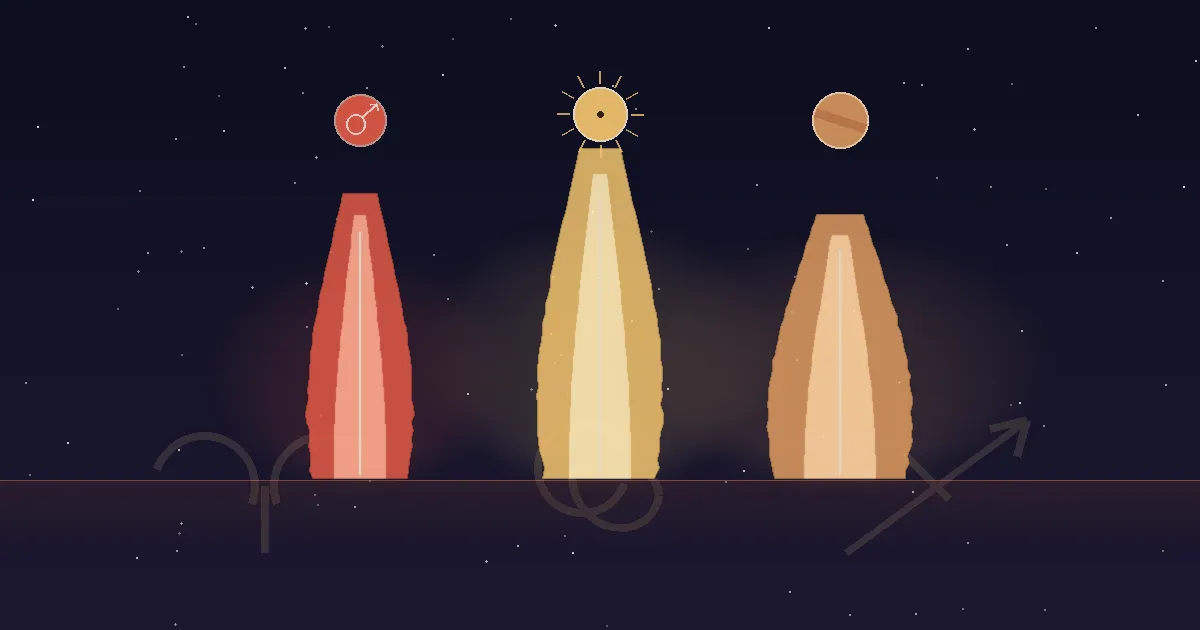
The three fire signs are Aries, Leo, and Sagittarius. They share the same classical element — fire — and that is where the useful similarity ends. The reason every generic listicle blends them together into "bold, confident, passionate" is that the listicle was written by someone who did not bother to look up the rulers, the modalities, or the houses. The reason this one does not is that those three details are where the actual personality of each sign comes from — and they happen to be three of the most different rulerships in the zodiac (Mars, the Sun, and Jupiter — three planets that share almost nothing else).
A real number first, because we like to anchor things in data: Pew Research's fall 2024 survey of 9,593 U.S. adults found that 30% of Americans consult astrology, tarot, or a fortune teller at least yearly (28% astrology specifically) — but most hold it lightly: 20% say they do it "just for fun" versus 10% for genuine insight, and only about 1% rely on it heavily for major decisions. That is the audience searching "what are the fire signs," and the existing answer it gets is almost always the same three recycled paragraphs that do not mention that Leo is the only sign whose ruler is the Sun or that Saturn entered Aries on February 13, 2026 for the first time since 1996. This is the longer version.
Below: the plain definition, the modality that actually differentiates the three, the rulers (Mars, Sun, Jupiter, a set no other element has), the 2027 calendar for each fire sign (Saturn through 8°20′ to 27°53′ of Aries, Jupiter's last seven months in Leo, the August 2 total eclipse at 9°55′ Leo, and a Mercury retrograde year that starts in water and ends in air) plus links into the full per-Moon-sign and per-rising-sign reads for each.
Quick answer
The fire signs are Aries (cardinal, ruled by Mars), Leo (fixed, ruled by the Sun), and Sagittarius (mutable, ruled by Jupiter) — the zodiac's element of drive, identity, and forward motion. They share the element and little else: their three rulers are a malefic, a luminary, and a benefic — a spread no other element's modern rulers cover.
Don't know which fire sign placements you have? Pull your free birth chart on ZodiScope and see whether Aries, Leo, or Sagittarius shows up as your Sun, Moon, rising, or any of the personal planets. Takes about a minute.
Open the free birth chart calculator →The plain definition
The zodiac's twelve signs are sorted into four classical elements — fire, earth, air, water — three signs per element. The fire signs are:
- Aries — roughly March 20 to April 19. Cardinal fire. Ruled by Mars.
- Leo — roughly July 23 to August 22. Fixed fire. Ruled by the Sun. The only sign in the zodiac whose ruler is the Sun.
- Sagittarius — roughly November 22 to December 21. Mutable fire. Ruled by Jupiter in both traditional and modern astrology — no modern reassignment, unlike water and air signs.
"Fire" is shorthand for a temperament. In the classical-elements scheme inherited from Hellenistic astrology, fire signs handle drive, identity, self-expression, and forward motion — the part of you that decides who you are and moves toward it. Earth signs handle the body and the material world. Air signs handle thought and language. Water signs handle emotion and intuition. The four elements are not meant to be ranked; they describe four different operating systems the same person can have running in different parts of their chart.
Almost everyone has fire-sign placements somewhere in their chart, even people whose Sun is in an earth, air, or water sign. Your Sun is in one sign; your Moon is in another; your rising is in a third; Mercury, Venus, Mars, Jupiter, Saturn, and the outer planets are in nine more. The number of "fire signs" you have isn't determined by your birthday — it's determined by where the personal and outer planets fell at the moment you were born. The birth chart reading walkthrough covers how to pull the whole picture; the ZodiScope Big 6 calculator covers the quick version.
The modality and the ruler are what actually differentiate them
The single biggest thing the generic listicles get wrong about fire signs is treating them as basically interchangeable. They are not. Each one occupies a different modality — cardinal, fixed, or mutable — and a different ruler, and that combination changes the shape of how the fire element actually behaves (the rulers get their own section below, because they are the strangest set in the zodiac):
- Cardinal fire = Aries, ruled by Mars. Cardinal signs initiate. Mars is the planet of action, edge, and direct will. The combination is the fastest zero-to-action signature in the zodiac — Aries is the placement whose first move is to start something, and Mars is the planet that does not believe in waiting for permission. The lived experience is the impulse to do the thing before the analysis is complete. The shadow is that the fire that starts the easiest also burns out the fastest.
- Fixed fire = Leo, ruled by the Sun. Fixed signs sustain. The Sun is the only luminary that does not retrograde, never stations, and moves at near-constant speed — the central organizing principle of the entire solar system. The combination is the placement that can hold a creative or public role for decades without losing the signal: Leo is the fixed fire that does not burn out the way Aries does, because its ruler is structurally incapable of going backward. The lived experience is the steady warmth that other people gather around. The shadow is the need to be the center, which becomes load-bearing if it goes unexamined.
- Mutable fire = Sagittarius, ruled by Jupiter. Mutable signs adapt and spread. Jupiter is the planet of expansion, faith, and the larger meaning behind events — the biggest planet in the solar system, ruling the biggest sign by reach. The combination is the placement that does not stay in one place — Sagittarius is the fire that spreads horizontally across new countries, new philosophies, new fields, new beliefs. The lived experience is the appetite for the next horizon. The shadow is that the same mutability that produces range can produce restlessness — the fire never holds long enough to do the deep work fixed signs do.
If you only remember one thing from this section: cardinal fire starts, fixed fire holds, mutable fire spreads. Aries lights the match. Leo keeps the hearth. Sagittarius carries the torch into new territory. They are not three flavors of the same thing — they are three different jobs being done by three different planets in the same temperamental register.
The strange thing about fire's rulers: a malefic, a luminary, and a benefic
Here is the structural fact this whole article turns on, and the one no beginner explainer mentions: fire's three rulers share nothing. Mars is the planet Hellenistic astrologers called the lesser malefic — the significator of conflict, heat, and the cut. The Sun is a luminary — not a planet at all in the traditional sense, but the light the whole system is organized around. Jupiter is the greater benefic — the significator of growth, luck, and meaning. In the modern rulership scheme pop astrology runs on, no other element's three rulers span that classification the way fire's do: earth's rulers (Venus, Mercury, Saturn) and air's (Mercury, Venus, Uranus) trade the same two personal planets between them, and water's modern set (Moon, Pluto, Neptune) leans on two outer planets that traditional astrology never classified at all. Fire got a malefic, a luminary, and a benefic — the three poles of the old system — assigned to three signs that are supposed to be siblings.
That predicts something specific and testable about how differently the three fire signs fight. Aries fights like Mars: fast, direct, to win the moment — and then it is genuinely over, often before the other person has finished being upset. Leo fights like the Sun: the anger is almost never about the object of the argument, it is about being diminished — and it does not resolve when the point is conceded, it resolves when the acknowledgment arrives. Sagittarius fights like Jupiter: over principles — it argues the idea, bluntly, at full volume, and is frequently astonished that anyone took it personally. Three fire tempers, three completely different exit conditions.
Same for how they lead. Mars leads from the front — Aries is first through the door and assumes you are behind it. The Sun leads from the center — Leo holds a room together by being its reference point, the fixed thing everyone else orbits. Jupiter leads from the horizon — Sagittarius leads by vision and morale, the case for why, and is often three countries ahead of the people it is nominally leading.
And same for how they burn out, which is where the ruler distinction costs people the most. Mars burns out by fuel exhaustion: Aries sprints, crashes, recovers, repeats — the failure mode is the sixth sprint nobody asked for. The Sun burns out by role-fusion: Leo's failure mode is the performance becoming the person, the public warmth that the private self can no longer afford. Jupiter burns out by dispersal: Sagittarius's failure mode is six open horizons and nothing finished. This is why "bold, confident, passionate" is a useless description of the fire signs — the trait list describes the element, but the ruler describes the person, and fire's rulers are the least interchangeable set in the zodiac.
Aries in one section
Aries opens the zodiac. It is the first sign — cardinal fire, ruled by Mars, sitting on the spring equinox and the moment in the year when daylight overtakes darkness in the northern hemisphere. The pop-astrology version is "Aries are aggressive." The practitioner read is closer to cardinal fire plus Mars's edge: this is the placement that decides and moves, and the decisiveness reads as aggression to anyone whose default speed is slower. Aries is also the natural sign of the 1st house — the house of self, body, and the surface you present to the world — which is why Aries placements tend to be visible in a room before they have said anything.
Cultural data point worth knowing: Moon in Aries is the Moon operating inside Mars's house — a placement with no traditional dignity of its own, running the Moon's protective function through Mars's fast, direct register. The placement is the opposite of Cancer Moon's protective register and Pisces Moon's permeable one; Aries Moon needs motion to feel safe. Anyone with Aries rising is wearing a Mars-shaped surface to the world (see our Aries rising deep dive for the structural read).
A worked example before the rolodex: Lady Gaga (March 28, 1986 — Aries Sun, Scorpio Moon, Gemini rising, per the Astro-Databank AA-rated birth record) is the textbook Aries-Sun chart at scale: the entire public arc was the cardinal-fire signature operating at full power — the willingness to be first, to do the thing other people would not, and to reinvent the surface every time the audience caught up. Pair that with a Scorpio Moon (the fixed water that goes deep) and a Gemini rising (the mutable air that reinvents the surface) and you get the chart that produced both \"Bad Romance\" and the slow piano arc of A Star Is Born. Mariah Carey (March 27, 1970), Robert Downey Jr. (April 4, 1965), and Emma Watson (April 15, 1990) are the contemporary examples — different careers, same cardinal-fire signature. For the full sign read, the complete Aries profile covers traits, compatibility, and the current sky.
Leo in one section
Leo is the only sign of the zodiac ruled by the Sun — meaning the placement is doing the work of the Sun (identity, vitality, the central organizing principle of the chart) in its most undiluted form. The pop-astrology version is "Leos are dramatic." The practitioner read is closer to fixed fire plus the Sun's center: this is the placement whose entire structural job is to be the source, the way the Sun is the source of the solar system. Leo is the natural sign of the 5th house — the house of creativity, play, performance, romance, and what you make for the sake of making it — which is why Leo placements tend to be at their best when they are generating something visible.
Cultural data point worth knowing: Moon in Leo is the Moon inside the Sun's house — a structurally unusual placement where the receptive Moon is borrowing the radiant Sun's home, which produces the emotional register that needs to be witnessed to feel real. And Leo rising is the only Ascendant whose chart ruler is a luminary that never retrogrades — meaning Leo risings spend their entire lives with their chart ruler moving forward at constant speed, which is the structural reason Leo risings tend to read as so steady and so visible at the same time.
A worked example: Madonna (August 16, 1958 — Leo Sun, Virgo Moon, Virgo rising) is the textbook fixed-fire-Sun chart — the 40-plus-year career arc, the reinvention that does not flinch, the refusal to leave the center of the cultural conversation. The Virgo Moon and rising are the analytical, detail-obsessed engine underneath that handles the execution; the Leo Sun is the structural reason the engine is pointed at being seen in the first place. Barack Obama (August 4, 1961), Jennifer Lopez (July 24, 1969), and Mick Jagger (July 26, 1943) are the rolodex — and notice how all of them have built decades-long public roles without burning out, which is the fixed-fire signature in action. For the full sign read, the complete Leo profile covers traits and the current sky, and the Jupiter in Leo 2026 piece covers what Jupiter's 13-month Leo transit does for Leo Suns.
Curious which fire-sign placements are loud in your chart? ZodiScope shows every planet's sign and degree on one screen — not just your Sun. Most people with an "earth sign" or "water sign" Sun are surprised by how much fire shows up in their Mars, Jupiter, or rising.
See your full chart on ZodiScope →Sagittarius in one section
Sagittarius is the third and final fire sign — mutable fire, ruled by Jupiter, sitting on the threshold of winter in the northern hemisphere and on the centaur-archer's bow in the symbolism. Sagittarius is one of only two signs ruled by Jupiter (Pisces is the other, in traditional astrology) and the only one where Jupiter's expansive register runs through fire instead of water. The pop-astrology version is "Sagittarians are blunt." The practitioner read is closer to mutable fire plus Jupiter's reach: this is the placement whose default move is to extend — to travel farther, learn more, believe bigger, and say the unsanctioned thing because the unsanctioned thing is usually the truer one.
Cultural data point worth knowing: Moon in Sagittarius is one of only two Jupiter-ruled Moons (Moon in Pisces is the other) — the Moon holds no major dignity in Sagittarius, but it gets the benefit of Jupiter's expansive temperament underneath. It is the lunar placement that does not feel its feelings in one room — it feels them across whole countries, philosophies, and time zones. And Sagittarius rising is the Jupiter-ruled ascendant with Jupiter in a fellow fire sign until July 25, 2027: Jupiter in Leo trines a Sagittarius Ascendant by sign, and exactly so for Ascendants from 17° to 27° (the retrograde loop around the April 12 station at 16°59′ covers that band twice). From July 26 Jupiter moves to Virgo, the 10th sign from Sagittarius, and the support turns into a square: more career, less ease.
A worked example: Taylor Swift (December 13, 1989 — Sagittarius Sun, Cancer Moon; her rising sign rests on an unverified birth time) is the textbook mutable-fire-Sun chart at scale — the appetite for narrative reinvention, the willingness to keep extending the public arc into new genres and new eras, and the Jupiter-coded ability to convert personal experience into a bigger philosophical statement that other people can attach their own meaning to. The Cancer Moon is the protective interior; the Sagittarius Sun is the engine pointed at the next horizon. Brad Pitt (December 18, 1963), Jay-Z (December 4, 1969), and Britney Spears (December 2, 1981) are the rolodex — and the pattern across all four is the same mutable-fire restlessness. For the full sign read, the complete Sagittarius profile covers traits and the current sky.
Is 2027 still the year of the fire signs?
Half of it is. The two transits that made 2026 a fire year, Saturn into Aries and Jupiter into Leo, both carry into 2027, but they part ways in July. Saturn stays in Aries until April 12, 2028. Jupiter leaves Leo on July 25, 2027 and spends the rest of the year in Virgo, which supports nothing in the fire trine and squares Sagittarius. So the fire calendar runs hot until late July and cools after it. The per-sign summary, honestly: Leo keeps Jupiter for seven more months, with Mars and three eclipses on top; Aries has a heavier year than 2026, because Saturn now covers 8°20′ to 27°53′ instead of 0° to 14° and crosses the 22° to 27° band three times; Sagittarius is easy until the square from Virgo starts in late July. One thing to keep separate: 2027 is the Year of the Fire Goat in the Chinese calendar from February 6, which has nothing to do with Aries, Leo or Sagittarius.
1. Saturn walks the middle and late degrees of Aries. Saturn entered Aries on February 13, 2026, in its fall, and covered 0° to 14°45′ in 2026. It opens 2027 at 8°20′, crosses 15° on March 17 and 21° on May 4, stations retrograde on August 9, 2027 at 27°53′, and backs up to 21°01′ by the December 23 direct station. Any Aries Sun, Moon or rising from about 8°20′ to 27°53′ gets its exact Saturn conjunction in 2027, and the 22° to 27° band gets it three times (May 13 to July 8, September 11 to November 20 retrograde, and again from January 26, 2028). Two dates worth circling: the April 6 Aries New Moon at 16°57′, which falls 0°38′ from Saturn, and the October 15 Aries Full Moon at 21°59′, with Saturn retrograde 2°37′ away. Neptune sits on the first decan all year (1°43′ to 6°39′), below Saturn's range, so early Aries placements meet Neptune's fog rather than Saturn's weight. The Saturn in Aries piece has the per-sign read.
2. Leo gets Jupiter, Mars retrograde and the eclipse of the century, in that order. Jupiter in Leo opens the year retrograde at 26°26′ Leo, stations direct at 16°59′ Leo on April 12, re-crosses 27°01′ on July 11 and leaves for Virgo on July 26: Leo placements from 17° to 27° take the conjunction two or three times, and none of them take it again for another twelve years. Mars retrograde overlaps the front of that. It stations at 10°26′ Virgo on January 10, backs into Leo on February 21, stations direct at 20°56′ Leo on April 1 and re-enters Virgo on May 14, so 21° to 30° Leo hosts Mars twice more in the first half, after a first pass in late 2026. Then the August 2, 2027 total solar eclipse at 9°55′ Leo: the longest land totality of the century, six minutes and twenty-three seconds near Luxor, closest to Leo placements between 5° and 15°. The Aquarius eclipses on February 6 (17°38′) and August 17 (24°12′) oppose Leo from the other end of the axis; the February 6 one is the third of the Leo–Aquarius family that began in February 2026. The Leo Full Moon on January 22 at 2°14′ opens the year for the sign.
3. Sagittarius rides the trine, then meets the square. Jupiter in Leo trines Sagittarius by sign until July 25, and the retrograde loop means 17° to 27° Sagittarius gets the exact trine more than once. After July 26, Jupiter in Virgo (the 10th sign from Sagittarius) squares it: growth through work rather than through luck. Uranus spends the whole year between 1°41′ and 9°57′ Gemini, opposite Sagittarius's first decan, the one genuinely disruptive contact the sign gets in 2027. The Sagittarius lunations are the June 19 Full Moon at 27°33′ and the November 28 New Moon at 5°39′; Venus visits January 7 – February 2, 2027.
4. The retrogrades flip from all-water to water-in, air-out. In 2026 every Mercury retrograde sat in a water sign, fire's blind spot. In 2027 each one starts in water and ends in air: February 9 to March 3 (5°58′ Pisces back to 20°55′ Aquarius), June 10 to July 4 (6°21′ Cancer to 27°28′ Gemini) and October 7 to October 28 (4°55′ Scorpio to 19°18′ Libra). Air is the element fire works with most easily, so each review ends somewhere a fire sign can talk its way through, though each air exit opposes one fire sign (Aquarius opposes Leo, Gemini opposes Sagittarius, Libra opposes Aries). There's no Venus retrograde in 2027 at all; Venus makes clean passes through Aries April 20 – May 13, 2027, Leo July 27 – August 19, 2027 and Sagittarius January 7 – February 2, 2027. Add it together and 2027 is a fire year with a July hinge. Against 2026 it trades well for Leo and Sagittarius (no Venus retrograde, seven more months of Jupiter in Leo, retrogrades that end in air) and badly for Aries, which gets Saturn on the bulk of the sign while Mars retrogrades through late Leo and Jupiter moves on to help earth in the second half. If Aries, Leo or Sagittarius is in your Big Three, front-load the year. The Mercury retrograde 2027 piece has the shadows and cazimi days.
How the fire element shows up in your chart, even if your Sun isn't a fire sign
The most common mistake beginners make is treating "fire signs" as a yes/no question about the Sun. It isn't. Every chart has ten planets and twelve houses, and the fire-sign distribution across them is what actually matters. The places to look:
- Your Moon sign. If your Moon is in Aries, Leo, or Sagittarius, you have a fire Moon — meaning your emotional baseline runs in the fire register regardless of what your Sun does. This is the single most underrated placement in pop astrology, and it is why "I'm a Cancer Sun but I feel like a Sagittarius" is one of the most common reports when people first see their full chart. The three fire Moons are the Mars-ruled Moon in Aries, the Sun-ruled Moon in Leo, and the Jupiter-ruled Moon in Sagittarius — each one a completely different emotional register.
- Your rising sign. The Ascendant determines the rest of the chart's house structure. A fire rising — Aries, Leo, or Sagittarius rising — is the body and surface most people read as confident, present, or visibly alive. The three fire risings — Aries rising, Leo rising, and Sagittarius rising — each have a different chart ruler driving the surface.
- Your Mars sign. Mars is the planet that rules Aries, and it is the placement most people miss in casual astrology. Mars in a fire sign acts fast and direct. Mars in earth acts patiently and methodically. Mars in air acts through language and ideas. Mars in water acts indirectly through emotional pressure. If your Mars is in Aries, Leo, or Sagittarius, you have a fire Mars regardless of what your Sun is — and this is the part of the chart that determines how you fight, how you pursue, and how you assert yourself.
- Stelliums or piled-up placements in 1st, 5th, or 9th houses. These are the three fire houses — the natural homes of Aries, Leo, and Sagittarius respectively. A chart with multiple planets in those houses operates in the fire register even if the actual signs involved are not fire signs. The stellium explainer covers what a stellium is and how it concentrates a chart's signal.
The honest practitioner read: most people with strong fire in their charts already know it. You don't need an astrologer to tell you you need motion to feel like yourself — you've been doing it your whole life. What the chart does is name the part of you that was already doing the work, attach it to a planet, a sign, and a house, and give you a calendar of transits that will activate it. For the full guide, the birth chart explainer covers what each placement actually means.
The honest version: what the fire signs actually struggle with
No element is "the best" element — every elemental temperament has a failure mode it is structurally prone to. The fire signs' shared shadow patterns, in the order they cost people the most:
- Mistaking velocity for direction. Fire signs would rather move than wait, which is mostly a gift — but the failure mode is the relationship, the career, or the project that gets six months of full-throttle effort before fire realizes it was pointed at the wrong target. The skill the chart is asking fire placements to build is the discipline to aim before firing, which is the exact discipline cardinal-fire Aries finds the hardest and mutable-fire Sagittarius can sometimes skip past.
- Treating slowness as obstruction. Where water signs read silence as protection and earth signs read it as patience, fire signs tend to read it as resistance — as something pushing back that needs to be pushed through. The practitioner-level move is to learn the difference between a closed door and a slow door, because fire's instinct to kick the slow door open is the source of most of its preventable relationship damage.
- Skipping the emotional rethink. Fire signs are temperamentally allergic to the long, quiet conversation about what something meant; they would rather move to the next chapter than re-read the last one. 2026 forced the issue with three water-sign Mercury retrogrades. 2027 is gentler: each retrograde opens in water (5°58′ Pisces on February 9, 6°21′ Cancer on June 10, 4°55′ Scorpio on October 7) and closes in air (March 3, July 4, October 28). The water half tends to bring the emotional part of a problem up first; by the time Mercury is back in air, the same problem is easier to name and talk through. Fire signs that skip the first half usually meet the problem again in the second.
- Burning bright, burning out. Aries is the fastest-burning of the three (cardinal fire spends fuel fastest), Sagittarius is the most prone to dispersal (mutable fire spreads thin), and Leo is the most prone to over-committing to a public role that the private self cannot sustain. Each fire sign has a different version of the same problem — running the engine past the structural limit of the placement.
In 2027 the sky asks for the discipline skill specifically. Saturn across the middle and late degrees of Aries forces cardinal fire to learn the difference between speed and direction; Jupiter's last seven months in Leo ask fixed fire what it wants to have built by July 25; the Virgo square that follows hands mutable-fire Sagittarius the detail work it has been skipping. The planetary weather stays pro-fire through July and turns practical after it.
Stop reading the wrong horoscope. Pull your full birth chart on ZodiScope: see every fire-sign placement in your chart, watch Saturn's 2027 walk through Aries and Jupiter's last months in Leo land on each one by degree, and read the personalized monthly forecast that comes out of it.
Get your free birth chart →Keep reading
- · The fire signs (and the other nine) as boyfriends, grouped by modality: zodiac signs as boyfriends — read through Mars, ruler, and modality.
- · Fire's July hinge has a flip side, and Aries is at the top of it: Unlucky Zodiac Signs 2027: the signs the year's hardest transits land on, with exact dates.
- · The fire signs (and the other nine) as girlfriends: zodiac signs as girlfriends — all 12 by element, ruler, and the Sun's dignity.
- · The three fire Moons, in depth: Moon in Aries — the Mars-ruled Moon and what Saturn in Aries does to it, Moon in Leo — the Moon inside the Sun's house, and Moon in Sagittarius — the Jupiter-ruled Moon with no dignity of its own.
- · The three fire risings, in depth: Aries rising, Leo rising, and Sagittarius rising — three Ascendants with three completely different chart rulers.
- · The two big fire-sign transits, in full: Saturn in Aries: the structuring of cardinal fire, 2026 to 2028 and Jupiter in Leo: the expansion of fixed fire, June 2026 to July 2027.
- · The retrograde year that starts in water and ends in air: Mercury retrograde 2027: dates, shadows and what to expect.
- · The other element hubs: What are the water signs? — the receptive, emotional half of the elemental wheel; What are the earth signs? — the embodied, material register; and What are the air signs? — the relational, abstract register that completes the four-element series.
- · Beginner tools: the free sun, moon & rising calculator (or the free birth chart calculator for every planet), the rising sign guide, and the full birth chart reading walkthrough.
- · Sign profiles: Aries, Leo, Sagittarius, or all journal articles.
FAQ
What are the three fire signs in astrology?
The three fire signs are Aries (March 20 – April 19), Leo (July 23 – August 22), and Sagittarius (November 22 – December 21). They share the fire element — the classical-elements register for drive, identity, self-expression, and forward motion — but they are deliberately different from each other in modality. Aries is the cardinal fire sign (initiates and starts), Leo is the fixed fire sign (sustains and radiates), and Sagittarius is the mutable fire sign (spreads and seeks). Their rulers are different too, and this is where most listicles fall apart: Aries is ruled by Mars, Leo is ruled by the Sun (the only sign with the Sun as its ruler), and Sagittarius is ruled by Jupiter in both traditional and modern astrology. Same element, three completely different ignition systems.
What do fire signs have in common?
Three things, and they are all real even when the surface looks calm. First, fire signs run on identity rather than analysis — the question "who am I and what am I here to do" sits closer to the surface than for earth, air, or water signs, which is why fire placements often read as confident or self-assured even when they are not. Second, the emotional register is hot rather than cold: anger, enthusiasm, and disappointment all arrive faster and bigger than the situation strictly requires, and they leave faster too. Fire signs do not typically hold grudges the way water signs do. Third, motion is the default state — fire signs would rather act and adjust than wait and watch, which is the temperamental opposite of earth's measure-twice-cut-once and water's wait-and-feel. The shared traits are real, but they get expressed very differently by Aries, Leo, and Sagittarius — cardinal-fire starts, fixed-fire holds, mutable-fire wanders.
Which fire sign gets the most 2027 transits: Aries, Leo or Sagittarius?
Leo, by count, and Aries, by weight. Leo keeps Jupiter until July 25, 2027 (it opens the year retrograde at 26°26′ Leo and stations direct at 16°59′ Leo on April 12), hosts Mars retrograde from February 21 to its April 1 direct station at 20°56′ Leo, and takes the August 2, 2027 total solar eclipse at 9°55′ Leo, with two Aquarius eclipses (17°38′ Aquarius on February 6, 24°12′ Aquarius on August 17) opposing it. Aries gets one transit that outweighs all of those: Saturn, in its fall, crossing 8°20′ to 27°53′ of Aries, with a triple pass over 22° to 27° that starts May 13 and doesn't finish until March 19, 2028, around the August 9 retrograde station at 27°53′. Sagittarius is the quiet one: a Jupiter trine by sign until July 25, then a square from Virgo, plus Uranus at 1°41′ to 9°57′ Gemini opposing its first decan. Saturn in Aries also trines Leo and Sagittarius from 8°20′ to 27°53′, and Jupiter in Leo trines Aries until July 25: the quiet support under all of this. If fire is in your Big Three, Leo gets the busiest first half, Aries carries Saturn all year, and Sagittarius loses Jupiter's trine on July 25.
Which fire sign is the strongest?
The honest practitioner answer is that the question is malformed — "strongest" depends on what you are measuring. If you mean raw kinetic energy and capacity to initiate, Aries is the strongest fire sign: the cardinal modality plus Mars's rulership produces the fastest zero-to-action of the zodiac, and nothing else is close. If you mean sustained intensity and the capacity to hold a creative or public role for decades without losing the signal, Leo is the strongest: the fixed modality plus the Sun's rulership produces a placement that does not run out of fuel the way Aries does. If you mean range, vision, and the capacity to convert experience into philosophy, Sagittarius is the strongest: the mutable modality plus Jupiter's rulership produces the placement that travels farthest and integrates the most. Pop astrology usually crowns Aries because of the Mars rulership, but a serious chart read would never collapse the three into a ranking — they are doing different jobs in different keys.