Zodiac Basics
What Are the Earth Signs? Taurus, Virgo & Capricorn, and Jupiter's 2027 Move Into Virgo
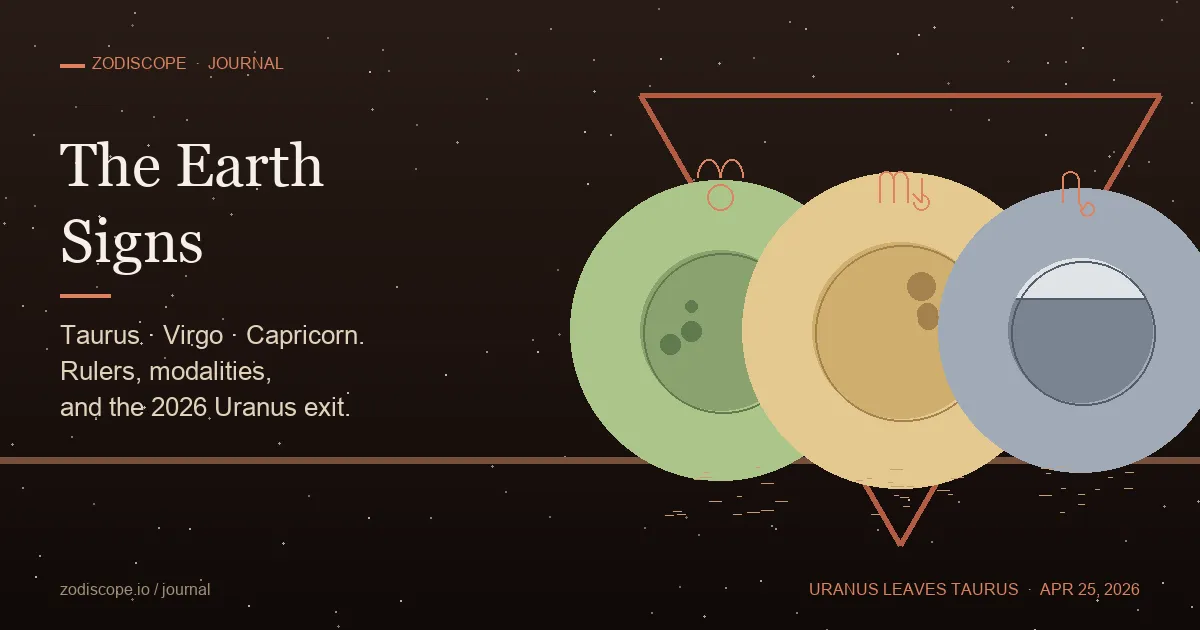
The three earth signs are Taurus, Virgo, and Capricorn. They share the same classical element — earth — and that's the part the generic listicles tell you correctly. The part they almost always skip is the dignity inversion that's structurally unique to this element: Taurus holds the exaltation of the Moon (the Moon's highest dignity outside its own house), and Capricorn holds the detriment of the Moon (the Moon's worst placement in the zodiac). Same element. Opposite poles of the same planet. No other element does that with the Moon. Add in that Capricorn is also where Mars is exalted while Taurus is where Mars is in detriment — and you have an element where the two outer signs have the Moon's and Mars's scoreboards completely flipped between them. That dignity-inversion is the actual reason Taurus and Capricorn feel like opposite personalities of the same operating system, and most beginner explainers don't mention it at all.
A real number first, because we like to anchor things in data: Pew Research's fall 2024 survey of 9,593 U.S. adults found that 27% of Americans believe in astrology, and the demographic doing the most believing — by a wide margin — is women aged 18 to 49, of whom 43% say astrology can affect people's lives. Earth-sign content tends to be the most under-served slice of that audience, because the listicles all flatten Taurus, Virgo, and Capricorn into "practical, grounded, hardworking" and call it a day. That is the audience that searches "what are the earth signs," and the existing answer they get is almost always the same recycled three paragraphs. This is the longer version.
Below: the plain definition, the modality that actually differentiates the three, the traditional rulers (Saturn-Mercury-Venus, in that order from Capricorn down), the 2027 calendar for the earth signs (Jupiter's July 26 entry into Virgo, Mars retrograde over early Virgo before it, Saturn's square to Capricorn, and the first full year since 2007 with no outer planet in an earth sign) plus the dignity-inversion paragraph the rest of the internet skips, and links into the full per-Moon-sign reads for each.
Don't know which earth sign placements you have? Pull your free birth chart on ZodiScope and see whether Taurus, Virgo, or Capricorn shows up as your Sun, Moon, rising, or any of the personal planets. Takes about a minute.
Run the free birth chart calculator →The plain definition
The zodiac's twelve signs are sorted into four classical elements — fire, earth, air, water — three signs per element. The earth signs are:
- Taurus — roughly April 20 to May 20. Fixed earth. Ruled by Venus. The Moon's exaltation; Mars's detriment.
- Virgo — roughly August 23 to September 22. Mutable earth. Ruled by Mercury (and Mercury's exaltation, the only sign where the ruler and the exaltation are the same planet).
- Capricorn — roughly December 22 to January 19. Cardinal earth. Ruled by Saturn. The Moon's detriment; Mars's exaltation; Jupiter's fall.
"Earth" is shorthand for a temperament. In the classical-elements scheme inherited from Hellenistic astrology, earth signs handle the embodied, material, productive register — the part of you that organizes the body, the house, the calendar, the money, and the long-term plan. Fire signs handle drive and self-expression. Air signs handle thought and language. Water signs handle the emotional, receptive, intuitive register. The four elements are not meant to be ranked; they describe four different operating systems the same person can have running in different parts of their chart. For the contrasting element read, the water signs guide walks through Cancer, Scorpio, and Pisces in the same shape.
Almost everyone has earth-sign placements somewhere in their chart, even people whose Sun is in a fire, water, or air sign. Your Sun is in one sign; your Moon is in another; your rising is in a third; Mercury, Venus, Mars, Jupiter, Saturn, and the outer planets are in nine more. The number of "earth signs" you have isn't determined by your birthday — it's determined by where the personal and outer planets fell at the moment you were born. The birth chart reading walkthrough covers how to pull the whole picture; the ZodiScope Big 3 calculator covers the quick version.
The modality is what actually differentiates them
The single biggest thing the generic listicles get wrong about earth signs is treating them as basically interchangeable variations on "practical." They're not. Each one occupies a different modality — cardinal, fixed, or mutable — and that modality changes the shape of how the earth element actually behaves:
- Fixed earth = Taurus. Fixed signs sustain and accumulate. Taurus is the earth sign whose first instinct is to hold something material — a body, a possession, a habit, a relationship — and stay with it. Ruled by Venus, the same planet that rules Libra, but routed through earth instead of air: where Libra Venus organizes through aesthetics and partnership, Taurus Venus organizes through the body and the senses. The lived experience is the slowest, most weather-resistant of the twelve signs — Taurus doesn't initiate the project, and doesn't reinvent it; it stays with what it has built until it stops being livable.
- Mutable earth = Virgo. Mutable signs adapt and refine. Virgo is the earth sign whose default state is editorial — the placement that organizes the material world by analyzing it, breaking it down, and improving the parts that aren't working. Ruled by Mercury, the same planet that rules Gemini, but routed through earth instead of air: where Gemini Mercury circulates information, Virgo Mercury filters it. Mercury is also exalted in Virgo (the only sign where a planet's domicile and exaltation coincide), which is why the placement is associated with such an unusual amount of precision. The lived experience is the most procedural of the twelve signs — Virgo is the part of the zodiac that notices the misalignment before anyone else does.
- Cardinal earth = Capricorn. Cardinal signs initiate. Capricorn is the earth sign that starts the structural project — the institution, the long career, the ten-year plan, the responsibility no one asked it to take. Ruled by Saturn (the planet of time, structure, and consequence), Capricorn inherits the appetite for delayed gratification that no other sign in the zodiac comes close to. The lived experience is the longest planning horizon of the twelve signs — Capricorn is the part of the chart that decided at 22 what it wanted at 52, and got it.
If you only remember one thing from this section: fixed earth holds, mutable earth refines, cardinal earth builds. Taurus's earth is the field. Virgo's earth is the harvest sorted into bushels. Capricorn's earth is the silo. They are not three flavors of the same thing.
Taurus in one section
Taurus is the fixed earth sign, ruled by Venus — the same planet that rules Libra, but routed through the body instead of the room. The pop-astrology version is "Taurus is stubborn and loves luxury." The practitioner read is closer to fixed-Venus settling: this is the sign that finds something it loves — a person, a craft, a house, a meal, a piece of music — and stays with it for thirty years. The famous stubbornness is the back end of the same trait; what looks like immovability from the outside is, from the inside, the placement refusing to break with a thing it has slowly built attachment to.
Structural fact most articles skip: Taurus is the exaltation of the Moon — meaning the Moon (the planet of emotional baseline, the body, and safety) is operating at its second-strongest dignity inside Taurus. Anyone with a Moon in Taurus has the Moon's signal amplified by the sign it's in — the placement most often described as "the most emotionally settled placement on the wheel." That same article also covers Uranus's 7-year transit of Taurus and what its April 25, 2026 exit meant for Taurus Moons specifically. For the rising-sign version of the Taurus signature, the Taurus rising deep-dive walks through Venus-ruled ascendants and the same Uranus exit.
The Taurus Sun pattern at scale: long-arc careers built on a single craft that the person refuses to abandon even when the market or the genre moves on. Adele (May 5, 1988) is the most legible contemporary example — a Taurus Sun who has put out four studio albums in thirteen years, each one slower and more deliberate than the pace of the industry, each one waiting until the work is finished before it ships. Stevie Wonder (May 13, 1950), Janet Jackson (May 16, 1966), and George Clooney (May 6, 1961) are the longer-arc examples of the same pattern — the Taurus engine is the multi-decade career, not the one-album moment. For the full sign read with the current sky, see the complete Taurus profile.
Virgo in one section
Virgo is the mutable earth sign, ruled by Mercury — and the only sign in the zodiac where the ruling planet is also in its exaltation. That coincidence is structural, not decorative: it means Mercury (the planet of language, analysis, and editorial discernment) is operating at maximum strength inside Virgo, in a way it doesn't even reach in its other domicile, Gemini. The pop-astrology read is "Virgo is critical and perfectionist." The practitioner read is closer to Mercury exalted on earth: the placement notices the misalignment because Mercury's job is to notice things, and earth's job is to ground that noticing in the material world rather than abstract conversation.
The famous Virgo "service" theme is downstream of that: when you can see the misalignment that other people can't see, you tend to end up fixing it for them. Moon in Virgo specifically is the peregrine Moon that runs on Mercury — meaning the emotional baseline is being processed through analysis rather than direct feeling, which is the actual reason Virgo Moons are stereotyped as "anxious" (they're not anxious; they're computing). The Virgo rising guide covers the surface version of the same signature, including the rare March 3, 2026 lunar eclipse that landed at 12°54' Virgo on the Ascendant for anyone with a 10°–16° Virgo rising.
The Virgo Sun pattern at scale: long careers built on a craft of refinement — editing, curating, naming, sorting, getting the detail right at a level the audience doesn't consciously register but absolutely feels. Beyoncé (September 4, 1981) is the highest-profile contemporary Virgo Sun, and the precision-engineered rollouts and album cycles are the textbook signature — every detail accounted for, nothing left to chance, the Virgo Mercury operating at scale. Zendaya (September 1, 1996), Keanu Reeves (September 2, 1964), and Idris Elba (September 6, 1972) round out the contemporary list. For the full sign read, the complete Virgo profile covers the current sky.
Curious which earth sign placements are loud in your chart? ZodiScope shows every planet's sign and degree on one screen — not just your Sun. Most people with a fire, air or water Sun are surprised by how much earth shows up underneath, especially in Mercury and Saturn.
See your full chart on ZodiScope →Capricorn in one section
Capricorn is the cardinal earth sign, ruled by Saturn — the planet of time, structure, limits, and consequence. The pop-astrology version is "Capricorn is ambitious and cold." The practitioner read is closer to cardinal earth carrying Saturn's signal: this is the sign that initiates structural projects, takes on responsibility at ages other people refuse it, and operates on a planning horizon measured in decades, not years. The "coldness" is downstream of that — when your time scale is "what do I want this to look like in 2046," your bandwidth for performative warmth in the present is just lower than someone running on a daily emotional metabolism.
Structural fact most articles skip: Capricorn is the detriment of the Moon — meaning the Moon (safety, the body, emotional baseline) is operating at its weakest in the zodiac inside Capricorn. Moon in Capricorn covers what that actually feels like on the inside — not "broken" or "dysfunctional," but the project of finding emotional safety inside a Saturn-ruled sign that wants productivity rather than rest. Capricorn is also where Mars is exalted, which is why the placement has the appetite for sustained, disciplined action that Mars-ruled Aries (which is cardinal fire and burns out faster) doesn't have. Same planet, different routing: Aries Mars is the sprint, Capricorn Mars is the marathon.
The Capricorn Sun pattern at scale: 30+ year career arcs in industries that reward institutional persistence. Michelle Obama (January 17, 1964 — Capricorn Sun) is the cleanest contemporary example — Harvard Law, hospital VP, First Lady, post-White House publishing empire, all stacked in sequence, none of it luck. Denzel Washington (December 28, 1954), Dolly Parton (January 19, 1946), Martin Luther King Jr. (January 15, 1929), and Muhammad Ali (January 17, 1942) are the longer-arc examples of the same pattern — the Capricorn engine is structural authority earned over decades, not borrowed. For the full sign read with the current sky, see the complete Capricorn profile.
The dignity inversion: the structural fact unique to earth
This is the section you won't find on Allure, Cosmopolitan, or Co—Star, and it's the actual structural reason Taurus and Capricorn feel like opposite personalities of the same operating system. In Hellenistic astrology, each planet has four "essential dignities" — the signs where it's strongest (domicile, exaltation) and weakest (detriment, fall). The Moon's dignities are:
- Moon domicile: Cancer (water)
- Moon exaltation: Taurus (earth)
- Moon detriment: Capricorn (earth)
- Moon fall: Scorpio (water)
Earth holds the Moon's exaltation in one sign and its detriment in the opposite sign. Same element. Opposite poles of the same planet. No other element does that with the Moon — water holds the Moon's domicile and fall (Cancer and Scorpio), fire and air hold no Moon dignities at all. Earth is the only element that contains the Moon's highest and lowest scores. That is the reason a Taurus Moon and a Capricorn Moon are nothing alike inside, despite both being "earth Moons" on a beginner chart.
Then it happens again — with Mars. Mars's dignities are:
- Mars domicile: Aries (fire), Scorpio (water)
- Mars exaltation: Capricorn (earth)
- Mars detriment: Taurus (earth), Libra (air)
- Mars fall: Cancer (water)
Same pattern. Earth holds Mars's exaltation in one sign (Capricorn) and Mars's detriment in the opposite sign (Taurus). And the inversion is exactly flipped from the Moon's: where Taurus is the Moon's exaltation, it's Mars's detriment; where Capricorn is the Moon's detriment, it's Mars's exaltation. Two of the most personally-loaded planets in the chart — emotional safety and assertive drive — have their dignity scoreboards completely swapped between the two outer earth signs. That is the structural reason Taurus reads as soft-bodied and slow-to-anger while Capricorn reads as disciplined and willing to fight: it is not personality, it is dignity. For more on how dignity actually works at the degree level, the degree theory primer covers the sub-sign machinery.
Is 2027 a good year for the earth signs?
From late July, yes, and more clearly than for any other element. Jupiter enters Virgo on July 26, 2027 and stays until August 23, 2028: the first earth-sign Jupiter since it left Taurus in 2024, a conjunction for Virgo and a trine for Taurus and Capricorn. Say the dignity plainly, because most previews won't: Jupiter in Virgo is in detriment, the sign opposite its Pisces home, so its gains come through routines, health, work and the details it usually skips. The other structural change is an absence. Pluto left Capricorn for good in November 2024 and Uranus left Taurus for good on April 25, 2026, which makes 2027 the first full calendar year since 2007 with no outer planet in an earth sign. The earth signs hosted Pluto, Uranus or both for almost every month between November 2008 and April 2026. That particular pressure is gone, though Capricorn still has Saturn's square, Taurus the eclipse squares and early Virgo the Uranus square.
1. Virgo: Mars first, then the eclipse that closes a series, then Jupiter. The year opens with Mars stationing retrograde at 10°26′ Virgo on January 10; it backs out into Leo on February 21, returns to Virgo on May 14 and clears its shadow on June 7, so Virgo placements from 0° to 10° take three Mars passes across the cycle, the last finishing in early June. The February 20, 2027 penumbral lunar eclipse at 2°06′ Virgo is the last of the Virgo–Pisces eclipse series that started in September 2024. Then Jupiter arrives July 26, reaches 7°51′ Virgo by September and 24°49′ Virgo by December, and the Sun-Jupiter conjunction on August 31 at 7°42′ falls on the Virgo New Moon (8°06′): a new moon, the transit's peak day and the sign's own season in one date. Uranus at 1°41′ to 9°57′ Gemini squares early Virgo all year, which is the honest caveat for the first decan. The Virgo rising guide and Moon in Virgo take it by house and by Moon.
2. Taurus: Uranus gone, eclipses squaring, Jupiter trining from July. For the first time since May 2018 there is no Uranus anywhere in Taurus, and no return coming. Uranus has left, but three fixed-sign eclipses still square the sign: 17°38′ Aquarius on February 6 (the third of the Leo–Aquarius family that began in February 2026), 9°55′ Leo on August 2 (the century's longest total solar eclipse) and 24°12′ Aquarius on August 17, which touch Taurus placements near 18°, 10° and 24°. Pluto sits at 4°21′ to 7°10′ Aquarius, squaring the first decan. From July 26 the Jupiter trine from Virgo covers 0° to about 27° Taurus by year end. The Taurus New Moon falls May 6 at 15°42′, the Full Moon November 14 at 21°31′, and Venus, the sign's ruler, is home May 14 – June 7, 2027 with no retrograde anywhere in the year. Moon in Taurus and Taurus rising have the first-year-without-Uranus read.
3. Capricorn: the ruler squares the sign all year. Saturn, Capricorn's ruler, is in Aries and in its fall, and it squares Capricorn placements from 8°20′ to 27°53′ across the year: it crosses 15° Aries on March 17, 21° on May 4, stations retrograde at 27°53′ on August 9 and stations direct at 21°01′ on December 23, so 22° to 27° Capricorn takes the square three times. Neptune at 1°43′ to 6°39′ Aries squares the first decan. The July 18, 2027 lunar eclipse at 25°49′ Capricorn is borderline, so shallow that some almanacs list it as a plain full moon; treat it as a strong Capricorn Full Moon rather than an eclipse. On the plus side: the Jupiter trine from Virgo after July 26, two Capricorn New Moons (January 7 at 17°18′, December 27 at 5°50′), and Venus in the sign twice, February 3 – February 28, 2027 and November 25 – December 18, 2027. Moon in Capricorn covers the Saturn square from the inside.
If you have Taurus, Virgo or Capricorn in your Big Three, 2027 splits at July 26. Before it: Mars retrograde on early Virgo, eclipse squares on Taurus, Saturn's square building on Capricorn. After it: the first earth-sign Jupiter in three years, trining the other two. Better than 2026 for Virgo and Taurus, and a real second half for Capricorn; worse than 2026 only for Capricorn placements in the 22° to 27° band, which take Saturn's square three times. The Mercury retrograde 2027 piece covers the smaller weather: three retrogrades that begin in water and end in air, none of them in earth.
How the earth element shows up in your chart, even if your Sun isn't an earth sign
The most common mistake beginners make is treating "earth signs" as a yes/no question about the Sun. It isn't. Every chart has ten planets and twelve houses, and the earth-sign distribution across them is what actually matters. The places to look:
- Your Moon sign. If your Moon is in Taurus, Virgo, or Capricorn, you have an earth Moon — meaning your emotional baseline runs in the material-and-procedural register regardless of what your Sun does. This is the single most underrated placement in pop astrology, and it's why "I'm a Gemini Sun but I feel like a Capricorn" is the most common report when fire-and-air Suns first see their full chart. The Moon sign compatibility piece covers how earth Moons pair with the other elements.
- Your rising sign. The Ascendant determines the rest of the chart's house structure. An earth rising — Taurus, Virgo, or Capricorn rising — is the body and surface most people read as "grounded" or "competent." Roughly 95% of people don't know their rising sign because they've never pulled their birth-time chart.
- Your Venus sign. Venus in an earth sign loves through the body, the routine, the shared house, the accumulated history. The Venus sign meaning piece walks through all twelve Venus signs in detail — earth Venuses tend to be the slowest to fall and the slowest to leave.
- Personal planets in earth. Mercury in an earth sign thinks in checklists and material constraints, not metaphors. Mars in an earth sign builds the project before announcing it. Saturn in an earth sign — and many Millennials have one, since Saturn was in Capricorn from 2017–2020 — operates at home in the structural-discipline register.
- Stelliums or piled-up placements in 2nd, 6th, or 10th houses. These are the three earth houses — the natural homes of Taurus, Virgo, and Capricorn respectively (money/values, work/health, career/legacy). The stellium primer covers what it means when multiple planets stack in one of those houses. A chart with multiple planets in 2nd, 6th, or 10th operates in the earth register even if the actual signs involved aren't earth signs.
The honest practitioner read: most people with strong earth in their charts already know it. You don't need an astrologer to tell you that you'd rather build the thing than talk about it — you've been doing it your whole life. What the chart does is name the part of you that was already doing the work, and connect it to a planet, a sign, and a calendar of transits that will activate it. For the full guide, the birth chart explainer covers what each placement actually means.
The honest version: what the earth signs actually struggle with
No element is "the best" element — every elemental temperament has a failure mode it's structurally prone to. The earth signs' shared shadow patterns, in the order they cost people the most:
- Treating effort as the only legitimate currency. Earth signs reliably overestimate how much effort the situation requires and underestimate how much rest, play, or non-productive time it would tolerate. The shadow form is the person who can't enjoy the weekend because there are still emails. Taurus is the most likely to override this with sensory pleasure; Virgo is the most likely to convert it into a chore list; Capricorn is the most likely to ignore it until the body forces a stop.
- Confusing security with control. The earth-sign nervous system reads "material stability" as "safety," which is mostly correct but becomes a problem when the placement starts using control of the material world as a proxy for emotional regulation. The fix is not less competence; it's noticing the moments when the spreadsheet, the routine, or the financial plan is being asked to do work that actually belongs to a feeling.
- Slow to update beliefs after the data changes. Fixed earth (Taurus) is the most structurally prone to this, but all three signs share a version: the body trusts what it has already verified, which means the placement can be running a model of the world that was accurate in 2018 long after the world has moved. The countermove is the deliberate, scheduled check-in with reality — not the immediate pivot that fire signs do, but the quarterly reread.
- Quiet judgment of less-grounded people. Earth signs see fire's combustion and water's emotional flooding and air's theorizing as luxuries the earth sign is paying for. The judgment is often correct in specific cases and almost always wrong as a default — earth doesn't see its own dependence on the other elements to convert its work into meaning, beauty, motion, and connection. The practitioner-level move is to name the trade openly: I built the thing; you made it matter.
In 2027 the earth signs get to renegotiate security versus control without an outer planet sitting on them, Capricorn excepted. No outer planet sits in an earth sign for the first full year since 2007; what arrives instead is Jupiter in Virgo from July 26, which rewards the quarterly reread rather than the white-knuckle grip. Capricorn is the exception, with Saturn's square running all year. Staying grounded is still the goal. The work is learning which kind of grounding is real, and which is just gripping the wheel harder.
Stop reading the wrong horoscope. Pull your full birth chart on ZodiScope: see every earth-sign placement in your chart, watch Jupiter's 2027 pass through Virgo and Saturn's square to Capricorn land on each one by degree, and read the personalized monthly forecast that comes out of it.
Get your free birth chart →Keep reading
- · The earth signs (and the other nine) as boyfriends — including why Mars is exalted in Capricorn and in detriment in Taurus: zodiac signs as boyfriends, all 12 by modality, ruler, and Mars's dignity.
- · The earth signs (and the other nine) as girlfriends: zodiac signs as girlfriends — all 12 by element, ruler, and the Sun's dignity.
- · The three earth Moons, in depth: Moon in Taurus — the exalted Moon and Uranus's final pass, Moon in Virgo — the peregrine Moon that runs on Mercury, and Moon in Capricorn — the Moon in its detriment, the single hardest lunar placement.
- · The earth-rising deep dives: Taurus rising: the Venus-ruled ascendant after seven years of Uranus on the 1st house and Virgo rising: the other Mercury-ruled ascendant, with Jupiter arriving on the 1st house in 2027.
- · The other element guides: What are the water signs? Cancer, Scorpio, Pisces and the Moon's two extremes, What are the fire signs? Aries, Leo, Sagittarius and the year's fire calendar, and What are the air signs? Gemini, Libra, Aquarius and the relational-ruler thesis.
- · The transit that put Capricorn's ruler in its fall: Saturn conjunct Neptune at 0° Aries: the once-in-36-years reset, and where it goes next: Saturn in Aries, 2026 to 2028.
- · Venus on earth: Venus sign meaning — what your Venus placement actually says about how you love (all 12 signs).
- · Beginner tools: the free sun, moon & rising calculator (or the free birth chart calculator for every planet), the rising sign guide, and the full birth chart reading walkthrough.
- · The year's ranking, with Virgo's Jupiter arrival and Capricorn's Saturn square placed against the other ten signs: Lucky Zodiac Signs 2027: the full luck ranking, with exact dates and Unlucky Zodiac Signs 2027.
- · Sign profiles: Taurus, Virgo, Capricorn, or all journal articles.
FAQ
What are the three earth signs in astrology?
The three earth signs are Taurus (April 20 – May 20), Virgo (August 23 – September 22), and Capricorn (December 22 – January 19). They share the earth element — the classical-elements grouping for the embodied, material, structural register of the zodiac — but they are deliberately different from each other in modality. Taurus is the fixed earth sign (holds, accumulates, settles into the body), Virgo is the mutable earth sign (analyzes, refines, edits the material world), and Capricorn is the cardinal earth sign (initiates structure, builds institutions, takes responsibility). Their rulers are different too: Taurus is ruled by Venus, Virgo is ruled by Mercury (the only Mercury-ruled earth sign), and Capricorn is ruled by Saturn. Same element, three completely different operating systems.
What do earth signs have in common?
Three things. First, they process the world through material reality — what you can touch, build, schedule, measure, or eat — before they process it emotionally or theoretically. The fire signs trust drive, the air signs trust thought, the water signs trust feeling; the earth signs trust whatever they can verify with the body. Second, they have a relationship to time that the other elements don't — earth signs tend to think in years and decades, not in moods or moments, which makes them the planners and finishers of the zodiac. Third, they all care more about results than appearances. The shared traits are real, but they get expressed very differently: Taurus's slow accumulation, Virgo's surgical refinement, and Capricorn's institutional climb are not interchangeable.
Does Jupiter in Virgo help Taurus and Capricorn too, or only Virgo, in 2027?
All three, in different measure, from July 26, 2027. Virgo gets the conjunction: Jupiter reaches 1°12′ Virgo by the start of August, 7°51′ Virgo by September, 20°17′ Virgo by November and 24°49′ Virgo by December, so Virgo placements from 0° to about 27° take the exact pass before the year ends (Jupiter is near 27° by New Year), and the Sun-Jupiter conjunction on August 31, 2027 at 7°42′ lands the same day as the Virgo New Moon at 8°06′. Taurus and Capricorn get the trine, the easiest aspect Jupiter makes, over the same degree range. Two caveats. Jupiter in Virgo is in detriment (Virgo is opposite its Pisces home), so this is a careful, small-print Jupiter rather than a windfall one. And the trine doesn't cancel the harder contacts: Saturn squares Capricorn from 8°20′ to 27°53′ Aries all year, and the eclipses at 17°38′ Aquarius, 9°55′ Leo and 24°12′ Aquarius square Taurus.
Which earth sign is the most grounded?
The honest practitioner answer is that the question is malformed — all three are grounded, but they're grounded in different parts of the material world. Taurus's groundedness is sensory and possessive: the body, the home, the bank account, the slow Sunday. It's the kind of grounded that a chair is. Virgo's groundedness is procedural and informational: the spreadsheet, the to-do list, the routine, the editorial pass. It's the kind of grounded that a checklist is. Capricorn's groundedness is structural and institutional: the career ladder, the long-term plan, the legacy, the responsibility you took on at 19 that other people would have refused. It's the kind of grounded that a building is. Generic listicles will tell you Taurus is the most grounded because they're imagining a bull standing in a field — but anyone with a Capricorn ascendant or a Virgo Mercury knows which one of the three has the longest planning horizon.