Birth Chart
What Is a Stellium? Plain Definition, Real Examples
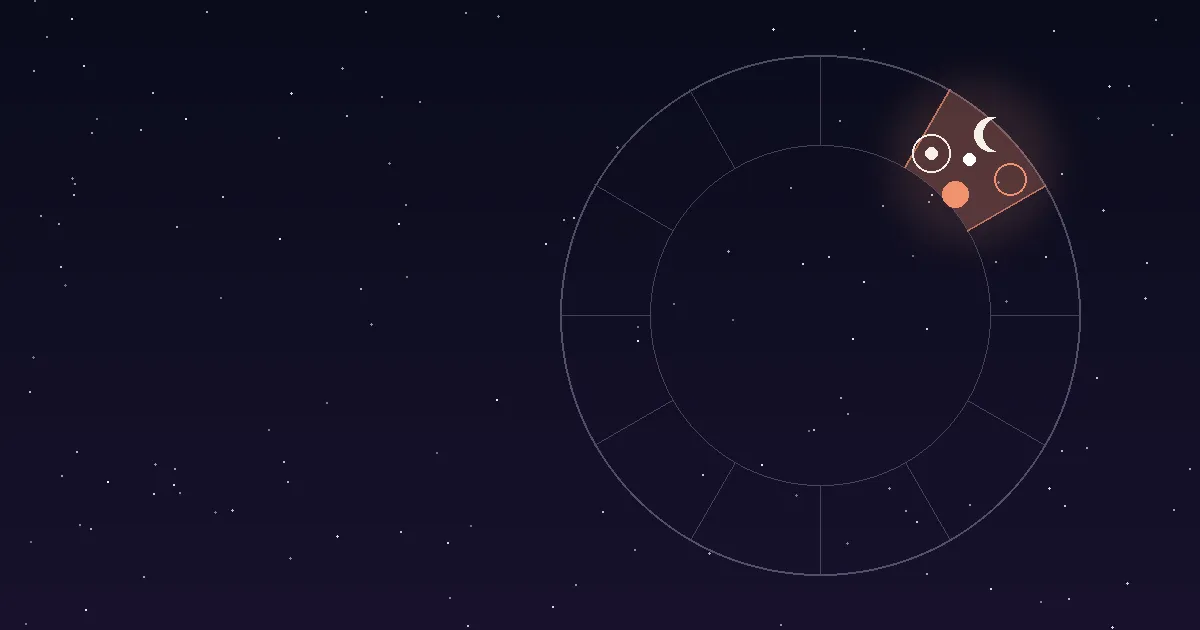
A stellium is the simplest "advanced" concept in astrology: a cluster of three or more planets sitting in the same sign or the same house of a birth chart. That's it. The confusion starts immediately afterwards, because named astrologers disagree on the minimum count, on whether the Sun and Mercury "really" count, on how strict the orb should be, and on whether a generational outer-planet pile-up means anything personal at all.
This guide is a plain answer, with the disagreements named openly and the 2026 sky used as a working example — including the once-rare six-planet stellium on January 18, 2026 and the five-planet Aquarius stellium that ran through late February. By the end you should be able to look at a natal chart and tell whether what you're seeing is a real stellium, a fake-looking stellium, or just an inner-planet cluster doing what inner planets do.
Want to see whether you have a stellium without having to count anything yourself? Get your free birth chart on ZodiScope — every planet, sign, and house in under a minute.
Get your free birth chart →The plain definition (and where astrologers actually disagree)
Three or more planets in the same sign or house. That's the definition you'll see on roughly nine of the ten page-one search results. It is also the loosest possible version of the concept, and it papers over a real disagreement.
Chani Nicholas uses three: "a stellium (i.e., group of three or more planets in the same sign)." Bonnie Gillespie agrees and pushes back on stricter definitions directly — her line is "why so strict?" because gatekeeping the count excludes most people from a concept that's meant to describe concentrated energy. Alice Sparkly Kat draws a harder line: "a stellium is when four or more planets are all in one sign or house of a chart." That's not nitpicking. It changes who has one. A three-planet definition catches 30 – 40% of all natal charts. A four-planet definition catches roughly 3 – 10%.
Here's the rule I'd actually use, having read both sides:
- Three planets is enough to name a stellium — fine for SEO, fine for tarot decks, fine for casual chart talk.
- Four planets is when the placement starts behaving like a single body of influence, not three separate ones. It shapes how you move through the world.
- If the three planets are Sun, Mercury, Venus — exclusively — your "stellium" is the inner-planet cluster doing what it does every year. Mercury never strays more than 28° from the Sun and Venus never more than 48°. A Sun-Mercury-Venus stellium in one sign is a high-probability event, not a personal signature.
- If outer planets (Saturn, Uranus, Neptune, Pluto) are in the cluster, the stellium tilts towards the generational. Useful for understanding context, less useful for personality reads.
The other piece astrologers don't talk about enough: tightness matters. Three planets stretched across 28° of a sign behave differently from three planets crammed inside a 4° window. A tight stellium fuses; a wide one just shares a tone. If your three planets are at 2°, 17°, and 27° of Leo, that's three Leo placements that happen to share a sign — not one Leo conglomerate.
Sign stellium vs house stellium: they answer different questions
Every guide mentions both. Most don't tell you why you need both. They answer different questions:
| Type | Answers | Example |
|---|---|---|
| Sign stellium | How the cluster behaves — element, mode, ruling planet | Three planets in Scorpio → intense, fixed, water; Pluto-ruled |
| House stellium | Where in your life it shows up | Three planets in the 10th house → career and public life |
| Both | Strongest configuration — quality and life-area aligned | Capricorn stellium that all sits in the 10th house |
Whole-sign astrology often collapses these into one — if your Aries rising puts Aries on the 1st house cusp, then an Aries sign stellium is a 1st-house stellium. In Placidus or other quadrant houses, sign and house can diverge sharply, and you can have a sign stellium that splits across two houses. If that happens to you, both are real; you just have to read them as two distinct emphases.
Alice Sparkly Kat's framing is worth quoting on this: "when a bunch of your planets are in one part of your chart, the houses that those planets rule over always come back to the same area of life." That's the under-discussed second-order effect. A 10th-house stellium isn't just loud at work — every house ruled by a planet in that stellium gets pulled towards the 10th. It's the closest astrology gets to a pulley system.
Don't know your houses yet? Pull your full natal chart on ZodiScope — sign, house, and planet for every placement, with the stellium highlighted automatically.
See my chart →Stellium by house: what each one actually emphasises
A short scan of what a stellium tends to amplify when it lands in each of the twelve houses. Useful as a starting point, not a verdict — the planets and signs involved change the colour. For the full house breakdown, read the 12 houses in your birth chart, explained.
| House | What a stellium here emphasises |
|---|---|
| 1st | Identity, appearance, the first impression. People feel the sign before you speak. |
| 2nd | Money, values, self-worth, what you keep close. |
| 3rd | Communication, siblings, the local environment, daily thinking. |
| 4th | Home, family, lineage. The literal physical home is often unusually load-bearing. |
| 5th | Creativity, romance, children, performance. The "shine" house. |
| 6th | Work, routines, health, service. Life organised around the daily craft. |
| 7th | Partnership — romantic, business, and open enemies. You move through life paired. |
| 8th | Other people's money, intimacy, death, transformation. The deep-water house. |
| 9th | Higher learning, travel, philosophy, publishing. The horizon-expanding house. |
| 10th | Career, public role, legacy, the title on the building. |
| 11th | Friends, networks, the future, large groups, ideologies. |
| 12th | Hidden things, solitude, undoing, the inner life, what you carry alone. |
The 2026 sky has been unusually stellium-heavy
Natal stelliums are about who you are. Transit stelliums — temporary pile-ups in the current sky — are about what the weather is doing to everyone at once. 2026 has had two of the year's largest before we're even halfway through it.
January 18, 2026 — six planets at the Capricorn / Aquarius hinge
On the day of the Capricorn new moon, the sky held six planets in a tight band: Mercury and Mars conjunct at roughly 26° Capricorn, the Sun and Moon (the new moon itself) at 28°43′ Capricorn, and Venus and Pluto at 1° and 3° Aquarius respectively. That's six bodies inside roughly 7° of zodiac — the kind of pile-up that happens once or twice in a decade at this density. Anyone with personal placements between late Capricorn and early Aquarius woke up that day inside a transit stellium, whether they noticed or not.
February 23 – March 2, 2026 — five planets in Aquarius
Six weeks later, a second large stellium: Sun, Mars, Mercury, Venus, and the lunar north node all gathered in Aquarius for a week. Pluto, sitting at the start of Aquarius all year, was effectively a sixth body in the room. The Aquarius themes — networks, ideologies, futures, large-group dynamics — were unusually loud across that window. If you were online in early March 2026, you felt it.
The rest of 2026 is comparatively quiet on stelliums
The lunar nodes shift from the Virgo / Pisces axis to Leo / Aquarius on July 27, 2026, and Jupiter ingresses Leo on June 30, but neither of those creates another six-planet pile-up. The two big sky stelliums of 2026 have already happened. What's left is Pluto holding the early degrees of Aquarius all year, which means anyone with personal placements at 2° – 5° of any fixed sign keeps living near the activated zone.
Famous people, real stelliums
Examples are clarifying. None of these are interpretations of the person — they're just real placements visible on public charts.
Anne Hathaway — Scorpio stellium (Sun, Mercury, Venus, Jupiter)
Four planets in Scorpio, including the Sun and Venus. This is the "passes the four-planet test" version. The cluster mixes identity (Sun), communication (Mercury), aesthetic taste (Venus), and expansion (Jupiter) all in one sign — the same archetype shapes the conscious self, the speaking voice, the look, and the appetite. It's the kind of stellium where you can read one sign and get a lot of the person.
Oprah Winfrey — Aquarius stellium
Aquarius is the sign of the audience, the network, the room full of strangers organised around an idea. A natal cluster there pulls the identity towards exactly that scale of relationship — not the close inner circle, but the broadcast. The textbook "humanitarian on a stage" pattern, which is also the textbook talk-show pattern: same astrology, different decade.
Blake Lively — Virgo stellium and a 1st-house stellium
A Virgo sign stellium that maps onto a 1st-house stellium (Sun, Mercury, Venus) plus a separate 5th-house stellium (Saturn, Uranus, Neptune). Two stelliums in one chart isn't unusual; what's unusual here is that the 1st-house cluster is all inner planets and the 5th-house cluster is all outer planets. The personal self runs Virgo; the structural / generational layer plays through the 5th house of creativity and performance. A useful chart to study if you want to see how two stelliums sound different even in the same person.
Nelson Mandela — 9th-house stellium
The 9th is the house of higher learning, foreign cultures, law, philosophy, and the long horizon. A 9th-house pile-up is the placement astrologers reach for when a life's work is the slow widening of what a society treats as legitimate to argue about. No single placement makes a person, but the 9th-house concentration is the one most worth marking here.
The generational stellium most articles skip
Here's the bit pop-astrology rarely says out loud. Anyone born roughly between 1955 and 1995 has a high statistical chance of an outer-planet stellium because Uranus, Neptune, and Pluto move slowly — they sit in the same sign for years, sometimes for over a decade.
A few specific overlaps worth knowing:
- Uranus and Pluto in Virgo (1968 – 1971): any inner planet that passed through Virgo in those years added itself to a ready-made stellium. Most early-Gen-X charts have it.
- Saturn, Uranus, Neptune all in Capricorn (1988 – 1991): three outer / structural planets in one sign for almost three years. Most charts from that window already have a Capricorn stellium before you count the inner planets.
- Uranus and Neptune in Aquarius (1998 – 2003): any millennial with a late-90s / early-2000s birth year and a personal Aquarius placement has at minimum a three-planet Aquarius stellium.
This matters because generational stelliums describe a cohort, not a person. If your stellium is half outer planets, what it's actually telling you is which historical era you grew up inside — the cultural water around you, the structural concerns of your generation, the news cycle you can't unsee. To read a generational cluster as a personal signature, you have to look at which houses those planets fall into in your chart, not the sign. House placement is what makes a generational stellium personal. The full birth-chart reading guide walks through that distinction.
How to actually find — and use — your stellium
- Pull your natal chart. Any free birth-chart tool will list planet positions by sign and house. (You can use the ZodiScope zodiac lookup or the full app.) If you don't know your exact birth time, your sign stelliums are still accurate. House stelliums require birth time.
- Count by sign first. Any sign with three or more planets is a candidate. Note whether they include the Sun, Mercury, and Venus (loose cluster) or include outer planets / Moon / Mars / Jupiter / Saturn (stronger).
- Then count by house. Same rule. Any house with three or more planets is a candidate. A house stellium without a matching sign stellium is the more practically useful of the two — it tells you where your energy goes.
- Check the tightness. Look at degrees. Three planets within 8° feel like one body. Three planets spread across 25° feel like three placements that share a flavour. Both are real; the first is louder.
- Read the cluster as one thing, not three. When transits hit a stellium, they hit everything in it at once. Alice Sparkly Kat's image is the most useful: "Think of a bunch of dominos being knocked down at once." A Saturn return to a Capricorn stellium is not one Saturn return — it's three or four in close succession.
- Don't over-read inner-planet clusters. If your stellium is Sun + Mercury + Venus only, that's the inner-planet trio doing its normal thing. Useful information, but it's the loosest possible read.
A stellium is one of the cleanest tools in astrology — it tells you, without any interpretation, where the gravity in a chart sits. The disagreement about minimum count, the inner-planet caveat, and the generational asterisk are all real, but they don't change the underlying mechanic. Find the dense part of the chart. Read the sign. Read the house. Notice when transits come through it. That's the whole technique. And if you're sceptical of all of this in the first place, that's a fair instinct — the honest, data-backed answer to "is astrology real?" is the place to start.
If a stellium lights up in your chart, the next two layers worth knowing are your rising sign (which determines how the houses are oriented in the first place) and your Venus sign if Venus sits inside the stellium. For a tighter timing read, degree theory tells you which exact degrees of each sign carry extra weight — useful when you want to know whether your cluster is hitting a critical degree.
Want to see exactly which signs and houses your planets cluster in — and which transits are about to roll through them? Get your full chart on ZodiScope. Free, takes a minute.
Get your free birth chart →Keep reading
- · The two-chart technique where a stellium activated by a partner's planet is a high-leverage signature: synastry chart free — how to read two birth charts side-by-side.
- · The companion explainer to this one: the 12 houses in your birth chart, explained — the structural piece a house stellium plays through.
- · Start from zero: birth chart reading — Big Three, planets, houses, aspects in plain English.
- · A stellium is a cluster; an aspect pattern is geometry — read birth chart aspects explained for T-squares, grand trines, grand crosses, yods, and kites.
- · Find your rising sign first: what is my rising sign — and why most horoscopes are calibrated to the wrong placement.
- · The Aquarius transit stellium of February 2026 sat on top of the once-in-36-years Saturn-Neptune conjunction — the bigger-picture story behind the early-2026 weather.
- · Jupiter changes house on June 30, 2026 when it ingresses Leo — the next big transit after the stellium-heavy first quarter.
- · The two-year Saturn story underneath all of it: Saturn in Aries 2026 — why the next two years will test your patience.
- · If your stellium includes the Moon: Moon in Cancer meaning — the only home the Moon has or Moon in Pisces meaning — what it actually feels like.
- · If your stellium includes Venus: Venus sign meaning — what your Venus placement actually says about how you love.
- · Skeptical of all this? Is astrology real? An honest, data-backed answer.
- · Track the cluster's sign specifically — the Aquarius and Capricorn sign pages, the Aquarius monthly horoscope for the rolling read.
- · A small live cluster to read: New Moon May 2026 — the Sun, Moon and Mercury gathered in Taurus on May 16.
- · Back to all journal articles.
FAQ
Do you need three planets or four for a real stellium?
Both definitions are in active use, and named astrologers disagree on this directly. Chani Nicholas and most pop-astrology sites use three or more planets in the same sign. Alice Sparkly Kat draws the line at four or more, because four is roughly where the cluster starts behaving like a single body of influence rather than a coincidence. The practical rule: three is the search-engine definition, four is when the placement actually shapes how you move through the world. If your three-planet group includes the Sun, Mercury, and Venus, it's the loosest possible read — those three travel together anyway. A stellium without the inner-planet trio is more meaningful.
Is a stellium rare?
A loose three-planet sign stellium is not rare — roughly 30 – 40% of charts have at least one if you count Sun-Mercury-Venus clusters. A tight four-planet stellium is genuinely uncommon — around 3 – 10% of charts. Five-planet stelliums are rare. Six-planet stelliums in a natal chart are extremely rare. There's also a generational effect: anyone born between roughly 1955 and 1995 has a high chance of an outer-planet stellium because Uranus, Neptune, and Pluto stayed in the same sign for years at a time and often overlapped. Yours might not feel personal — that's because half your generation has it.
What's the difference between a sign stellium and a house stellium?
A sign stellium concentrates the qualities of a zodiac sign — its element, mode, and ruling planet — across a chunk of your personality. A house stellium concentrates planetary energy into a specific area of life: home, work, partnership, identity. They answer different questions. Sign stellium tells you how the cluster behaves; house stellium tells you where in your life it shows up. The strongest configuration is when the same planets share both — three planets in Capricorn that all sit in the 10th house, for example. Then sign-quality and life-area point the same direction.
Does the January 18, 2026 stellium still affect me now?
Partially. The six-planet pile-up of Sun, Moon, Mars, Mercury, Venus, and Pluto across late Capricorn and early Aquarius on January 18, 2026 was a transit event, not a natal one — its immediate exact-conjunction window has passed. But anyone with personal placements between roughly 26° Capricorn and 3° Aquarius had a major lit-up zone in their chart that day, and Pluto's still moving through that section of Aquarius all year. The transit stellium does not stay activated; the Pluto-in-Aquarius backdrop does. If January through March 2026 felt unusually concentrated for you — for better or worse — that stellium is the most likely astrological reason.