Birth Chart
Degree Theory Astrology: What's Real, What TikTok Got Wrong, Tested on the 2027 Sky
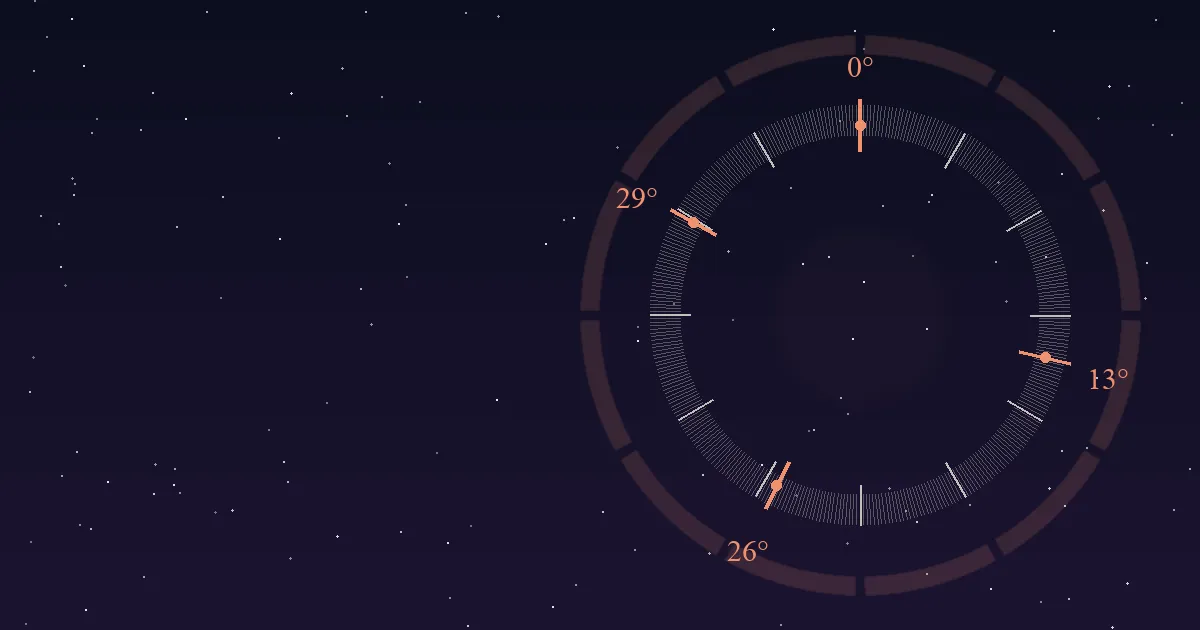
If you learned degree theory on TikTok, you've been sold a story with the dates filed off. The "secret" system flooding your FYP — your planet is at the 8th degree, that's a Scorpio degree, here's why everything makes sense now — isn't ancient Hellenistic wisdom. It is a roughly 20-year-old framework from a single Serbian astrologer named Nikola Stojanovic, who died in 2021.
The classical tradition does have degree-based techniques — the Hellenistic Egyptian terms, critical degrees, and the 29° anaretic point — but those are not the same thing as what's circulating on social. They operate by different rules, ask different questions, and were invented at least 1,800 years earlier. Here's what each one actually says, what Stojanovic added, and the specific places TikTok keeps getting the story wrong.
Quick answer
Degree theory assigns each of the 30 degrees inside a zodiac sign its own sign flavor — 8° reads as a Scorpio degree, 10° as Capricorn. The viral version comes from Serbian astrologer Nikola Stojanovic, not the classical tradition: it's a modern interpretive overlay, useful as a flavor lens but never a verdict.
Want to see the exact degree of every planet in your chart? ZodiScope gives you the full breakdown — degree, sign, house, aspects — in about 60 seconds.
Open the free birth chart calculator →What degree theory actually claims
The version on your For You page is Stojanovic's. Every sign in the zodiac contains 30 degrees, numbered 0° through 29°. Stojanovic's system assigns each of those degrees an underlying zodiac sign flavor, looping through the 12 signs in order. A note on counting before we go further: two conventions circulate in TikTok content, and they don't agree. The popular one — used by most TikTok creators and Astrology.com — reads the integer degree as the sign number, so 10° = Capricorn (10th sign). The stricter Stojanovic-purist reading treats 0°00′–0°59′ as "the 1st degree," which would make 10°25′ "the 11th degree" (Aquarius). The article uses the popular integer-mapping convention below because that's what 90% of degree-theory content uses, but the ambiguity itself is a useful signal: if a TikTok creator can't tell you which convention they're using, they probably learned the system from another TikTok.
| Degree | Sign flavor | Cycle |
|---|---|---|
| 0° | Raw / Aries (start) | Initiation |
| 1°–12° | Aries → Pisces | First cycle |
| 13°–24° | Aries → Pisces (again) | Second cycle |
| 25°–29° | Aries → Leo | Partial third cycle |
| 29° | Leo (anaretic) | Endpoint |
So a Mars at 8° Cancer picks up an "8th-sign," Scorpio-flavored undertone. A Sun at 22° Libra picks up Capricorn overtones. A Moon at 9° Taurus gets a Sagittarius twist. That's the engine — but degree work presumes you know your signs. The sun, moon and rising calculator handles Sun through Mars; the full chart takes care of the rest.
It is a clean, satisfying framework. It is also relatively new. Stojanovic was born in Belgrade in 1957 and died of Covid-19 on April 5, 2021, at age 64. His major contribution — the book The Degrees Theory: The Secret of Exact Astrology — circulated mostly through his own teaching and a small group of students. The viral TikTok adoption began roughly in 2019–2021, often without crediting him. None of this makes the system worthless. It does mean any creator who calls degree theory "ancient" or "Hellenistic" is wrong about the receipts.
What the classical tradition actually says
The classical world cared a lot about degrees — just not in the Stojanovic way. There are three pieces of the traditional system worth knowing, because they are what TikTok is usually accidentally referencing without realizing:
1. The Egyptian terms (bounds)
The Hellenistic tradition subdivides each sign into five unequal sections ruled by the five visible planets (Mercury, Venus, Mars, Jupiter, Saturn — the luminaries are excluded). These are called terms or bounds. There are three competing systems — Egyptian, Ptolemaic, Chaldean — but the Egyptian terms were the most widely used in practice, preserved by Vettius Valens, Firmicus Maternus, and Paulus Alexandrinus.
In Aries, for example, the Egyptian terms run: Jupiter from 0°–5°59′, Venus from 6°–11°59′, Mercury from 12°–19°59′, Mars from 20°–24°59′, Saturn from 25°–29°59′. So a planet at 8° Aries is in Venus's bound of Aries, and Hellenistic astrologers would read it as taking on a Venusian flavor in addition to its Aries sign placement.
The key distinction, and the one to keep front of mind every time a TikTok video reaches for "ancient wisdom" framing: the Egyptian terms ask who is the boss of a slice of the sign — they're about dignity and power. Stojanovic's degree theory asks what flavor a planet picks up at a given degree — it's about vibe. One is a structural, functional system used by working astrologers for two thousand years. The other is a 20th-century overlay. Either can be useful; they are not the same theory under different labels.
2. The classical critical degrees
A separate tradition — usually traced to the lunar mansions — identifies specific "critical" degrees that amplify a planet's energy. These are different from Stojanovic's degrees and different from the terms:
| Modality | Signs | Critical degrees |
|---|---|---|
| Cardinal | Aries, Cancer, Libra, Capricorn | 0°, 13°, 26° |
| Fixed | Taurus, Leo, Scorpio, Aquarius | 8°–9°, 21°–22° |
| Mutable | Gemini, Virgo, Sagittarius, Pisces | 4°, 17° |
A planet at a critical degree is read as amplified, urgent, or significant — but the tradition doesn't say which other sign is doing the amplifying. It just flags the degree as sensitive. When a TikTok creator says "the 22nd degree is a Capricorn degree, that's why it's fated," they're collapsing two separate traditions into one and crediting it to neither.
3. The anaretic degree (29°)
This is the one piece of the degree-meaning conversation that almost every tradition agrees on. The word anaretic comes from the Greek anairetes, "destroyer": in Hellenistic astrology the anareta was the planet that cut off the length of life, and applying the word to the 29th degree is a modern borrowing, not a Hellenistic doctrine. A planet at 29°00′ to 29°59′ of any sign has traversed the entire arc of that sign and now sits at the threshold of the next one.
Modern practice reads it as urgency, mastery, and a sense of running out of time on whatever theme the planet represents. The TikTok version flattens this into "29° is cursed." That's wrong, and it's wrong in a way that scares people unnecessarily. The truer reading: 29° is the Degree of the Master. The planet has absorbed every lesson its sign has to teach and is now being asked to either demonstrate that mastery or get jolted into the next chapter. It's high-pressure because the planet is packing its bags to leave — not because the universe is punishing you. It's a final exam, not a death sentence.
Curious whether any of your planets land on a 29° anaretic, a critical degree, or a Stojanovic-flavored degree? See your full degree-by-degree chart on ZodiScope.
Check your chart degrees →Where TikTok goes wrong
Most viral degree-theory content commits at least one of five mistakes. Watching for these is the single most useful skill if you want to use the framework without getting sucked into the bad version.
1. Calling it ancient or Hellenistic
It isn't. Stojanovic's system is roughly two decades old and not part of any classical lineage. The actual ancient degree systems — Egyptian terms, the anaretic point — are different theories with different rules. A creator saying "the Greeks knew about this" is either confused or borrowing authority they haven't earned.
2. Treating every degree as a verdict
"You have Venus at the 8th degree, that means your relationships are fated to be Scorpio-intense and probably traumatic" is not how any astrologer with traditional training would read a chart. The planet, its sign, its house, and its aspects all carry far more weight than the degree it lands on. Degree is a footnote, not the headline.
3. The 22° "death degree" panic
"The 22nd degree" became a TikTok boogeyman around 2021 — the alleged "death and killing" degree, sometimes pinned to assassinations and serial-killer charts. This is the single most toxic distortion of degree theory currently circulating, and it's straightforwardly fear-mongering. The actual claim is that 22° corresponds to Capricorn, picking up Saturnine themes of structure, fate, and consequence. Stojanovic's interest in "death degrees" came from his specific research into tragic events — not a universal law that anyone with a personal planet at 22° is doomed. If your natal Venus is at 22° Cancer, what that means is "Capricorn-flavored tenderness," not "you're going to die." Several practicing astrologers have spent the last few years walking the panic back — re-reading "kill or be killed" as metaphor and pressure, not sentence.
4. The Hitler / 25° Libra appeal
Degree-theory content loves citing Hitler's natal ascendant at "25° Libra" — a 25° = Aries warrior-degree reading — as a flagship proof the system works. Two problems. First, the chart doesn't say that: the AA-rated birth record on Astro-Databank (6:30 PM, Braunau) puts the ascendant at 26°41′ Libra — which under the popular counting is a Taurus degree, and no one's warrior story survives that. Second, even if the degree matched, cherry-picking one chart that fits the story you've already decided to tell is the definition of bad data. There are 360 degrees in a wheel and roughly 110 billion people who have ever lived; you can always find a dramatic match. The example keeps getting recycled because it's memorable, not because it's evidence.
5. Credit-stripping from Black creators
A real ongoing issue. Rolling Stone reported in 2021 on plagiarism accusations against TikTok astrologer Maren Altman, with multiple BIPOC astrologers — including @sitaradidi and AstroDim — saying content and techniques they had developed and posted were later presented as original by larger verified creators. The astrology corners of TikTok have continued to argue about this for the five years since. If you're learning degree theory from short-form video, it's worth tracing the chain back to where the content actually started.
Worked example: the 2027 sky, by both systems
Take the sky on January 1, 2027 and read five slow-moving planets first through Stojanovic's degree theory and then through the Egyptian bounds. The bounds below follow the Egyptian table as printed in Chris Brennan's Hellenistic Astrology (Table 8.3), the same table this article used for Aries above; Ptolemy's revised table splits Aries differently, and the two shouldn't be mixed. Here is where the readings split.
| Planet | Position (January 1, 2027) | Stojanovic degree | Egyptian bound |
|---|---|---|---|
| Saturn | 8°20′ Aries (direct since December 10, 2026) | Scorpio degree (8th sign) | Venus's bound of Aries (6°–11°59′) |
| Neptune | 1°43′ Aries (direct since December 12, 2026) | Aries degree (1st sign) | Jupiter's bound of Aries (0°–5°59′) |
| Jupiter | 26°26′ Leo, retrograde until April 12, 2027 | Taurus degree (26 − 24 = 2nd sign) | Mars's bound of Leo (24°–29°59′) |
| Uranus | 2°18′ Gemini, retrograde until February 8, 2027 | Taurus degree (2nd sign) | Mercury's bound of Gemini (0°–5°59′) |
| Pluto | 4°21′ Aquarius | Cancer degree (4th sign) | Mercury's bound of Aquarius (0°–6°59′) |
Saturn makes the problem easy to see, because it stays in one sign while its label keeps changing. When this article first ran in May 2026, Saturn sat at 10°25′, a "Capricorn degree" by Stojanovic's logic. At its July 26, 2026 station (14°45′) it was a "Taurus degree". On January 1, 2027 it's a "Scorpio degree". At the August 9, 2027 retrograde station (27°53′) it becomes a "Gemini degree", and at the December 23, 2027 direct station (21°01′) a "Sagittarius degree". Five snapshots, five labels, in nineteen months, while Saturn's sign condition, in fall in Aries, hasn't changed at all. Saturn crosses bounds too, and each one claims less: it is in Venus's bound in January, crosses into Mercury's at 12° (February 19) and Mars's at 20° (April 26), and enters its own bound at 25° on June 11, where it stays until the retrograde carries it back below 25° on October 10. That June 11 to October 10 window is the only stretch of the whole 2026 to 2028 transit where Saturn sits in its own Egyptian bound. Along the way it crosses the cardinal critical degrees at 13° (February 28) and 26° (June 23, then September 27 retrograde, then March 11, 2028), which is the only sense in which any classical system flags these dates as special.
Jupiter and Uranus both land on a "Taurus degree" under the integer mapping, yet one sits in Mars's bound and the other in Mercury's: the systems don't converge, and a reading that borrows the Taurus flavour from one and the ruler from the other is inventing a third system. Saturn and Neptune share a sign but not a bound (Venus's and Jupiter's), which is the whole point of bounds: sign alone doesn't settle who governs a degree. One example of the blend to avoid, from a page found in a September 2026 search: it describes 22° Libra as a Taurus degree close to a fixed critical degree. Under the integer mapping 22° is Capricorn, and Libra is cardinal, so its critical degrees are 0°, 13° and 26°. Two errors in one sentence, both from mixing systems.
Use either system, but name it, and if you combine them, say so. Many TikTok creators advertise the Stojanovic reading and then borrow the gravitas of the Hellenistic anaretic in the same video, a hybrid nobody has tested.
Two stations give degree-watchers something to test in 2027, because a slow planet near its station holds one degree for weeks (Saturn especially; Jupiter's April station is briefer). Jupiter stations direct at 16°59′ Leo on April 12: a "Cancer degree" (16 − 12 = 4th sign) inside Saturn's bound of Leo (11°–17°59′). Saturn stations retrograde at 27°53′ Aries on August 9: a "Gemini degree" inside Saturn's own bound. Write down what a Gemini-degree Saturn should look like before August, then compare notes while Saturn sits near 27° Aries through September. Saturn and Neptune also share Aries for the whole year, the pairing that defined 2026, though by 2027 they sit roughly 7° to 21° apart and the conjunction itself is history.
How to use degree theory without falling for the bad version
A short practical workflow for anyone curious about the framework but unwilling to mistake it for received wisdom:
- Find your degrees first, then look for patterns. Pull your chart, write down the degree of every personal planet (Sun, Moon, Mercury, Venus, Mars), and only then map them to Stojanovic's table. Going in the opposite direction — picking a degree and looking for a chart that fits the story — is how confirmation bias becomes a worldview.
- Treat any 29° placement seriously. This is the one degree where Hellenistic, modern, and Stojanovic systems agree something is happening. If you have a personal planet at 29°, look at what that planet rules in your chart, and notice whether you tend to operate that domain with urgency and slight overdrive.
- Notice critical degrees as secondary signals. The classical critical degrees (0°, 13°, 26° cardinal; 8°–9°, 21°–22° fixed; 4°, 17° mutable) are worth a glance but should never override sign, house, and aspect.
- Don't use degrees to predict doom. If a creator's reading of your degree fundamentally contradicts the rest of your chart, the rest of your chart is right. Degrees are a flavoring system, not a verdict.
- Credit the source. If you're going to use Stojanovic's framework, call it Stojanovic's framework. He spent decades on it. The credit is owed and the lineage matters.
Stop guessing what's happening in your chart. ZodiScope shows every planet's exact degree alongside its sign, house, and aspects — calculated from Swiss Ephemeris data with arcminute precision. Free to start.
Read my chart →The bottom line
Stojanovic's degree theory is a valid modern lens, not an ancient one. If you're going to use it, credit the man who built it and stop confusing a 20th-century overlay with two thousand years of Hellenistic dignity. The Egyptian terms and the anaretic degree predate Stojanovic by 1,800 years and operate by different rules. Knowing which framework you're inside is the difference between practicing astrology and being sold a story about your own chart.
If you want to test the framework on real data, the move is to pull your full chart, find your degrees, and treat what you learn as one signal among many — not the headline. Our birth chart reading guide walks through how the major placements actually fit together, and the houses guide covers the structure most degree-theory posts skip entirely.
Keep reading
- · The Hellenistic 29° anaretic point is the only degree-theory idea most traditional astrologers agree on — see it in context in how to actually interpret your natal chart.
- · Saturn and Neptune share Aries again through all of 2027, Saturn from 8°20′ to 27°53′ and Neptune inside 1°43′ to 6°39′: Saturn conjunct Neptune 2026, the conjunction that started it, and Saturn in Aries, the transit that continues it.
- · Houses matter more than degrees do — read the 12 houses in your birth chart explained.
- · Tightness within a sign matters too — three planets at 2°, 17°, and 27° behave very differently from three packed inside a 4° window. Read what is a stellium — plain definition and the tightness rule.
- · The angles between planets matter more than any single degree — read birth chart aspects explained — the six angles that actually matter and the orb rules almost every beginner gets wrong.
- · If you're new to all of this, start with what does my birth chart mean — a practical guide.
- · Your rising sign also has a degree, and it's the most sensitive point in the chart: what is my rising sign.
- · One of the most common "wrong" pop-astrology readings is the Moon's dignity — fixed in Moon in Pisces meaning and Moon in Leo meaning.
- · Skeptical about all of this? Read is astrology real? — an honest, data-backed answer.
- · Find your sign by birthday with the sun, moon & rising calculator.
- · A late-degree lunation in the wild: New Moon May 2026 — the super new moon at 25°57' Taurus, days before the Sun changes sign.
- · Back to all journal articles.
FAQ
Does the 2027 sky support degree theory?
Not in any way that survives a side-by-side test. The two systems divide a sign differently: Stojanovic's label changes at every whole degree a planet crosses, while an Egyptian bound ruler changes only at fixed boundaries. On January 1, 2027, Saturn at 8°20′ Aries is a Scorpio degree under the popular integer mapping and sits in Venus's Egyptian bound of Aries (6° to 12°); Neptune at 1°43′ Aries is an Aries degree in Jupiter's bound (0° to 6°); Jupiter at 26°26′ Leo, retrograde, is a Taurus degree in Mars's bound of Leo (24° to 30°). Sample Saturn at five points and you get five labels: it was a Capricorn degree (10°25′) in May 2026 and a Taurus degree at the July 26, 2026 station (14°45′). It's a Scorpio degree in January, a Gemini degree at the August 9 retrograde station (27°53′) and a Sagittarius degree at the December 23 direct station (21°01′). Its sign condition never changes: Saturn is in fall in Aries throughout. Saturn crosses bounds too, and each one only names which planet governs that stretch of the sign: it enters its own bound of Aries (25° to 30°) on June 11 and stays there until October 10, the only stretch of the whole 2026 to 2028 transit where Saturn sits in its own Egyptian bound.
Is degree theory astrology a real, traditional system?
Not in the sense most TikTok creators imply. Degree theory in its current viral form was developed by Serbian astrologer Nikola Stojanovic (1957–2021), and his book "The Degrees Theory: The Secret of Exact Astrology" is the main written source. The classical tradition has its own degree-based systems — the Hellenistic Egyptian terms (bounds), critical degrees, and the anaretic 29° — but those are different concepts with different rules. Calling Stojanovic-style degree theory "ancient wisdom" is wrong; it's a modern theory roughly 15–20 years old.
Does the 29° anaretic degree actually mean something bad?
The 29th degree is the only degree where almost every astrological tradition agrees something is happening. The word anaretic comes from the Greek anairetes, "destroyer": in Hellenistic astrology the anareta was the planet that cut off the length of life, and applying the word to the 29th degree is a modern borrowing. Modern readings frame it as urgency, mastery, and a sense of running out of time. It is not necessarily bad — a planet at 29° has traversed the entire sign and carries that sign's full lessons. Where TikTok goes wrong is treating 29° as universally cursed; the classical reading is closer to "high-stakes finale," not "automatic disaster."
What are the actual classical critical degrees?
The traditionally cited critical degrees are 0° and 13° and 26° for cardinal signs (Aries, Cancer, Libra, Capricorn), 8°–9° and 21°–22° for fixed signs (Taurus, Leo, Scorpio, Aquarius), and 4° and 17° for mutable signs (Gemini, Virgo, Sagittarius, Pisces). These come from the lunar mansions and have been carried into modern Western astrology. They are distinct from Stojanovic-style degree theory, which assigns a zodiac sign meaning to every single degree.
Should I read into my planets at "sub-sign" degrees?
Use it as a flavor lens, not a verdict. If your Mars is at 8° Cancer, Stojanovic's framework would call that a "Scorpio degree" (8 = the 8th sign), and the framing of intensified Scorpio undertones can sometimes ring true. But treat it as one signal among many: the planet's house, its aspects, its sign rulership, and your overall chart matter far more. If a degree-theory reading contradicts everything else in your chart, the rest of the chart is probably right.