Zodiac Basics
What Are the Air Signs? Gemini, Libra & Aquarius, and the 2027 Retrogrades That End in Air
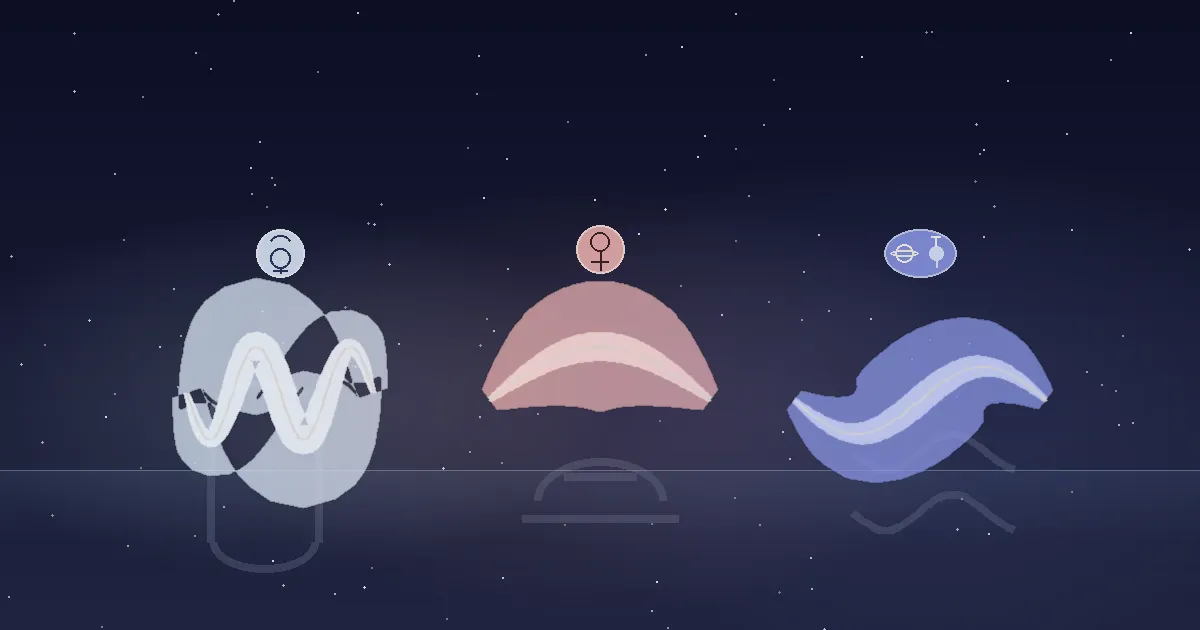
The three air signs are Gemini, Libra, and Aquarius. They share the same classical element — air — and that is where the useful similarity ends. The reason every generic listicle blends them into "intellectual, social, communicative" is that the listicle was written by someone who did not bother to look up the rulers, the modalities, or the houses. The reason this one does not is that those three details are where the actual cognition of each sign comes from — and they happen to be three of the most relationally-loaded rulerships in the zodiac. Every single air ruler — Mercury for Gemini, Venus for Libra, Saturn-and-Uranus for Aquarius — is a planet about what happens between people rather than what happens inside one.
A real number first, because we like to anchor things in data: Pew Research's fall 2024 survey of 9,593 U.S. adults found that 27% of Americans believe in astrology, and the demographic doing the most believing — by a wide margin — is women aged 18 to 49, of whom 43% say astrology can affect people's lives. About half of LGBTQ+ adults consult astrology at least yearly. That is the audience searching "what are the air signs," and the existing answer they get is almost always the same three recycled paragraphs that do not mention that Aquarius is one of only three signs (with Scorpio and Pisces) whose two rulers come from completely different eras of astronomy or that Uranus entered Gemini on April 25, 2026 for the first time since 1949. This is the longer version.
Below: the plain definition, the modality that actually differentiates the three, the rulers (Mercury, Venus, Saturn-and-Uranus, a set with one structural thing in common no other element has), the 2027 calendar for the air signs (Uranus at 1°41′ to 9°57′ Gemini all year, Pluto and two eclipses in Aquarius, Saturn opposing Libra, and three Mercury retrogrades that each station direct in an air sign) plus links into the full per-Moon-sign and per-rising-sign reads for each.
Don't know which air sign placements you have? Pull your free birth chart on ZodiScope and see whether Gemini, Libra, or Aquarius shows up as your Sun, Moon, rising, or any of the personal planets. Takes about a minute.
Get your free birth chart →The plain definition
The zodiac's twelve signs are sorted into four classical elements — fire, earth, air, water — three signs per element. The air signs are:
- Gemini — roughly May 21 to June 20. Mutable air. Ruled by Mercury — the same planet that rules Virgo. Same dispositor, opposite element.
- Libra — roughly September 23 to October 22. Cardinal air. Ruled by Venus — the same planet that rules Taurus. Same dispositor, opposite element.
- Aquarius — roughly January 20 to February 18. Fixed air. Ruled by Saturn in traditional astrology and Uranus in modern. The only sign in the zodiac with two completely different rulers from two completely different eras of astronomy, one of which was not discovered until 1781.
"Air" is shorthand for a temperament. In the classical-elements scheme inherited from Hellenistic astrology, air signs handle thought, language, abstraction, and the social space between people — the part of you that takes in information, names it, and exchanges it. Fire signs handle drive, identity, and forward motion. Earth signs handle the body and the material world. Water signs handle emotion and intuition. The four elements are not meant to be ranked; they describe four different operating systems the same person can have running in different parts of their chart.
Almost everyone has air-sign placements somewhere in their chart, even people whose Sun is in a fire, earth, or water sign. Your Sun is in one sign; your Moon is in another; your rising is in a third; Mercury, Venus, Mars, Jupiter, Saturn, and the outer planets are in nine more. The number of "air signs" you have isn't determined by your birthday — it's determined by where the personal and outer planets fell at the moment you were born. The birth chart reading walkthrough covers how to pull the whole picture; the ZodiScope Big 6 calculator covers the quick version.
The thing every air-sign listicle misses: the rulers are all relational
This is the structural fact that explains the air signs as a group, and it is not a coincidence. Pull the rulers out and look at them on their own:
- Mercury is the planet of communication, exchange, language, and the moving of information from one mind into another. It is the planet of the conversation, the contract, the message, the negotiation. Mercury without a second party is silent.
- Venus is the planet of relationship, partnership, aesthetic harmony, and the value-exchange that happens when two people meet. The full Venus sign meaning piece covers what your Venus actually says about how you love; for now the headline is that Venus is the planet of the and between two parties.
- Saturn (Aquarius's traditional ruler) is the planet of structure, time, and the social contract — the laws, institutions, and roles that organize the collective. Saturn is the planet of the agreement that holds groups together over time.
- Uranus (Aquarius's modern ruler) is the planet of disruption, invention, and the collective leap — the technology, the movement, the network that changes how the group functions. Uranus is the planet of the new connection that did not exist before.
Now compare to the other three elements: fire is ruled by Mars (action), the Sun (identity), and Jupiter (the larger self) — three planets about the self extending outward. Earth is ruled by Venus, Mercury, and Saturn — a mix, but expressed through the body and the material plane. Water is ruled by the Moon (the inner emotional life), Mars-and-Pluto (the deep drives), and Jupiter-and-Neptune (the felt larger meaning) — three pairs about the interior life. Air is the only element where every single ruler is fundamentally about what happens between two minds, two people, or two parts of the collective. Not the self. Not the body. Not the feeling. The exchange.
This is the structural reason air placements read as "social" or "communicative" in pop astrology, and it is the structural reason that read is incomplete. The actual signature is not social — it is relational. Air signs do their best thinking in dialogue, their best work in partnership, and their best invention in the network. Take Gemini out of the conversation, Libra out of the partnership, or Aquarius out of the collective, and you are looking at a placement running below its native capacity. The chart placements named in your 3rd, 7th, and 11th houses — the air-element houses in the natural zodiac — are where this signature lives.
The modality and the ruler are what actually differentiate them
The second biggest thing the generic listicles get wrong about air signs is treating them as basically interchangeable. They are not. Each one occupies a different modality — cardinal, fixed, or mutable — and a different ruler, and that combination changes the shape of how the air element actually behaves:
- Mutable air = Gemini, ruled by Mercury. Mutable signs adapt and recombine. Mercury is the fastest-moving planet in the chart, the only personal planet whose speed varies most across the sky, and the planet whose entire job is to move information from one place to another. The combination is the fastest input-to-output signature in the zodiac — Gemini is the placement that takes in three streams of conversation and synthesizes them into a fourth one before the room has caught up. The lived experience is the curiosity that does not turn off. The shadow is that the air that moves fastest also commits to the least.
- Cardinal air = Libra, ruled by Venus. Cardinal signs initiate. Venus is the planet of partnership, aesthetic harmony, and the value-exchange between two parties. The combination is the placement whose default move is to start a relationship — a creative collaboration, a partnership, a deal, an aesthetic — and to hold both sides of it in view without collapsing one. Libra is the cardinal-air sign that initiates the and. The lived experience is the eye that sees what makes the room work. The shadow is the difficulty of choosing when both sides are visible.
- Fixed air = Aquarius, ruled by Saturn (traditional) and Uranus (modern). Fixed signs sustain. Saturn is structure across time; Uranus is disruption that creates new structure. The combination is the placement that holds the long view on the collective — Aquarius is the fixed-air sign that names the pattern other people will not see for another decade, then holds it steadily until they catch up. The lived experience is the conviction about the future that does not waver. The shadow is the distance between the future-self and the people still living in the present.
If you only remember one thing from this section: mutable air recombines, cardinal air initiates, fixed air holds the long view. Gemini synthesizes the conversation. Libra starts the relationship. Aquarius sees the future. They are not three flavors of the same thing — they are three different jobs being done by three (or four) different planets in the same temperamental register.
Gemini in one section
Gemini opens the air-sign trine. It is the third sign — mutable air, ruled by Mercury, sitting on the cusp of summer in the northern hemisphere and on the symbol of the Twins. The pop-astrology version is "Geminis are two-faced." The practitioner read is closer to mutable air plus Mercury's speed: this is the placement whose entire structural job is to process and exchange information, and the apparent inconsistency reads as duplicity only to someone who expects every position to be permanent. Gemini is also the natural sign of the 3rd house — the house of communication, siblings, short journeys, and the local environment — which is why Gemini placements tend to be connected across more conversations and contexts than most other signs at the same time.
Cultural data point worth knowing: Moon in Gemini is the other Mercury Moon — same dispositor as the Virgo Moon, opposite face. Where Moon in Virgo runs Mercury's analytical, refining register, Moon in Gemini runs Mercury's circulating, connecting register — the same planet on the emotional baseline, expressed through completely different elements. And Gemini rising is the Mercury-ruled Ascendant that just left a 14-year Neptune career fog — Neptune left Pisces for good on January 26, 2026, after a first pass into Aries in 2025, finally clearing the 10th house of work and public identity for everyone with Gemini rising.
A worked example before the rolodex: Marilyn Monroe (June 1, 1926 — Gemini Sun, Aquarius Moon, Leo rising) is the textbook Gemini-Sun chart at scale — the surface that the camera could not stop describing, the ability to be three different people in three different conversations on the same day, the Mercury signature operating through performance instead of journalism. Pair that with an Aquarius Moon (fixed air on the emotional baseline — the air-sign double signature) and a Leo rising (fixed fire on the surface) and you get the chart that produced both Some Like It Hot and the late-life retreat into psychoanalysis. Paul McCartney (June 18, 1942), Angelina Jolie (June 4, 1975), and Kanye West (June 8, 1977) are the contemporary examples — different careers, same Mercury-driven multiplicity. For the full sign read, the complete Gemini profile covers traits, compatibility, and the current sky.
Libra in one section
Libra is the only cardinal air sign — meaning the only sign in the zodiac whose job is to initiate relationship. The pop-astrology version is "Libras are indecisive." The practitioner read is closer to cardinal air plus Venus's balance: this is the placement that sees both sides of every question because both sides are actually there, and the apparent indecision is the cost of refusing to collapse the picture before the picture is complete. Libra is the natural sign of the 7th house — the house of partnership, marriage, open enemies, and contractual relationships — which is why Libra placements tend to be at their best when there is another party in the room to balance against.
Cultural data point worth knowing: Moon in Libra is the other Venus Moon — same dispositor as the Taurus Moon, opposite register. Where Moon in Taurus runs Venus's earthbound, sensory, possession-oriented register, Moon in Libra runs Venus's relational, abstract, harmony-oriented register — the same planet on the emotional baseline, expressed through opposite elements. Libra is also the only sign in the zodiac symbolized by an object rather than an animal or a person — the Scales — which is the visual shorthand for what the placement is structurally doing: weighing.
A worked example: Kim Kardashian (October 21, 1980 — Libra Sun, Pisces Moon, Sagittarius rising) is the textbook cardinal-air-Sun chart in the modern era — the entire public arc structured around relationship as the primary unit (the marriages, the family, the partnership business model), the Venus-coded aesthetic eye that built a billion-dollar brand on harmony of image, and the cardinal-air ability to keep initiating new partnerships across two decades of public life. The Pisces Moon is the emotional permeability underneath; the Sagittarius rising is the mutable-fire surface; the Libra Sun is the structural reason the entire arc is pointed at relationship. Will Smith (September 25, 1968), Bruno Mars (October 8, 1985), and Gwyneth Paltrow (September 27, 1972) are the rolodex — careers built on partnership, aesthetics, and the cardinal-air ability to start the and. For the full sign read, the complete Libra profile covers traits and the current sky.
Curious which air-sign placements are loud in your chart? ZodiScope shows every planet's sign and degree on one screen — not just your Sun. Most people with a "fire sign" or "water sign" Sun are surprised by how much air shows up in their Mercury, Venus, or rising.
See your full chart on ZodiScope →Aquarius in one section
Aquarius is the third and final air sign — fixed air, ruled by Saturn in traditional astrology and Uranus in modern, sitting on the depth of winter in the northern hemisphere and on the symbol of the Water-Bearer (the figure pouring abstract knowledge out into the world — a misleading name, because Aquarius is air, not water). Aquarius is one of only three signs in the zodiac (Scorpio and Pisces are the others) with two chart rulers from two completely different eras of astronomy — Saturn was its ruler for ~2,000 years; Uranus was added after the planet's discovery in 1781. The pop-astrology version is "Aquarians are weird." The practitioner read is closer to fixed air plus the Saturn-Uranus pair: this is the placement whose default move is to hold the long view on the collective, and the apparent weirdness is the signal that the future-self is two decades ahead of the room.
Cultural data point worth knowing: the fixed-air Moon is the lunar placement that processes feeling as pattern. Where Moon in Cancer is the emotional baseline at home in its own element, and Moon in Capricorn is the emotional baseline in its detriment, Moon in Aquarius is the emotional baseline operating from a distance — feelings observed and categorized before they are felt at full volume. And Aquarius rising is the two-ruler Ascendant living through the once-in-248-years Pluto transit of its own 1st house — Pluto in Aquarius (2024–2043) is, for anyone with an Aquarius rising, the slowest and deepest transformation of the surface and the self in the next two decades.
A worked example: Oprah Winfrey (January 29, 1954 — Aquarius Sun, Sagittarius Moon, Sagittarius rising) is the textbook fixed-air-Sun chart at scale — the 40-plus-year career built on convening audiences (the collective, the network, the group), the conviction about the future of the medium that other people did not see until she had built it, and the Aquarian signature of treating private interview as public liberation. The double Sagittarius (Moon and rising) is the philosophical-fire engine underneath; the Aquarius Sun is the structural reason the engine is pointed at the collective. Abraham Lincoln (February 12, 1809), Bob Marley (February 6, 1945), Shakira (February 2, 1977), and Harry Styles (February 1, 1994) are the rolodex — and the pattern across all of them is the fixed-air signature of holding a future-coded position long enough for the rest of the room to arrive. For the full sign read, the complete Aquarius profile covers traits and the current sky.
Is 2027 the year of the air signs?
Closer than any other element. Air is the only one hosting two outer planets in 2027: Uranus in Gemini for the whole year and Pluto in Aquarius, with the North Node in Aquarius too, until March 26, 2028. Two of the year's five eclipses fall in Aquarius. And every Mercury retrograde, the cycle of Gemini's own ruler, ends in an air sign. The honest cost is Libra: Saturn opposes it from Aries all year, and Neptune opposes its first decan. So it's a Gemini and Aquarius year, with Libra doing the hard part.
1. Every Mercury retrograde starts in water and stations direct in air. 2026's three retrogrades all sat in water signs. 2027's each begin there and back out: February 9 – March 3, 2027, from 5°58′ Pisces to 20°55′ Aquarius; June 10 – July 4, 2027, from 6°21′ Cancer to 27°28′ Gemini; October 7 – October 28, 2027, from 4°55′ Scorpio to 19°18′ Libra. Each air sign gets exactly one direct station on its own degrees, and the station degree is the one to check against your chart: Aquarius placements near 21°, Gemini near 27° and Libra near 19° get the full stop-and-restart. The shadow periods and cazimi days are in the Mercury retrograde 2027 piece.
2. Gemini: Uranus on the first decan, all year. Uranus entered Gemini for good on April 25, 2026, stations direct at 1°41′ on February 8 and retrograde at 9°57′ on September 15, so Gemini placements from about 1° to 10° take the exact conjunction in 2027, a contact any given degree gets once in a lifetime. Jupiter in Leo sextiles Gemini until July 25, then squares it from Virgo; Saturn in Aries sextiles the sign from 8°20′ to 27°53′. The Gemini New Moon is June 4 at 13°58′, the Full Moon December 13 at 21°25′, and Venus passes through June 8 – July 2, 2027. Moon in Gemini and Gemini rising take the Uranus pass by placement.
3. Aquarius: Pluto, the Node and two eclipses. Pluto runs from 4°21′ to 7°10′ Aquarius (retrograde May 8, direct October 17 at 4°44′), so the first decan gets the exact conjunction. The February 6, 2027 annular solar eclipse at 17°38′ is the third of the Leo–Aquarius family that began in February 2026; the August 17, 2027 lunar eclipse at 24°12′ closes the year's second eclipse season, and the August 2 total solar eclipse at 9°55′ Leo sits directly opposite the sign, on Aquarius placements near 5° to 15°. Jupiter in Leo opposes Aquarius until July 25, and Saturn in Aries sextiles it from 8°20′ to 27°53′. The North Node stays in Aquarius until March 26, 2028. Venus visits March 1 – March 25, 2027. Aquarius rising has the Pluto pass by house.
4. Libra: Saturn opposite, from 8°20′ to 27°53′. Saturn opens the year at 8°20′ Aries, crosses 15° on March 17 and 21° on May 4, stations retrograde at 27°53′ on August 9 and direct at 21°01′ on December 23: Libra placements from 8°20′ to 27°53′ take the exact opposition, and 22° to 27° take it three times. Neptune at 1°43′ to 6°39′ Aries opposes the first decan. Softer contacts: Jupiter's sextile from Leo until July 25, the March 22 Full Moon at 1°35′ and September 30 New Moon at 6°43′, Venus home September 14 – October 7, 2027, and the October 28 Mercury station at 19°18′ Libra. Libra rising and Moon in Libra take the opposition by degree. Add it up: Gemini and Aquarius get clearer momentum than in 2026 (Uranus past its ingress, no Venus retrograde anywhere in the year, retrogrades that station direct in air), while Libra trades 2026's Venus retrograde for a year of Saturn opposite, which is the harder deal.
How the air element shows up in your chart, even if your Sun isn't an air sign
The most common mistake beginners make is treating "air signs" as a yes/no question about the Sun. It isn't. Every chart has ten planets and twelve houses, and the air-sign distribution across them is what actually matters. The places to look:
- Your Moon sign. If your Moon is in Gemini, Libra, or Aquarius, you have an air Moon — meaning your emotional baseline runs in the abstraction-and-language register regardless of what your Sun does. This is the single most underrated placement in pop astrology, and it is why "I'm a Cancer Sun but I feel like a Gemini" is one of the most common reports when people first see their full chart. The three air Moons are the Mercury-ruled Moon in Gemini, the Venus-ruled Moon in Libra, and the Saturn-and-Uranus-ruled Moon in Aquarius — each one a completely different emotional register.
- Your rising sign. The Ascendant determines the rest of the chart's house structure. An air rising — Gemini, Libra, or Aquarius rising — is the body and surface most people read as articulate, sociable, or visibly cerebral. Roughly 95% of people do not know their rising sign because they have never pulled their birth-time chart. The three air risings, in depth: Gemini rising, Libra rising, and Aquarius rising.
- Your Mercury sign. Mercury is the planet that rules Gemini, and it is the placement that determines how you actually think and communicate. Mercury in an air sign processes through language and concept. Mercury in earth processes through detail and material. Mercury in fire processes through impulse and certainty. Mercury in water processes through feeling and image. If your Mercury is in Gemini, Libra, or Aquarius, you have an air Mercury regardless of what your Sun is — and this is the part of the chart that determines the texture of your inner voice.
- Stelliums or piled-up placements in 3rd, 7th, or 11th houses. These are the three air houses — the natural homes of Gemini, Libra, and Aquarius respectively. A chart with multiple planets in those houses operates in the air register even if the actual signs involved are not air signs. The stellium explainer covers what a stellium is and how it concentrates a chart's signal.
The honest practitioner read: most people with strong air in their charts already know it. You don't need an astrologer to tell you you do your best thinking in conversation, or that you cannot make a decision in isolation, or that you can see the future shape of a thing before anyone around you can. The chart names the part of you that was already doing the work, attaches it to a planet, a sign, and a house, and gives you a calendar of transits that will activate it. For the full guide, the birth chart explainer covers what each placement actually means.
The honest version: what the air signs actually struggle with
No element is "the best" element — every elemental temperament has a failure mode it is structurally prone to. The air signs' shared shadow patterns, in the order they cost people the most:
- Mistaking the map for the territory. Air signs would rather understand the pattern than be inside the example, which is mostly a gift — but the failure mode is the relationship, the job, or the decision that gets analyzed for two years and never lived. The skill the chart is asking air placements to build is the discipline to commit to a position before the picture is complete, which is the exact discipline mutable-air Gemini finds the hardest and cardinal-air Libra can sometimes skip past.
- Treating feeling as an information problem. Where water signs read silence as protection and fire signs read it as resistance, air signs tend to read feelings as data they have not yet categorized — as something to name and route rather than something to sit inside. The practitioner-level move is to learn the difference between thinking about a feeling and actually having one, because air's instinct to abstract the feeling before it has been felt is the source of most of its preventable relationship damage.
- Performing the connection instead of having it. Air signs are temperamentally fluent in the social space — the conversation, the partnership, the network — and the failure mode is the performed version of each of those things. Gemini's version is the conversation that is brilliant but means nothing; Libra's is the partnership that looks balanced but is hollow on one side; Aquarius's is the collective identity that is announced without ever being lived. The 2027 transits (Uranus through early Gemini, Pluto through early Aquarius, Saturn opposite Libra) press each placement to stop managing how a connection looks and deal with how it works.
- Going up into the abstraction and not coming back down. Aquarius is the most prone to this (fixed-air sees the long-range pattern and never returns), Gemini is the most prone to dispersal (mutable-air scatters across so many threads that none of them get finished), and Libra is the most prone to suspending the decision indefinitely (cardinal-air's eye for both sides becomes paralysis). Each air sign has a different version of the same problem — staying in the head past the structural limit of the placement.
In 2027 the sky asks for the commit-and-land skill specifically. Uranus on early Gemini forces mutable air to commit to one new direction instead of keeping all seventeen open; Pluto on early Aquarius asks fixed air whether the future-vision can survive being lived inside rather than held at a distance; Saturn opposite Libra hands cardinal air the decision it has been postponing, three times over for the 22° to 27° band. The year favours air, but it favours the version that lands: Gemini needs a direction, Aquarius needs to test its ideals in daily life, and Libra needs to make the call it has been delaying.
Stop reading the wrong horoscope. Pull your full birth chart on ZodiScope: see every air-sign placement in your chart, watch Uranus in Gemini, Pluto in Aquarius and Saturn's opposition to Libra land on each one by degree in 2027, and read the personalized monthly forecast that comes out of it.
Get your free birth chart →Keep reading
- · The air signs (and the other nine) as boyfriends — including why Libra's Mars-in-detriment makes him the conflict-avoidant one: zodiac signs as boyfriends, all 12 by modality, ruler, and Mars's dignity.
- · The air signs (and the other nine) as girlfriends — including why Libra's Sun-in-fall makes it the relationship-native sign: zodiac signs as girlfriends, all 12 by element, ruler, and the Sun's dignity.
- · The two air Moons in the journal: Moon in Gemini — the other Mercury Moon and Moon in Libra — the other Venus Moon — same dispositors as Virgo and Taurus respectively, opposite element.
- · The air risings, in depth: Gemini rising — the Mercury-ruled Ascendant, Libra rising — the Venus-ruled Ascendant, and Aquarius rising — the two-ruler Ascendant under the 248-year Pluto transit.
- · The other element hubs: What are the water signs?, What are the earth signs?, and What are the fire signs? — the complete four-element series.
- · The 2027 air-sign transits in the journal: Mercury retrograde 2027: three retrogrades that start in water and station direct in air, Libra rising: the Venus-ruled Ascendant in the year Saturn sits opposite it, and Saturn in Aries, the transit behind that opposition.
- · The Venus piece: Venus sign meaning — what your Venus placement actually says about how you love, including the long Libra and Taurus reads.
- · Beginner tools: the free sun, moon & rising calculator (or the free birth chart calculator for every planet), the rising sign guide, and the full birth chart reading walkthrough.
- · Sign profiles: Gemini, Libra, Aquarius, or all journal articles.
FAQ
What are the three air signs in astrology?
The three air signs are Gemini (May 21 – June 20), Libra (September 23 – October 22), and Aquarius (January 20 – February 18). They share the air element — the classical-elements register for thought, language, abstraction, and the social space between people — but they are structurally distinct from each other in both modality and rulership. Gemini is mutable air ruled by Mercury (communication), Libra is cardinal air ruled by Venus (harmony and partnership), and Aquarius is fixed air with a dual rulership — Saturn in traditional astrology, Uranus in modern. The combined thread is that every ruler on the air-sign list is a planet of connection between minds rather than a planet of the body, the self, or the inner emotional life. Air is the element that does not exist in isolation; it is the element that processes through what is between people.
What do air signs have in common?
Three things, and they hold up under any honest read of the signs. First, air signs process information faster than they process emotion — the mind reaches the conclusion before the body or the feelings have caught up, which is why air placements can read as detached even when they are not. Second, air signs are oriented toward the social space rather than the self — Gemini through conversation and exchange, Libra through partnership and aesthetic harmony, Aquarius through groups, networks, and the collective. None of the three air-sign rulers (Mercury, Venus, Saturn-Uranus) is about the self in isolation; every one of them is about something that happens between people. Third, abstraction is the native habitat — air signs are the ones who would rather think about the pattern than be in the example, which is why air placements often read as intellectual, ironic, or one step removed. The shared traits are real, but they get expressed very differently by Gemini (mutable, scatters and recombines), Libra (cardinal, initiates relationship), and Aquarius (fixed, holds the long collective view).
Which air sign has the biggest 2027: Gemini, Libra or Aquarius?
Aquarius has the busiest, Libra the hardest, Gemini the most personal. Aquarius hosts Pluto (4°21′ to 7°10′), the North Node until March 26, 2028, and two eclipses: the February 6 annular solar at 17°38′ (the third of the Leo–Aquarius family that began in February 2026) and the August 17 lunar at 24°12′, with the August 2 Leo total eclipse at 9°55′ opposite, on Aquarius placements near 5° to 15°. Libra gets Saturn's opposition from 8°20′ to 27°53′ Aries, three times over 22° to 27° around the August 9 station at 27°53′, plus Neptune opposite its first decan. Gemini gets Uranus on its own degrees, 1°41′ to 9°57′, and the July 4 Mercury direct station at 27°28′ Gemini. Every one of the year's Mercury retrogrades ends in one of the three: 20°55′ Aquarius on March 3, 27°28′ Gemini on July 4, 19°18′ Libra on October 28.
Which air sign is the smartest?
The honest practitioner answer is that the question is malformed — "smartest" depends on what you are measuring. If you mean raw processing speed and verbal facility, Gemini is the strongest air sign: the mutable modality plus Mercury's rulership produces the fastest input-to-output signature in the zodiac, and nothing else is close. If you mean judgment and the capacity to weigh competing perspectives without collapsing one of them, Libra is the strongest: the cardinal modality plus Venus's rulership produces the placement that can actually hold both sides of a complicated question without picking the easy side. If you mean long-range pattern recognition and the capacity to see the structure other people will not see for another decade, Aquarius is the strongest: the fixed modality plus the Saturn-Uranus dual rulership produces the placement that sees the future first, which other people read as eccentricity until they catch up. Pop astrology usually crowns Aquarius because of the "genius" trope, but a serious chart read would never collapse the three into a ranking — they are doing different cognitive jobs in different keys.