Birth Chart
Sun in the 12th House: Born Just After Sunrise, and Read as Hidden
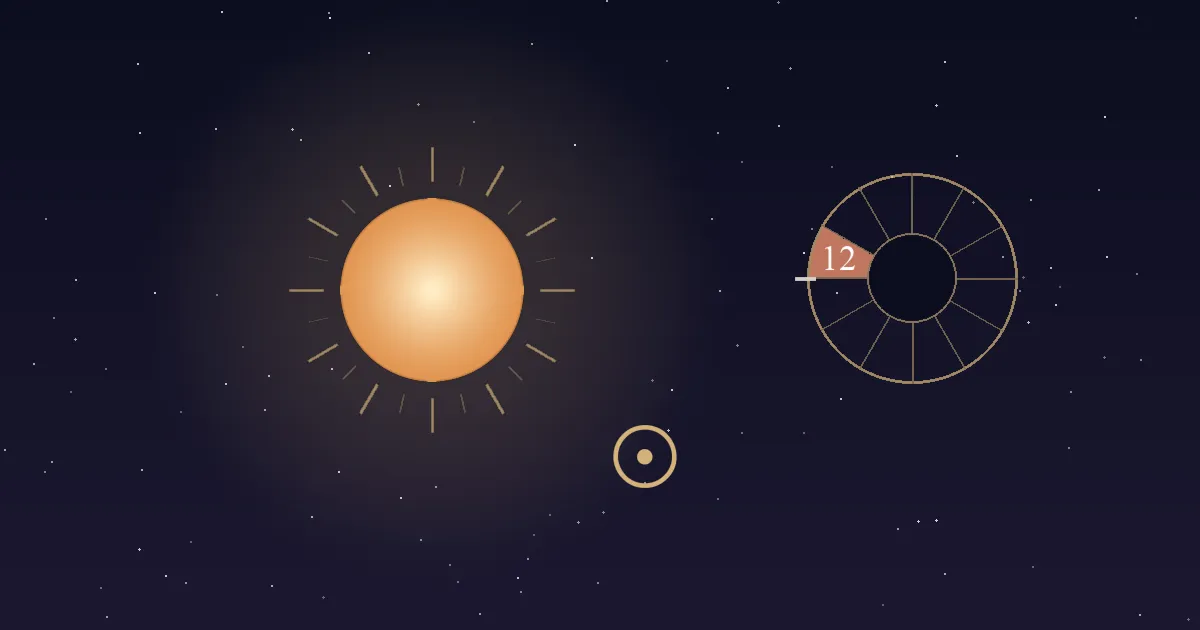
The biggest thread online about this placement, a Reddit question with more than 240 replies, starts with someone who'd been told that 12th-house Suns have a hard life and wanted to know if it's true. The reply at the top agreed: challenging, and very lonely. Further down, plenty of people disagreed, and the old sources disagree just as much. Start with the sky, because it argues against the scariest reading.
In Placidus houses, the ones most apps use, a 12th-house Sun isn't hidden at all. It had just risen when you were born and was low in the eastern sky, in roughly the first couple of hours of the day. The "hidden" reputation comes from what the 12th meant to the old astrologers, and they meant something much darker than shy.
Quick answer
In Placidus houses, the Sun in the 12th means you were born in roughly the first two hours after sunrise, with the Sun already up and climbing. Traditional texts read the 12th harshly, with loss, confinement and trouble for the father. Modern astrologers read solitude, inner work and service to others, and the "invisible" label fits many real lives poorly.
| When you were born | The first sixth of daylight in Placidus houses, starting just after sunrise |
| U.S. births, 2024 | About 9.5%, most between 6:55 and 8:51 a.m. by the clock (our estimate) |
| House type | Cadent; Valens's "Bad Daimon"; the joy of Saturn, not the Sun |
| Firmicus | "Slavery, captivity, early death of the father" |
| Vedic | Phaladeepika: the native "will hate his father" |
| Modern counterweight | Robert Hand: Jimmy Carter and Henry Kissinger have 12th-house Suns |
A 12th-house Sun sits just above the Ascendant, and a few minutes either side of sunrise can move it into the 1st. On a whole-sign chart a 12th-house Sun often moves into the 1st as well, so check it on a chart cast from your real birth time.
Check whether your Sun had risen when you were born →Is the Sun in the 12th house a difficult placement?
In the old books, yes, and the bluntest one is Firmicus Maternus. "Slavery, captivity, early death of the father, and total loss of inheritance can be expected from the Sun in the twelfth house; also afflictions and serious illnesses" (Mathesis III.5, Bram's translation, pp.93–94). He doesn't offer a way out for the Sun alone, and he calls the house itself Malus Daemon, a "passive house because it is not aspected to the ascendant." Vettius Valens called it the Bad Daimon too. That's where the imprisonment worry comes from: Firmicus. The Indian texts we read don't give it to a 12th-house Sun, and the Saravali lists imprisonment under the 7th house instead.
The Indian verdicts are milder but not kind. Mantreswara's Phaladeepika: "the person born will hate his father. His eye-sight will be defective and he will be without wealth and children" (VIII.4, Sastri, p.84). The Brihat Jataka says only that the native "will suffer degradation," and its translator adds, "In the 12th house he is bad." By 1928 Alan Leo had turned this into a lifetime estimate: "one-third, if not more, of the native's life will be unfortunate and liable to obscurity; but from misfortune and sorrow he will rise to success, principally by his own efforts" (How to Judge a Nativity, p.229).
That last clause, recovery through your own effort, is the hopeful part, and modern authors take a kinder line still. Howard Sasportas, in The Twelve Houses (1985, p.103), describes 12th-house energy as if it is "not intended to be used solely for personal ends," expressed "for the sake of others, not just for ourselves." Robert Hand is plainer: "Contrary to what many astrologers believe, a twelfth-house energy is not necessarily difficult." In practice the modern 12th-house Sun is someone whose sense of self grows in private first: in care, research, art, institutions or quiet service, and in more time alone than most people need. Recognition often comes late or second-hand, through the work rather than the person, and that's the part that can sting. Whether it feels hard depends a lot on whether the people around you value that kind of work, and on whether you let yourself ask for credit.
A Sun that has already risen
Placidus houses divide the Sun's day into six equal parts, and the 12th is the first of them. It starts when the Sun's centre crosses the Ascendant, which is a few minutes after the sunrise time printed in an almanac (about four to five minutes later at New York's latitude, because the printed time counts the Sun's upper edge and the bending of light near the horizon). So a baby born at the very minute of printed sunrise still has a 1st-house Sun, and it belongs with the pre-dawn births behind the "confident" label.
How long the 12th lasts depends on the season. At the equinoxes it's two hours. At 40 degrees north in June it runs about two and a half hours after sunrise, and in December about an hour and a half; in Helsinki on the June solstice it ran from 4:05 to 7:11 a.m. by the clock. After that the Sun moves into the mid-morning 11th. Either way the Sun is above the horizon, which is why astrologers who think about the actual sky, rather than the house keywords, tend to read this placement as early light rather than darkness.
The 8 a.m. babies
The busiest hour for American births is 8 a.m. The CDC's National Center for Health Statistics found it was the peak hour in 2013, with 6.3% of births (NCHS Data Brief No. 200), and in the 2024 birth-certificate data it was still 6.27%. We simulated 400,000 births from the 2024 time-of-day patterns, placed them by state birth totals and county population (the public file has no birthplaces), and worked out each Sun's Placidus house with real time zones and daylight time. In that model, 72% of the babies born in the 8 a.m. hour had the Sun in the 12th.
Across the year, by our estimate, about 9.5% of U.S. babies had a 12th-house Sun, most of them born between 6:55 and 8:51 a.m. by the clock. That's more than the one in twelve (8.3%) you'd expect from an even spread, and the reason is the hospital timetable. In the model, 41% of 12th-house Sun babies were cesareans with no trial of labor, against 23.1% of all births. Most of those are planned deliveries, and hospitals tend to book them for the morning.
If your birth was scheduled, your Sun's house was partly set by a surgical list. Astrologers disagree about what that means, and some argue a chosen birth time still reads as a real chart. Either way, it's a reminder that the "hidden, lonely" story attached to this house gets applied to a very ordinary group of people: a large share of them simply arrived at breakfast time on a weekday.
The father question
Ask a 12th-house group about their fathers and you'll get some of the most-answered threads anywhere on this placement: one on Reddit about absent or neglectful fathers has more than 140 replies. The fear has four different sources, and they don't say the same thing. Firmicus says "early death of the father." The Indian texts say enmity: "hate his father" in the Phaladeepika, "inimical to his father" in the Saravali. Ptolemy says that when the Sun and Saturn are afflicted and "declining from the angles," as a 12th-house Sun is, "they merely make the fathers weak" (Tetrabiblos III.4). Leo says "estranged from his parents."
So "absent father" is a modern summary that picks the worst of four verdicts. Replies in those threads keep running into counterexamples, people with this placement whose fathers were there and fine. Hand's version of the Sun as "the experience of being fathered, not the objective truth about one's father" fits the 12th especially well. A father who worked nights, was ill, was emotionally hard to reach or lived somewhere else describes the symbol as well as a father who left. So does the person who ended up parenting themselves.
Astrologers treat the month the Sun spends in your 12th as a time to rest and finish things before it reaches your Ascendant. A free account lists today's transits to your natal planets.
See today's active transits →Carter, Maradona, Katy Perry: 12th-house Suns on the record
Robert Hand made the best case against the "invisible" reading in 1981, in Horoscope Symbols: "the usual description of which indicates a retiring, withdrawn individual who prefers to be alone and who shuns the limelight. According to the birth data generally accepted, however, Jimmy Carter, Rosalynn Carter, and Henry Kissinger all have twelfth-house Suns." We checked Jimmy Carter's chart ourselves, and it holds.
- Jimmy Carter (Astro-Databank AA), born 7:00 a.m., October 1, 1924, Plains, Georgia: Sun at 8°04′ Libra in the 12th, and still in the 12th if Plains kept Eastern rather than Central time that morning.
- Diego Maradona (AA, from the birth certificate), born 7:05 a.m., October 30, 1960, Lanús, Argentina: Sun at 6°59′ Scorpio, 21 degrees deep in the 12th.
- Katy Perry (AA), born 7:58 a.m., October 25, 1984, Santa Barbara: Sun at 2°23′ Scorpio in the 12th.
- Johnny Cash (A, from his mother), born 7:30 a.m., February 26, 1932, Kingsland, Arkansas: Sun at 6°45′ Pisces in the 12th.
- David Letterman (A), born 6:00 a.m., April 12, 1947, Indianapolis: Sun at 21°44′ Aries in the 12th.
A president, the most famous footballer of his era, a pop star, a country legend and a late-night host, all born in the first hours of daylight. None of that proves anything about the placement, and we're not claiming it explains them. It does make "shuns the limelight" hard to defend as a general rule. One more detail: on a whole-sign chart, Carter, Maradona, Perry and Cash all have a 1st-house Sun instead. Only Letterman is 12th in both systems.
12th or 1st? Why apps disagree about this one
The 12th/1st split is the house-system argument people raise most online. Across U.S. births in our model, Placidus and whole-sign houses gave the Sun the same house only 47.1% of the time. A Placidus 12th is actually the steadiest of the twelve, keeping its house on a whole-sign chart 53% of the time. The trouble runs the other way: among babies whose Sun is in the whole-sign 1st, 54.9% were born after sunrise and so have a Placidus 12th.
Whole-sign houses start the 1st when the Sun's own sign begins to rise, which can be long before the Sun does. In New York on October 20, 2026, with the Sun at 27° Libra, the whole-sign 1st began at 5:00 a.m. and sunrise came at 7:17: a gap of two hours and seventeen minutes. Neither system is a mistake. They answer different questions, one about the sign rising and one about the Sun's actual height in the sky, and how your rising sign is set explains the first.
What Gauquelin's research did and didn't find here
If any house should show a statistical Sun effect, it's this one. Michel Gauquelin's famous "key sectors", the zones just after a planet rises and just after it culminates, fall in the 12th and 9th houses. He found effects there for Mars, Jupiter, Saturn, the Moon and Venus in eminent professionals. For the Sun he found nothing. The researcher Geoffrey Dean, summarising the whole body of work, puts it flatly: "There was no effect for the Sun, Mercury, Uranus, Neptune, or Pluto, or for ordinary people such as those who visit astrologers" (Astrology and Science). Gauquelin himself wrote that he "found no truth whatever behind" the "reported role of the 'houses'" (Journal of Scientific Exploration, 1988, p.29).
There's also a reason the Sun is hard to test this way, and it's the same reason the 8 a.m. hour matters above: births aren't spread evenly over the day, so the Sun's position at birth is tangled up with hospital routine and the seasons. What Gauquelin's athletes showed for Mars is the case people usually cite, and it's a very different story from the Sun's.
A partner's Sun in your 12th house
This is a separate question, and a popular one: what it means when a partner's Sun lands in your 12th house in chart comparison. Astrologers usually read it as someone who sees the private side of you that others don't, and who may stir up feelings you can't easily name, which is why one Quora version of the question asks whether it explains thinking about a person too much. The caution is lopsided openness: one person may share far more than the other and end up feeling exposed.
The Sun's month in your 12th
Every year the transiting Sun spends about a month in your 12th house, the month before it reaches your Ascendant. Astrologers treat it as the quiet end of a personal year: a time for rest, loose ends and less public effort, which fits our houses guide's reading of the 12th as the end of a cycle before the wheel starts again. Saturn has its traditional joy in the 12th, which gives Saturn's own placement in the 12th a very different starting point from the Sun's.
Transit note, October 2026
The Sun entered Libra on September 22, 2026 and moves into Scorpio on October 23, 2026 (US Eastern dates). In whole-sign houses that stretch puts the transiting Sun in the 12th house for Scorpio risings. From October 23, 2026 until November 22, 2026 it is the turn of Sagittarius risings. Every rising sign gets about a month of the Sun in its 12th house once a year, so this is a yearly season, not the birth placement this page is about. That one depends on the time of day you were born.
Which sign was rising?
A dawn Sun and your rising sign are usually neighbours, and the rising sign decides whether a whole-sign chart calls your Sun 12th or 1st. The free lookup needs only your birth details to find it.
Work out your rising sign →Keep reading
- · The Moon's version of this house, and why its feelings come clear only in private: Moon in the 12th house.
- · The benefic that some astrologers call a guardian angel here: Jupiter in the 12th house.
- · Secret affairs or quiet devotion? Venus in the 12th house takes the love question.
FAQ
Does the Sun in the 12th house mean an absent father?
Not as a rule. The oldest source of the fear is Firmicus Maternus, who lists 'early death of the father' among a 12th-house Sun's troubles. The Indian texts we read say something different: the native will 'hate his father' or be 'inimical to his father', which is friction, not absence. Ptolemy goes softer still, with fathers made 'weak' when the Sun is afflicted in a cadent house. Many people with the placement grew up with a present father. Read through Robert Hand's idea of 'the experience of being fathered', it can describe a father who was hard to know, or a role you had to fill yourself.
Why do I feel invisible with the Sun in the 12th house?
The 12th is the house astrologers tie to what happens out of public view, so a Sun there is read as an identity that works best behind the scenes or for other people. That can feel like being overlooked, especially when you don't push yourself forward. But the placement doesn't hide you. Robert Hand pointed out that Jimmy Carter and Henry Kissinger have 12th-house Suns, and neither was invisible. The feeling is real; the label is too strong.
My Sun is in the 12th house. Was I born just after sunrise?
On a Placidus chart, yes: the 12th covers the first sixth of daylight, starting when the Sun's centre crosses the Ascendant a few minutes after the printed sunrise. That's about two hours at the equinoxes, closer to two and a half in June and an hour and a half in December at New York's latitude. On a whole-sign chart the answer can differ, because the house changes when a new sign rises, not at sunrise.
Why do people say the Sun in the 12th house makes life hard?
Because the old texts were harsh about the 12th. Firmicus gives the Sun there slavery, captivity, loss of inheritance and illness; Vettius Valens calls the house the Bad Daimon; Alan Leo's How to Judge a Nativity (1928 printing) says a third of the life would be 'unfortunate and liable to obscurity'. But Leo also wrote that the native 'will rise to success, principally by his own efforts', and modern authors such as Howard Sasportas and Robert Hand read the house as solitude, inner work and service. A hard reputation isn't a hard life.