Birth Chart
North Node in the 12th House: Is It a Bad Placement, and Is It About Past Lives?
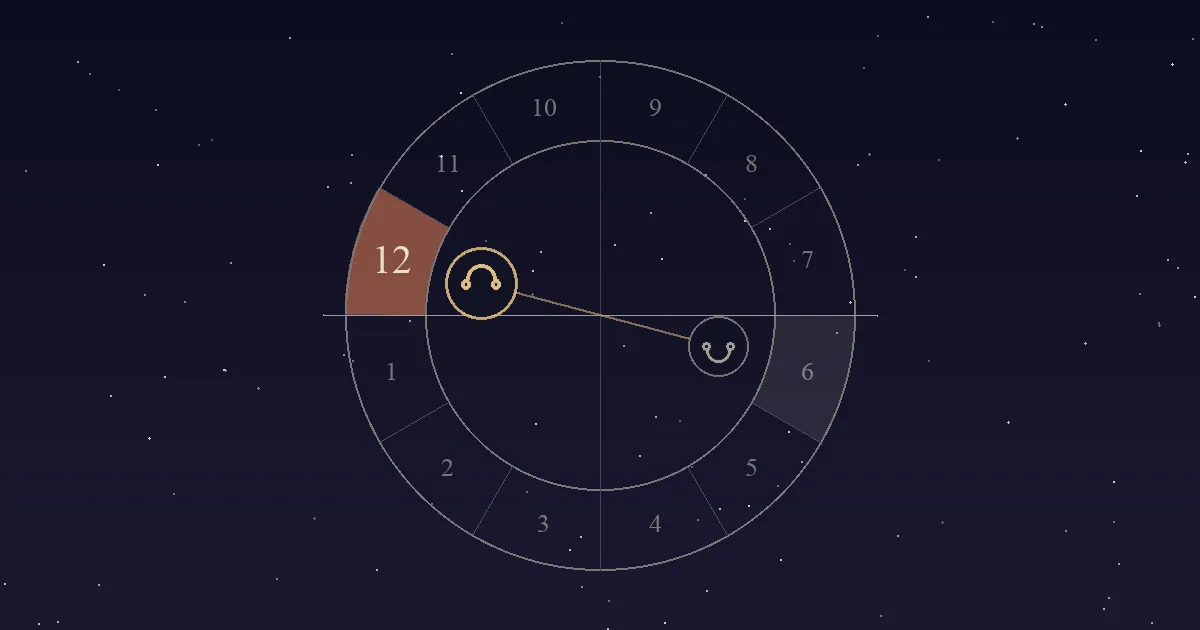
A North Node in the 12th house can sound worrying if you've read about hidden enemies or isolation. Is it a bad placement? Is it about past lives? One Reddit poster wrote that a 12th-house North Node felt like being set up for "a mission impossible."
Those fears come from different places: some from old lines about the Dragon's Tail, some from the 12th house in general, and some from modern karmic astrology. If your North Node is in the 12th house, your South Node is in the 6th, and most of the story is how those two ends pull on each other.
Quick answer
A North Node in the 12th house is read as a call to solitude, rest, inner life, spiritual practice and quiet service. Its partner, the South Node in the 6th, makes busy work and fixing things the easy default. Western sources don't call it a bad placement, and the past-life reading comes from modern karmic astrology and can't be checked.
| North Node house | 12th: solitude, rest, the inner life, quiet service |
| South Node house | 6th: work, routine, being useful |
| Natural sign of the house | Pisces |
| Lilly | Counted the Dragon's Head here with "equall signification with Venus or Jupiter" |
| Our data point | In our birth model, 11.5% sit in an intercepted sign, the most of any house |
Only some 12th-house nodes sit close to the Ascendant, but for those, a few minutes of birth time decides between the 12th and the 1st. Cast the chart from your recorded time and place and see which side of the Ascendant the node falls on.
Check whether your node is 12th or 1st →A bad placement, a past-life mark, or neither?
The 12th has a dark name in the old books, and that's where the "bad placement" fear starts. But the warnings attach to the house and to the planets that suffer there, and the Western authors read the Dragon's Head as a benefic. William Lilly's rule for judging enemies counted the planets in the 7th and 12th houses, and in it he gave the Head "equall signification with Venus or Jupiter" (Christian Astrology, 1647, pp. 639–640). So in Lilly's method a 12th-house Head is one testimony in that count, a benefic one, and he doesn't spell out what outcome it brings.
The "hidden enemies" line that turns up in so many readings is real, but it belongs to the other end of the axis. It comes from Guido Bonatti's list of the Dragon's Tail by house (Consideration 139), where he gave it to the Tail in the 12th. With your North Node in the 12th, the Tail is in the 6th, so that warning goes with the reverse placement. Prison and hospitals, the other fears that gather here, are general meanings of the 12th house rather than node rules. The nearest a node source comes is Schulman's advice, below, to work inside a large institution.
Vedic astrology calls the North Node Rahu, and its texts disagree about Rahu in the 12th. Mantreswara's Phaladeepika says that with Rahu in the 12th a person "will be intent on committing sinful acts secretly, will spend much" (VIII.27, V. Subrahmanya Sastri's translation, 1950, p. 95). The Saravali's general rule cuts the other way: malefics "are auspicious in evil Houses, i.e. 6th, 8th and 12th" (30.86–87), and the Indian texts count Rahu as a malefic. The kinder line on this axis goes to Ketu, the South Node: the Phaladeepika gives Ketu in the 6th "everlasting fame, firmness and high authority" (VIII.30). Liberation, the 12th's highest meaning in Jyotish, belongs to Ketu as well. R. Santhanam's note in his Brihat Parashara Hora Shastra translation says the 12th "indicates final emancipation as well for which Saturn is not the indicator but Ketu," so with Ketu in the 6th, a 12th-house Rahu isn't the moksha placement it's sometimes sold as.
Then the past lives. That reading is modern. The karmic language comes mostly from Martin Schulman's Karmic Astrology (1975), and his 12th-house section is written in it: "His past-life karma is erased when he learns how to flow rather than allow his life to keep interrupting itself by petty distractions" (p. 97). Astrology can't verify a past life, as our North Node guide says, and Schulman's advice about petty distractions works just as well without one. The same karma question comes up in how astrologers read the Moon in the 12th.
What growth toward the 12th looks like
Schulman opens his 12th-house section with someone who "undergoes a crisis in consciousness" and writes that "much of his life is spent in deep thought" (p. 94). Two pages on, he says "periods of forced isolation help to bring him to a higher consciousness" (p. 96). The astrologer Donna Cunningham, on her blog in 2010, named "service and spiritual studies" as the positive uses of the 12th for a node there. Schulman puts the weight on solitude and deep thought, and Cunningham adds service to the list.
In practice, astrologers describe a person who's very good at being useful. They fill every hour, fix other people's problems, keep the lists, and feel uneasy whenever things go quiet. The 12th-house North Node asks them to stop sometimes: to take time alone without an agenda, to rest before they're worn out, and to help someone without taking charge of the whole problem. That can look like a meditation practice, a retreat, volunteering at a shelter, creative work done for its own sake, or evenings with no plans. For a parent or caregiver, time alone may depend on someone else taking a turn, and asking for that is part of the work. This kind of rest differs from escape: a nap that leaves you clearer counts, and scrolling until 2 a.m. to avoid tomorrow doesn't. Astrologers call the 12th the house of the unconscious, and the work here is getting comfortable in it.
Does this mean a lonely life? The modern readings quoted here don't predict one. Schulman writes about "periods of forced isolation," which are periods, and Cunningham's first positive use, service, is done for other people. The solitude this node asks for is time alone that sits alongside friends and family. What you do with the quiet matters as much as finding it. Astrologers suggest things like writing down dreams, sitting with a question you can't answer yet, or listening to a friend without offering a fix.
Schulman also says this native "does well by immersing himself in the works of a large institution where he can develop a group-consciousness" (pp. 96–97), which is why 12th-house careers in readings run to hospitals, charities, research and the arts. Those associations don't tell you which career to choose. The node's sign, which a lookup by birth date gives you, changes the tone too: a Gemini node in the 12th might make the inward turn through reading and journaling, and an Aries node through time alone to work out what you want before anyone else weighs in. A node in Pisces, the sign modern astrologers pair with the 12th, gets the same message from sign and house: trust, imagination and letting go of control (more in the Pisces North Node reading). One more distinction: this page is about the node in your own birth chart. Another person's North Node falling in your 12th is a synastry question, read across two charts.
With a free account you can see today's transit aspects to the planets in your birth chart.
Get today's transit aspects free →The South Node in the 6th house: busy as a hiding place
Bonatti gives the Tail in the 6th "losses by servants or small cattle" (Consideration 139; 1886 edition, p. 61). Lilly states a general rule in a chapter on horary questions: wherever "Cauda Draconis" is, "it prenotes detriment and impediment in such things as are signified by that House" (Christian Astrology, pp. 172–173), though that rule was written for questions, not birth charts. Modern readings of a South Node in the 6th focus on something else, overwork and the need to feel useful. Those are different interpretations of the same house.
The familiar end here is work, routine, health habits and being needed. You might notice the pattern when a finished task brings no relief and you look for the next one right away.
You don't have to give up being good at useful things. The axis asks you to keep the skill and stop hiding in it. Someone with a 6th-house North Node struggles the other way, drifting into retreat when the routine needs keeping.
Cher, Spielberg, and three charts within 17 minutes of a change
Popular lists rarely say which house system or node they used. For these five, all with AA-rated birth times at Astro-Databank (from a birth certificate or birth record), we cast the charts and got a 12th-house North Node with the true node and the mean node, in Placidus and in whole sign.
- Cher (AA), born 7:25 a.m., May 20, 1946, El Centro, California: North Node at 20°51′ Gemini.
- Steven Spielberg (AA), born 6:16 p.m., December 18, 1946, Cincinnati, Ohio: North Node at 11°45′ Gemini.
- Sigourney Weaver (AA), born 6:15 p.m., October 8, 1949, Manhattan, New York: North Node at 16°39′ Aries.
- Marilyn Monroe (AA, birth certificate), born 9:30 a.m., June 1, 1926, Los Angeles: North Node at 16°54′ Cancer.
- LeBron James (AA), born 4:04 p.m., December 30, 1984, Akron, Ohio: North Node at 26°34′ Taurus.
Three of them are close calls. Move Weaver's recorded time 17 minutes earlier, or Monroe's or LeBron James's 16 minutes later, and at least one of those four readings changes.
On the Ascendant: Mozart and the 12th-or-1st problem
Some 12th-house nodes sit right on the Ascendant, your rising degree, and then the house label stops being reliable. In our model of 400,000 simulated U.S. births (1960 to 2024, CDC birth times, places across U.S. counties), 16.2% of 12th-house North Nodes fell within 5 degrees of the Ascendant. The 12th held the node in 8.6% of the charts, about 1 in 12.
Mozart is the clearest example, and he's here as a boundary case, not as a 12th-house native. His birth time is rated AA (8:00 p.m., January 27, 1756, Salzburg). His true node is at 11°28′ Virgo, which a Placidus chart puts in the 12th. His mean node, the smoothed version some software uses, is at 12°51′ Virgo, which puts it in the 1st. Both sit within about a degree of his Virgo Ascendant, on opposite sides of it, and a whole-sign chart calls both of them 1st. Of the 261 rated charts we checked for this series, he and one other person were the only ones whose Placidus house changed between the true and mean node.
This site uses the true node, like its calculators. The two points are never more than about 2 degrees apart, and in our birth model they put the node in different houses only about 3% of the time. When the node is this close to an angle, though, read it as conjunct the Ascendant first and treat the house as secondary. A node on the Ascendant brings the 1st house's questions of self and first impressions into the picture too.
Intercepted signs: where the 12th leads the twelve
In the same model, 11.5% of 12th-house North Nodes sat in an intercepted sign, about 1 in 9 and the highest share of any house. An intercepted sign sits wholly inside one Placidus house with no cusp in it, which happens when houses stretch wide at U.S. latitudes, and intercepts gather around the horizon, in the 1st, 6th, 7th and 12th.
When the node is intercepted, its sign rules no house cusp, and the South Node sits in the opposite intercepted sign in the 6th. Some modern astrologers read that as a lesson that takes longer to come into view. It's an interpretation. Interceptions happen in unequal house systems such as Placidus, and whole-sign houses never have them.
House systems disagree on this node less than on any other. A Placidus 12th-house node kept its number in whole-sign houses 50.3% of the time, more than any other house. When it moved, it went forward to the 1st (47.7%) or back to the 11th (2.0%), and never two houses. Whatever the system, the birth time matters most. In about half of modeled births (50.2%) the node sits within 30 minutes of a Placidus house change, so a recorded time that's half an hour out in the wrong direction can move it. A birth date that's a day off, at the same clock time, changes the house in only about 3% (3.4%). If your time came from family memory rather than a certificate, hold the house loosely.
The transiting North Node in your 12th
The transiting North Node returns to your 12th roughly once every 18.6 years, moving backward through the signs at about a year and a half each. In Placidus it enters the 12th as it moves backward across your Ascendant. In whole-sign houses it enters when it reaches the sign before your rising sign and stays about a year and a half; the note below uses whole sign to name the rising sign whose 12th it's in, with dates. Astrologers treat that stretch as a time for rest, retreat and closing out old business. The current run has its own guide: the North Node's 2026 to 2028 Aquarius window.
Transit note, October 2026
The transiting North Node has been in Aquarius since July 26, 2026 and moves on into Capricorn on March 26, 2028 (US Eastern dates). In whole-sign houses that puts it in the 12th house for Pisces risings, with the South Node in their 6th. From March 26, 2028 the same transit passes to Aquarius risings. Each rising sign gets about a year and a half of this once every 18.6 years. It is a passing transit, not the birth placement this page is about.
Rising sign first
On a whole-sign chart, your rising sign decides whether the node counts as 12th or 1st. The free Sun, Moon and rising lookup finds it from your birth details in a minute.
Find your rising sign in your Big 3 →Keep reading
- · Where the hidden-enemies question really lives for a planet, plus a Gauquelin twist: Mars in the 12th house.
- · The one planet the old books say rejoices in this house: Saturn in the 12th house.
- · The "guardian angel" claim, tried against the sources: Jupiter in the 12th house.
FAQ
Is the North Node in the 12th house a bad placement?
Not in the Western sources. William Lilly counted the Dragon's Head in the 12th with 'equall signification with Venus or Jupiter', and the 'hidden enemies' line people quote was written by Bonatti for the Dragon's Tail in the 12th, the reverse placement. Vedic astrology is split: the Phaladeepika is harsh about Rahu here, while the Saravali's general rule favors malefics in the 12th, and Rahu counts as one. Modern astrologers read it as a direction toward rest, solitude and quiet service, which can feel hard for busy people without being bad.
Why do Mozart's true and mean nodes fall in different houses?
Because both sit right on his Ascendant. His true node is at 11°28′ Virgo and his mean node, the smoothed average some software uses, is at 12°51′ Virgo, and his Ascendant falls between them, about a degree past the true node and just short of the mean one. In Placidus that leaves the true node at the end of the 12th and puts the mean node at the start of the 1st. Whole-sign houses call both 1st, because his rising sign is Virgo. With a node this close to the Ascendant, astrologers read it as conjunct the Ascendant first and treat the house as secondary.
Is a 12th-house North Node in an intercepted sign read differently?
Some astrologers think so. An intercepted sign has no house cusp in it, so the node's sign rules no house, and the South Node sits in the opposite intercepted sign in the 6th; some modern readers take that as a lesson that comes into view more slowly. In our model it happens to 11.5% of 12th-house North Nodes, the most of any house. Interceptions happen in unequal house systems such as Placidus. Whole-sign houses never have them, so on a whole-sign chart the question doesn't arise.
Does the North Node in the 12th house point to a spiritual life purpose?
Modern Western astrologers often say so. Martin Schulman tied it to solitude and a wider consciousness, and Donna Cunningham named service and spiritual studies as the positive uses of the 12th. The Vedic view is different: the 12th's highest meaning, liberation, belongs to Ketu, and with the North Node in the 12th, Ketu is in the 6th. So it's fair to call it a pull toward the inner life, as long as you don't call it a guarantee of anything.