Birth Chart
North Node in the 1st House: Is Putting Yourself First Selfish?
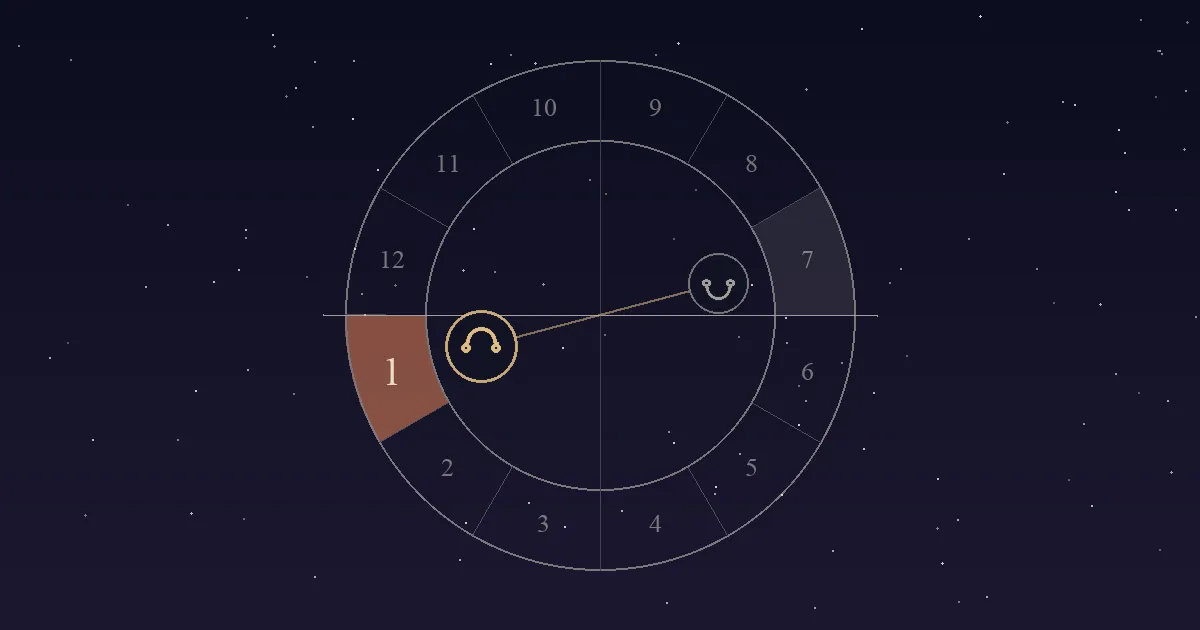
Most write-ups of this placement boil it down to one instruction: put yourself first. People who already feel guilty saying no hear that as permission to be selfish, and they don't like it. Others look at the far end of the axis, a South Node in the 7th, and ask whether it means they'll end up alone. Both worries come from reading the axis as a choice between yourself and everyone else.
Martin Schulman's 1975 reading describes someone who pleased other people for too long, and the old relationship warnings sit at the other end of the axis, where the sources disagree with each other. There's also a practical question to settle first. In Placidus houses, a 1st-house North Node is an invisible point just under the eastern horizon at the moment of birth, due to rise within a couple of hours. In about one chart in six it sits within 5 degrees of the Ascendant, close enough that a slightly later birth time could put it in the 12th house instead.
Quick answer
The North Node in the 1st house makes self-direction the growth area: choosing, deciding and being seen as yourself. The South Node sits opposite in the 7th, so your practiced habit is adapting to partners and other people. It isn't a selfish placement. The work is holding your own view inside your relationships, not leaving them.
| South Node | Always in the 7th house, in Placidus and in whole-sign houses |
| Where the node was at birth | Just below the eastern horizon, rising within about two hours (Placidus) |
| Natural sign of the house | Aries |
| Life areas | The self, the body, first impressions, starting things on your own |
| Medieval Western line | Bonatti: the Tail in the 7th means "prosperity to the Native" |
| Our data point | 17% sit within 5 degrees of the Ascendant (model of 400,000 U.S. births) |
Compare two numbers on your chart: the North Node's degree and the Ascendant's. If the node sits only a few degrees past the rising point, a few minutes of birth time decide between the 1st and the 12th.
Find out which side of the Ascendant your node is on →Does a North Node in the 1st house make you selfish?
Schulman's Karmic Astrology (1975) describes close to the reverse. His 1st-house native is someone who leaned too hard on other people: "Submerged in the desire to please, he has made himself a reflection of an ideal peculiarly opposite to his own basic nature" (pp. 63–65). He doesn't tell that person to stop caring. He warns that overcorrecting turns them into "an extremist" who grows "too over-assertive," and he puts the goal plainly: "he must learn how to balance equally his own needs with those around him" (p. 64).
Selfish means taking at someone else's cost. This node asks for something smaller and, for a lot of people, harder: knowing your own preference before the group weighs in. It's saying which apartment you actually want before you hear what everyone else thinks. It's telling a partner the plan you'd have made alone, then talking it through. At work, it's pitching your own idea in the meeting, or starting the project without waiting for someone to sign off on it. For a person whose reflex is to read the room first, each of those feels rude the first few times, and that feeling is the reason the "selfish" label sticks.
Schulman adds one more line that gets misread: "He must ultimately learn how to assume gracefully the role of leadership." That's a lesson, not a forecast.
Fluent in other people: the South Node in the 7th house
The 7th is the house of partners, contracts and the people you face one to one, and a South Node there reads as skill you already have: reading what a partner needs before they say it, keeping a negotiation calm, being the teammate everyone wants. People born with a 7th-house North Node start from the reverse problem: they handle everything alone and have to learn to let a partner steer.
Plans go to committee. A partner's taste becomes the default for where you live and what you eat. You know exactly who you are in a relationship and feel oddly blank when you're on your own for a week. The houses guide calls the 7th the house of "others," set directly opposite the 1st house of "self," and its tour of the twelve astrological houses lays out the rest of the wheel.
The medieval astrologer Guido Bonatti wrote about this end of the axis, and he wrote two verdicts that look contradictory. In Consideration 139 the Tail (South Node) in the 7th brings "loss by Women, Companions, or open Enemies." In Consideration 111 the same Tail "signifies damage or overthrow to the Native's enemies and prosperity to the Native or Querent, because the Dragon's Head will then be in the Ascendant" (Coley's translation, 1886 reprint, pp. 47–48 and 61). Both fit his scheme, since the 7th holds partners and open enemies alike, and 111 was written with lawsuits in mind. Neither passage is about people pleasing; that reading is modern.
A free ZodiScope account lists today's transit aspects to the planets in your birth chart.
Check today's transits against your chart →Bonatti's lawsuit rule and the Rahu verses for the 1st
The older Western books never list what the Head means in each house. For this placement the nearest thing is Bonatti's Consideration 111, quoted above: written with lawsuits and quarrels in mind, it ties the Head in the Ascendant to an advantage over opponents, by way of the Tail in the 7th. William Lilly mentions a node in the Ascendant only in passing, among the signs of a person's complexion and in a judgment about childbirth. In the 1886 reprint of Bonatti, the editor W. C. Eldon Serjeant added a footnote: "Modern Astrologers do not consider the effects of the Dragon's Head or Tail." Reading the North Node by house as a life direction came back in the 20th century, in books such as Schulman's.
Vedic astrology calls the North Node Rahu, and its verses for this house are blunter. Mantreswara's Phaladeepika gives Rahu in the 1st a person who will "possess wealth and strength," in the same verse that promises a short life and illness (VIII.25, Sastri's translation, 1950, p. 94). The Saravali softens it for three rising signs: "Rahu in the Ascendant identical with Aries, Taurus, or Cancer protects the native from the clutches of all evils, just as a pleased king forgives the crimes of a person" (12.10–11). Ketu in the 7th gets "loss of wife" (Phaladeepika VIII.31). They're predictions from another system, and nothing in them shows that they come true.
How close a 1st-house node sits to the Ascendant
About 1 in 6 Placidus 1st-house North Nodes (17.1%) sat within 5 degrees of the Ascendant in our model. Across every birth in the model, only 2.8% had the node that close to the rising degree. The model is 400,000 simulated U.S. births from 1960 to 2024, built from CDC birth-time data with each birth placed in a real U.S. county; they're modeled births, not birth records, and each one uses the true node.
A node on the Ascendant sits right on a house line. A few degrees below it, the node is in the 1st; a few degrees above, it's in the 12th (the 12th-house North Node page covers that side), and a slightly later birth time carries it across. Read it as a node on the Ascendant first and the house number second. Astrologers give a point on an angle more weight than one in the middle of a house, so a node that close puts the self-direction theme near the front of the chart. The next things to read are the rising sign and the planet that rules it, which astrologers call the chart ruler. The rising sign guide explains how a birth time sets the Ascendant degree, and the Sun's version of this house shows what the same patch of sky means for a pre-dawn birth.
The birth time matters more here than people expect, because the Earth turns the whole house frame past the node once a day. In our model, a recorded time 15 minutes off in one direction moved the North Node's Placidus house in about 1 in 8 births (12.6%), and an hour off moved it in about half (50.1%). Getting the date wrong by a day, with the clock time right, moved it in only about 3% (3.4%), because the node itself barely moves in a day.
The house system matters too. In our model, a Placidus 1st-house North Node was never in the whole-sign 12th, because Placidus puts it at or after the Ascendant degree. It stayed in the 1st on a whole-sign chart about half the time (49.9%) and moved to the 2nd in 48%. And 10.3% of 1st-house nodes sat in an intercepted sign, one with no house cusp in it. Only unequal house systems such as Placidus produce interceptions; a whole-sign chart never has one. Some astrologers prefer the mean node, which never sits more than about 2 degrees from the true one; the two put the node in different houses in about 3% of modeled births.
Will a 1st-house North Node keep you single?
This is the question people ask most about the placement, usually with the South Node in the 7th as the reason. The texts don't predict a single life. Bonatti's Tail in the 7th brings loss through partners in one passage and an advantage over opponents in another. The Phaladeepika predicts loss of a wife. Neither tells you what will happen in your relationships.
The modern reading puts the growth in how you act for yourself, and that applies inside a relationship as much as outside one.
For a 1st-house node, the risk is the kind of relationship you fall into, not whether you have one. The South Node in the 7th is comfortable with a partner who decides, and that's pleasant until you notice you've stopped having opinions. A relationship that suits this axis is one where you can disagree out loud and nothing breaks. Some people with the placement find that after a stretch on their own, and some find it inside a marriage that makes room for it. If it's a partner's North Node that falls in your 1st house, that's a synastry overlay, a separate reading from the node in your own chart.
The birth certificate that moved Paul Simon's node into the 1st
Each birth time below is rated AA (from a birth certificate or record) or A (from the person or family) at Astro-Databank, and we cast every chart ourselves. Each node stays in the 1st with the true or the mean node, in Placidus or whole-sign houses, and with the time moved 15 minutes earlier or later.
- Paul Simon (AA, birth certificate), born 2:33 a.m., October 13, 1941, Newark, New Jersey: North Node at 22°24′ Virgo in the 1st.
- Jerry Lewis (AA), born 12:15 p.m., March 16, 1926, Newark, New Jersey: North Node at 23°25′ Cancer, about 6 degrees past his Ascendant.
- Michael Jordan (AA), born 1:40 p.m., February 17, 1963, Brooklyn: North Node at 29°17′ Cancer in the 1st.
Jerry Lewis's node is just outside our 5-degree orb from the Ascendant, and a birth about 25 minutes later would have moved it to the 12th under at least one of the four ways of computing it. Paul Simon used to be listed with a 12:30 a.m. birth, which puts his node in the 2nd; his birth certificate replaced that time. It's a good example of why celebrity node lists disagree.
The transit: when the moving node crosses your 1st house
The moving North Node is a separate thing from the one in your birth chart. It backs through the houses of every chart once in about 18.6 years, and in whole-sign houses it spends around a year and a half in each. Astrologers read its pass through the 1st as a stretch for questions about how you present yourself and what you start on your own. The node's 2026 to 2028 pass through Aquarius has its own guide to the Aquarius stretch.
Transit note, October 2026
The transiting North Node has been in Aquarius since July 26, 2026 and moves on into Capricorn on March 26, 2028 (US Eastern dates). In whole-sign houses that puts it in the 1st house for Aquarius risings, with the South Node in their 7th. From March 26, 2028 the same transit passes to Capricorn risings. Each rising sign gets about a year and a half of this once every 18.6 years. It is a passing transit, not the birth placement this page is about.
When the node's sign seems to argue with the house
It's a common puzzle: "My North Node is in Libra, but it's in my 1st house. Aren't those opposites?" Libra is the sign of partnership, the 1st is the house of the self, and the two seem to point in different directions. They answer different questions. Schulman closes each house section with the same split: the house is the arena, the sign is the manner. A Libra node in the 1st builds a self through fairness and good company. A Capricorn node in the 1st builds it through responsibility.
The confusion has a source. Many writers read the 1st house as if it were Aries, its natural sign, and Cafe Astrology's note on Jan Spiller's sign-based book puts it plainly: "if your North Node is in the first house, for example, the North Node in Aries chapter will apply" (Cafe Astrology). That works as a shortcut, and how an Aries North Node is interpreted covers the same lesson by sign. But if your node is in another sign, the sign is part of the reading too.
The two also come from different data. Your birth date usually settles the node's sign, which holds for about a year and a half at a stretch; on a day when the node changes sign, the birth time decides it. Its house needs your birth time and place, and our guide to what the nodes are explains why.
Which sign is your node in?
Your node's sign usually comes from your birth date alone, so you can look it up in seconds and read it against the 1st house.
Look up your North Node sign by birth date →Keep reading
- · Feelings that show on your face before you've decided to share them: Moon in the 1st house.
- · Does it make you aggressive? The honest answer, plus the scar question: Mars in the 1st house.
- · Why two ancient traditions called this Jupiter's strongest seat: Jupiter in the 1st house.
FAQ
Does a North Node in the 1st house mean I'm meant to stay single?
No. Modern astrologers read the placement as learning to keep your own view inside a relationship, which is a reason to choose partners carefully. The old relationship warnings attach to the other end of the axis, the South Node in the 7th, and Bonatti reads that same South Node as good for the native in disputes.
Is a North Node right on the Ascendant a 12th-house or a 1st-house placement?
Read it as a node on the Ascendant first and treat the house as secondary. A node a few degrees below the Ascendant is in the 1st, and a few degrees above it is in the 12th, so a birth time that's a few minutes off can flip the label. In our model of 400,000 U.S. births, about 1 in 6 Placidus 1st-house North Nodes sat within 5 degrees of the Ascendant. If your node is that close, the rising degree matters more than the house number.
My North Node is in Libra but sits in the 1st house. Is that a contradiction?
No. The sign and the house answer different questions, so neither cancels the other. A Libra node in the 1st builds a self through tact and fair dealing. You work out what you think, then say it graciously.
Does a 1st-house North Node change your appearance?
There's no evidence that it does. William Lilly counted a node in the Ascendant among the 'Significators of the Complexion', and he treated the Dragon's Head as Jupiter-like, but in 1647 complexion meant temperament and build as much as looks. Most astrologers give the appearance question to the rising sign and to planets close to the Ascendant. The node is a point in space with no light of its own, so treat any 'node look' list as a guess.