Birth Chart
Sun in the 1st House: The Pre-Dawn Birth Behind the "Confident" Label
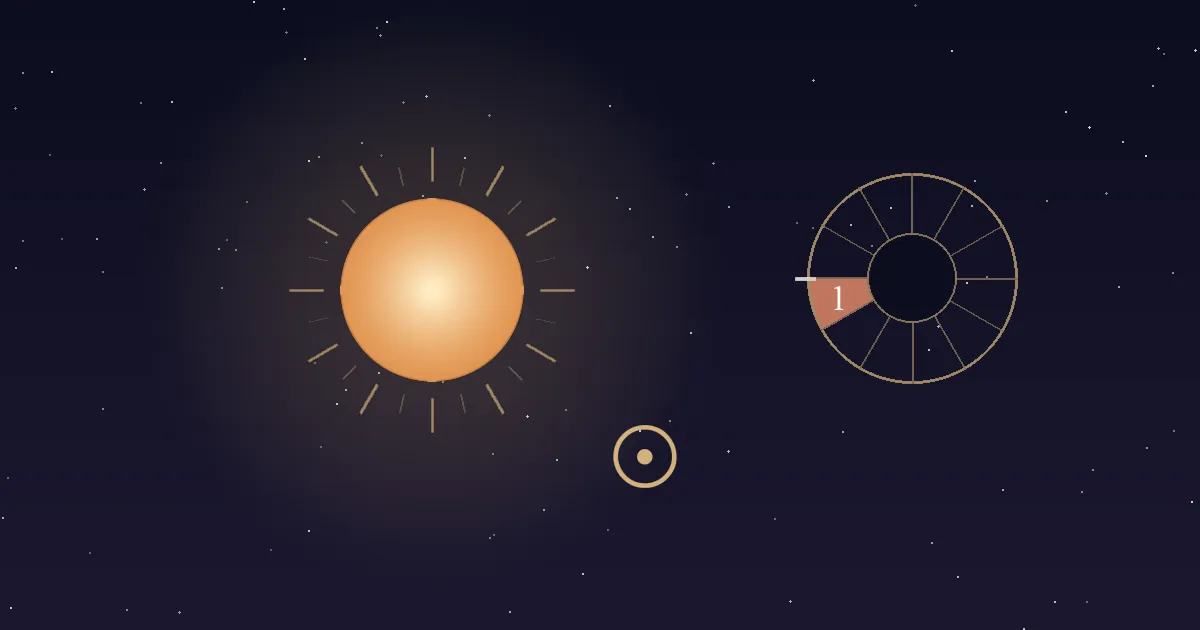
Almost every page about this placement says the same thing: magnetic, self-assured, a natural leader. Then you read the threads written by people who have it, and a different word keeps coming up. Self-conscious. In one Reddit thread a 1st-house Sun asks how to stay grounded when they feel over-exposed, and the top reply says they've started hiding from social media. In another, with sixty-odd comments, someone with the placement says they still lack confidence.
The clock explains a lot of this. In Placidus, the house system most Western apps use, a Sun in the 1st house means you were born in the last stretch of the night, just before the Sun came up. It sits right under the eastern horizon, on the point that stands for your body and the first thing people notice. That's also why so many people aren't sure whether their Sun is in the 1st or just across the line in the 12th.
Quick answer
In Placidus houses, the Sun in the 1st house means you were born in the hours before sunrise, with the Sun just below the Ascendant. Astrologers read it as an identity that shows on the surface: visible, physical, hard to hide. It's called confident, but many people with it feel watched. Indian classics add pride and weak eyes.
| Birth time (Placidus) | The last sixth of the night, ending a few minutes after the printed sunrise |
| U.S. births, 2024 | About 6.3%, most between 4:54 and 7:05 a.m. by the clock (our calculation from CDC data) |
| House type | Angular: the Ascendant, the strongest house of the chart in most traditions |
| Rising sign | Almost always the Sun's own sign or the sign before it |
| Traditional worry | Pride and eye trouble in the Indian texts; Firmicus ties weak eyes to malefic aspects |
The line between the 12th and the 1st house is the Ascendant, and the Sun crosses it within a few minutes of sunrise. A birth time that's off by twenty minutes can move your Sun from one house to the other, so check which side of the line yours is on before you read on.
See which side of the Ascendant your Sun is on →Born in the last hours of the night
The Sun moves through the houses backwards over the course of a day. It rises across the Ascendant into the 12th, climbs through the 11th and 10th to noon, sets through the 9th, 8th and 7th, and spends the night in the 6th down to the 1st. In Placidus houses each of those is exactly one sixth of the Sun's day or night. So a 1st-house Sun is the final sixth of the night: the stretch when the sky is going grey and the Sun is still below the horizon. Robert Hand put it the same way in Horoscope Symbols (1981): the 1st house "is the area of the heavens occupied by the Sun during the two hours or so before sunrise."
We wanted to know how many people that actually is. The CDC's public natality file gives the clock time of U.S. births but not where each baby was born, so we built a model: 400,000 simulated births drawn from the 2024 timing data, placed by state birth counts and county population, with real time zones and daylight saving, and a Placidus chart for each. In that model, about 6.3% of U.S. babies born in 2024 had the Sun in the 1st house. Most were born between 4:54 and 7:05 a.m. by the clock, with the middle of the window near 5:54. That's well under the 8.3% you'd get if births were spread evenly through the day. The gap comes from when babies are born: the small hours have the fewest births, and planned deliveries cluster later in the morning. Only 13.9% of these babies were cesareans with no trial of labor, against 23.1% of all births.
The season changes the odds too. Summer nights are short, so the 1st house is a narrow window in June: 5.0% of June and July births had a 1st-house Sun, against 7.7% in December and January. One small detail matters if you were born at dawn. The almanac sunrise time is when the top edge of the Sun appears over the horizon (with refraction lifting it a little), while the house line is the Sun's centre on the geometric horizon, and that comes a few minutes later. At New York's latitude the gap is about four to five minutes. A baby born right at the printed sunrise still has the Sun in the 1st.
Confident on paper, self-conscious in person?
The 1st house is the body, the face and the first impression, and our houses guide points out that people notice 1st-house planets before they learn your Sun sign. Put the Sun there and what you are tends to show before you've decided how much to show. That's where the "magnetic, confident" reading comes from: astrologers connect the placement with a presence other people notice. Stephen Arroyo, discussing Meher Baba's chart in Astrology, Karma & Transformation (1992, pp. 38–39), called the Sun in the first house "an apt symbol for one who so completely identified himself with life's creative power."
But visibility and confidence aren't the same thing. If people react to you before you've said much, you can end up feeling inspected rather than admired, and that's the experience the Reddit threads describe. Hand was blunt about the tradition here. Because the 1st-house hours are, in his words, "the day's low point," he argued that the house "cannot be quite so potent as tradition has made it." A pre-dawn Sun is strong in position and still waiting to come up. Many people with it describe a confidence that arrived late and had to be built.
What about arrogance? The charge is real in some texts and missing in others, which we'll get to below. The practical version is simpler. A 1st-house Sun's wants are easy to see, so pride is easy to notice; with a Sun that had already risen into the 12th, astrologers expect the same trait to stay more private.
The eye verses, and the condition Firmicus attached
If you've seen a Vedic reading of this placement, you've probably seen the eye warning. It's the one point the Indian classics agree on. Varahamihira's Brihat Jataka (XX.1, in Subrahmanya Sastri's translation) says the native will be "valiant, obstinate, will have defective eyes and be cruel-hearted," and then gets specific by rising sign: Aries rising brings eye disease, Cancer inflamed eyes, Leo night-blindness, Libra blindness and poverty. Phaladeepika (VIII.1) and Saravali (30.2) give near copies of the same sign list, with small changes. Oddly, Leo gets one of the worst eye readings even though it's the Sun's own sign, where most Western readings call the Sun strongest.
The Latin tradition is milder and more conditional. Firmicus Maternus, writing in the fourth century (Mathesis III.5.1, in Jean Rhys Bram's 1975 translation), says the Sun on the ascendant in its own sign or exaltation, with benefic planets involved, "indicates high office," and only "if malefic planets are in aspect, this to a great extent weakens the eyes." (The ancient authors counted houses by whole signs, so their "ascendant" is the rising sign, not a Placidus wedge.) So the same placement goes from a fixed eye complaint in one tradition to a contingency in another.
Firmicus has a second twist that fits the clock rather neatly. "In general the Sun on the ascendant will make the natives high-born and noble," he writes (III.5.9), but "if the Sun is on the ascendant by night, the native will be born into a lower class family" (III.5.11). A Sun in the Placidus 1st house is, by definition, still below the horizon, so in Firmicus's terms it's always a night birth. His "high-born" line would apply to a Sun that has already risen, which a Placidus chart would usually file in the 12th. None of this is a verdict on anyone's family; it shows how much the old reading depended on which side of sunrise the birth fell.
The transiting Sun crosses your Ascendant once a year, and slower planets reach it far less often. A free account lists the transits aspecting your natal planets today.
See today's transits to your chart →Pre-dawn births in rated charts
We took people whose birth times are rated AA at Astro-Databank (from a birth certificate or record) and computed their Placidus houses with Swiss Ephemeris. Each of these keeps the Sun in the 1st even if the recorded time is off by more than half an hour, and every one was born in the dark before sunrise.
Paul Newman (AA, birth certificate) was born at 6:30 a.m. on January 26, 1925, in Cleveland Heights, Ohio, with the Sun at 6° Aquarius in the 1st. Grace Kelly (AA) was born at 5:31 a.m. on November 12, 1929, in Philadelphia, with the Sun at 19° Scorpio in the 1st and Scorpio rising, the textbook case of a rising sign and Sun sign that match. Nina Simone (AA) was born at 6:00 a.m. on February 21, 1933, in Tryon, North Carolina, with the Sun at 2° Pisces in the 1st. Johannes Brahms (AA, parish register) was born at 3:30 a.m. on May 7, 1833, in Hamburg, with the Sun at 16° Taurus in the 1st.
Three of the four are a good illustration of the house-system problem. Newman, Simone and Brahms all have the Sun in the Placidus 1st and the whole-sign 2nd, because their rising sign is the one before their Sun sign. Only Kelly is 1st in both systems. We're stating placements here, not explaining careers; four charts can't tell you what a 1st-house Sun does.
Transit note, October 2026
The Sun entered Libra on September 22, 2026 and moves into Scorpio on October 23, 2026 (US Eastern dates). In whole-sign houses that stretch puts the transiting Sun in the 1st house for Libra risings. From October 23, 2026 until November 22, 2026 it is the turn of Scorpio risings. Every rising sign gets about a month of the Sun in its 1st house once a year, so this is a yearly season, not the birth placement this page is about. That one depends on the time of day you were born.
12th or 1st? When the Sun sits on the Ascendant
If two apps give your Sun different houses, check which house system each one uses. In Placidus, the 1st house starts at the Ascendant degree. In whole-sign houses, the 1st is simply your whole rising sign. Run the numbers on U.S. births and a Placidus 1st-house Sun is the whole-sign 1st in 51.1% of cases and the whole-sign 2nd in 47.1%. It's never the whole-sign 12th. The confusion runs the other way: of everyone whose whole-sign chart puts the Sun in the 1st, 54.9% have a Placidus 12th-house Sun (born after sunrise) and 42.2% a Placidus 1st.
So if one app says 1st and another says 12th, the first is probably whole sign and the second Placidus, and both can be correct inside their own rules. The planet positions themselves match almost everywhere, because nearly every site runs on the same ephemeris; the house system is the setting that differs. Astrologers also read a Sun within a few degrees of the Ascendant as conjunct it, whichever side it falls on, and many treat that conjunction as more important than the house label.
One useful check needs no software. A 1st-house Sun almost always means your rising sign is either your Sun sign or the sign just before it (that held for 98% of U.S. births in our model), because the Sun is sitting just under the rising degree. If you're a Pisces with Aquarius or Pisces rising and were born before dawn, the 1st is plausible. If you're a Pisces with Gemini rising, it isn't. The rising sign guide explains why the rising sign needs an exact time in the first place.
How it plays out: work, love and being looked at
Read astrologically, a 1st-house Sun does best in roles where being seen is part of the job: teaching, sales, performing, coaching, anything where your own name or face is the brand. In How to Judge a Nativity (1928 printing), Alan Leo said the Sun near the Ascendant "will increase the pride and ambition, give greater firmness and stability, and raise the native beyond his sphere of birth" (p. 104), and that the rising Sun gives "abundant vitality, recuperative power" (p. 108). The harder edge is that it can be difficult to take a back seat, or to separate criticism of your work from criticism of you.
In relationships the same visibility cuts both ways. Partners usually know where they stand, which is a relief, and some 1st-house Suns end up taking up more room than they mean to. Vedic readers sometimes warn about a dominating partner here. The practical fix is unglamorous: ask what your partner wants before deciding for both of you.
The sign matters as much as the house. A 1st-house Sun in Aries (its exaltation) or Leo (its own sign) is read as strong and easy to express; in Libra (its fall) or Aquarius (opposite Leo) astrologers expect the same visibility with more doubt behind it. Physical descriptions vary as much: the old texts mostly talk about eyes and temper, while modern readers mention a strong build or a face people remember.
It's worth comparing the other planets that sit on this point. Vedic astrology gives Jupiter its directional strength in the 1st, and Jupiter in the 1st house tests that claim. The Sun gets its own strength at the top of the chart, which is why Vedic texts rate the noon Sun of the 10th house highest. If Saturn sits in your 1st house as well, read its more guarded interpretation alongside the Sun's.
When their Sun lands in your 1st house
In synastry, the other person's Sun falling in your 1st house is one of the more noticeable overlays. They tend to see you clearly and quickly, sometimes before you're ready, and their attention lands on how you present yourself: your look, your manner, the first thing you do in a room. It can feel like being encouraged or like being studied, depending on how secure you are with them. The overlay depends on your birth time and house system, which is one reason free synastry calculators can disagree.
The other half
A 1st-house Sun sits right next to your rising sign, so the two are read together. Find your Sun, Moon and rising signs with your birth date, time and place.
Find your rising sign →Keep reading
- · Where the Sun is the self on display, the Moon in the 1st is the mood on display, and the appearance question plays out differently.
- · The stretch of night just before this one: why 2nd-house money readings never quite fit.
FAQ
Why do I feel self-conscious with the Sun in the 1st house?
Because the placement puts your sense of self where other people can see it before you've had time to arrange it. The 1st house is the body and the first impression, so a Sun there tends to feel watched. Robert Hand calls the pre-dawn hours the Sun spends in this house the day's low point and doubts the house is as potent as tradition claims. Plenty of 1st-house Suns say their confidence came later and had to be built.
Does the Sun in the 1st house make you arrogant?
Not by itself. Phaladeepika calls this native proud and quick to anger, but Saravali also calls them honourable, and Firmicus Maternus gives no character flaw at all, only high birth by day and humble origins by night. The more useful reading is visibility: your moods and wants show, so pride is easier for others to notice. Sign, aspects and the rest of the chart decide how much of it there is.
Does the Sun in the 1st house mean you were born just before sunrise?
In Placidus houses, yes. The 1st house holds the Sun for the last sixth of the night, ending when the Sun's centre reaches the Ascendant a few minutes after the printed sunrise time. By our calculation from CDC birth-certificate data, most American babies with a 1st-house Sun were born between about 4:54 and 7:05 a.m. by the clock. Whole-sign houses work differently: they put the Sun in the 1st whenever its own sign is rising, which can start hours earlier.
Does the Sun in the 1st house cause eye problems?
Several Indian texts say so. Brihat Jataka gives this native defective eyes and names specific complaints for four rising signs (Aries, Cancer, Leo and Libra), and Phaladeepika and Saravali repeat the idea. Firmicus Maternus, writing in Latin in the fourth century, only weakens the eyes when malefic planets aspect the Sun. It's a traditional reading, and a chart is no substitute for an eye test.