Birth Chart
Saturn in the 1st House: Is It the Worst Placement, or Only the Slowest Start?
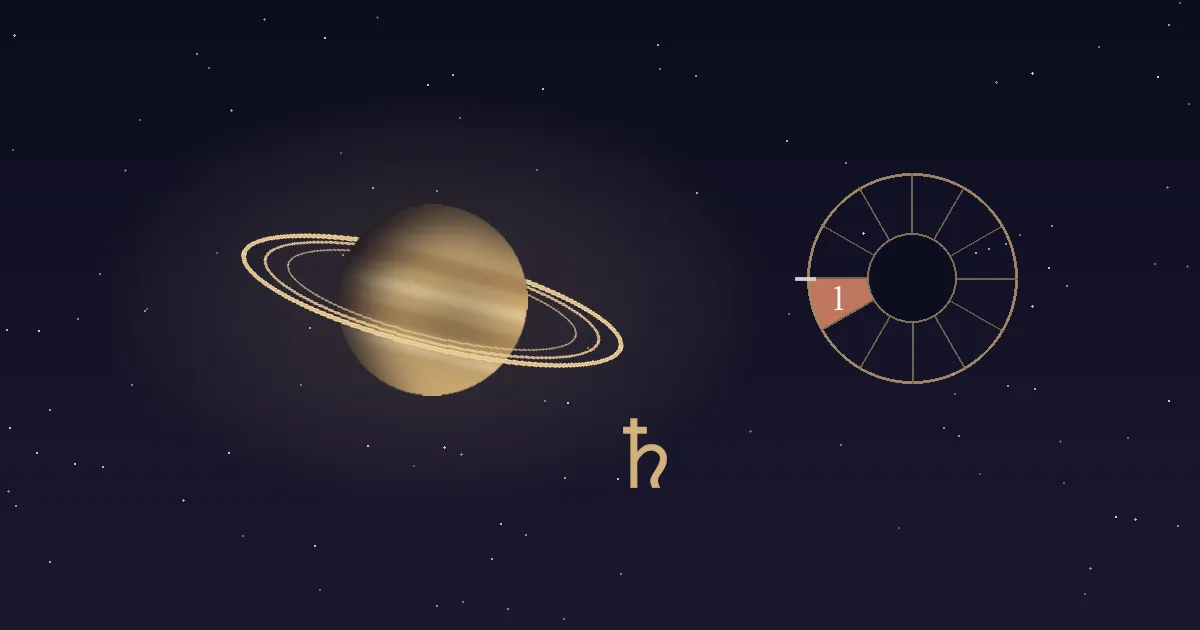
This placement arrives with a verdict attached. "Saturn in the first house: hardest placement?" is how one r/astrology thread put it, and the poster wasn't joking: they expected "a lifetime full of suffering and constant struggle." Quora has a whole question asking whether this is the worst place Saturn can be. People with Saturn rising also get told they look older, sterner, closed.
The texts that started the verdict don't agree with each other, and even the harshest of them carve out exceptions. They're worth reading before you accept a sentence passed by an app.
Quick answer
Saturn in the 1st house puts caution, duty and self-criticism into your first impression and your sense of self. It's often read as a hard start: serious young, responsible early, slow to trust. It is not the worst placement. The old texts split on sign and day or night birth, and most pages promise it eases after thirty.
| Arena | The body, the face you show, how you start things |
| The fear | A hard life, and looking old before your time |
| Firmicus by sect | Day birth: eldest child, proud. Night birth: "the greatest weariness" |
| Vedic status | Phaladeepika: royal in its own or exalted sign. Brihat Jataka adds Jupiter's two signs |
| House-system check | Our simulation: whole-sign 1st 49.5%, 2nd 47.7%, 3rd 2.8%, never the 12th |
| What it's good at | Endurance, self-command, a presence people trust with serious things |
The 1st house starts at your Ascendant, and the Ascendant moves about a degree every four minutes. Whether Saturn sits just inside it, just above it in the 12th, or deep in the house depends on your birth time.
See where Saturn sits against your Ascendant →Is Saturn in the 1st house the worst placement for Saturn?
No. But the reputation makes sense once you read the harsher Vedic passages. Mantreswara's Phaladeepika (VIII.20, in the Sastri translation) says a person with Saturn rising in an ordinary sign "will be afflicted with sorrow and misery from his very childhood and will suffer from indigence. He will be slovenly and indolent." Varahamihira's Brihat Jataka (XX.9) goes further: "poor, sickly, love-stricken, very unclean, suffering from diseases during his childhood."
Read both sentences to the end, though. Phaladeepika opens with the opposite case: if Saturn rises in its own sign or its exaltation, "the person concerned will be on a par with the king, a chief or mayor of a city." Brihat Jataka lists five rising signs (Sagittarius, Pisces, Aquarius, Capricorn and Libra) where the same Saturn makes someone "equal to a king" and "a great scholar." That's five of twelve. A rule with that many exceptions was never meant as a blanket sentence on everyone with the placement.
The royal language has a name in Vedic astrology. Saturn in its own sign or its exaltation in an angle of the chart, and the 1st is an angle, forms Sasa yoga, one of the five "great person" yogas of the BPHS (ch. 75). The same text gives Saturn special aspects on the 3rd and 10th houses counted from itself (BPHS 26.2–5), on top of the 7th that every planet aspects. So a rising Saturn looks straight at the 7th house of marriage, and that's one reason Vedic pages tie this placement to late marriage. All of this is read on a sidereal chart, which can put Saturn in a different sign and house from your Western one.
The Western side splits on another line: day or night birth. Saturn is a day planet, so Firmicus, writing in the fourth century (Mathesis III.2, in Jean Rhys Bram's 1975 translation), is kinder to the daytime version. By day, Saturn on the ascendant "will bring the native to birth with a great cry," makes the child the eldest or the first raised, and makes them "boastful and full of pride." By night the same Saturn means "the greatest weariness" and a native who "will always be oppressed by hard labor." For Firmicus, which side of the horizon the Sun was on changes the reading from mixed to heavy.
William Lilly, in 1647, gave the kindest reading of the three. His house chapter in Christian Astrology names Saturn a co-significator of the 1st, since it is "the first of the Planets," and says that when Saturn there is "but moderately well fortified" and gets a good aspect from Jupiter, Venus, the Sun or the Moon, "it promiseth a good sober constitution of body, and usually long life." Lilly's strength table gives any planet on the Ascendant +5, the top score. So the "worst placement" claim holds up only if you quote one line of one text and stop reading there.
Do people with Saturn in the 1st really look older?
Lilly has a line on the face as well. He wrote that "if either Saturn, Mars or South Node be in this House ... you shall observe some blemish in the face." He meant marks, not age, and it's the same line the Mars-in-the-1st scar doctrine comes from. The "looks older" version is modern, and the people who report it mostly describe an expression. On a long-running AstrologyWeekly thread on appearance, people with the placement describe a serious face, a lean frame and a reserve strangers mistake for disapproval. One reply in the same thread says the opposite: taken for ten or fifteen years younger. We found no study of it, and the reports run both ways.
Liz Greene's reading, in Saturn: A New Look at an Old Devil (1976), explains the reserve better than any claim about bone structure. "The person with Saturn in the first house is often high in suspicion and low in self-confidence," she writes (p.77), "and he looks out at others from behind an intangible but often very powerful barrier." Guardedness is easy to mistake for maturity, and a twelve-year-old who checks the room before speaking gets treated as older than one who doesn't. Greene doesn't make that link to age herself. It's our reading of why the reports exist. Greene even has a line that sits beside Firmicus's "great cry": she suggests the reluctance to be exposed "might even extend to birth" (p.76).
What's worth your attention is what the "looks older" label does to you if you believe it. A Yale study of 660 people, with attitudes measured up to 23 years earlier, found that older adults with more positive views of their own aging lived 7.5 years longer than those with more negative ones. The study didn't test astrology, and it measured an association, not a cause. Still, it's a good reason not to take on "I was born old" as an identity because an app said so. If you also have the Moon in the 1st, the face question gets more complicated, since a 1st-house Moon tends to show feelings a rising Saturn would rather keep behind the barrier.
Saturn spends about two and a half years in each sign; the faster planets cross your chart every day. A free account shows which of your planets today's transits are touching, Saturn included.
See today's transits to your planets →Why astrologers keep saying "after thirty"
Most pages about this placement say life gets easier "after thirty," and the reason usually given, when one is given, is the Saturn return. The astronomy behind it is simple. Saturn takes about 29.4 years to go round the zodiac once (NASA's Saturn fact sheet gives a tropical period of 10,746.94 days), so it comes back to its birth position around 29, and it gets back into the house it started in a little earlier. In our simulation of 240,000 births from 1940 to 2010, transiting Saturn re-entered the natal Saturn's house at a median age of 28.0 and reached the exact natal degree at 29.1. That timing is the same whichever house your Saturn is in. The house decides what the return is about.
For a 1st-house Saturn, astrologers read the return as a change in how you present yourself and who you're seen to be. Alexandria Ocasio-Cortez is the cleanest example we found. Her birth time is rated A at Astro-Databank (her congressional office supplied it), and computing her chart with Swiss Ephemeris puts Saturn at 8°09' Capricorn in the Placidus 1st house, more than twelve degrees from the nearest cusp. On June 26, 2018 she won her primary at 28, with transiting Saturn 2.2 degrees from her natal Saturn and inside her natal 1st house. On November 6 she was elected at 29, and Saturn was 2.7 degrees away. She took office as the youngest woman ever elected to Congress, and a former bartender became a national political figure within months.
Warren Buffett, whose Saturn also sits in Capricorn in the 1st, met Charlie Munger in 1959, at 28 or 29. We couldn't pin down the month, and it barely matters: from the second week of January 1959 transiting Saturn stayed within five degrees of his natal Saturn for the rest of the year, and it crossed the exact degree three times: around the start of March, in early June and in late November. Both are Saturn in Capricorn, Saturn's own sign, where tradition counts it strong. Two careers turning near a Saturn return don't prove that this placement pays late for everyone. They do show what people mean when they say it.
Aries rising: Saturn's whole-sign 1st-house transit runs until April 2028
There's a second way to "have Saturn in the 1st house," and a lot of people searching this in 2026 have it without knowing it: a transit. Saturn entered Aries on February 13, 2026 and stays there, retrograde loops included, until April 12, 2028. In whole-sign houses, that puts it in the 1st house of every Aries rising for the whole stretch. On a Placidus chart it enters the 1st only when it reaches your Ascendant degree and leaves at your 2nd cusp, so the dates are personal. Our Saturn in Aries guide goes through it rising sign by rising sign.
A transit is Saturn passing through the house now; a natal placement is where it stood when you were born. If you were born with Saturn in the 1st, you live with it. If you're an Aries rising, you're getting a long look at it. Either way, the Aries rising profile explains why this particular ascendant takes Saturn hard: Saturn is in its fall in Aries.
Transit note, October 2026
Transiting Saturn is in Aries from February 2026 until April 2028. In whole-sign houses that puts it in the 1st house for Aries risings for the whole stay. It is retrograde from July 26, 2026 (at 14°45′ Aries) until December 10, 2026, going back over ground it already crossed. When Saturn moves into Taurus, the 1st-house transit passes to Taurus risings. A transit is a passing season, not the birth placement this page is about. On a Placidus chart the dates can differ by months, sometimes by more than a year, because the house cusps rarely sit at 0° of a sign.
Rising Saturn or 1st-house Saturn? Check the degree and the house system
Two things change what "Saturn in the 1st" means on your chart. The first is how far Saturn sits from the Ascendant. The 1st house sits just below the eastern horizon. A Saturn within a few degrees of the rising degree was about to rise as you were born, and the "stern face" folklore is about that version. A Saturn deep in the house was still well below the horizon and rose later, often more than an hour later, and astrologers tend to read it as an inner standard more than a visible manner. Michel Gauquelin's disputed research only touches this house at the edge. His rising zone for Saturn in the charts of eminent scientists and physicians sat mostly in what Placidus calls the 12th, and reached only the third of the 1st nearest the Ascendant. The physician result was 130 in the key sectors against 96 expected in a first batch of 576, then 90 against 85 in the second, which led the Dutch skeptic Jan Willem Nienhuys to call the first result "a fluke". It doesn't support a personality claim about Saturn in the 1st.
The second is the house system, and here the geometry is strict. A Placidus 1st house begins exactly at the Ascendant degree. So a Placidus 1st-house Saturn can land in the whole-sign 1st (49.5% of charts in our simulation of births between 25 and 55 degrees north) or the whole-sign 2nd (47.7%), and in a few very wide houses the 3rd (2.8%). It is never in the whole-sign 12th. The confusion that does happen runs the other way. A Saturn in the same sign as your Ascendant but a few degrees above it is whole-sign 1st and Placidus 12th, which is the case for 48.3% of Placidus 12th-house Saturns, and then you want the Saturn-in-the-12th reading as well.
Everything here depends on your rising sign, and your rising sign depends on your birth time. To read your own placement, look at five things together: Saturn's sign, how far it sits from the Ascendant, whether you were born by day or night, whether Jupiter, Venus, the Sun or the Moon aspects it (Lilly's condition for the good version), and whatever else shares the 1st house. If you haven't confirmed your rising sign, look up your Sun, Moon and rising together before you trust any house.
Saturn in the 1st in charts with rated birth times
Lists of "Saturn in the 1st house celebrities" rarely give a birth-time rating or a house system. We only use people whose time is rated AA (a birth record) or A (from the person or their family) at Astro-Databank, and we compute the Placidus house ourselves.
Britney Spears (A, time from her mother) has Saturn at 19°16' Libra in the 1st under both Placidus and whole sign. Libra is Saturn's exaltation, so a Western reader of Phaladeepika would call this the royal case. The sidereal chart a Vedic astrologer uses disagrees: by our calculation it puts both her Saturn and her Ascendant in Virgo, where the exception doesn't apply. The zodiac you use changes Saturn's dignity here, so the tropical reading doesn't carry over unchanged. Her life has the fame, and it has thirteen years, 2008 to 2021, under a conservatorship that controlled her money and her person, until a court ended it after she testified against it. A chart can't explain why that happened. It's hard not to notice, though, that the 1st house is the house of the self.
Alexandria Ocasio-Cortez (A), above, is the return example. Warren Buffett (A, though the thinnest source here: an anonymous contributor said a friend got the time from Buffett himself) has Saturn at 5°20' Capricorn, about ten degrees past his Ascendant. He's known for frugality at a scale nobody else can afford to be frugal at, and still lives in the Omaha house he bought in 1958 for $31,500.
Also verified into the 1st: Adam Levine and Jimmy Carter (both AA) and Mick Jagger (A), whose Saturn stays in the 1st across his doctor's whole "between 2 and 3 AM" window, but only just at 3:00. Note that Ocasio-Cortez and Buffett are both whole-sign 2nd, while Spears stays in the 1st. Switching house systems moves a real share of charts.
When someone else's Saturn lands on your Ascendant
In synastry, their Saturn in your 1st house gets described two ways: the Saturn person makes you feel either watched and corrected, or steady and taken seriously. Astrologers read the overlay as their standards landing on how you present yourself. A practical test is whether their advice leaves you more able to make your own choices. If it does, you've found someone who takes you seriously. If every conversation turns into a correction, that wears down confidence whatever the chart says.
In the 7th, Saturn's caution lands on the people you choose. With Saturn in the 1st the caution can't be handed to anyone else, so the work is on your own hesitation and self-judgment. Greene put the upside plainly: "the controlled and directed will, coupled with a sense of purpose, is one of the more positive qualities offered by Saturn in the first house" (p.78).
Your return window
For a 1st-house Saturn, the return is the stretch when you're asked to become the person you've been practising to be. Your birth date is enough to find the window when Saturn returns to its birth sign.
Find your Saturn return window →Keep reading
- · The planet that gets full directional strength on the Ascendant is Jupiter, the opposite of Saturn's zero.
- · What changes when Saturn rules the rising sign instead of sitting in the house? Capricorn rising answers it.
FAQ
Is Saturn right on the Ascendant different from Saturn deeper in the 1st house?
Yes. The 1st house lies just below the eastern horizon, so a Saturn a few degrees past the Ascendant was about to rise when you were born, and astrologers read it strongly into the first impression, the body and the way you enter a room. A Saturn twenty degrees into the house was still some way below the horizon and wouldn't rise until later, usually more than an hour later, and it tends to be read as a private standard you hold yourself to. Check the degree gap between Saturn and your Ascendant on your chart: under about five degrees is the classic 'Saturn rising' people describe.
Why do some people with Saturn in the 1st house look younger as they get older?
We found no study of it, so treat this as something people report, not a finding. People with the placement often describe themselves the same way: taken for older in school, taken for younger at forty. Our guess is that it's about manner more than skin. A serious, careful teenager comes across as grown up, and the same person at fifty, who stopped trying so hard to be taken seriously decades ago, comes across as relaxed. The 'old soul' look is often a young person carrying responsibility early.
Did the old astrologers link Saturn in the 1st house to teeth or bones?
William Lilly did. In Book III of Christian Astrology (1647) he calls Saturn in the Ascendant, in any sign except Capricorn or Aquarius, 'an assured argument of great paine in the Teeth'. It's a seventeenth-century rule of thumb, and we know of no study that has tested it. A chart can't diagnose anything, so if your teeth or joints hurt, see a dentist or doctor.
What does it feel like when transiting Saturn crosses the Ascendant of someone born with Saturn in the 1st house?
For you, that crossing is the run-up to your Saturn return. Transiting Saturn has to cross your Ascendant to get back to a 1st-house natal Saturn, and astrologers read that stretch as pressure on how you present yourself, from your body to the image you've outgrown. The return itself is a separate event: it comes when Saturn reaches your natal Saturn's exact degree, which in our simulation was a median of about 1.1 years after it entered the house. If your return seemed to start early, the Ascendant crossing is one likely reason.