Birth Chart
Moon in the 1st House: The Feelings Everyone Can See
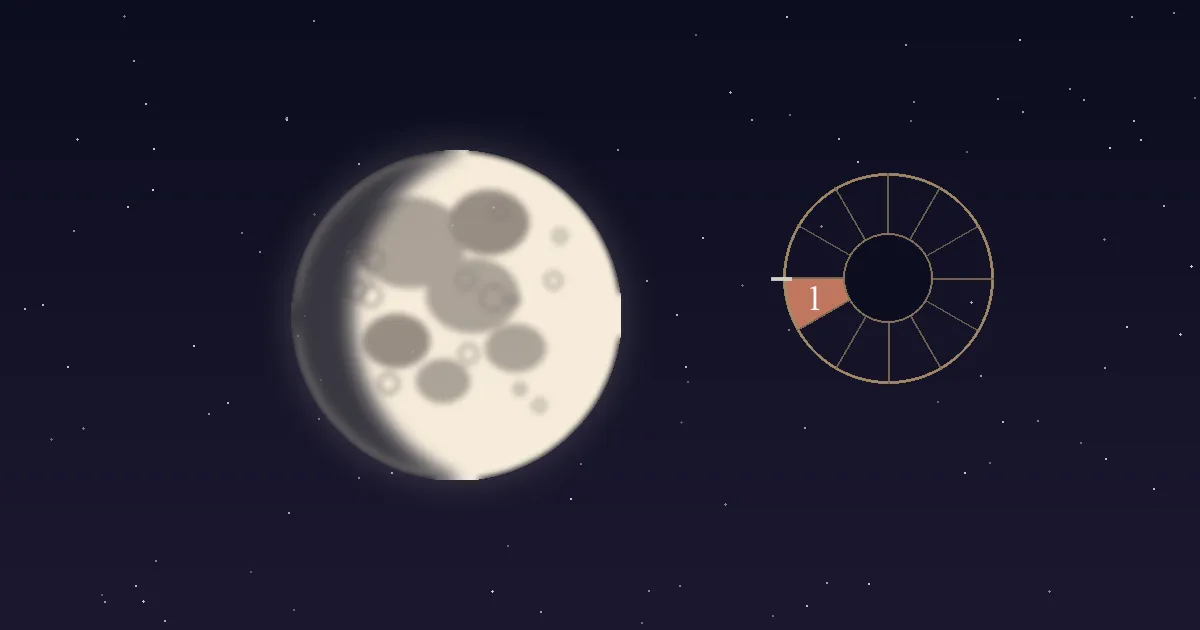
Most planets in the 1st house shape how you come across. The Moon in the 1st house decides something more specific: whether your inner state is visible at all. With this placement it is. Your face runs a live feed of your feelings, people you've just met treat you as someone they've known for years, and "you look tired" lands on you more than on anyone else you know.
Three questions bring people to this placement: the appearance and attractiveness claims (a real psychology study gets attached below), whether Moon in the 1st equals Moon on the Ascendant (it doesn't, quite), and what the fullest surviving Roman astrology manual said about it in the fourth century. Houses new to you? Our primer on all twelve houses is the ten-minute foundation; this page assumes the basics.
Quick answer
Moon in the 1st house places your emotional nature in the house of self and body, so feelings show immediately in your face, posture, and presence. It reads as warmth, openness, and changeability. Identity and mood run on one circuit. The placement is angular, which tradition counts among the strongest positions a Moon can hold.
| Placement | Angular 1st house: self, body, face, first impressions |
| Emotional style | Worn openly; mood and identity share one surface |
| Classical note | Firmicus rates a full Moon rising by night "the greatest good fortune" |
| The appearance claim | Real but overstated: expressiveness, not a beauty guarantee |
| Monthly rhythm | The transiting Moon re-crosses this house for roughly two days each month |
| Sign layer | Your Moon sign sets the style this house broadcasts |
Houses depend on your birth time, so no sun-sign column can tell you whether this page is about you. A chart cast for your exact birth minute can, and it takes about sixty seconds.
Get your free birth chart and find your Moon's house →What Moon in the 1st house means
The 1st house is the chart's front edge: the body you walk around in, the face people meet, the personality that arrives before your history does. The Moon is the fastest thing in the sky and the symbol of everything that fluctuates. Vettius Valens, the second-century astrologer whose Anthology survives in full, lists the Moon's territory as "man's life, body, the mother, conception, beauty, appearance, sight" before he gets to anything else. Body and appearance are literally in the Moon's ancient job description. Put her in the house of the body and the two lists merge.
In practice, people with this placement are responsive. They mirror the emotional temperature of whoever is in front of them, they notice a shift in the room before anyone names it, and strangers open up to them in checkout lines. The cost runs on the same wire: they absorb atmospheres they never agreed to carry, and their own state is public information. A 1st-house Moon can't play poker with its face.
Identity is the deeper layer. For most people, "who I am" and "how I feel today" are separate files. With the Moon in the 1st they share a folder. A rough week doesn't just feel bad, it feels like being a different person. That's not fragility. It's how the placement is built, and the same build updates fast: stale self-images get dropped quickly here, and other people's moods get read early and well.
Does Moon in the 1st house make you attractive?
This is the question under half the searches for this placement, so it deserves a straight answer instead of a compliment. The honest version: the placement makes you expressive, and expressiveness is a large share of what people experience as attractiveness in person. It is not a beauty verdict, and any page telling you the Moon guarantees a lovely face is reading tea leaves.
Here's why the expressiveness part matters more than it sounds. In a much-cited Princeton study, Willis and Todorov (2006) found that people form judgments of attractiveness, likeability, and trustworthiness from a face in as little as 100 milliseconds, and that longer exposure barely changed the verdict. First impressions are decided on the surface, instantly. To be clear about what that study is and isn't: it measured snap judgments of faces and has nothing to say about Moon placements. What it establishes is that the surface decides fast. The 1st house IS the surface, a Moon there floods it with feeling, and readable warmth is working in exactly the tenth of a second where those judgments happen.
The classical tradition backs the softer claim too: a well-conditioned Moon rising was associated with a pleasing, notable appearance, and the Moon's own significations include beauty in Valens' list above. So keep the claim honest. Moon in the 1st gives a face people trust fast and remember as warm. What it does for symmetry, only your parents decided.
Moon on the Ascendant is not quite the same thing
Almost every page treats "Moon in the 1st house" and "Moon on the Ascendant" as synonyms. They overlap, and they are not identical, and the difference decides how strongly the placement plays.
The Ascendant is a degree, not a zone. A Moon within a few degrees of it (on either side) is conjunct the Ascendant: that is the placement at maximum volume, the version the old texts were describing when they wrote about the Moon "rising." A Moon twenty-five degrees below the Ascendant still sits in the 1st house, still colors the self, but broadcasts at lower wattage. And the house system you use moves the boundary: in whole-sign houses the entire rising sign is the 1st house, while quadrant systems like Placidus cut it by degree, so a Moon late in the rising sign can be a 1st-house Moon in one system and a 2nd-house Moon in the other. Our chart calculator states which system it uses right on the result, because a placement claim without a house system attached isn't checkable.
There's an even finer detail no ranking page mentions, and it only bites the Moon. Charts are normally computed geocentrically, from the Earth's center. Seen from your actual birthplace on the surface, the Moon shifts by up to about a degree (astronomers call it lunar parallax, and the Swiss Ephemeris documentation details the difference). No other planet is close enough for this to matter, but a Moon sitting within a degree of your Ascendant can land on either side of the line depending on the convention your software uses. If that's you, treat the house call as genuinely ambiguous and read both pages.
If your Moon sits near a house line, don't agonize. Read this page and the neighboring house's page and notice which one describes your life. Charts are read by people, and you're the person. The full rising sign explainer covers why that Ascendant degree anchors everything else.
The Moon crosses your 1st house for about two days every month, and most people with this placement can feel which days those are. ZodiScope tracks the transiting Moon through your houses in real time and shows you today's overlay on your own chart.
See today's Moon on your chart →The fourth-century read: night charts, full Moons, and ship captains
The most extensive astrology manual to survive from the Roman world, the Mathesis of Firmicus Maternus (fourth century CE), delineates the Moon through the houses in Book III, and his 1st-house entry is a small masterclass in how ancient astrology actually worked. In the Bram translation: "The Moon on the ascendant in a nocturnal chart, if she is full and in signs in which she rejoices, indicates the greatest good fortune." Then, wonderfully specific: "By day she makes captains of great ships."
Notice what he's doing. The verdict isn't one-size-fits-all; it's conditioned on sect (a night birth suits the Moon, ruler of the night) and phase (the ancients read a bright, growing Moon more generously than a waning sliver). Modern astrology flattened those dials, which is partly why modern delineations all sound alike. If you want the classical best case for this placement, the checklist is: born at night, Moon waxing or full, in a sign she likes (Cancer, her home, or Taurus, her exaltation). Each condition you miss dims the reading a step; none of them breaks it.
And the ship captains? The Moon governed the sea in ancient rulership, so a day-chart Moon rising pointed a career toward water. It reads charmingly literal now, and it's a useful reminder that these texts were written for a world of grain ships, not job boards. The pattern underneath survives translation: a 1st-house Moon does well fronting anything that moves with public mood, from nursing to hospitality to an audience-facing feed.
The mother, worn openly
In every era of astrology the Moon carries the mother, and a 1st-house Moon puts that inheritance in plain view. People with this placement often visibly resemble their mother, or carry her mannerisms, or built their emotional habits by direct copy or deliberate contrast with hers. The searches asking what this placement says about your mother are really asking about that transfer: with the Moon in the house of self, the maternal imprint isn't tucked away in the family corner of the chart. You wear it.
What the placement does not do is grade your mother, and you should distrust pages that read a low-quality childhood into a house position alone. How the imprint feels depends on the Moon's sign and aspects, which is exactly where a real chart earns its keep against a one-line delineation. The 4th house, the Moon's own angular seat, carries the deeper family story: the Moon in the house of roots covers it, including the version where home wasn't warm.
How your Moon sign colors a 1st-house Moon
The house says your feelings show. The sign says what shows. Grouped by element:
- Fire Moons rising (Aries, Leo, Sagittarius): the feelings arrive as action and volume. Quick to flare, quick to clear, impossible to miss. The loudest edition of the placement by a distance.
- Earth Moons rising (Taurus, Virgo, Capricorn): steadier weather, shown through the body. Stress reads as tension and appetite changes rather than speeches. The most composed version, and the one most surprised to learn everyone can still tell.
- Air Moons rising (Gemini, Libra, Aquarius): feelings become words on arrival. Talkative under stress, charming in company, and prone to narrating an emotion instead of having it.
- Water Moons rising (Cancer, Scorpio, Pisces): the full-immersion edition. Maximum receptivity, maximum absorption of the room, and the strongest need for recovery time alone afterward.
Don't know your Moon sign? The Moon sign lookup below finds it from your birth details, and the full Moon sign guide walks all twelve.
Living with the open channel
Advice for this placement usually amounts to "be less sensitive," which is like advising a lighthouse to be less tall. The workable moves are structural. Build in recovery time after heavy social exposure, because the channel doesn't close on command. Say "I'm off today, it isn't about you" out loud, since people will read your face anyway and invent worse explanations. And learn your monthly rhythm: the transiting Moon completes a lap of your whole chart every 27.3 days (NASA puts the sidereal month at 27.32166 days), which hands your 1st house roughly two of those days (a little more or less depending on how wide your chart's houses run). Many 1st-house Moon people can point at their calendar and name the monthly stretch when everything feels louder. Once you know it's a tide, you stop treating it as a verdict.
If you're comparing notes across placements, the same front-of-chart position hosts very different tenants: Venus in the house of self is charm at the front door and Jupiter in the 1st house is confidence at scale. The Moon is the only one that makes the door transparent. A 1st-house Sun is read through identity and first impressions instead. On a Placidus chart it also means a birth in the hours before sunrise.
The other half of your Moon
This page covers the house. Your Moon sign sets what the open channel broadcasts, and one birth date, time and place gives it to you with your Sun and rising. It's free and needs no account.
Find your Moon sign, Sun and rising →Keep reading
- · This Moon wears the feeling; a Mars in the 1st acts on it before the feeling has a name.
- · The opposite corner, where feelings meet a partner: Moon in the partnership house.
FAQ
How do I know if my Moon is in the 1st house?
You need your exact birth time. Houses are anchored to the Ascendant, which shifts by roughly a degree every four minutes on average (faster or slower by latitude and season), so a chart cast from the date alone can't place the Moon in any house. Cast a chart with date, time, and birthplace, then look for the Moon in the wedge just below the Ascendant line on the left of the wheel. The free birth chart calculator on this site does it in about a minute and tells you the house directly.
Is Moon in the 1st house the same as Cancer rising?
No, though they get mixed up constantly because both put lunar energy at the front of the personality. Cancer rising means the Moon RULES your 1st house from wherever it happens to sit, so its condition colors your whole presentation at one remove. Moon in the 1st house means the Moon is physically standing in the house of self, whatever your rising sign is. Someone can have both at once (Cancer rising with the Moon also in the 1st), and the two reinforce each other. The mechanisms are different: rulership works by delegation, placement works by presence.
Is a 1st-house Moon stronger in a night chart?
Traditional astrology says yes. The Moon is the ruler of the night sect, so ancient astrologers graded her more generous when she rises in a nocturnal chart. Firmicus Maternus, writing in the fourth century, reserved his best 1st-house Moon delineation for a night birth with a full, well-placed Moon, and gave the day-chart version a more modest reading. Modern astrology mostly dropped sect, but it costs nothing to check: born at night with a waxing 1st-house Moon, you're reading the placement's classical best case.
Can Moon in the 1st house cause visible mood swings?
The placement doesn't create more moods than anyone else has; it removes the curtain in front of them. The 1st house is the body and the face, so a Moon here routes emotional weather straight to the surface: friends know your state before you've said a word, and a bad hour is hard to hide in a meeting. The transiting Moon also crosses the 1st house for roughly two days every month (the exact length depends on your chart's house sizes), which many people with this placement feel as a monthly emotional high tide. Tracking it takes the mystery out of the pattern.