Birth Chart
Moon in the 4th House: The Moon at the Base of Everything
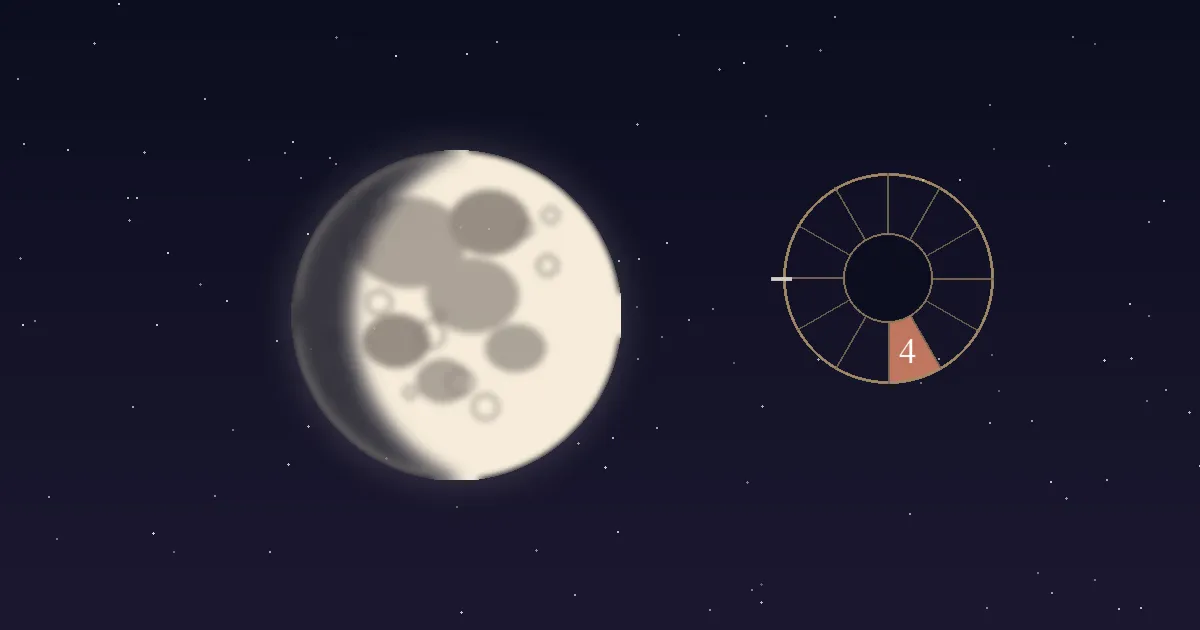
Start with the verdict, since it's what the searches ask: yes, this is a strong placement, arguably the strongest seat the Moon can take. Angular house, base of the chart, Cancer's natural turf, and the position Vedic astrology awards the Moon directional strength. If your Moon is here, the deepest layer of the chart holds its most emotional planet, and each makes the other matter more.
The delineations that usually come with that verdict all assume the same biography: warm mother, happy home, nostalgia in soft focus. Plenty of 4th-house Moons grew up in houses that were anything but safe, and the placement has a precise, recognizable shape in those lives too. This page covers both versions, plus what "home" even means when you rent it. For house basics first, read how the twelve chart houses work.
Quick answer
Moon in the 4th house anchors emotional life to home, family, and roots. It's an angular placement in the Moon's natural region of the chart, so the lunar needs (safety, belonging, care) run at full strength. The mother or primary caregiver leaves a defining imprint. Home is the non-negotiable: when it's right, everything works better.
| Arena | Angular 4th house: home, family, roots, endings; the IC, the chart's base |
| Strength | Angular + Cancer's natural house + Vedic dig bala: the Moon's power seat |
| Core need | A true base; a home that functions as a nervous-system anchor |
| The imprint | The caregiver's emotional style, inherited or deliberately inverted |
| Classical split | Firmicus grades it by day/night birth and lunar phase |
| Later life | The 4th also rules endings: this Moon tends to deepen with age |
In the quadrant house systems most chart sites use, the 4th house starts at the IC, a point that exists only when a chart is cast for an exact birth time. One minute with the free calculator settles whether this page is yours.
Cast your free birth chart →Why astrologers call this seat hers
The claim isn't sentimental; it's structural, three ways at once. First, the 4th is angular: the four houses on the chart's cross (1st, 4th, 7th, 10th) where planets act at full strength. Second, modern astrology pairs it with Cancer, the Moon's own sign (an analogy rather than an old rulership, but a telling one), so the house's topics (home, family, memory, care) are the Moon's topics before she even arrives. Third, Vedic astrology formalizes it: in the dig bala scheme of directional strength, the Moon attains her maximum at the 4th, the way Jupiter does at the 1st.
The base of the chart is also its most private point: the IC (Imum Coeli, "bottom of the sky") is where the Sun sits at midnight. Planets here work interior lives. So the full picture of a 4th-house Moon is strength without spotlight: an emotional life that's powerful, deep, and mostly invisible from the street, the exact inverse of the 10th-house Moon living directly overhead.
Home as a nervous-system requirement
Everyone likes being home. For this placement it's closer to physiology. A 4th-house Moon runs on its base: sleep quality, mood, even social capacity all track how settled home currently feels. These are the people who can't relax at a party because they haven't finished unpacking, who feel a bad roommate situation in their body, who need one room arranged exactly right before anything else in life is negotiable.
Environmental psychology has, without meaning to, measured the thing this placement lives on. A three-wave longitudinal study during the 2020 confinement period found people's attachment to their home associated with lower depression, anxiety, and stress, with the authors naming refuge, security, and stability as the working mechanisms. The study wasn't about charts. What it establishes is that an emotional bond with a dwelling is a real, measurable buffer. The 4th-house Moon just runs that buffer as primary infrastructure rather than backup.
Which is why the modern housing landscape hits this placement specifically. Census data counts 6.0 million multigenerational households in the U.S. as of 2020, up from 5.1 million a decade earlier, and many adults now rent far deeper into life than their parents did. A 4th-house Moon without a deed doesn't get a lesser version of the placement. The signature moves into what's controllable: the rental transformed past recognition, the same mugs and lamp recreating "home" in every new flat, the housemates converted into family. Roots, this Moon eventually learns, are portable. They're made of people and ritual, with the mortgage optional.
The mother, both versions
The Moon is the tradition's chief significator of the mother (not its only one, but the one every era kept), and in the house of family that signification runs at maximum. The warm version is well covered by every other page: mother as anchor, kitchen as chapel, an adult who calls home twice a week and means it. It's real, and if it's yours, the placement mostly asks you to notice how much of your emotional style is inherited recipe.
The version nobody writes about is just as common in practice. When the caregiver was unpredictable, absent, or frightening, a 4th-house Moon child calibrates to household weather as a survival skill and carries that barometer into adulthood. The tells: hypervigilance about "atmosphere" at home, disproportionate distress when living situations wobble, and the compulsion to fix everyone else's comfort before feeling any themselves. If that's you, the placement isn't mocking you with a happy-family symbol. It's naming the size of the need, and adults with this configuration are unusually good at building the thing they missed. The inversion is the healing: same Moon, new house.
The old texts, typically, graded the mother's own fortune from this placement. Firmicus Maternus splits it cleanly: by day, a hard reading for the mother; by night, a full Moon here "will make the mother rich" and provides "constant increases in income" (Mathesis III, Bram translation). Read those as artifacts of a fatalistic era with one true observation inside: this placement and the mother's story are structurally entangled, whichever way the story runs.
About two days a month the transiting Moon crosses your 4th house; most people with this placement feel those days as a pull homeward, a nesting urge, or family surfacing in dreams. ZodiScope shows the live overlay on your chart so the pattern gets a schedule.
Watch the Moon cross your houses →Career, marriage, property: the adjacent questions
The long-tail searches around this placement ask about everything the base touches. Quick, honest answers. Career: the 4th opposes the 10th, so a Moon here often means work matters less than home, and the best career moves are ones that protect the base (remote work was invented for these people). Marriage: nothing about this placement delays or denies partnership, but a partner who doesn't take home seriously is disqualifying here in a way other placements don't experience; the partnership house itself is the 7th. Property: the drive is real, the deed is not guaranteed, and when astrologers read property through this placement, they read it arriving through family in some form, in either direction.
And one the searches don't ask but should: the 4th traditionally rules endings, the last chapter of matters. Astrologers read a Moon here as deepening with age: the placement's needs get easier to meet over time, the home gets truer, and later life is often this Moon's best era, presiding over the base it spent decades building.
Twelve kinds of homesickness
The sign your Moon wears decides what "home" has to feel like before your system counts it as real:
- Home-sign Cancer Moon in the 4th: the maximum edition, Moon in her own sign in her own house. Home is memory made walkable; this person keeps everything and forgets nothing.
- Saturn-run Capricorn Moon in the 4th: home as achievement. Security means the structure is sound and the bills are prepaid; warmth arrives via competence.
- Venus-run Libra Moon in the 4th: home must be beautiful and conflict-free to count. One ugly argument in the kitchen reads as structural damage.
- Jupiter-run Sagittarius Moon in the 4th: the paradox edition, roots plus wanderlust. Solves itself with a home base worth leaving and returning to; the returning is the point.
The other eight follow the same grammar. Your sign is one lookup away in the box below, and the in-depth Moon sign guide covers each one. For how differently this wedge behaves under other tenants, compare Venus in the 4th house (the beautiful home) and Jupiter in the 4th house (the expanding one).
Your kind of homesickness
Your Moon sign decides what home has to feel like before it counts. Look it up with your Sun and rising from a birth date, time and place. Free, no sign-up.
Get your Moon sign with your Sun and rising →Keep reading
- · A loud house instead of a soft one: Mars at the base of the chart and the childhood-home question.
- · Where the sibling story lives, one door back: the 3rd-house Moon.
FAQ
Is the Moon strongest in the 4th house?
It's one of her two best seats, and by house logic arguably the best. The 4th is an angular house, the strongest tier, and it sits at the base of the chart, the region tradition associated with home, family, and endings, all lunar territory. The natural-sign echo doubles it: the 4th corresponds to Cancer, the Moon's own sign. Vedic astrology also grades the Moon as gaining directional strength (dig bala) at the 4th. Her other claim to comfort is the 3rd house, her traditional 'joy.' Angular power in the 4th, native ease in the 3rd; both count as the Moon at home.
What does Moon in the 4th house say about your mother?
That she's central, for good or ill, not that she was good or ill. The Moon signifies the mother, and in the house of family her imprint sits at the root of your emotional life: her moods set the household weather you calibrated to, and her way of caring became your definition of care, kept or deliberately reversed. Ancient texts graded her fortune from this placement (Firmicus splits it by day birth versus night birth and by lunar phase). The modern read is about transmission, and it holds whether the inheritance was a warm kitchen or a walking-on-eggshells hallway.
Does Moon in the 4th house mean you will own property?
No placement can promise a deed, and be suspicious of pages that say otherwise. What this Moon reliably produces is the drive: home matters enough that people with it organize their lives around securing one, and property, when it comes, tends to arrive through family in some form (inheritance, help with a down payment, buying near or with relatives). If ownership isn't reachable, the drive doesn't vanish, it redirects into making whatever space you rent profoundly, permanently yours. The nesting is the signature; the paperwork is circumstance.
What if my Moon is in the 4th house but my childhood home wasn't a refuge?
Then the placement usually shows up inverted, and it's one of astrology's more poignant patterns: the person becomes, in adulthood, the maker of the home they didn't get. The need for a true base doesn't switch off when the original base fails; it compounds. Adults with this version often build almost ritually safe households, feed everyone, keep the door open, and get called 'the mom friend' regardless of gender. The placement describes how much home matters to you. Your history decides whether that's a nostalgia or a project.