Birth Chart
Sun in the 4th House: Why a Midnight Sun Gets Called a Late Bloomer
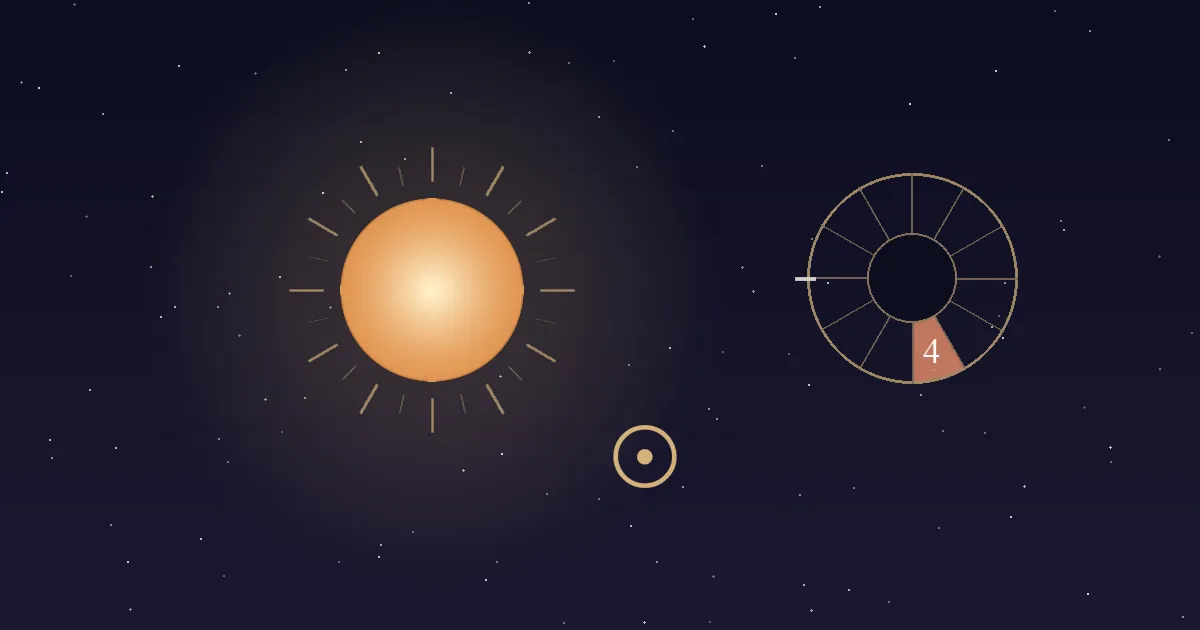
"I've always read that the Sun in 4th makes for late bloomers." That line, from a long-running AstrologyWeekly thread, is where most people with this placement start, usually followed by a second question: what does it say about my father? One Reddit discussion with more than forty replies describes the parental roles as flipped, with a father who was distant or simply not there.
Both ideas make more sense once you know what the placement is on the clock. In Placidus houses, a 4th-house Sun means you were born in the hours before solar midnight, while the Sun was sinking toward the lowest point of its daily circle. And the one classical text with a father warning attaches conditions to it that most summaries leave out.
Quick answer
In Placidus houses, the Sun in the 4th house means you were born in the late evening, before solar midnight, with the Sun near the bottom of the chart. Astrologers read it as a self rooted in home, family and private life, often slower to show in public. Firmicus already promised it a prosperous old age.
| Birth time (Placidus) | The sixth of the night that ends at solar midnight |
| U.S. births, 2024 | About 6.8%, most between 10:25 p.m. and 12:53 a.m. by the clock (our calculation from CDC data) |
| House type | Angular: the IC, the root of the chart, home and family |
| Vedic note | Weak directional strength: zero at the 4th-house cusp, full at the 10th |
| The father question | Firmicus predicts trouble only with Mars and Saturn both aspecting the Sun |
Near midnight the 3rd, 4th and 5th houses sit within a couple of hours of each other, and a few minutes of birth time can move the Sun across a line. Check where your Sun actually falls first; the rest of this page assumes the 4th.
Place a midnight birth in the right house →Why a 4th-house Sun is called a late bloomer
The modern reasoning is about position. In Placidus houses the Sun passes through the 4th on its way down to the IC, the lowest point of its daily circle, which it reaches at solar midnight before moving into the 3rd. Astrologers read that as an identity that forms in private first, inside the family and the home, and reaches the public world later. It's the opposite of the noon Sun at the top of the chart, which Vedic tradition rates highest. That's the career placement this one always gets compared with: a 10th-house Sun and the fame question.
What surprised us is how old the "late" part is. Firmicus Maternus, writing in the fourth century, has the bleakest passage for this placement and still ends it on the native's later life: "he will have a fortunate old age with the greatest prosperity" (Mathesis III.5.17, in Bram's 1975 translation). Alan Leo was even more direct in How to Judge a Nativity (1928 printing): "THE Sun in the fourth house shows success at the end of life, realised ambitions, hopes and desires when the life is nearing the close" (p. 168).
Leo's claim is about the end of life, and modern astrologers stretch it into something gentler: the base gets built first (a home, a family, a sense of belonging) and the public part follows. Some people with the placement do well young and still feel they only came into their own later.
Born before solar midnight: what the clock says
Over a day the Sun moves backwards through the houses: rising into the 12th, crossing the top of the chart into the 9th at noon, setting into the 6th and passing through the 5th and 4th through the evening. In Placidus houses each house is one sixth of the Sun's night or day, and the 4th is the sixth that ends at solar midnight, the Sun's lower crossing of the local meridian, where it meets the IC.
That's not the same as midnight on the clock. Daylight saving, time zones and the season all shift it. In New York, solar midnight fell at 12:57 a.m. on June 21, 2026, and at 11:54 p.m. on December 21. The CDC's natality file has the clock time of U.S. births but no birthplace, so we simulated 400,000 births from its 2024 timing data, spread them by state birth counts and county population with real time zones and daylight saving, and cast a Placidus chart for each. In that model about 6.8% of babies had the Sun in the 4th house, most born between 10:25 p.m. and 12:53 a.m., with the middle of the window near 11:49 p.m.
The share swings with the season, because winter nights are long and summer nights short: 8.5% of December and January births had a 4th-house Sun, against 5.3% of June and July births. These late-evening babies were also more likely to arrive on a weekend (24.7%, against 21.4% of all births) and less likely to be cesareans with no trial of labor (11.8%, against 23.1%), which fits what an NCHS data brief found for 2013: births peak at 8 a.m., and every hour from midnight to 7 a.m. accounts for under 3% of them.
The father question: what Firmicus actually wrote
The Sun is the traditional significator of the father, so any house that hides the Sun gets read as a story about Dad. For the 4th, the fear has one real classical source. Firmicus writes: "Death for the father, ruin for the whole family, and loss of the entire inheritance is the prediction of the Sun in the fourth house if Mars and Saturn are in any aspect to him." That's a hard sentence, but it carries a condition people tend to drop: both malefics have to aspect the Sun. And in the same passage he gives the native himself "difficulties, troubles, and reverses" and then the fortunate old age quoted above.
The Indian texts don't predict the father's death here at all. Their theme is property. Phaladeepika (VIII.2) says this native "will serve the State and spend away his paternal property," and Saravali (30.5) says he will "destroy paternal house and wealth." In Vedic astrology the father belongs to the 9th house anyway; the 4th is the mother, the home and vehicles.
Modern astrologers mostly reframe it as an experience, not an event. Robert Hand, in Horoscope Symbols (1981), writes that "the Sun represents the experience of being fathered, not the objective truth about one's father." He also says the parent question is genuinely unsettled: "either parent may be symbolized by the fourth, depending on what role the parent is playing in the eyes of the child." Howard Sasportas reported Liz Greene's view that the image of the father "worked better with the 4th" (The Twelve Houses, 1985, p. 56). So a 4th-house Sun can describe a father who was absent, one who was the warm centre of the house, or a mother who did that job. If your father was present and loving, the placement hasn't failed. It just isn't describing a fact about him.
Astrologers watch slow transits for moves and family changes. A free account shows which of today's planets are aspecting your natal Sun, Moon and the rest of your chart.
Check today's aspects to your chart →Home, family and the private self
Beyond the parent question, the 4th house is where you go when nobody's watching: home, roots, the family you came from and the one you make. A Sun here is usually read as someone whose sense of self is tied to that private ground. You may put a lot of effort into choosing where you live and who you live with. People with the placement often describe a strong pull to the family early on, and astrologers who see it as a late bloomer signature say the hard part is leaving.
Sasportas used Marcel Proust as his example, with the Sun, Mercury, Jupiter and Uranus in Cancer in the 4th house, the novelist who spent In Search of Lost Time on memory and early life. The sign of the 4th house is Cancer in the natural zodiac, which is why the two get read together. The Moon tells the same story in a different register: a 4th-house Moon looks for comfort at home, where the Sun looks for identity.
At work, astrologers connect it with jobs done from home or for the family: a family business, property, genealogy, caring work. The classic conflict is with the 10th house straight across the chart, when a promotion means moving away or a career asks for evenings the family expects. In relationships it usually means home and family come up early: a partner who wants a place of your own within months, or who treats your parents' table as theirs, will find you easy to win; one who never wants to settle will feel it. The shadow side is the one Hand's parent point hints at: a family identity strong enough that it's hard to tell where your plans end and theirs begin.
Midnight births on record
These people have birth times rated AA at Astro-Databank, from birth certificates or records, and we computed their Placidus houses with Swiss Ephemeris. All four have the Sun in the 4th with room to spare: the time would have to be wrong by at least half an hour to move it.
Julia Roberts was born at 12:16 a.m. on October 28, 1967, in Atlanta, with the Sun at 4° Scorpio in the 4th. Tiger Woods was born at 10:50 p.m. on December 30, 1975, in Long Beach, California, with the Sun at 8° Capricorn in the 4th. Tina Turner was born at 10:10 p.m. on November 26, 1939, in Brownsville, Tennessee, with the Sun at 4° Sagittarius in the 4th. Pablo Picasso's birth record gives "a las once y cuarto de la noche," a quarter past eleven at night, on October 25, 1881, in Málaga, with the Sun at 2° Scorpio in the 4th.
Three of the four show the house-system issue. Roberts, Woods and Turner have the Sun in the whole-sign 5th, because their rising signs sit four signs before their Sun signs; Roberts, for instance, is a Scorpio Sun with Cancer rising. Only Picasso is 4th in both systems. We list placements, not causes.
Transit note, October 2026
The Sun entered Libra on September 22, 2026 and moves into Scorpio on October 23, 2026 (US Eastern dates). In whole-sign houses that stretch puts the transiting Sun in the 4th house for Cancer risings. From October 23, 2026 until November 22, 2026 it is the turn of Leo risings. Every rising sign gets about a month of the Sun in its 4th house once a year, so this is a yearly season, not the birth placement this page is about. That one depends on the time of day you were born.
The 4th-house Sun in Vedic astrology
The Vedic texts are the harshest on this placement, and directional strength is one reason. The Brihat Parashara Hora Shastra (3.35–38 in R. Santhanam's translation) says the Sun and Mars are strong "in the south," which Santhanam's note explains as the 10th house, and the same note adds that "the planet gets no Digbala if it is in the opposite sign with reference to its Digbala house." The fuller rule in chapter 27 (27.7) grades the strength by distance: full at the 10th-house cusp, zero at the 4th-house cusp, so a 4th-house Sun sits at or near the bottom of the scale.
The house-by-house verses follow suit. Varahamihira's Brihat Jataka (XX.2) says the native "will have no happiness and will be troubled in mind," and the translator's note adds that the Sun is "bad in the 4th." Phaladeepika lists "no happiness, no relations, no lands, no friends and no house." Saravali adds heart trouble and serving "a bad king." It reads as a grim list, and it's worth knowing that it comes from a system in which a planet's strength depends heavily on its direction.
Two cautions before anyone takes it to heart. The old texts, Western and Indian, counted houses by whole signs, and Vedic charts are also sidereal, so a Western Placidus 4th-house Sun can be a 3rd or 5th-house Sun in a Vedic chart, and the other way round. And directional strength is one strength among six that a Vedic astrologer weighs. A 4th-house Sun in its own sign or with good aspects can be read very differently from the bare verse.
4th, 5th or 3rd? Checking a midnight chart
Because the 4th house is a band of only about two hours, centred close to midnight on the clock, small errors in a recorded time matter. Half of all U.S. births in our model fall within 30 minutes of a change in the Sun's house. A birth noted as "around midnight" could be a late 4th or an early 3rd; one noted at 10 p.m. could be the 4th or the 5th, where the old "fewer children" verses for the Sun come in.
The house system changes it again. In whole-sign houses a Placidus 4th-house Sun is the 4th in 45.0% of U.S. births, the 5th in 45.5% and the 3rd in 5.7%. A quick sanity check: with a 4th-house Sun your rising sign is usually three or four signs before your Sun sign (in 90% of U.S. births in our model), so a Scorpio Sun in the 4th points to Leo or Cancer rising. If you know your rising sign and it doesn't fit, check the time. You can find your rising sign with the Sun, Moon and rising lookup if you have a birth date, time and place.
The same two-hour sensitivity applies to every planet, which is why finding your houses starts with an exact birth time. If the old lost-parent fear is what brought you here, Saturn in the 4th house checks that claim against the texts for a different planet.
Their Sun in your 4th house
In synastry, someone whose Sun falls in your 4th house tends to feel like family, sometimes very quickly. Astrologers read it as a person who brings out your sense of home, which can be comforting or can stir up old family patterns, depending on what home meant to you.
You and your family
Put a parent's or partner's birth date next to yours and compare the Sun, Mercury, Venus and Mars signs side by side, free and without an account.
Compare your signs with a parent's →Keep reading
- · If the father verses still sting, our birth chart guide on what a chart can and can't tell you puts any single placement in proportion.
- · Jupiter at the root of the chart reads as abundance at home: Jupiter in the 4th house.
- · Born just after solar midnight instead? Then the Sun has crossed into the 3rd, and the elder-sibling verses for a 3rd-house Sun are the ones to check.
FAQ
Does the Sun in the 4th house mean your father was distant?
It's a common modern reading, not a rule. The Sun is the traditional symbol of the father, and the 4th is the private, hidden part of the chart, so astrologers often describe a father who was absent, busy or hard to reach, or a parent who played both roles. Robert Hand points out that astrologers don't even agree which parent the 4th house stands for. The one classical text we found that predicts trouble for the father here, Firmicus Maternus, only does so when Mars and Saturn both aspect the Sun.
Why is the Sun in the 4th house called a late bloomer?
Partly geometry and partly old texts. The 4th house is the stretch where the Sun is heading down to the lowest point of the chart, so modern astrologers read the identity as forming at home first and showing in public later. The older sources point the same way: Firmicus promises a fortunate old age with the greatest prosperity, and Alan Leo wrote that this Sun shows success at the end of life. Neither says anything stops you doing well earlier.
Does the Sun in the 4th house mean you were born around midnight?
Close to it. In Placidus houses the 4th holds the Sun for the sixth of the night that ends at solar midnight, when the Sun crosses the lower half of your local meridian (the IC). Solar midnight is rarely 12 o'clock on the clock: in New York it fell at 12:57 a.m. on June 21, 2026, and at 11:54 p.m. on December 21. In our model built on CDC birth-time data, most U.S. babies with a 4th-house Sun were born between about 10:25 p.m. and 12:53 a.m.
Is the Sun weak in the 4th house in Vedic astrology?
By direction, yes. Vedic astrology gives the Sun its full directional strength (dig bala) at the 10th-house cusp, and Brihat Parashara Hora Shastra (27.7) grades it by distance, so the strength falls to zero at the 4th-house cusp and is low throughout the 4th. The translator of Brihat Jataka also notes that the Sun is bad here. Directional strength is one of six strengths Vedic astrologers weigh, so a Sun in its own sign or with good aspects can still be read well.