Birth Chart
Saturn in the 4th House: Does It Mean a Hard Childhood, or Losing a Parent?
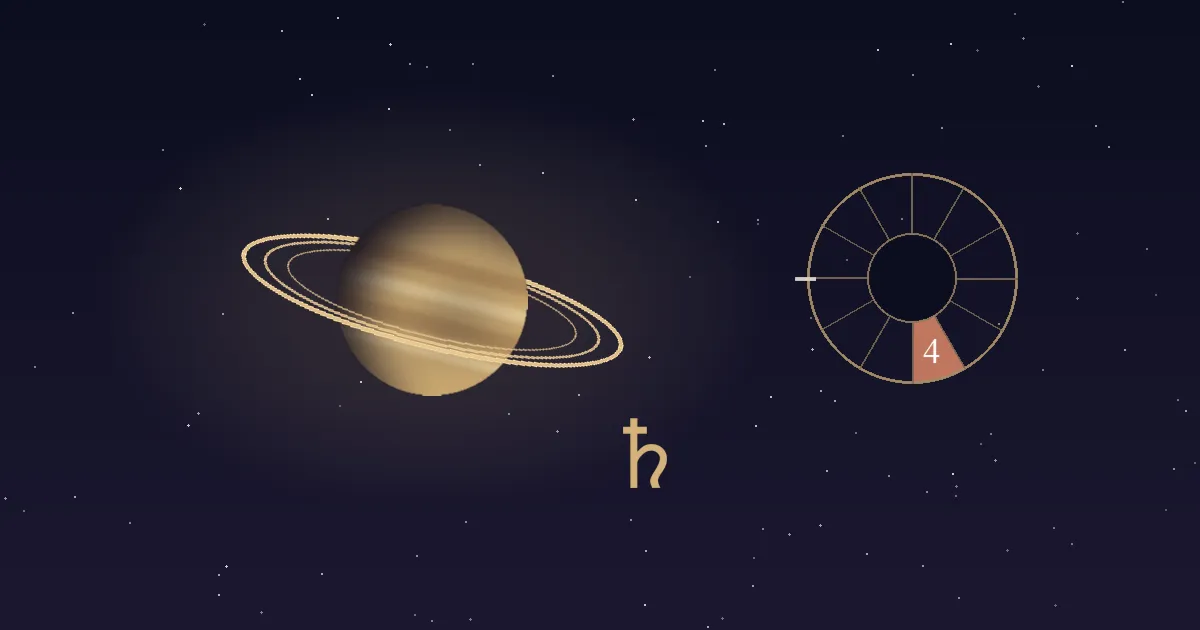
Most people who search this placement bring one of two worries. Some are adults who grew up in a house that felt cold, strict or unsafe, and want to know if the chart saw it coming. Others are parents, often new ones, who just ran their baby's chart and found Saturn at the bottom of it. One mother put it in a post on r/AstrologyCharts that drew 39 replies: "it breaks my heart that she might feel restricted in their home in some way, or experience me as harsh or cold" (the thread).
Both deserve the actual old sentences, not the paraphrase that scared them. The three books behind the parent fear disagree about which parent they mean, and that disagreement is the best place to start.
Quick answer
Saturn in the 4th house puts Saturn's weight on home, family and your private life. Astrologers read it as a childhood that felt strict or lonely, or that made you grow up early, and an adult who builds security slowly and on purpose. It does not predict a parent's death, and the traditions don't even agree on which parent it means.
| The house | Angular 4th, opened by the IC: home, family line, property, the private self |
| The fear | A cold home, or a parent lost young. The first is common; the second is not in a chart to find |
| Firmicus, by day | "Misers, hoarders of gold and silver" |
| Which parent | The father (Firmicus, Lilly) or the mother (Phaladeepika) |
| Retrograde check | In our simulation, a retrograde 4th-house Saturn was a daytime birth in about 96% of charts |
| What it grows into | A home built on purpose, an eye for old things, a steady private life |
The 4th house opens at the IC, the lowest point of the chart, and the IC isn't tied to your rising sign the way the 1st house is. A Saturn a few degrees either side of it can read as the 3rd house on one birth time and the 4th on another.
See where Saturn sits against your IC →Does Saturn in the 4th house mean losing a parent?
Here is the sentence behind the fear, because you've probably met it secondhand. Firmicus Maternus, writing around 335 AD, in the Mathesis (III.2, Bram's translation, p.76): "Misers, hoarders of gold and silver are those who have Saturn by day in the fourth house. By night in this house he makes them waste their paternal inheritance, and he indicates an early death for the father. He also causes serious illnesses and horrible chills for the natives and always brings ill repute in early years."
That is one book. The Indian tradition says something else. Mantreswara's Phaladeepika (VIII.22) gives Saturn in the 4th a native who is "unhappy, houseless, without vehicles, deprived of his mother and sickly during his early years." Firmicus names the father; Mantreswara names the mother. William Lilly, in 1647, says this house "represents Fathers, so doth the Sun by day and Saturn by night" (Christian Astrology), which makes Saturn a stand-in for the father in night charts, not a prediction about him. The mother reading Mantreswara gives Saturn is the question the Moon in the same house gets asked from the warmer side.
Put the texts next to each other and the certainty goes. They disagree about which parent, the same authors write lines this dark for Saturn in several other houses too, and none of them offers a way to test the prediction. They tell you what those writers believed about the worst that could happen in this area of life, in a world where losing a parent in childhood was ordinary. They don't tell you what will happen to your family.
A birth chart can't tell you when anyone will die, yours or your parents'. What it can describe, with this placement, is how home felt. And plenty of people without this Saturn had a hard home too. The CDC's 2023 analysis of ten years of state survey data found that 63.9% of U.S. adults reported at least one adverse childhood experience and 17.3% reported four or more. Saturn sits in the 4th in roughly one chart in twelve, so it can't be the reason most people carry something from childhood. If the house you grew up in was cold, you may recognise it in this placement. That's recognition, and a chart can offer no more than that. And if your childhood was happy, the placement hasn't failed. Plenty of 4th-house Saturns describe a strict but loving home, or none of this at all.
Retrograde or direct: which of Firmicus's two sentences is yours
Firmicus split that verdict by sect, day birth against night birth, and for Saturn the split runs the way you'd hope: Saturn is a day planet, so the day reading is the milder one. Hoarding by day. The inheritance and the father by night. The direct way to check is the Sun: above the horizon (houses 7 to 12) is a day chart, below it (houses 1 to 6) is a night chart. If you only have Saturn to hand, there's a shortcut in our own numbers.
A retrograde Saturn sits roughly opposite the Sun. So if Saturn is retrograde and sitting at the bottom of the chart, the Sun is usually near the top, in daytime. We simulated 240,000 charts (births from 1940 to 2010 between 25 and 55 degrees north, times spread evenly over the clock) and the pattern is strong: with a retrograde Saturn in the 4th, the birth was by day in about 96% of cases. With a direct Saturn in the 4th it's the reverse, and about four in five were night births. Natal Saturn is retrograde in 36% of charts, so plenty of readers can check this against the little R on their chart.
Since most natal Saturns are direct, just over half of 4th-house Saturns are night births and carry Firmicus's harsher sentence. What we will say is that his day reading, the hoarder, is the one that keeps turning up in modern descriptions too. Liz Greene, in Saturn: A New Look at an Old Devil (1976, p.22), noticed that "Saturn in the fourth house is also often concurrent with a compulsion to accumulate land." A person who grew up without enough security tends to stockpile it later: property, savings, a pantry that never runs low.
What a Saturn 4th-house childhood tends to look like
Greene's description (p.20) is the one that people with the placement quote back to each other: the 4th-house Saturn "is usually considered, in Cancer or in the fourth house, to suggest conditions of coldness, limitation, authority without love, separation or isolation, and a generally unsympathetic early home life." She adds (p.21) that "a definite feeling of having been unloved, unwanted, is common."
Notice the word feeling. Howard Sasportas, in The Twelve Houses (1985), makes the same point more carefully: Saturn here "sometimes describes a home atmosphere which was felt as cold, strict or unloving" (p.56), and he suggests a child with this placement tunes in to the Saturnine side of a parent who "may be warm and kind seventy-five per cent of the time" (pp.57–58). Two children in one house can remember two different childhoods, and Sasportas's point is that this placement tends to remember the hard part.
The descriptions that recur, in the books and in forum threads:
- · Growing up early. The kid who knew the rent was late, or who parented a parent, or who learned that feelings were better kept in their room.
- · A home with rules and not much play. Sometimes a strict house, sometimes a sad one, sometimes one where the adults were simply absent at work.
- · Moving a lot, or never feeling settled wherever you lived. Cafe Astrology's write-up of the placement leans the other way, toward staying close to home and resisting change, which is a reminder that the literal housing history varies a lot.
- · Oddly, a love of old things. One r/Advancedastrology post described someone with the placement who has "a huge collection of antique furniture and porcelain," adding that people "feel like they walked into their grandparents house." Saturn is the planet of age, and here it lives in the house of home.
Jupiter in the 4th house has the more hopeful reputation in this house, with a fortunate old age among its traditional promises. If you have both planets here, read the two pages side by side: the texts pull in opposite directions, and neither guarantees how home will feel at seventy.
If a move, a lease or a parent's care is on your mind, look at what today's sky is doing to your own chart before you decide.
See today's transits to your chart →For parents: your child has Saturn in the 4th
If you're reading this about a baby or a small child, here is the plain version. The chart doesn't say you'll be a cold parent. Astrologers read it as a child who may be sensitive to the structure of home: rules, money stress, who's in charge, whether promises hold. Don't assume that describes your child. Watch, ask, and go by what they actually tell you.
If it does fit, these help, and they help most children anyway:
- · Predictability over grand gestures. The same routines, and the same response when they mess up.
- · Say the stressful thing out loud, in words a child can hold ("money is tight this month, and it's not your job to fix it"). Children who sense a problem and hear nothing about it often imagine something worse.
- · Protect their play. A child who seems unusually responsible still needs it.
- · Let them own something in the house: a shelf, a job, a say in how their room looks. Responsibility they chose feels different from responsibility that landed on them.
Greene's hopeful line applies to your kid as much as to any adult reader: when Saturn is in the fourth house "the opportunity is offered ... for the person to build an inner sense of security and self-acceptance based on an understanding of his real origin" (p.22). A parent who talks honestly about where the family comes from is doing that work early.
Manilius put Saturn's joy here, at the bottom of the chart
Most ancient authors give Saturn its "joy", the house where it feels most at home, in the 12th. One doesn't. Chris Brennan notes in his paper on the planetary joys that "Manilius is the only ancient author who described an alternate scheme for the joys, where Venus rejoices in the 10th rather than the 5th, and Saturn in the 4th rather than the 12th." Manilius, in Thomas Creech's 1697 verse translation of the Astronomica, calls the bottom of the chart "Saturn's Seat", and gives Saturn a reason to like it: "Himself a Father, He pretends to bear / Respect to Fathers, and makes Age his care."
That reads very differently from Firmicus. Manilius ties this position to fathers and old age, and it's the ancestral side of this placement, the one that turns up as the antique collection, the family archive, the adult who ends up being the person who keeps everyone's history. Lilly's table of accidental fortitudes, for what it's worth, gives any planet in the 4th a score of +4, one of the stronger houses in his scheme.
Will you ever own a home?
Short answer: this placement can't tell you whether you'll own a home, or when. The "houseless, without vehicles" line in Phaladeepika has a modern cousin, property after 35, and we found no verse behind that number in the texts we checked. What sits behind "late" with this planet is Saturn's cycle. It takes about 29.4 years to go round the zodiac (NASA's planetary fact sheet gives 10,747 days for the tropical period), so the first time it comes back to where it was at your birth is your late twenties. A 4th-house Saturn gets no earlier or later return than any other.
For a 4th-house Saturn, astrologers read that return through home: buying a place, moving away, setting new terms with family. None of those decisions has to wait for it. In our sample transiting Saturn took about three years from first entering a house to leaving it for good (two to about four years for most charts, depending on how wide the house is, and a retrograde loop can briefly take it back out), so it's a chapter, not a date.
Transit note, October 2026
Transiting Saturn is in Aries from February 2026 until April 2028. In whole-sign houses that puts it in the 4th house for Capricorn risings for the whole stay. It is retrograde from July 26, 2026 (at 14°45′ Aries) until December 10, 2026, going back over ground it already crossed. When Saturn moves into Taurus, the 4th-house transit passes to Aquarius risings. A transit is a passing season, not the birth placement this page is about. On a Placidus chart the dates can differ by months, sometimes by more than a year, because the house cusps rarely sit at 0° of a sign.
The same slow planet is crossing somebody's 4th house at any given time. Saturn's pass through Aries, from February 13, 2026 to April 12, 2028, sits in the whole-sign 4th house of every Capricorn rising, and our guide to what that Aries pass means for each rising sign reads it as the stretch when people rebuild where and how they live. If that's you and you were also born with Saturn in the 4th, you're getting the natal theme and the transit at once.
Verified charts: Monroe, Olsen and Disney
Celebrity lists for this placement mostly copy each other. We used only people whose birth time Astro-Databank rates AA (from a birth certificate or record) or A (from the person or family), and we computed the Placidus house from that time ourselves.
Marilyn Monroe (AA, birth certificate) has Saturn at 21°26′ Scorpio in the 4th, more than fifteen degrees from either cusp. She spent most of her childhood in foster homes and an orphanage. Her Saturn return lines up with a clear event. On January 7, 1955, at 28, she announced Marilyn Monroe Productions in New York, having left Hollywood for the East Coast. That day transiting Saturn stood at 18°54′ Scorpio, two and a half degrees from her natal Saturn and inside her natal 4th house.
Elizabeth Olsen (AA) has Saturn at 10°42′ Capricorn in the 4th, 4.3 degrees from the nearest cusp. The family name was the weight: she has said that at ten she planned to act as "Elizabeth Chase" so people wouldn't connect her with her famous sisters (GMA).
Walt Disney (A, a time from his studio) has Saturn at 14°41′ Capricorn in the 4th, and he rebuilt his own hometown for millions of strangers: Main Street, U.S.A. at Disneyland was inspired by his boyhood hometown of Marceline, Missouri. Mars sits in his 4th as well, so the house holds both malefics, and a good part of his career went into rebuilding a small-town childhood at theme-park scale.
One we left out on purpose: Judy Garland. Her birth certificate puts Saturn squarely in the 4th, but the time in Gerold Frank's biography moves it to the 10th, and we don't lean on a chart that depends on which record you believe. Also note that Olsen and Disney are 5th-house Saturns under whole-sign houses. That's normal for this house. In our simulation a Placidus 4th-house Saturn stayed in the 4th under whole sign in 43% of charts, moved to the 5th in 42%, and moved back to the 3rd in about 9%, which can happen here because the IC isn't locked to the rising sign.
What changes the reading: sign, the Moon, and Sasa yoga
The house is one layer of the reading. The sign is the next. Traditional astrology counts Saturn strongest in its own signs, Capricorn and Aquarius, and in Libra, where it's exalted, and weakest in Cancer and Leo, its signs of detriment, and in Aries, its fall. Greene wrote her 4th-house chapter as "Saturn in Cancer and the fourth house", pairing this house with the sign where Saturn is least comfortable, and that pairing may be part of why her portrait is so cold. Olsen and Disney both have Saturn in Capricorn, the dignified version.
After the sign, look at the Moon, the other planet of home. Astrologers read a hard aspect between Saturn and the Moon as the heavier version of the home story, and a supportive one as the version where duty and care got along. The Indian tradition adds a flattering twist for the angles. When Saturn sits in its own sign or its exaltation in one of the four angular houses, the 4th included, the Brihat Parashara Hora Shastra names it Sasa yoga, one of five "great person" yogas, and Santhanam's translation describes a native who "rules happily over several parts of the earth." That is judged on the sidereal chart counted from the Ascendant, so check it there, not on a Western chart.
The 4th and the 10th: the private and public ends of one line
The IC and the Midheaven are the two ends of the same axis, and Saturn behaves like itself at both: slow, serious, building for later. At the top of the chart it builds a career and a reputation, which is why Saturn in the 10th house gets the rise-and-fall warning. At the bottom it builds a private life that nobody else sees, which is why this placement is so often invisible from outside.
Angular houses are the corners of the chart, and planets there are read as strong. Being in the 4th is also different from sitting on the IC itself: a Saturn within a few degrees of the IC is read far more strongly than one near the far end of the house, so check the gap.
Your return, dated
Your Saturn return has a start and an end. The calculator needs only a birth date and gives the sign-based windows for your first, second and third returns.
Find your Saturn return dates →Keep reading
- · Mars in the same house gets asked whether this is the worst seat it can have, by day and by night birth: Mars in the 4th house.
- · Capricorn rising has Saturn as its chart ruler, so wherever Saturn sits carries extra weight: Capricorn rising.
FAQ
My child has Saturn in the 4th house. Did I do something wrong?
No. A birth chart can't grade parenting, and your child was born with this before you'd done any. Astrologers read the placement as a child who may notice rules, moods and money worries early and take some of the weight on, so it's worth watching for that rather than assuming it. What helps any child who does is a home that's predictable: the same bedtime, promises kept, problems named out loud instead of hidden. Warmth that is also reliable is something a parent can give.
Is Saturn in the 4th house about the mother or the father?
The old books don't agree. Firmicus and Lilly point Saturn in the 4th at the father; Lilly even says the 4th signifies fathers and that Saturn does so by night. Mantreswara's Phaladeepika points it at the mother instead. Many modern Western astrologers read the 4th as whichever parent made the home feel like home, which in practice is often the mother. Ask which parent set the tone of the house you grew up in, and read Saturn there.
Why do people with Saturn in the 4th house say life got easier with age?
Because the hard part of this placement sits at the start, in the house that describes where you came from, and the start is the one part of life you don't choose. Adulthood lets you pick the rooms, the people and the rules. Liz Greene saw the placement as a chance to build an inner sense of security from an understanding of your own origins. She sets no age for that, but for many people it follows the first Saturn return in the late twenties, when the family story is hard to avoid.
What does it feel like when transiting Saturn crosses the IC?
It usually shows up as a housing or family decision with weight on it: a move, a renovation, a parent who needs more care, or the decision to stop going home for the holidays. Saturn reaches the IC about once every 29 years, sometimes crossing it three times when a retrograde loop falls there, and in most charts it takes two to four years to leave the 4th house, so it's a slow chapter, not a single bad week.