Birth Chart
North Node in the 4th House: Home Over Career? The South Node in the 10th and the Nodal Return Clock
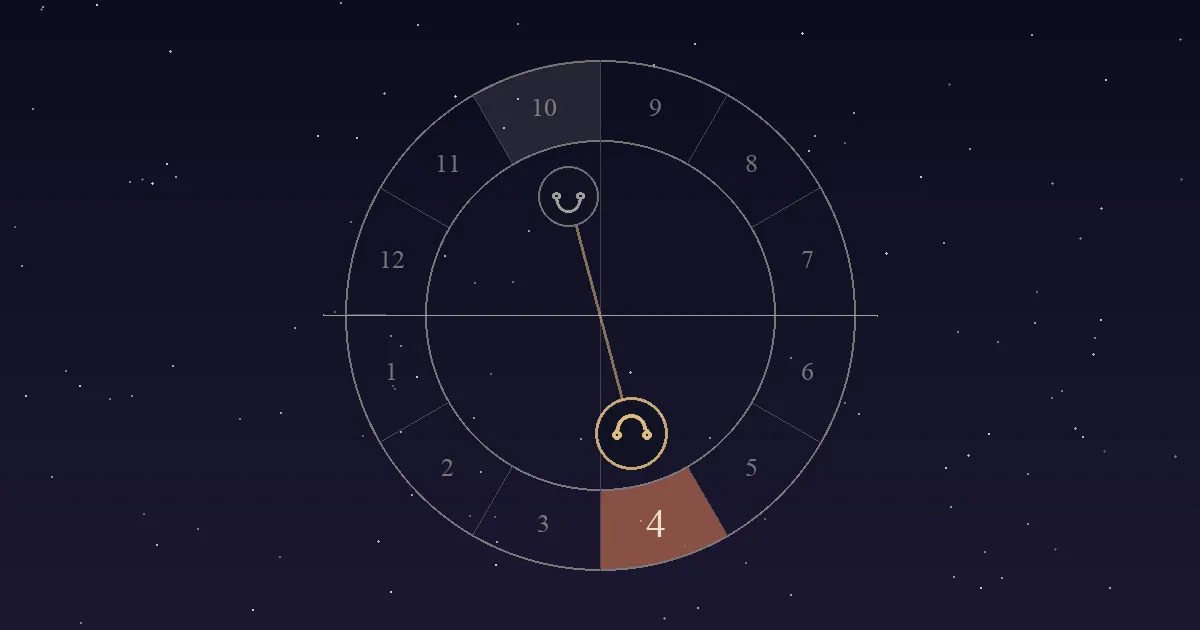
A North Node in the 4th house raises two practical questions: whether home has to come before your career, and when your nodal returns fall, the dates astrologers use to time the node. The career worry comes from the other end of the axis. With the North Node in the 4th, the South Node sits in the 10th, the house of career and reputation, and modern astrologers call the South Node the end you lean on too much.
On the first question, the sources discussed here don't ask you to stop working. Martin Schulman describes a conflict between career and family, and his advice concerns the need for recognition. On the second, the returns come at about 18 years 7 months, 37 years 2 months and 55 years 10 months, and the last sections list the birth dates with a return or half-return between July 2026 and March 2028.
Quick answer
It doesn't mean giving up your career. Modern readings of a 4th-house North Node put the growth in home, family, roots and a private life that doesn't need an audience, and the old career warnings belong to the South Node in the 10th. In this reading, the hard part is letting people care for you when you haven't achieved anything for them.
| North Node house | 4th: home, family, roots, the private self |
| South Node house | 10th: career, status, reputation, authority |
| Natural sign of the 4th | Cancer |
| How often | About 1 in 12 modeled U.S. births (8.2%) |
| Our data point | Among modeled births with a Placidus 4th-house North Node, 43.8% keep it in the whole-sign 4th, the lowest agreement of the twelve houses |
| Nodal returns | About 18 y 7 m, 37 y 2 m and 55 y 10 m |
A 4th-house North Node needs a birth time to place, and it changes house number between Placidus and whole-sign charts more often than a node in any other house. The free chart draws Placidus houses. For whole sign, count from your rising sign as the first: if the node's sign is the fourth, it's in the whole-sign 4th too.
Cast your chart and find the node's house →Does a 4th-house North Node mean giving up your career?
No. The reading that comes closest to the fear is Martin Schulman's, in Karmic Astrology, Vol. 1 (1975), the first full house-by-house North Node text we found. He writes that "this incarnation brings him through the experience of facing the conflict between a career for himself and the demands of his family" (p.71). That's a conflict to live through, and Schulman doesn't settle it by taking the career away. His lesson for these nodes is about motive. The native "must learn to overcome the karmic feeling that he is the vital center of all situations around him", and, two pages later, that "achievement is to be its own reward" (pp. 70 and 72). Put plainly: keep working, but stop needing the audience.
The career fear does have an older root, and it's on the South Node's side. Guido Bonatti's thirteenth-century 146 Considerations read the Dragon's Tail house by house, and in the 10th it brings harm "to his preferment" (no. 111) and loss "by or in his preferments, honours, etc." (no. 139; Coley's translation, 1886 reprint, pp.47–48 and 61). Both lines warn about promotion and honors going wrong, and both are written for the Tail in the 10th. Bonatti never says the Head in the 4th takes your work away.
There's also a reason this placement can feel like a loss even when it isn't. In a 2023 Pew Research Center survey, 71% of U.S. adults said a job or career they enjoy is extremely or very important for a fulfilling life, against 26% for having children and 23% for being married (Pew's 2023 survey on family life). Pew asked about enjoyable work, marriage and children. That leaves out much of what this reading means by home, including privacy and feeling settled.
You might enjoy a promotion and still miss having an evening free to cook with your sister. That gap is what astrologers point to with this placement. In Placidus, the IC, the lowest point of the chart, marks the beginning of the 4th house; the guide to how the IC defines the Placidus 4th house shows how that cusp is drawn. The 4th is also Cancer's natural house, and the two share a theme without being the same thing. The birth date usually settles the Cancer and Capricorn node axis, and the node stays in a sign for about a year and a half (a birth on the day it changes sign needs the clock time as well), while the house always needs your birth time.
"Home and family" in this reading doesn't have to mean the family you were born into, or accepting every obligation it hands you. Modern readings of the 4th cover roots and the private self too, so the work can look like a home you share with friends, an apartment you live in alone, or seeing relatives less often but on clearer terms. Receiving counts as much as providing: letting a partner cook after you've had a bad week, or telling a parent what you need instead of organizing the holiday for everyone. The node's sign, and any planets close to it, change how the 4th-house theme plays out, so two 4th-house North Nodes in different signs won't read alike; our North Node basics cover what the sign adds.
The South Node in the 10th house: the résumé you started with
Astrologers read a South Node in the 10th house as competence in public: being responsible, being the one in charge, knowing how to look the part. People with it are often the reliable one at work long before anyone hands them a title. The difficulty starts when another work commitment becomes your answer to every problem at home: working longer hours, taking on another role, chasing the next sign of approval from whoever ranks above you. Another project can earn you praise while the problem at home stays unresolved.
The opposite worry, that this axis promises fame, belongs to a 10th-house North Node and the fame question. There the career is the growth end and home the comfortable one, and the page verifies the placement in five famous birth charts.
The natal placement sets the theme; the transits set the timing. With a free account you get the day's transits measured against the planets in your birth chart, aspect by aspect, so you can see what's active on the days the work-or-home question comes up.
Match today's transits to your birth chart →Rahu in the 4th and Ketu in the 10th: the Phaladeepika's verses
Vedic astrology calls the North Node Rahu and the South Node Ketu, and its verses for this axis don't match the modern reading. Mantreswara's Phaladeepika says that with Rahu in the 4th "the person born will be a fool, will cause sorrow, will have friends ... and happy at some time or other" (VIII.25, Sastri's translation, 1950, p.94). For Ketu in the 10th it lists "obstacles to the performance of good acts" but also makes the native "energetic, bold and widely renowned" (VIII.32, p.97). So the Vedic text puts renown at the 10th-house end, the end modern astrologers call the habit to outgrow, and its Rahu verse for the 4th describes a mixed life, not a direction to grow in. Vedic charts also use the sidereal zodiac and usually whole-sign houses, so a Vedic Rahu in the 4th and a Western North Node in the 4th aren't always the same placement.
The house most likely to change number between chart systems
A Placidus 4th-house North Node stayed in the 4th on the whole-sign chart in only 43.8% of modeled births, the lowest agreement of the twelve houses. In 45.1% it moved one house later, to the 5th. In 6.6% it moved one house earlier, to the 3rd, more often than any other house moves backward. In the remaining 4.5% it landed two houses away. Those figures come from our model of 400,000 simulated U.S. births from 1960 to 2024, built on CDC birth-time data with each birth placed in a real U.S. county and time zone; they are modeled births, not birth records.
Interceptions are rarer here than anywhere else: just 6.4% of modeled 4th-house North Nodes were in an intercepted sign, because intercepts gather near the horizon at U.S. latitudes. And the node sits right on the IC, within 5 degrees, in 2.8% of all modeled births; a node that close to the angle is read as on the IC first, and its house label is the least stable thing about it. As for the birth time, a recorded time that's 15 minutes off in one direction moves the North Node to another Placidus house in about 1 in 8 modeled births, and one that's 30 minutes off in about 1 in 4. A date that's one day off at the same clock time moves it in only about 3%, because the node itself barely moves in a day.
The true node and the mean node are never more than about 2 degrees apart, and they put the node in different houses in about 3% of modeled births. The house system matters far more. Among 261 famous people whose birth times are rated AA or A by Astro-Databank, Placidus and whole-sign houses gave the North Node different houses for 148 of them (57%).
A few charts give one clean answer. Ernest Hemingway (AA; his birth record, and his mother's scrapbook: "At 8 o'clock on the morning of July 21st") was born in Oak Park, Illinois, in 1899, with the North Node at 29°17′ Sagittarius in the 4th on a Placidus chart. Antoine de Saint-Exupéry (AA, from the birth register) was born at 9:15 a.m. on June 29, 1900, in Lyon, with the node at 10°47′ Sagittarius in the 4th on a Placidus chart; Gauquelin's older 9:00 a.m. gives the 4th too. John Krasinski (AA) was born at 8:44 p.m. on October 20, 1979, in Brighton, Massachusetts, with the node at 7°29′ Virgo, also 4th on a Placidus chart. In all three the 4th survives every check we ran: the mean node, whole-sign houses, and a birth time moved 15 minutes either way. What they show is that a 4th-house node can be pinned down, even in the house that changes number most often between systems.
Nodal returns: the 4th-house axis on an 18.6-year clock
The nodes move backward around the zodiac, and the mean node takes 6,798.38 days to go all the way round: 18.613 years. Every time it completes a lap it's back on the degree it held when you were born. That's a nodal return, and the arithmetic puts them here:
| Event | Age (years) | In years and months |
|---|---|---|
| First half-return | 9.31 | 9 y 4 m |
| First nodal return | 18.61 | 18 y 7 m |
| Second half-return | 27.92 | 27 y 11 m |
| Second nodal return | 37.23 | 37 y 2 m |
| Third half-return | 46.53 | 46 y 6 m |
| Third nodal return | 55.84 | 55 y 10 m |
| Fourth half-return | 65.15 | 65 y 2 m |
| Fourth nodal return | 74.45 | 74 y 5 m |
The half-return (some astrologers call it a nodal reversal) is the moment the transiting North Node reaches your natal South Node. Those are mean-node ages. The true node, which ZodiScope uses, wobbles, so we checked it directly for 2,882 birth dates from 1940 to 2010, one every nine days. The first true-node return came between ages 18.53 and 18.80, with a median of 18.61. For 95.6% of those birth dates the node crossed the natal degree once; for 4.0% it crossed three times and for 0.3% five times, and when it did cross more than once, the first and last crossings were a median of 8 days apart (33 at most).
For a natal North Node in the 4th, astrologers who use returns read each one through home and family, since the returning node is back in your 4th. A half-return brings the transiting North Node to your South Node in the 10th, and they read it as a stretch when work questions press harder. The first return lands at about 18 and a half, close to when many people first move out. The second half-return, near 28, comes about a year and a half before the first Saturn return, which runs on a cycle of about 29.4 years (how the Saturn return is timed).
A transit through the 4th is a different event
A return reaches your natal node's degree. A transit through the 4th can come without one: the transiting node passes through the 4th house of every chart, whatever house the natal node is in, and astrologers read that stretch as a season for home and family questions. The note below gives the rising sign that has it.
Transit note, October 2026
The transiting North Node has been in Aquarius since July 26, 2026 and moves on into Capricorn on March 26, 2028 (US Eastern dates). In whole-sign houses that puts it in the 4th house for Scorpio risings, with the South Node in their 10th. From March 26, 2028 the same transit passes to Libra risings. Each rising sign gets about a year and a half of this once every 18.6 years. It is a passing transit, not the birth placement this page is about.
Who has a return between July 2026 and March 2028
Who gets a return in a given window depends on the node's sign, not its house, so the dates apply whatever house your node is in. While the node is in Aquarius, from July 26, 2026 to March 25, 2028, people born with an Aquarius North Node have a return, at about 18 to 19, 37, 56 or 74, and people born with a Leo North Node have a half-return. The birth-date ranges, with the days the true node wobbled between signs, are on the Aquarius North Node page and the Leo North Node page.
Which return window is yours?
Your return window follows your North Node's sign, which your birth date usually settles; the exact crossings depend on the node's degree. The free lookup finds the sign from your birth date, and takes a birth time if you were born near a sign change.
Find your North Node sign →Keep reading
- · Why astrologers call the bottom of the chart the Moon's own seat, and the mother question answered both ways: Moon in the 4th house.
- · A cold home or a parent lost young? What Firmicus and Lilly actually wrote: Saturn in the 4th house.
- · The fortunate old age promised in 1,700-year-old fine print: Jupiter in the 4th house.
FAQ
Does a North Node in the 4th house mean giving up my career for family?
Not in the texts this page draws on. Martin Schulman, whose 1975 Karmic Astrology is the first full house-by-house North Node text we found, describes 'the conflict between a career for himself and the demands of his family' (p.71), and he leaves the career in place. His lesson for this placement is that achievement can be 'its own reward', a point about motive.
Is the North Node in the 4th house a karmic placement with my parents?
That's how karmic astrology frames it. Schulman wrote that 'the relationship established with parents early in life is more important in these Nodes than in any other position', and that many people with them have 'one unusually demanding parent'. The past-life part can't be checked by astrology or anything else, so read it as a story about patterns, not a fact about your history. If the description fits, ask which of your parents' expectations you still follow.
How is a nodal return different from a transit through the 4th house?
A return is a crossing, usually just one: the transiting node comes back to the exact degree your North Node held at birth, near ages 18 years 7 months, 37 years 2 months and 55 years 10 months. A transit through the 4th is a stretch of months, and every chart gets one every 18.6 years whatever house its natal node is in. With a natal North Node in the 4th the two overlap, because your house lines don't move after birth: the returning node is back in your 4th, so each return falls during one of those passages, and astrologers read it through home and family.
Why do some apps put my 4th-house North Node in the 5th house?
Because they use different house systems. Placidus divides the sky by time, whole-sign houses count whole signs from the rising sign, and the two rarely draw the line in the same place. In our model of 400,000 simulated U.S. births, a Placidus 4th-house North Node was in the whole-sign 5th 45% of the time and stayed in the 4th only 43.8% of the time, the lowest agreement of any house. Neither app is broken; check which system each one uses.