Transits
Saturn Return Meaning: The Only Transit With a Universal Age Window (and Why 2026 Is a Big Year for Anyone Born 1996–1999)
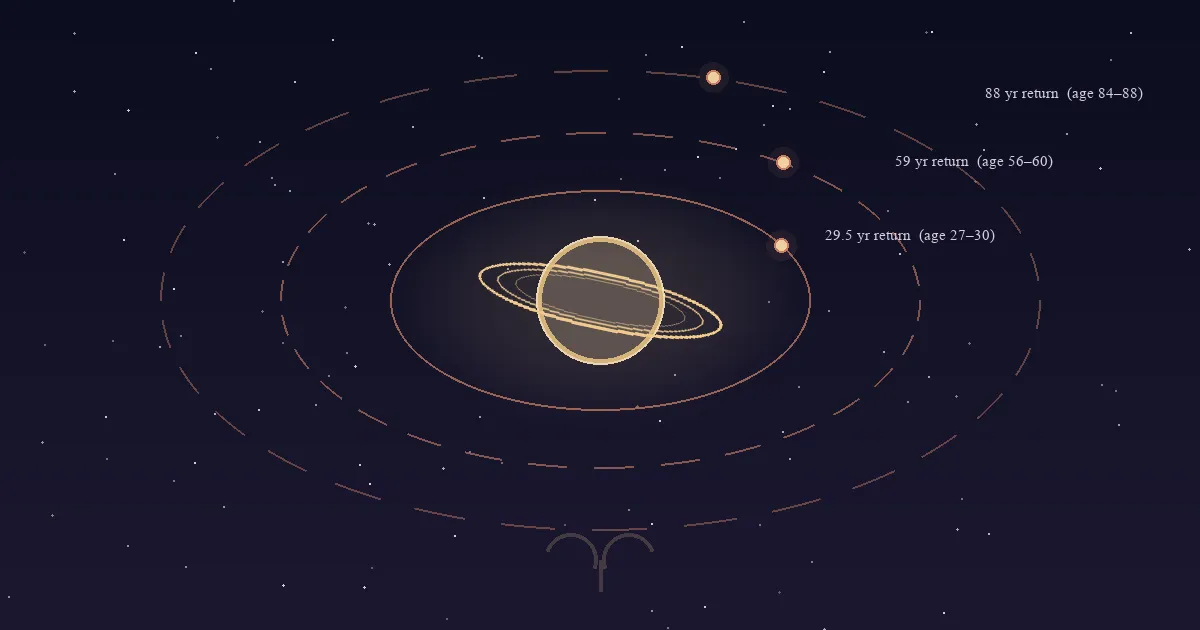
A Saturn return is the moment Saturn — the planet of structure, limits, time, and consequences — comes back to the exact zodiac position it occupied on the day you were born. Saturn takes ~29.5 years to orbit the Sun, which means every person on Earth gets their first return between roughly age 27 and 30, their second between 56 and 60, and (if they live long enough) their third between 84 and 88. It is the only major transit in astrology with a universal age window — every other transit depends on which sign and house you have planets in. Mercury retrograde lands on different placements for different people. Jupiter return depends on where Jupiter sits in your chart. Saturn return is the one transit where age alone tells you when it is happening.
A real number first, because the cultural weight of this transit is worth anchoring. Pew Research's fall 2024 survey of 9,593 U.S. adults found that 27% of Americans believe in astrology, and the demographic doing the most believing — by a wide margin — is women aged 18 to 49, of whom 43% say astrology can affect people's lives. About half of LGBTQ+ adults consult astrology at least yearly. The 18-to-49 window covers two full Saturn returns. The 27-to-30 cohort — the people whose first return is hitting right now — is the single demographic most likely to know what a Saturn return is before they search for it, which is the reason this term gets ~6,600 searches per month and rising. The conversation got real because the cohort got their transit.
Below: the plain definition (with the actual orbital math), the universal age window — the part that makes this transit structurally unlike every other transit — the 2026 calendar reason this is a big year specifically (Saturn entered Aries on February 13, 2026 for the first time since 1996, which means anyone born 1996–1999 is getting their first return in cardinal fire), the difference between the first, second, and third returns, what it actually feels like for the people in it, and how to find your own Saturn placement on your chart.
Don't know where Saturn sits in your natal chart? Pull your free birth chart on ZodiScope — see Saturn's sign, house, and exact degree, and find out when your first (or second) return lands. Takes about a minute.
Get your free birth chart on ZodiScope →The plain definition (and the orbital math underneath)
Saturn is the second-largest planet in the solar system and the slowest-moving classical planet visible to the naked eye. It orbits the Sun once every 29.46 years, which works out to about 2.46 years per sign of the zodiac — meaning Saturn spends roughly two and a half years transiting through each of the twelve signs before moving on. A Saturn return is the moment Saturn, in the sky, returns to the exact ecliptic longitude it occupied on the day you were born.
Because Saturn's orbit is slow and stable, the return doesn't shift around — it always lands in the same age window for every person regardless of culture, geography, or hemisphere. This is structurally different from, say, the lunar return (which happens every ~27 days), the solar return (every ~365 days, on your birthday), or the Jupiter return (every ~12 years). Saturn's slow orbit is the reason this transit became the cultural shorthand for "the universe's audit" — it is the longest cycle of personal-planet structure most people will live through more than once.
The reason the return isn't a single calendar date but a 2-to-3-year arc: Saturn retrogrades roughly once a year for about 4 to 5 months at a stretch. Most people's Saturn returns include at least one retrograde station on or near the natal degree, which means the planet crosses the position three times — direct, retrograde, and direct again. The technical name for this is "triple-passage," and the lived experience is that the return doesn't arrive once and leave; it arrives, retreats, and arrives again, which is the structural reason people report it as a longer arc than a single transit. The birth chart reading walkthrough covers how to find Saturn's natal degree in your own chart; and if you don't know your Big 3 yet, the ZodiScope calculator is the place to start.
The universal age window — the thing that makes this transit structurally unique
This is the section the other "saturn return" listicles bury or skip. Every other major astrological transit lands on different people at different times, because every other transit depends on where you have planets in your natal chart. A Pluto transit through the 7th house is years away for some people and finishing for others. A Jupiter return depends entirely on what sign Jupiter was in at your birth. Even the Nodes — which take roughly 18.6 years to circle the zodiac — produce different "nodal return" ages for different placements.
Saturn return is the one transit where this isn't true. The reason: Saturn's orbital period (29.46 years) and a human lifespan (~78 years in the U.S., per CDC mortality tables) produce a fixed, repeating pattern that lands on the same age window for every person on Earth:
- First Saturn return: ages 27 to 30. This is the return everyone has heard of — the existential reorganization that hits between the late twenties and early thirties. The cultural archetype: the 29-year-old who quits the job, ends the relationship, or moves countries because something internal has finally cohered. Roughly 100% of adults who reach age 30 have had their first Saturn return.
- Second Saturn return: ages 56 to 60. Less talked about in pop astrology, more talked about in practitioner work. The second return tends to be a re-evaluation of the legacy structure built during the first return — careers, marriages, residences, and identities that have now run their full 29-year arc. Empty-nester transitions, late-career pivots, second-half-of-life recalibration. About 91% of U.S. adults reach age 60 and live through this one.
- Third Saturn return: ages 84 to 88. Rare in the data but real. The third return tends to be the placement that defines the final chapter — the relationship to mortality, the question of what gets passed on, and (for the people who reach it) the unusual late-life clarity reported by 80-somethings who report the third return as the most peaceful of the three.
Compare this to literally any other transit. No other planet produces a universal age window. Jupiter returns depend on natal Jupiter. Outer-planet transits depend on natal placement. Even the Saturn opposition (~age 14–15, 44–45, 73–75) and Saturn square (~age 7, 21, 36, 51) — Saturn's other personal milestones — are universal age windows for the same orbital reason, but the return is the one with the strongest signal because it is the planet coming back to its own starting position, not just crossing a 90° or 180° angle. The honest practitioner read: this is the single most reliable astrological transit to plan around, because the math doesn't care whether you believe in the symbolism. Age 29 (or 58, or 87) is going to be a structural reorganization for everyone whose chart you check.
Why 2026 is a big year for Saturn return — the 1996–1999 cohort specifically
Saturn entered Aries on February 13, 2026 and stays through April 12, 2028. The last time Saturn was in Aries was from April 1996 to February 1999. Which means: every person born between April 1996 and February 1999 — currently aged 27 to 30 — is having their first Saturn return in Aries, in cardinal fire, right now. The previous cohort that got this transit was born 1967–1969 and is now having their second Saturn return in Aries this year, at age 57–59.
This is unusual for one structural reason: Aries is the sign of pure initiation. Cardinal fire, ruled by Mars, sitting on the spring equinox. The pop-astrology shorthand for Aries is "I am" — the most identity-coded sign in the zodiac. Saturn, the planet of structure, landing on the sign of identity-without-structure, produces a very particular kind of return: not the dreamy boundary-dissolving Saturn-in-Pisces return the previous cohort (born 1993–1996) experienced, and not the steady, embodied Saturn-in-Taurus return the cohort before that (born 1969–1971) experienced — this one is a structural test of who you are as a self-starter, on your own terms. The full Saturn in Aries 2026 piece covers the broader transit; this section is specifically about what it means for the people whose natal Saturn is in Aries.
Two specific calendar dates to anchor on:
- February 20, 2026 — Saturn-Neptune conjunction at 0° Aries. This is a once-in-36-years aspect and it lands on the very first degree of the zodiac — the Aries point. For anyone with natal Saturn in the first 3° of Aries (born roughly April 1996), this conjunction intensifies the first Saturn return into a Saturn-and-Neptune-together return, which is a very different transit than a standard Saturn return. The Saturn-Neptune conjunction piece covers the historical precedent and what this aspect specifically does to identity and ambition.
- July 26, 2026 – December 10, 2026 — Saturn retrograde in Aries (14°45′ back to 7°56′, no exit from the sign). This is the retrograde phase that triggers triple-passage for the late-1996 and 1997-born cohort, who get Saturn over their natal degree three times. The retrograde phase is where most of the cohort reports the return "hitting differently" — the first direct pass is the wake-up call, the retrograde pass is the re-evaluation, the second direct pass is the new structure setting.
If you were born during the 1996–1999 window: your Saturn is in Aries, and your first return is happening this year and next. If you were born during the 1967–1969 window: your Saturn is in Aries, and your second return is happening at the same time. (Unsure where you sit in the timeline? The free Saturn return calculator dates your returns from a birth date — exact windows for anything inside its verified table, labelled estimates beyond it.) These two cohorts — late-Boomers and Millennials born during the Clinton administration — are going through the same transit at the same time, which is producing some unusually charged family dynamics in the people I see who have parents in one window and themselves in the other.
Curious where Saturn sits in your chart? ZodiScope shows Saturn's sign, house, and exact degree — and the transit calendar that tells you when your next return lands. Most people who think they're "early" in their return discover Saturn was still 4° away.
See your Saturn placement on ZodiScope →First, second, and third Saturn return — what's actually different about each
The three Saturn returns of a human life look superficially similar — same planet, same return-to-natal-position — but each lands on a structurally different version of the same person, and that matters more than the transit's "meaning" in the abstract.
The first Saturn return (age 27–30) is the famous one. It is structurally the placement's first pass over an adult life — the previous 29 years included childhood, adolescence, and early adulthood, but most of those choices were not yours to make in full. The first return is the moment the planet of structure looks at the structure you built once you actually had agency, and decides what to keep. The lived experience is usually: a relationship that doesn't survive the audit, a career that gets reshaped, a city that no longer fits, a self-concept that gets quietly retired. The work is to let go of what was never yours to begin with. The danger is mistaking necessary endings for personal failure.
The second Saturn return (age 56–60) is the one practitioners take more seriously than pop astrology does. By this point, the structure built during and after the first return has had a full 29.5 years to run its course — meaning marriages have either deepened or worn out, careers have either compounded or plateaued, and the body has begun the slow shift the third Saturn return will finish. The second return tends to land as a re-evaluation of the legacy: what gets passed on, what gets let go, what the second half of life is actually for. The lived experience is often retirement decisions, late-career pivots, empty-nester transitions, and (sometimes) a return to creative or intellectual work that got deferred during the first half of the chapter.
The third Saturn return (age 84–88) is the one most people don't reach, and the literature on it is thinner because the sample size is smaller. The practitioner reports I trust the most: the third return tends to land as a structural softening rather than a structural reorganization. The person has already done the hard work of the first two returns, and the third return is the placement coming back to confirm rather than re-test. Reports from clients in their late eighties going through this transit describe it as the most peaceful of the three. The work, if there is work, is to make peace with what was — not to build anything new. The danger is regret about the structures the first two returns took away.
What it actually feels like — the reports from people in it
The pop-astrology shorthand — "Saturn return is the worst three years of your life" — is half right and half lazy. The half that is right: nearly every report I have collected from people aged 27–30 in the middle of a return uses some version of the words "tired," "exposed," and "narrower than I expected." Saturn is the planet of contraction; the lived experience is that the options that felt infinite at 24 quietly become finite at 29. The half that is lazy: the same reports almost always also include "clearer," "more myself," and "less performative." The return doesn't take things away at random. It takes away the things that weren't load-bearing.
The most consistent patterns from the people I have read for in their first return:
- A relationship ends or compresses into its real form. Most-cited pattern. Relationships that the first return ends were almost always relationships that one partner had outgrown but was scared to leave; relationships that the return strengthens were almost always relationships that had been operating at less depth than they were capable of. Either way, the relationship arrives at its honest version by the end of the transit.
- A career pivot or career deepening. Second-most cited. The pattern: people who built a career on what looked good to other people (parents, peers, social media) tend to pivot during the return; people who built a career on what they actually wanted tend to deepen into it during the return. Same planet, opposite-looking outcomes.
- A structural relationship to time and money. Saturn rules both. People reliably report that the return is the year they "finally became an adult about money," which is half the planet's archetypal register and half the simple fact that age 29 is when most people are forced to look at retirement, mortgages, and long-term planning for the first time.
- A health audit. Saturn rules bones, teeth, joints, and the structural body. The return often surfaces an old injury, a chronic-but-ignored issue, or a stress pattern that finally demands a response. Most people in their first return report seeing a doctor or specialist about something they had been deferring.
The people who report the return as catastrophic are almost always the ones who try to push through it. The people who report it as clarifying are almost always the ones who let it dismantle what wasn't working. The transit is doing the same work in both cases — the difference is how much friction the person added on top.
Your Saturn placement (and what your specific return looks like)
Saturn in your natal chart is determined by which sign Saturn was in on the day you were born — not your Sun sign, not your birthday, but the actual astronomical position of Saturn at that moment. Saturn moves slowly enough that everyone born within the same ~2.5-year window has Saturn in the same sign. The recent Saturn-in-sign windows:
- Saturn in Aries — April 1996 to February 1999, and now February 2026 to April 2028. Cardinal fire. Return is a structural test of identity and self-direction. See the complete Aries profile and the Aries rising deep dive for the temperament Saturn is structuring this time.
- Saturn in Pisces — May 1993 to April 1996, and March 2023 to February 2026. Mutable water. The return that just finished — cohort born 1993–1996 had theirs from ~2023 to 2026. Return was a structural test of imagination, dissolution, and boundaries.
- Saturn in Aquarius — March 1991 to May 1993, and December 2020 to March 2023. Fixed air. Cohort born 1991–1993 had theirs from 2020 to 2023 — yes, that included the pandemic. The Aquarius rising piece covers the temperament.
- Saturn in Capricorn — February 1988 to February 1991, and December 2017 to March 2020. Cardinal earth. This is Saturn's own sign — the placement is at maximum dignity. Cohort born 1988–1991 had theirs from 2017 to 2020. The Moon in Capricorn piece covers what Saturn-in-its-own-sign produces — the Moon in Capricorn is the Moon operating in Saturn's home.
- Saturn in Sagittarius — November 1985 to February 1988, and December 2014 to December 2017. Mutable fire. Cohort born 1985–1988 had theirs from 2014 to 2017.
If you don't know your Saturn placement, the fastest way to find it is to pull your full birth chart — Saturn's sign, house, and degree will all be visible. The house Saturn occupies in your chart matters as much as the sign: a return in your 10th house (career) is structurally different from a return in your 7th house (relationships) or your 4th house (home and family). The 12 houses explainer covers what each house's Saturn return tends to focus on.
What to actually do during a Saturn return
The honest practitioner answer: less than you think, and more deliberately. Saturn is not the planet of fast action — that is Mars's department — and trying to "solve" a Saturn return with frantic activity tends to extend the discomfort rather than shorten it. The patterns from clients who have come through the return relatively cleanly:
- Let the endings end. The relationship, job, or self-concept that the return is pulling apart is almost always the one that was already on its way out — Saturn is just speeding up the existing trajectory. Resisting the ending tends to make the transit feel longer and more punitive than it needs to be. The work is to notice what is leaving and stop reaching for it.
- Build the smallest viable next structure. Saturn rewards real structure — not impressive structure, not aspirational structure, but the smallest possible version of the next chapter that you can actually live inside. The cohort that comes out of the return strongest tends to be the cohort that picks one career direction, one living arrangement, or one core relationship and commits to it during the transit, even if the commitment feels small.
- Track time deliberately. Saturn rules time, and the people who report the return as productive almost always pick up some version of a calendar, a journal, or a long-form weekly review during the transit. The mechanism is simple: the planet is asking you to take time seriously, and the people who respond by tracking time tend to integrate the lesson the fastest.
- Take the body seriously. The health audit Saturn produces is rarely catastrophic, but it is almost always real. Whatever has been deferred — the back, the teeth, the sleep, the chronic thing — comes due during the return. People who address it during the transit tend to enter their thirties (or sixties) with the issue behind them; people who defer it almost always defer it for another full Saturn cycle.
The single most useful thing I can say about the transit: the return is not punishing you for what you did wrong; it is finishing the chapter so you can start the next one. The structure that doesn't survive the audit was not your structure to begin with. The structure that does survive becomes the foundation for the next 29.5 years. The Moon in Aries piece covers the emotional register Aries-Saturn-return Millennials are running underneath the transit — it's worth reading if you're in the cohort and your Saturn is in Aries.
Stop reading generic Saturn return takes. Pull your full chart on ZodiScope, see exactly where your natal Saturn sits, watch the transit calendar tell you when each direct and retrograde pass hits, and read the personalized monthly forecast that comes out of it.
Get your free birth chart →Keep reading
- · Your own dates, from one input: the Saturn return calculator gives exact start and end windows for all three returns.
- · The other 18.6-year clock: nodal returns hit at ~18, 37, and 56 — the north node, explained. Enter your birth date and birthplace to find your North Node sign. Those return ages are roughly the same whatever your sign.
- · Where the 2026 cardinal cross lands across all twelve signs, ranked: Unlucky Zodiac Signs 2026 — the 5 signs the year's hardest transits hit worst.
- · The practical phase-by-phase plan if you're already in it: Saturn return survival guide — the four-phase calendar tied to the 2026–2028 retrograde stations.
- · The sign-specific deep dive for the 1996–1999 cohort: Saturn return in Aries — the only Saturn return where the planet is in its fall.
- · The transit that's making this Saturn return so charged: Saturn in Aries 2026 — the structuring of cardinal fire and the once-in-36-years Saturn-Neptune conjunction at 0° Aries.
- · The Saturn-coded placement: Moon in Capricorn — the Moon in Saturn's own sign, the hardest lunar placement of the twelve.
- · The other Saturn-ruled ascendant: Aquarius rising — the two-ruler Ascendant.
- · The cardinal-fire context: Aries rising meaning and Moon in Aries — the Mars-ruled Moon.
- · Beginner tools: the free sun, moon & rising calculator (or the free birth chart calculator for every planet), the full birth chart reading walkthrough, and the 12 houses explainer.
- · Sign profiles: Aries, Capricorn, Aquarius, or all journal articles.
FAQ
What is a Saturn return in plain English?
A Saturn return is the moment Saturn — the slowest-moving classical planet, orbiting the Sun once every ~29.5 years — comes back to the exact zodiac position it occupied on the day you were born. Because Saturn takes 29.5 years to circle the zodiac, every person on Earth gets their first Saturn return between roughly age 27 and 30, their second between 56 and 60, and (if they live long enough) their third between 84 and 88. It is the only major transit in astrology with a universal age window — every other transit depends on which sign and house you have planets in. The traditional reading: Saturn is the planet of structure, limits, time, and consequences, and the return is the moment the rough draft you built in your twenties (or fifties) gets audited by the same planet that handed you the assignment in the first place. The lived experience is usually a structural reshuffling — careers, relationships, and identities that don't survive the audit tend to be the ones that weren't yours to begin with.
What age does a Saturn return actually happen?
The first Saturn return arrives between ages 27 and 30 for almost everyone, with the exact age depending on Saturn's apparent speed at your birth and at the return. Saturn moves roughly one degree per 12 days, so a small variation in speed shifts the return forward or backward by months — most people experience the transit as a 2-to-3-year arc rather than a single date, because Saturn typically stations and retrogrades over the natal degree, then progresses, then stations again. The second Saturn return arrives between ages 56 and 60, the third (rare) between 84 and 88. This is the structural reason age 29 has become a culturally loaded number — the cohort of astrologers who use Saturn return as a framework all hit theirs together, and the language entered the wider culture through that cohort. The 1996–1999 cohort — the people having their first Saturn return in 2026 and 2027 — are getting theirs in Aries specifically, the first cardinal-fire cohort in 30 years.
Why is 2026 a big year for Saturn return?
Three reasons, in order of structural importance. First, Saturn entered Aries on February 13, 2026 — the first time since 1996 — and stays through April 12, 2028. Anyone born between April 1996 and February 1999, when Saturn was last in Aries, is now in the exact window where Saturn is transiting back over its natal position. That cohort gets its first Saturn return in cardinal fire, which is the sign of pure initiation — meaning the return lands as a structural test of identity and self-direction, not (as the previous Saturn-in-Pisces cohort got) a structural test of imagination and boundaries. Second, the Saturn-Neptune conjunction at 0° Aries on February 20, 2026 lights the fuse on the entire transit — a once-in-36-years aspect that lands on the Aries point and intensifies the early-Aries Saturn return for anyone born in the first half of 1996 specifically. Third, the cohort having its second Saturn return in 2026 is the 1967–1969 group — late-Boomers / early-Gen-X — whose second return overlaps with the first return for their own children's generation, which produces some unusually charged family dynamics.
Is Saturn return always bad?
No, and the framing has gotten worse than the actual transit. The cultural shorthand — "Saturn return is the worst three years of your life" — comes from the placement's reputation for ending things that weren't working, which feels bad in the moment and good in retrospect. The honest practitioner read: Saturn return is the moment the structure of the previous chapter gets stress-tested, and the parts that hold up become the foundation of the next chapter. People with relationships, careers, or self-concepts that were already aligned with their actual values tend to report the return as clarifying rather than catastrophic; people whose external structure was built on someone else's blueprint tend to experience it as a dismantling. The transit is doing the same work either way — the difference is how much of the existing structure was authentic to begin with. The piece of practitioner wisdom worth knowing: nothing gets taken away during a Saturn return that you genuinely needed.