Transits
Saturn Return Survival Guide: A Phase-by-Phase Plan for the 2026–2028 Transit (When You're Already In It and Don't Know What to Do Next)
This is not the explainer piece. If you are looking for the orbital math, the universal-age-window framework, or the question "what is a Saturn return" answered from scratch, the Saturn return meaning piece covers it. If you are looking for the sign-specific deep dive on why the 1996–1999 cohort is getting the hardest Aries version, the Saturn return in Aries piece covers that. This piece is for the person who already knows the basics — who is 28 or 29, already in the middle of it, and is searching "saturn return survival guide" at 11pm because something at work or in a relationship just collapsed and the standard "Saturn is auditing your life" reads on every other site are not telling them what to do tomorrow morning.
A real number first, because the panic is partly a misread of the math. A 2017 LinkedIn study run by Censuswide surveyed 6,014 people aged 25–33 across the U.S., U.K., India, and Australia and found that 75% had experienced a quarter-life crisis, with the average age 27. That is the same demographic window where Saturn returns to its natal position for everyone — ages 27 to 30. The "Saturn return = quarter-life crisis" overlap is not coincidence and it is not pure astrology either. It is the same age range producing the same lived experience for the same demographic, and the practical question is not "is this real" but "what do I do about it."
Below: the convergence data that explains why ages 27–30 feel like a perfect storm (the LinkedIn study, the U.S. Census median-marriage-age numbers, the BLS job-tenure data, the APA mental-health spike), the four-phase calendar tied to the actual 2026–2028 retrograde stations (so you can locate yourself on a calendar instead of in vibes), the six concrete things that help, and the five common mistakes that extend the transit rather than shorten it. No fluff, no horoscope-app filler. The working framework most practitioners use, written for the person already in the storm.
First step before any of this: find your exact Saturn degree. Knowing "Saturn in Aries" is not enough — the calendar dates of your specific return triggers depend on the degree. Pull your free birth chart on ZodiScope and see Saturn's sign, house, exact degree, and the personalised transit calendar that tells you which months of 2026 and 2027 hit your degree directly.
Get your free birth chart on ZodiScope →Why ages 27–30 feel like a perfect storm (the data underneath the astrology)
The single most useful reframe I can offer the person already in their Saturn return: the pressure you are feeling at 28 or 29 is not just astrological. The U.S. demographic data has been quietly pointing at this exact age window for decades, and the pressures stack on top of each other in a way that very few non-astrological pieces name plainly. Four numbers, all from non-astrology sources, that map the structure of the transit:
- 75% of 25-to-33-year-olds report a quarter-life crisis, average age 27 (LinkedIn / Censuswide, 6,014 respondents across four countries, 2017). The same study found 61% cited "finding a job or career they are passionate about" as the number-one driver, 48% cited comparing themselves to more successful peers, and 36% had entirely changed careers, switching industries and roles. The career-change number lands exactly on the cohort going through their Saturn return — not by coincidence, by definition.
- U.S. median age at first marriage: 28.4 for women, 30.8 for men (U.S. Census Bureau, 2025 estimates). Both numbers fall inside the Saturn return age window. The decision to marry, the decision not to marry, the decision to end a relationship that was supposed to lead to marriage, and the decision to renegotiate the terms of an existing one — these are statistically clustered in the same window where Saturn returns to its natal position. The cultural shorthand is "Saturn ends relationships during the return." The structural fact is: the median person is making the highest-stakes relationship decision of their life inside this window, with or without an astrological frame.
- Median tenure for workers aged 25–34: 2.7 years, with the average worker holding 4.5 jobs by age 34 (U.S. Bureau of Labor Statistics, 2024). The career instability the Saturn return is read as auditing is, on the ground, a baseline feature of the U.S. labour market for this age cohort. The astrology does not invent it. What the astrology adds is the structural frame: the job changes that happen during the return tend to be the ones that finally cohere into a direction, rather than another lateral move.
- 27% of U.S. adults under 30 have been diagnosed with depression at some point, a rate that has more than doubled since 2017, with 12% of millennials specifically diagnosed with an anxiety disorder — more than twice the boomer rate (American Psychological Association, CDC). The mental-health spike for this age cohort is real and well-documented in the non-astrological literature. The Saturn return frame neither causes it nor explains it away; it lands on a demographic already running an elevated baseline of clinical-grade stress.
The honest practitioner read: the Saturn return is not a stand-alone event happening on a calm life. It is a structural transit landing on a demographic window where the median person is already making the hardest career, relationship, and identity decisions of their adult life, against a backdrop of an elevated mental-health baseline. The frame is useful precisely because it gives a name to what is happening and a structure for moving through it — not because it makes the pressures astrological in origin. If you are 28 and feeling like everything is collapsing at once, the numbers say you are inside a window where, statistically, almost everyone in your cohort is also feeling that. The work is to use the next 2.5 years deliberately rather than to ride them out passively.
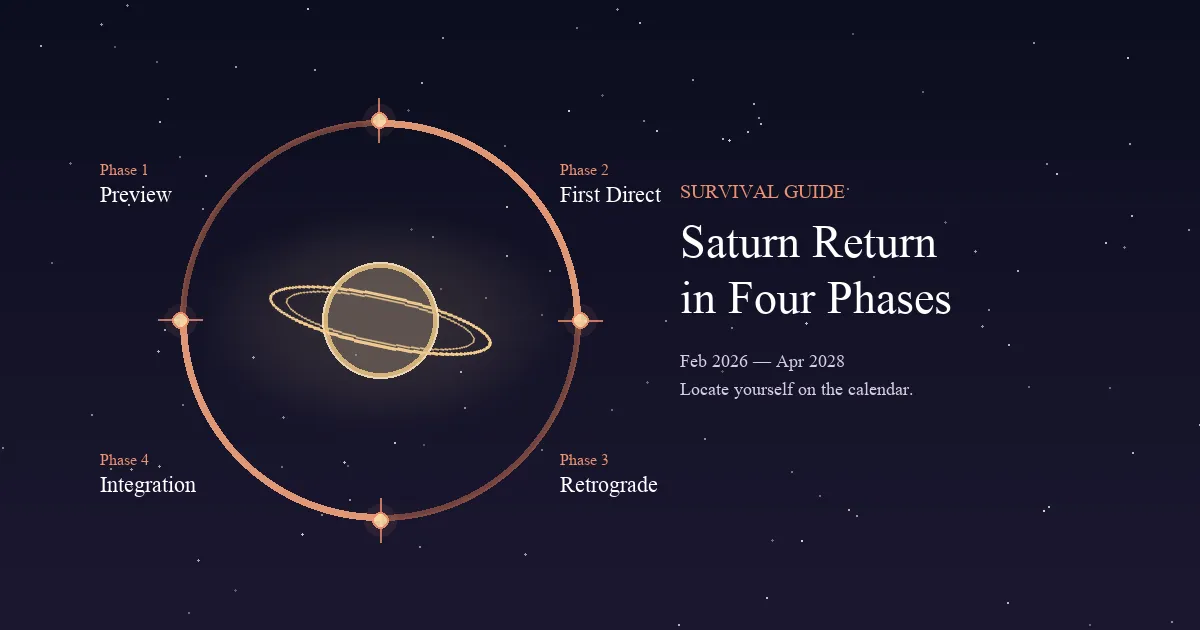
The four phases of the return — locate yourself on the calendar
A Saturn return is not a single event. It is a four-phase arc that runs from roughly six months before the first direct pass over the natal degree to roughly a year after the final direct pass — a 2.5-to-3-year window with structurally different texture in each phase. The cohort that comes through cleanly knows which phase they are in at each point. The cohort that feels lost is the one that experiences the whole window as a single undifferentiated mess. If you have not yet pinned your own window down, the free Saturn return calculator gives you the start and end dates from your birth date; the phase breakdown below assumes you know roughly where you sit inside them.
The phases for the 2026–2028 Aries Saturn return, tied to the actual transit calendar:
Phase 1 — The Preview (roughly May 2025 to February 2026)
Saturn briefly ingressed into Aries from May 24, 2025 through September 1, 2025, then retrograded back into Pisces for one final stretch. People with Saturn in the very first degree of Aries (born April–early May 1996) got an early preview of the return during that window — usually an event or realisation that, in retrospect, foreshadowed what the full return would ask about. Most people in the cohort had a less specific version of the same phenomenon: an unusual stretch of restlessness, a question that would not leave, a relationship or job that started to feel different.
What this phase is for: noticing what is no longer fitting before the structural-audit phase begins. The preview is the dress rehearsal. The cohort that pays attention to it tends to enter phase 2 with a working hypothesis about what the return will surface. The cohort that ignores it usually has to be told the same thing twice in phase 2, more loudly.
What to do here: if you are reading this and your preview window has already passed, write down what surfaced during summer 2025. Career restlessness, relationship distance, body symptoms, a sense of being in the wrong city, a recurring conversation with a parent — anything that started in that window. That list is the working draft of what the next two years will refine.
Phase 2 — The First Direct Pass (February 13, 2026 to July 26, 2026)
Saturn re-enters Aries on February 13, 2026 and moves direct (forward) through the early degrees through late July. The Saturn-Neptune conjunction at 0° Aries on February 20, 2026 lands seven days into this phase — for people born early April 1996, it lights the fuse on the entire return. For everyone else in the cohort, the conjunction is a generational marker that sets the temperature of the wider transit. The Saturn-Neptune conjunction piece covers what that aspect specifically does.
What this phase is for: the first direct pass is the wake-up call. The return makes itself known. Usually this is the phase where something visible changes — a job ends or a major project starts, a relationship intensifies or breaks, a move is decided, a body symptom becomes impossible to ignore. The cohort tends to read this phase as "the Saturn return starting" even though phase 1 already opened it.
What to do here: resist the urge to make every decision at once. Phase 2 produces the most pressure to act because it is when the surface starts shifting. The cohort that comes through cleanly is almost always the one that lets phase 2 surface the question without rushing to answer it. The answer is structurally the work of phase 4, not phase 2. The job of phase 2 is to name accurately what is being audited.
Phase 3 — The Retrograde Re-evaluation (July 26, 2026 to December 10, 2026)
Saturn stations and turns retrograde on July 26, 2026 at 14° Aries 45', then walks backward through the same degrees it just crossed, finishing the retrograde station direct on December 10, 2026 at 7° Aries 56'. This is the phase nobody warns you about. The return loosens. The pressure eases. The cohort tends to interpret this as "the Saturn return is over" and starts making the long-term decisions phase 2 surfaced — and then phase 4 arrives and the decisions get audited again.
What this phase is for: the retrograde is the re-read. The same material that surfaced in phase 2 comes back, this time with the surface pressure removed, so you can look at it without the panic. This is the phase where the genuine "is this mine or someone else's" sorting happens. Saturn moving backward is structurally the planet asking the same question from the opposite direction.
What to do here: use the breathing room for the audit work, not for the rebuild. The temptation in phase 3 is to start building the next chapter while the pressure is off. The pattern that produces the best phase-4 outcomes is to use phase 3 specifically for the structural question — what is mine, what was inherited, what would I choose freshly if I were choosing now — and to defer the rebuild until phase 4. The patience reads as wasteful while you are in it and as wisdom afterward.
Phase 4 — The Second Direct Pass and Integration (December 10, 2026 to April 12, 2028)
Saturn stations direct on December 10, 2026 and resumes its forward motion, then retrogrades a second time from August 9, 2027 to December 23, 2027 (this retrograde covers 21° to 27° Aries — the degrees held by the later part of the cohort). For most of the cohort, phase 4 is the long stretch where the new structure actually sets. Saturn finally leaves Aries on April 12, 2028 — the transit closes.
What this phase is for: phase 4 is the rebuild. The structural audit of phase 2 and the re-evaluation of phase 3 produce, in phase 4, the smallest viable next version of the next chapter. The relationship that is going to make it past the return locks in here. The career direction that is actually yours commits here. The body work that you started in phase 2 becomes a sustainable practice here. The move you considered in phase 2 and re-thought in phase 3 happens here.
What to do here: build small and committed. The cohort that comes out of phase 4 strongest is almost always the one that picked one direction — one career commitment, one core relationship, one living arrangement, one body practice — and let Saturn give it 29 years to compound. Phase 4 is not the place to start three things. It is the place to start one and let the other two wait for the next cycle.
A small calendar note: people born in late 1998 or in the early months of 1999 (with natal Saturn in 21° to 27° Aries) get their main triple-passage during the second retrograde window in 2027. Their phase 2 is essentially summer 2026 to summer 2027, their phase 3 is the August-to-December 2027 retrograde, and their phase 4 is December 2027 through early 2028. Same four phases, shifted ~12 months later than the early-cohort experience. The Saturn in Aries 2026 piece has the full transit calendar; the Saturn return in Aries piece has the cohort-specific dignity context.
Which phase you are actually in depends on your natal Saturn degree — not your birth year. ZodiScope shows your exact degree and the personalised transit calendar that tells you which week each direct and retrograde pass triggers your specific return. Most people in this cohort discover the pressure they are reading as "phase 2" is actually still phase 1 — or already phase 3.
See your Saturn return calendar on ZodiScope →The six things that actually help during a Saturn return
The honest practitioner answer is that the return is not a problem to be solved — it is a 2.5-year structural process to be moved through deliberately. That said, six specific actions show up reliably across the reports of people who came through the transit relatively cleanly, and they are concrete enough to start this week.
- Track the calendar, not just the vibes. Saturn rules time. The single most reliable correlate of a clean Saturn return outcome is the person knowing which phase they are in at any given moment. Put the four phase dates above on a calendar. Mark the Saturn stations (July 26, 2026; December 10, 2026; August 9, 2027; December 23, 2027) as quarterly check-in points. The act of marking time deliberately is itself the work the planet is asking for — Saturn cannot punish someone who is already taking the calendar seriously.
- Write down the structure you are currently inside. Not in a notes app. On paper. List the major structures of your life — primary relationship, job, living situation, financial commitments, friend group, family role, body practice — and next to each, write what you would choose if you were choosing freshly today. The gap between the two columns is the audit material. The exercise sounds basic; the cohort that does it consistently outperforms the cohort that tries to think their way through the return.
- Address one body issue you have been deferring. Saturn rules bones, teeth, joints, and the structural body, and the return reliably surfaces a chronic-but-ignored issue — the back, the jaw, the sleep, the gut, the recurring injury. The cohort that addresses one of these during the transit usually enters their thirties with the issue behind them. The cohort that defers usually defers for another full 29-year cycle. The body audit during a Saturn return is rarely dramatic; it is the moment something quietly comes due.
- Talk to someone who has already had this exact return. The 1967–1969 cohort is currently going through their second Saturn return in Aries — meaning they had their first in 1996–1999 and remember exactly what the placement asks for. They are the only people on Earth who can speak to the specifics of Aries-Saturn return from lived experience. If a parent or older relative falls in that age range, the intergenerational conversation is unusually available right now. The Saturn return in Aries piece covers the cohort overlap.
- Pick the one decision you keep deferring and put a date on it. Saturn rewards real structure. The decision you have been circling for months — leave the job, move, end the relationship, start the thing — is almost certainly part of the audit. The cohort that comes through cleanly tends to pick the one decision and assign it a hard deadline inside the return window (not "soon," but "by July 26, 2026" or "before the second station direct"). The deadline is the structure. Whether you keep it or move it is secondary; the act of naming a date with Saturn watching is the planet's preferred input.
- Take the mental-health baseline seriously. The APA data shows 27% of adults under 30 have been diagnosed with depression — a rate that more than doubled since 2017. The Saturn return frame is useful for context but it is not a treatment plan. If the transit is landing on top of a clinical-grade baseline, the astrology and the therapy are doing different jobs. The cohort that comes through the return strongest tends to be the cohort that uses the astrological frame for structural orientation and the clinical resources for the actual mental-health load. Either alone is incomplete.
The pattern underneath all six: Saturn is not the planet of fast action. The actions that work during the return are slow, structural, and committed to one direction rather than many. The cohort that tries to "solve" the return with frantic activity tends to extend the discomfort by another 6 to 12 months. The cohort that picks one body issue, one decision, and one direction and gives Saturn time to compound them usually finishes the transit with a small but durable foundation for the next 29 years.
The five things that extend your Saturn return rather than shorten it
The mistakes are predictable enough that practitioners can write the list before the cohort makes it. These are not abstract warnings — they are the patterns that reliably turn a 2.5-year transit into a 4-year one. If you recognise yourself in more than one, the fastest correction is usually to stop the pattern, not to add more activity on top of it.
- Trying to make every decision at once. The most common failure mode. The return surfaces a wide field of pressure — career, relationship, money, body, location — and the temptation is to address all of them simultaneously. The cohort that tries this almost always burns out by phase 3 and ends up making worse versions of the same decisions in phase 4 anyway. Saturn rewards focus over completeness. Pick the most load-bearing issue and let the rest sit until phase 4.
- Pushing through the body audit. The chronic issue Saturn surfaces — the back, the sleep, the gut, the recurring symptom — is being surfaced because deferring it is no longer working. The cohort that pushes through (one more deadline, one more sleepless month, one more crash diet) almost always re-encounters the same issue in the second Saturn return 29.5 years later, usually in a more advanced form. The body audit is one of the few parts of the return where the practitioner advice is unambiguous: address it now.
- Mistaking phase 3 for the end of the return. The retrograde phase produces a structural relief — the pressure eases, the surface settles, and the cohort tends to read this as "the worst is over." The most common consequence is that the cohort makes the major decisions in phase 3 while the planet is moving backward, then watches phase 4 come back and audit those decisions a second time. Phase 3 is the re-evaluation, not the integration. Holding back from major commitments during the retrograde almost always produces a cleaner phase 4.
- Treating the return as a personal failure. The pop-astrology shorthand — "Saturn return is the worst three years of your life" — is half right and half lazy. The half that is lazy is the implication that the return is something happening to you because you did something wrong. Saturn returns end the things that were not load-bearing; the absence of load-bearing structure is not a moral failing of the person who built the chapter, it is information about which parts of the previous structure were inherited rather than chosen. The reframe matters because shame extends the transit and clarity shortens it.
- Refusing to ask for help. The Aries-Saturn return (the current cohort) has a specific failure mode: Aries' temperamental register is independence and self-direction, and Saturn in fall in Aries amplifies the tendency to refuse outside input. The cohort that comes through cleanly is almost always the cohort that uses therapy, mentorship, intergenerational conversation, or just a friend who has already had their return as part of the working framework. The transit is not a solo discipline — it is a structural test the cohort has been built to take together. The 1967–1969 second-return cohort is, in particular, an unusually accessible mentorship layer for the 1996–1999 first-return cohort right now.
The single thread underneath all five: the return is a structural process running on its own schedule. The cohort that fights the schedule extends the transit. The cohort that respects the schedule — letting phase 1 be phase 1, phase 2 be phase 2, and so on — usually finishes the work on time. The general framework piece — the Saturn return meaning piece — covers the universal-age-window math that makes this scheduling structurally fixed. The Moon in Capricorn piece covers what Saturn-coded emotional weather looks like in the natal chart, which is useful context if your Moon is in Capricorn or any other Saturn-flavored placement. The Moon in Aries piece covers the emotional register the cohort is running underneath the cardinal-fire Saturn return.
Stop reading generic Saturn return takes. Pull your full chart on ZodiScope, see Saturn's exact degree, sign, and house — and the personalised monthly forecast that walks you through each phase as it arrives. The framework above is the same one practitioners use; the chart is the missing piece that makes it specific to you.
Get your free birth chart →Keep reading
- · First find out exactly when yours runs — the free Saturn return calculator dates all three windows from a birth date.
- · The year-ahead context for the whole 2026 sky: Unlucky Zodiac Signs 2026 — the 5 signs the hardest transits hit worst, ranked with dates.
- · The general framework underneath this survival guide: Saturn return meaning — the only transit with a universal age window.
- · When the return lands on work, health and the feeling that rest has to be earned, the house to read is Saturn in the 6th house.
- · The sign-specific dignity context for the 1996–1999 cohort: Saturn return in Aries — the only Saturn return where the planet is in its fall.
- · The wider transit for everyone else: Saturn in Aries 2026 — the two-year patience test that hits every chart.
- · The once-in-36-years aspect lighting the fuse on the early-1996 cohort: Saturn conjunct Neptune at 0° Aries — the reset.
- · The Saturn-coded lunar placement: Moon in Capricorn — the Moon in detriment, the single hardest lunar placement, run by Saturn.
- · The emotional register Aries-Saturn-return Millennials are running underneath the transit: Moon in Aries — the Mars-ruled Moon.
- · The natural-chart Ascendant under cardinal-fire Saturn transit: Aries rising meaning.
- · Beginner tools: the free sun, moon & rising calculator (or the free birth chart calculator for every planet), the birth chart reading walkthrough, the 12 houses explainer, and the practical birth chart guide.
- · Sign profiles: Aries, Capricorn, or all journal articles.
FAQ
I think I'm in my Saturn return — what should I actually do this week?
Three things, in order. First, find your exact natal Saturn degree (sign + degree, not just sign), because the calendar dates of your specific return triggers depend on which degree Saturn is hitting — a person with Saturn at 1° Aries has their return triggering February 2026 to spring 2027; a person with Saturn at 27° Aries has it triggering summer 2027 into early 2028. Same cohort, very different calendar. Second, stop trying to fix everything at once. Saturn returns produce a wide field of simultaneous pressure — career, relationship, money, body — and the cohort that comes through cleanly is almost always the one that picks the single most load-bearing issue and lets the others sit until phase 2. Third, write down — on paper, not in a note app — the structure you are currently inside and which parts of it you would not choose again if you were choosing fresh. That is the structure the return is asking about. The exercise sounds basic; most people skip it and try to think their way through the transit without ever naming what they have to look at.
How long does a Saturn return actually last?
Roughly 2.5 to 3 years, not the single year most pop-astrology pieces suggest. Saturn moves about one degree every 12 days at average speed, but because it stations and retrogrades roughly once a year for about 4.5 months, the planet usually crosses your natal degree three times — direct, retrograde, then direct again — producing a 'triple passage.' For the 1996–1999 cohort going through the current Aries return, the calendar runs from approximately February 13, 2026 (when Saturn re-enters Aries) to April 12, 2028 (when Saturn leaves Aries for Taurus), with the specific triple-passage dates depending on your natal degree. People born April–May 1996 hit their final direct pass in spring 2027; people born late 1998 hit theirs in early 2028. The lived experience for most people is that the transit feels much longer than the 'two and a half years' on paper because the build-up starts roughly six months before the first direct pass and the integration continues for at least a year after the third.
What's the difference between 'normal twenties life chaos' and the Saturn return specifically?
Honest answer: by the numbers, there is not always a clean line. Census data shows the U.S. median age at first marriage is 28.4 for women and 30.8 for men — landing directly inside the Saturn return age window for almost everyone. BLS data shows the median tenure for workers aged 25–34 is 2.7 years, meaning a career pivot during the return is statistically normal regardless of astrology. A 2017 LinkedIn study of 6,014 people aged 25–33 found 75% had experienced a quarter-life crisis, with the average age 27. The Saturn return frame does not invent these pressures — it lands on the same demographic window that already produces them. What the frame adds is the structural read: the same pressures that would feel like 'I'm failing at being an adult' read instead as 'I am in the structural-audit phase of a 29.5-year cycle and the things being audited are the structures that were not actually mine.' The reframe matters because the practical actions it suggests (let endings end, build the smallest viable next structure, take the body seriously) are the same actions a non-astrological coach would give a 28-year-old in the middle of a life pivot.
Is it bad if I'm not having a crisis during my Saturn return?
No, and the framing has gotten worse than the actual transit. The people who report Saturn return as catastrophic are almost always the ones whose life structure was built on someone else's blueprint — a career chosen for parental approval, a relationship maintained out of inertia, a city lived in by default. The return tends to dismantle that structure, which feels catastrophic from the inside. People whose existing structure was already aligned with their actual values almost always report the return as clarifying rather than crisis-inducing — a deepening rather than a reset. The transit is doing the same work in both cases; the difference is how much of the existing structure was authentic to begin with. If you are 28 or 29 and the return feels like a steady consolidation instead of a fire drill, that is not a failure to have the transit correctly. It is a sign the previous 29 years built something you can actually keep.