Birth Chart
Sun in the 5th House: Leo's Natural House, the Children Verses Traced to Their Source, and Who Gets Born in the Evening
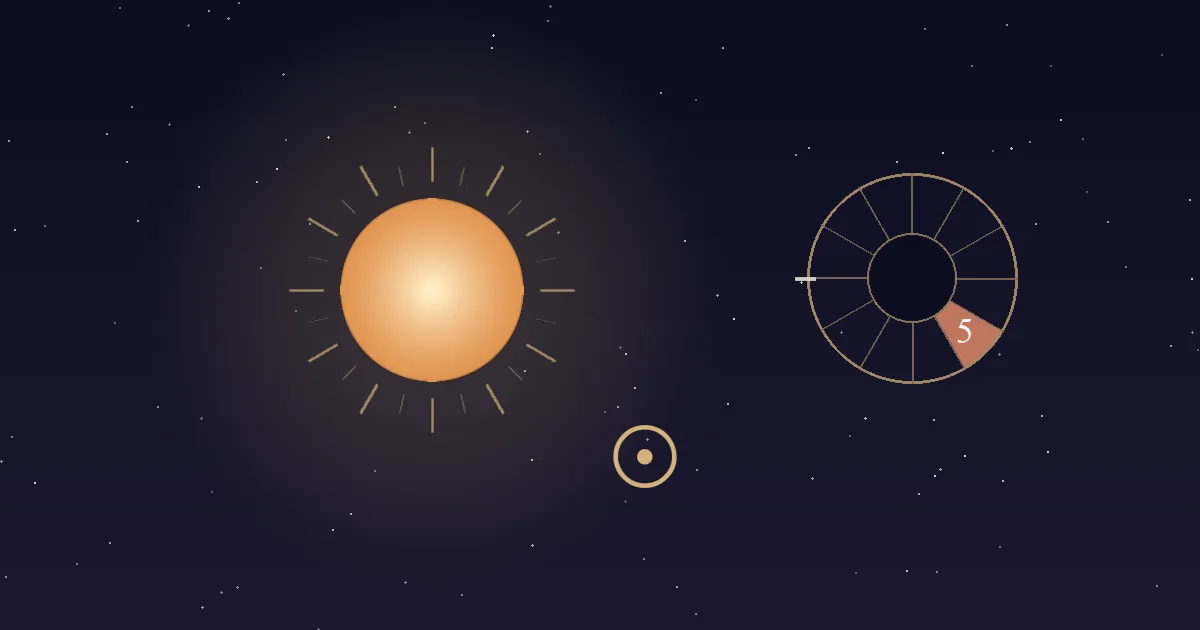
The 5th is the house modern astrology matches with Leo, the Sun's own sign, so you'd expect a Sun there to be the happiest placement in the book: creative, romantic, playful, a natural performer. Most Western pages say exactly that. Then you find a Vedic page, or a Reddit post that went round several astrology forums at the start of October 2026 asking which of two opposite fertility claims about this placement is true, and the pictures don't fit.
The creative reading comes from modern astrology; the warnings about children appear in several older texts, and the strongest of them is much narrower than the posts quoting it. In Placidus houses the placement also says something plainer: you were born in the evening, a few hours after sunset.
Quick answer
In Placidus houses, the Sun in the 5th means an evening birth, in the second sixth of the night after sunset. Creativity, romance, play and children are where astrologers expect you to find yourself. Several old texts say it's hard on children, but those verses are blanket rules or need extra conditions, and none is a fertility test.
| House type | Succedent, below the horizon: a night birth |
| Old name | "Good Fortune" (Agathe Tyche); Firmicus says malefics placed with the Sun here can't do their usual harm |
| Modern link | Leo's natural house; the Venus joy, not the Sun's (the Sun's is the 9th) |
| Vedic reading | Children and intelligence; Brihat Jataka gives "childless", BPHS's no-son combinations need extra conditions, such as a debilitated Sun |
| Sundial time (Placidus) | About 8 to 10 p.m. at the equinoxes (local solar time) |
| U.S. births, 2024 | About 7%, most between 8:07 and 11:05 p.m. on the clock (our estimate from CDC data) |
An evening birth sits in the 6th, 5th or 4th depending on the minutes, and a guessed time can put the Sun in the wrong one. Check the house against the time on your birth certificate, especially before you read the children verses.
See which evening house your Sun is in →Is the 5th house good for the Sun?
The ancient answer was yes, with one reservation. Firmicus Maternus calls the 5th "Bona Fortuna", Good Fortune, the house the Greeks named Agathe Tyche (Mathesis II.16, Bram's 1975 translation). On the Sun there he's warm: "Those who have the Sun in the fifth house are agreeable and successful and win all their desires, largely through the help of friends," and malefics placed with the Sun in this house "are not able to exercise their malevolence because of the natural benevolence of this house" (III.5.18). Vettius Valens, who ties his readings of this place to the planets that rule the Ascendant or the Lot of Fortune, agrees that the benefics help greatly here and the malefics can't harm, and says a Sun in this place makes people "friends of great lords, associates of kings, governors of temples" (Anthologies II.12, Riley translation).
The modern link with Leo is newer. Stephen Arroyo wrote in Astrology, Karma & Transformation (2nd ed., 1992, pp. 221 to 223) that it was "quite surprising" how little emphasis generations of astrologers placed "on the very house that corresponds to the Sun itself," and he came to treat the 5th as the strongest house after the 1st. Robert Hand pushes back in Horoscope Symbols (1981): there are affinities between Leo and the 5th, "but a total equation is impossible."
One detail most pages miss: in the old system of planetary joys, the 5th is where Venus rejoices. The Sun's joy is the 9th, the house Valens calls "the Place of the God Sun", which is why the 9th-house Sun gets the "luckiest placement" debate. So Firmicus praises its prospects while warning about children, and the Indian texts below are harsher. "At home" is a modern idea, and not one the Hellenistic authors used.
Where the "fewer children" idea comes from
Firmicus, for all his praise, adds: "It is, however, harmful to children. If the Sun is alone in this house, the good fortune is less and there will be harm to children and much grief over accidents and deaths of offspring" (III.5.18). The Indian classics go further. Brihat Jataka (XX.2, Subrahmanya Sastri translation) says the native "will be childless and without wealth." Phaladeepika (VIII.3) has "bereft of happiness, riches and children," and Saravali (30.6) "bereft of happiness, sons and wealth."
Look at what the most cited Vedic text actually requires, though. The Brihat Parashara Hora Shastra (ch. 83, vv. 20 to 30, Santhanam translation) lists combinations for having no male child "as a result of the curse of the father in the previous birth." The first one needs the Sun in its sign of debilitation, in the navamsa of Saturn, and hemmed in between malefics in the 5th. That's a rare stack of conditions, about sons specifically, and very different from "Sun in the 5th means no children." Keep in mind, too, that the old authors worked in whole-sign houses, and the Indian texts use the sidereal zodiac, so a Western Placidus 5th isn't always the house they had in mind.
Then there's the arithmetic. In our model built on the 2024 CDC natality data, about 7.4% of American babies are born with the Sun in the 5th, roughly 270,000 in that one year. A blanket rule would predict childlessness for a quarter of a million people from a single birth year. The verses are worth understanding as history, but whether you can have children is a medical question, and only a doctor can answer it.
Creativity, romance and the need to be seen
Howard Sasportas wrote in The Twelve Houses (1985, p. 60) that people with strong 5th-house placements "partake of the qualities of the Sun. They need to shine and create from inside themselves; they need to feel influential." Put the Sun itself there and astrologers expect someone who comes alive making things, performing, flirting, playing games, organising the party, coaching the team. Children fit this house too, as people you raise and play with and teach, which is part of why the fertility fear lands so hard.
The trouble spot follows from the same need. If being admired is where you feel most yourself, a quiet week or an unimpressed partner can feel like being switched off. Sasportas adds the counterweight himself: "the Sun, although vitally central and important, is not the only Sun in the galaxy." In love, astrologers read this placement as generous and romantic, with a taste for courtship that lasts well past the first dates, and a need to keep some play in a long relationship.
At work, the reading points to jobs where you're seen doing what you love: teaching, coaching, the arts, design, entertainment, sport, anything with a stage or a classroom in it. The 5th was also the house of speculation in traditional astrology, so some readings add a taste for risk with money. Vedic astrology reads the 5th as intelligence, learning and past merit (purva punya), and a strong Sun there is read as a sharp, confident mind. Whether any of this goes well or badly depends on more than the house: Firmicus himself says the good fortune is smaller when the Sun is alone here, and the Sun's sign matters too, since it's exalted in Aries, at home in Leo and in its fall in Libra.
Jupiter in the 5th looks at a different traditional claim about children: the Vedic maxim that the significator of a house can spoil it. The Sun's own sign is Leo, and if your Sun is there and in the 5th, the two readings stack.
Astrologers often look to the transits to time a creative push or a new romance. A free account lists today's aspects to your natal planets.
See which transits are active for you →An evening birth: the 5th-house Sun on the clock
Placidus houses, the system most Western apps use, cut the Sun's day and night into sixths. After sunset the Sun passes through the 6th, then the 5th, then the 4th, reaching the bottom of the chart at solar midnight. So a 5th-house Sun means the second sixth of the night. At the equinoxes, when every house lasts two hours, that's about 8 to 10 p.m. by sundial time. In winter the nights are long and the house stretches; in June at New York's latitude it lasts only about an hour and a half.
The CDC's 2024 natality data records the clock time of each birth but not the birthplace, so we simulated 400,000 births with that timing, weighted their locations by each state's birth total and each county's population, and worked out each Sun's Placidus house with Swiss Ephemeris. In that model about 7.4% of American babies born in 2024 had the Sun in the 5th, a little under the 8.3% an even spread would give, and most of them were born between 8:07 and 11:05 p.m. on the clock. The season shows clearly: 5.7% of June and July births had a 5th-house Sun, against 9.0% in December and January, when evenings come early and the night houses are long.
Because clocks run ahead of the Sun across most of the U.S., a fixed rule like "8 to 10 p.m. means the 5th" is wrong for a lot of people; exact birth time and place settle it. Born an hour or so earlier? Then the Sun is probably still in the 6th, the house where Firmicus promised illness and Saravali an army command.
Five evening births with the Sun in the 5th
These birth times are rated AA (from a birth or baptism record) or A at Astro-Databank, and we computed the houses with Swiss Ephemeris in Placidus. Each Sun stays in the 5th even if the time is off by 45 minutes or more. They describe a placement, not a cause.
Wolfgang Amadeus Mozart (AA) has one of the oldest times in the set: his baptism entry says he was born the day before "hora 8 vespertina", at 8 in the evening, in Salzburg on January 27, 1756. His Sun at 7°23' Aquarius is in the Placidus 5th. Henri Matisse (AA) was born at 8:00 p.m. on December 31, 1869, with the Sun at 10°15' Capricorn in the 5th. Franklin D. Roosevelt (AA) was born at 8:45 p.m. in Hyde Park, New York, Sun at 11°08' Aquarius in the 5th. For all three, whole-sign houses put the Sun in the 6th instead.
Kamala Harris (AA) was born at 9:28 p.m. in Oakland, with the Sun at 27°48' Libra in the 5th in both systems, and Will Smith (A) at 9:47 p.m. in Philadelphia, Sun at 3°02' Libra, also 5th in both.
These examples show the Placidus placement, nothing more. The older rules were written for whole-sign charts, and the Indian ones for the sidereal zodiac, so testing them would mean recalculating each chart in that system, and three of these five are whole-sign 6th anyway.
What it means if someone's Sun is in your 5th house
This is a common question in synastry, and the usual reading is a happy one. Their Sun lights up your house of play, romance and creativity, so you tend to feel more fun, more attractive and more yourself around them. Astrologers often see it in flirtations and in friendships built around shared hobbies, and in the people who get you making things again. The overlay doesn't say who "feels it more", and it doesn't promise a lasting match.
Placidus 5th, whole-sign 6th: which one is yours?
Three of the five people above show the split. In whole-sign houses the Sun's house is counted in whole signs from your rising sign, and across U.S. births in 2024 a Placidus 5th-house Sun was in the whole-sign 5th 47% of the time and the whole-sign 6th 47% of the time. Neither app is wrong; they draw the houses differently. If a Vedic reading puts your Sun in the 6th and a Western one in the 5th, that's usually why, and the zodiac difference can move it again. To count the whole-sign house yourself, look up your rising sign, call it the 1st and count forward to your Sun sign.
Transit note, October 2026
The Sun entered Libra on September 22, 2026 and moves into Scorpio on October 23, 2026 (US Eastern dates). In whole-sign houses that stretch puts the transiting Sun in the 5th house for Gemini risings. From October 23, 2026 until November 22, 2026 it is the turn of Cancer risings. Every rising sign gets about a month of the Sun in its 5th house once a year, so this is a yearly season, not the birth placement this page is about. That one depends on the time of day you were born.
You and them
Start with the two of you side by side: signs, elements and the planets your birth dates can already show, free.
Check the two of you side by side →Keep reading
- · Not sure which houses to look at first in your own chart? The houses guide's advice is to start with the ones holding your Sun, Moon and rising.
- · The fire sign the 5th is paired with, and what the element adds: the fire signs.
- · The house straight across the chart, where the same Sun plays to a group: why so many 11th-house Suns say they have few friends.
FAQ
Where does the idea that the Sun in the 5th house means fewer children come from?
From real verses. Brihat Jataka (XX.2) says a 5th-house Sun makes the native childless, Phaladeepika and Saravali say much the same, and Firmicus says the placement is harmful to children. But the BPHS combinations people quote for having no son need much more, for example a debilitated Sun in a Saturn navamsa, hemmed in by malefics. In our model built on CDC birth data, the Sun is in the 5th for about 7% of U.S. births, so a blanket rule would cover hundreds of thousands of babies a year. Fertility is a medical question, and a doctor can answer it in ways a chart can't.
Does the Sun in the 5th house mean your first child will be a son?
No. Some Vedic readings treat the Sun as a male planet and read sons into the 5th, the house of children, and BPHS talks about male issue in its combinations. But a child's sex is set at conception, not by a parent's birth chart. Read it as part of an old system's language about lineage, not a forecast.
Is the Sun stronger in the 5th house because it is Leo's house?
Some astrologers say so. Stephen Arroyo considered the 5th the strongest house in the chart after the 1st, because it corresponds to the Sun's own sign. Robert Hand warns that a house and a sign are not the same thing, and traditional astrology gives the Sun its joy in the 9th, not the 5th. The fair answer is that the 5th suits the Sun's themes of play and self-expression, while its strength still depends on its sign and aspects.