Birth Chart
Sun in the 6th House: Firmicus Promised Illness, Saravali an Army Command. Why They Disagree
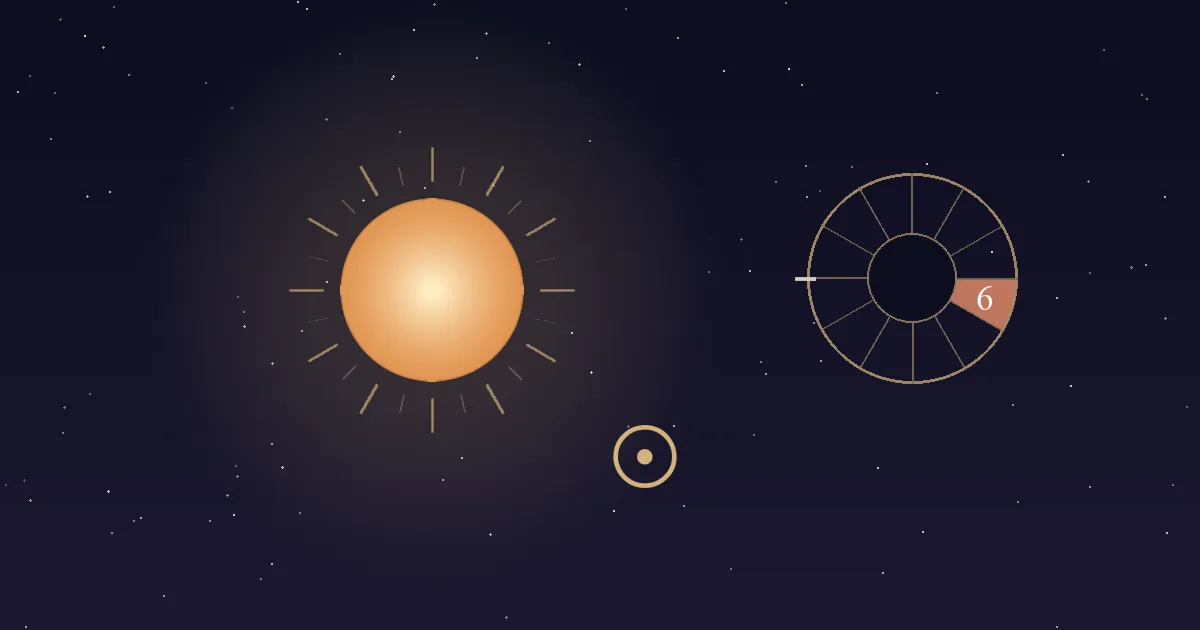
If you've looked this placement up, you've probably met both versions. One site says the 6th is a hard house of illness, debt and enemies, so a Sun there is bad news. Another says it's one of the best spots the Sun can have, good for promotion and good health. They can't both be the whole story.
They're both quoting real traditions, and the split is centuries old. This page sets the two side by side, explains why the Indian texts disagree with the Roman one, and answers the question most people actually came with: what kind of work and what kind of life a 6th-house Sun is built for. It also shows the time of birth the placement records.
Quick answer
The Sun in the 6th house builds identity through work, skill and daily routine. The old texts split sharply: Firmicus warned of long illness, while Saravali and Phaladeepika promised strength, victory and high rank. Robert Hand's modern reading puts work ahead of sickness. In Placidus houses it marks a birth in the early evening, just after sunset.
| Arena | Daily work, skills, routines, health habits, colleagues and employees |
| Hellenistic name | Bad Fortune; also the joy of Mars (Valens II.11) |
| Roman verdict | Firmicus III.5.19: "long, serious illnesses" |
| Indian verdict | Saravali 30.7: strong digestion, "a king, or an Army chief"; Phaladeepika VIII.3: "victorious" |
| Time of birth (Placidus) | The first sixth of the night, starting at sunset; most U.S. clocks read about 5:40 to 9:20 p.m. |
| Share of U.S. births | About 8% in 2024, 6% in June and July and 10% in December and January (our estimate from CDC birth-time data) |
In Placidus houses the Sun enters the 6th when its centre drops below the horizon, a few minutes before the printed sunset, and that line between the 7th and the 6th is the Descendant. For a birth near dusk, twenty minutes either way can move the Sun across it, so check the house with your real birth time and place.
Check your Sun's house for a dusk birth →Sickly or unstoppable? Two old answers to the same Sun
The harsh reading is Roman. Firmicus Maternus, writing around 335 CE, opens his paragraph on this placement in the Mathesis (Bram's 1975 translation), III.5.19, with: "Many misfortunes are indicated by the Sun in the sixth house. He will always be harmful and bring long, serious illnesses." The 6th was already a hard house in his system. He calls it Mala Fortuna, Bad Fortune, one of the places that cannot see the Ascendant. Like the Indian authors below, he counted houses by whole signs, so his 6th isn't always the Placidus 6th an app shows you.
The Indian reading is close to the opposite. Saravali (30.7) says the person "will have powerful digestive fire (capable of digesting fast), be strong, affluent, famous for virtues and be either a king, or an Army chief." Phaladeepika (VIII.3), in V. Subrahmanya Sastri's translation, has the native "become a King, famous, of good qualities, wealthy and victorious."
The split isn't random. It comes down to how each tradition files the 6th, and once you see that, both readings make sense.
Why Indian astrology rates the Sun well here
Vedic astrology puts the 6th in two groups at once. It is a dusthana, a difficult house, along with the 8th and 12th. It is also an upachaya, a house of growth, along with the 3rd, 10th and 11th. In the growth houses, forceful planets like the Sun, Mars and Saturn are expected to do well and to get better with age, because the 6th is a fight and they are fighters. That's why a page built on Vedic sources can call this "one of the best placements" while a Western page calls it a struggle.
The same logic explains why Saturn also does well in the 6th in Indian readings. And the Greek side had its own version of the idea: Vettius Valens calls the 6th "the place of Mars" (II.11), the house where Mars has its joy, which makes it the house of effort and contest rather than ease. Mars in its joy in the 6th shows what that means for the planet that owns the house.
The translation that made it sound worse
Some English pages quote the oldest Indian source, Varahamihira's Brihat Jataka, as saying a 6th-house Sun is "powerful but will be overpowered by his enemies." That line is in Sastri's English text (XX.2), but his own footnote corrects it. The Sanskrit word is Satrujit, conqueror of enemies, with a variant reading Nashtaripu, one whose enemies are destroyed, and he concludes: "He is good in the 6th house." So the one classical line that seems to side with Firmicus actually says the reverse.
What a 6th-house Sun does at work
For a Sun in the 6th, daily work becomes a source of pride. The 6th is the house of skills, tools, routines and service: the daily job rather than the career title. Robert Hand put it simply in Horoscope Symbols (1981, ch. 14): "While the Sun may not be as exuberant and self-expressive in the sixth as in other houses, it does get one strongly involved in whatever one may have to work at." Steven Forrest, in The Inner Sky (1984, ch. 11), describes the terrain as "mastering skills and techniques that are of value to other people. Sharing them, too."
So look for work where practice improves a skill and the result is visible: medicine and nursing, kitchens, trades, labs, editing, software, coaching, analysis, anything with a craft to get right. It likes being the person who knows how the system actually works. Forrest's warning is the other side: if the skill never gets built, the same placement "falls into patterns of subservience, drudgery, and low self-esteem."
The 6th is also the house of colleagues and staff, so the Sun here can take pride in looking after a team, and it can be precise, useful and a bit hard on itself.
At home the same habits show up as care. A 6th-house Sun tends to show love by doing things: fixing the leak, booking the appointment, remembering the prescription. The risk in a relationship is the reverse of neglect. Work can quietly come first for years, and a partner can end up feeling like one more task on a well-run list. Saying the affection out loud, and leaving some evenings unscheduled, matters more for this placement than for most.
Routines change when the sky does. A free account shows today's transit aspects to your own chart.
Check today's transit aspects →The health question, answered plainly
The fear that you'll be sickly comes from the older Western books, and it lasted into the twentieth century. Alan Leo wrote in How to Judge a Nativity (1928 printing, p. 180) that the Sun here "is not good for the health of the native", though he added that unless afflicted the native "generally knows how to safeguard his health."
Robert Hand dropped the first half and kept the second: "Contrary to the older literature, I do not find that sixth-house types tend to be more sickly. Because of their concern with taking care of themselves, they may in fact be very healthy indeed." Astrology isn't a medical test, and nothing in a birth chart replaces a doctor. What the placement does describe is someone who notices their body, cares about habits and can turn health into a project. If the Moon shares the house, the Moon in the 6th ties that body awareness to mood as well.
Born in the evening, just after sunset
This part of the reading is pure astronomy. On a Placidus chart the Sun's house is simply which sixth of the day or the night you were born in. The Sun's centre crosses the Descendant, the line between the 7th and the 6th, a few minutes before the printed sunset, and for the first sixth of the night after that it sits in the 6th. So a 6th-house Sun means you arrived in the evening, with the Sun already below the horizon: a night chart.
We estimated how common that is. The CDC's 2024 natality file gives the clock time of U.S. births but no birthplace, so our model draws 400,000 births from its timing pattern, spreads them across the country by state birth totals and county population, and works out each Placidus house with Swiss Ephemeris. About 8% landed in the 6th. The middle 80% were born between about 5:40 and 9:20 p.m. by the clock, with a typical time near 7:45.
Season matters more here than for most houses. A 6th-house Sun was about 6% of births in June and July but about 10% in December and January, because winter evenings start early and run long, so the night's first sixth is longer and catches more births. Cesareans with no trial of labor, mostly planned deliveries that happen in the morning, account for about 15% of 6th-house Suns against 23% of all births.
Whole-sign houses tell a different story for about half of these births. In our model, a Placidus 6th-house Sun stays in the whole-sign 6th 48.5% of the time and moves to the whole-sign 7th 49.4% of the time. If your chart flips, the reading moves to a 7th-house Sun and the "late marriage" claim. Whole-sign houses count from the rising sign: find your Sun and rising signs, then count forward with the rising sign as one, and a Sun in the sixth sign is in the whole-sign 6th.
Transit note, October 2026
The Sun entered Libra on September 22, 2026 and moves into Scorpio on October 23, 2026 (US Eastern dates). In whole-sign houses that stretch puts the transiting Sun in the 6th house for Taurus risings. From October 23, 2026 until November 22, 2026 it is the turn of Gemini risings. Every rising sign gets about a month of the Sun in its 6th house once a year, so this is a yearly season, not the birth placement this page is about. That one depends on the time of day you were born.
Three rated charts born after sunset
These birth times carry Astro-Databank's AA rating (from a birth record), and we computed their Placidus houses with Swiss Ephemeris. Each Sun sits at least 50 minutes of clock time from either edge of the 6th. The placement is a fact about the chart; we aren't claiming it explains anyone's career.
Serena Williams (born 8:28 p.m. on September 26, 1981 in Saginaw, Michigan) has the Sun at 3° Libra in the 6th, on both house systems. Steven Spielberg (born 6:16 p.m. on December 18, 1946 in Cincinnati) has it at 26° Sagittarius in the 6th, and Sigourney Weaver (born 6:15 p.m. on October 8, 1949 in Manhattan) at 15° Libra in the 6th, both on Placidus and whole sign alike.
For contrast, Steve Jobs (AA, born 7:15 p.m. in San Francisco) has a Placidus 6th-house Sun that becomes the whole-sign 7th. Same evening hour, different answer, depending on which system the chart uses.
The father, the boss and the credit
The Sun stands for the father in both traditions, so people ask whether a 6th-house Sun is bad for Dad. Firmicus does have a line on it, and it needs two other placements: with Mars on the ascendant, the father meets "an evil or quick death" or is condemned, and the inheritance is lost, "if there is no planet in the tenth house", while a planet on the Midheaven reverses it and makes the natives "immensely wealthy". That is one author's rule, and it depends on two placements besides the Sun. Robert Hand's modern reading is that the Sun shows "the experience of being fathered, not the objective truth about one's father."
The more common complaint is about bosses: doing the work while someone else presents it. The 6th is a service house, so the Sun here can end up in supporting roles longer than it wants. The practical fix: pick work where skill is visible and measured, and say out loud what you did. The opposite house, the 12th, has an even quieter reputation, and the case that "invisible" misreads a 12th-house Sun is worth reading beside this one.
When their Sun falls in your 6th house
In synastry this is the helpful, practical overlay. The other person's Sun lands in your house of routines, so they tend to organise your days, nudge your habits and notice when you're run down. Some people love that and some feel managed. It reads especially well for colleagues and housemates, and in a couple it's worth asking who does the daily work. Our synastry guide treats house overlays like this one as the second layer, read after the aspects.
Working together
Living or working with someone? Start with your two birth dates side by side: signs, elements and the planets a date can already show, free.
Put two birthdays side by side →Keep reading
- · The houses guide explains why the 6th covers the daily job rather than the career, and what each of the other eleven covers.
- · Worried by the "difficult house" label? Our birth chart guide goes through five placements beginners misread, with the 12th house among them.
FAQ
Does the Sun in the 6th house mean you'll end up working in healthcare?
Healthcare is one of the fields astrologers link to it, because the 6th covers health, care and daily service. The wider pattern is work that asks for skill and repetition: medicine and nursing, trades, editing, engineering, coaching, kitchens, any job where doing the routine well is the point. The house says where the Sun wants to prove itself, not which job title it gets.
Does the Sun in the 6th house mean working hard while someone else gets the credit?
It's a common complaint from people with the placement, and astrologers do read the 6th as the house of service rather than applause. But the house doesn't fix the outcome. Ask for the credit you've earned and choose roles where good work is visible. A 6th-house Sun tends to be happiest where the skill itself gets respect, whoever ends up presenting it.
Does the Sun in the 6th house defeat enemies or get defeated by them?
The Indian classics say it defeats them. Phaladeepika calls the native 'victorious' and Saravali says the person may be a king or an army chief. One English translation of Brihat Jataka reads 'overpowered by his enemies', but the translator's own note gives the Sanskrit as Satrujit, conqueror of enemies, and concludes that the Sun is good in the 6th.