Birth Chart
Mars in the 6th House: Enemies, Illness, and the One Room Where Mars Is at Home
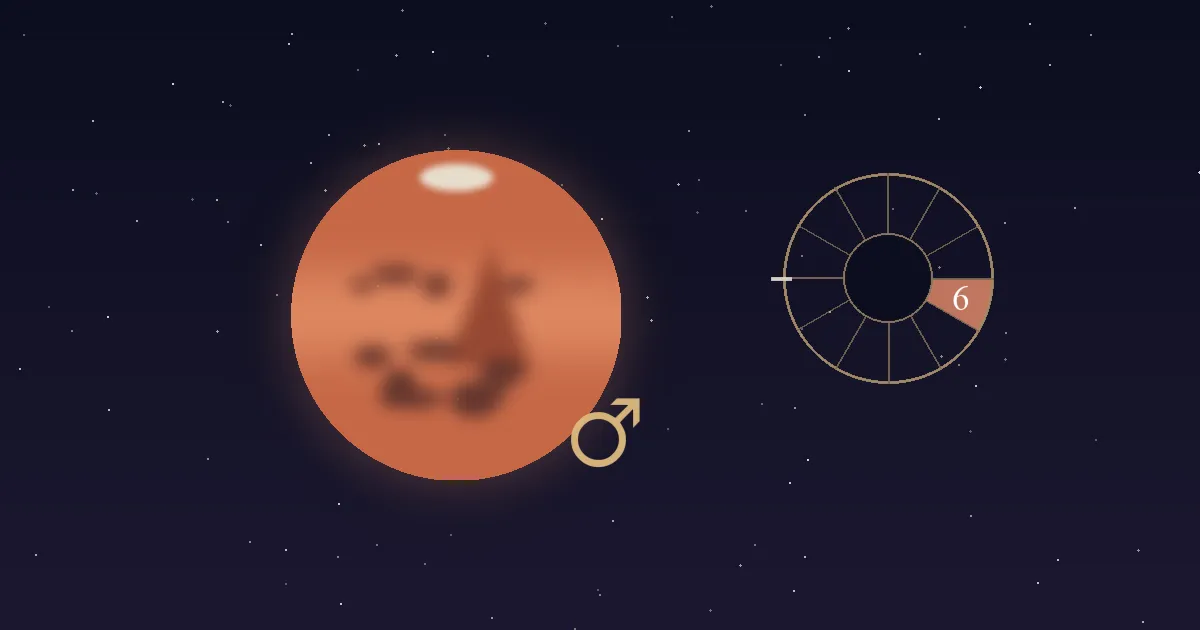
Search this placement and page one hands you a contradiction. Half the results call the 6th the house of enemies, illness and debt, and warn you about a Mars sitting in it. The other half tell you this is the one house where Mars "rejoices," a placement the ancient astrologers thought was favorable. Nobody explains how both can be true, so readers arrive in forums asking whether they should be worried, and the forums tell them to look at the whole chart.
Both claims are old, both are real, and they aren't in conflict once you know what "rejoices" meant. The ancient sentences settle it. Then the practical part: work, the body, the people you fight with, and why the marriage fear in the Vedic threads about this house is mostly a rulership chain. Rulership chains only make sense once the houses walkthrough is in your head.
Quick answer
Mars in the 6th house puts the planet of drive into the house of work, health, routine and conflict with the people you deal with daily. It's the one house where Mars traditionally "rejoices," because injury and labor are his native material. It describes a tireless worker with a body that runs hot. An enemy magnet it isn't, and it is no diagnosis.
| Arena | Cadent 6th house: work, health, service, daily conflict |
| Drive style | Task-first; restless without something to fix |
| Ancient name | "Bad Fortune," and in Valens, "The Place of Mars" |
| Classical verdict | Mars's joy (Paulus, Lilly; Valens names the place after Mars); Firmicus still lists "many evils" |
| Vedic note | Not a Mangal dosha house; upachaya, said to improve with age; "victory over enemies" is the headline benefit |
| The fear | Enemies, surgery, a bad marriage: examined below |
| Superpower | Outworks everyone, and wins the fights it picks |
The 6th is a cadent house sandwiched between two the folklore treats very differently, and both of its cusps move with latitude and clock time.
See how close Mars sits to the cusps →"Enemies and illness" or "Mars rejoices": which page one is right?
Both, and the sentences that prove it are older than either side of the argument. In the second century Vettius Valens headed his chapter on this place, in the Riley translation, "The VI Place. The Place of Mars." His table of place names files it as "The Bad Fortune, injuries." Two centuries later Paulus Alexandrinus (Greenbaum translation) spelled out the mechanism: the sixth "is called Evil Fortune... the place dealing with Ares. It gives signs for the determination that concerns injury. The star of Ares rejoices in this place beyond all the stars." Chris Brennan's paper on the planetary joys traces the doctrine back to the first century CE at the latest and gives the logic in one line: the house is under the earth, so it concerns the body; it is Mars's house, so it concerns bad things done to the body; hence injuries.
So the house of enemies and illness and the house where Mars rejoices are the same house for the same reason. He rejoices because the room is made of his material: cuts, effort, sickness, the daily grind, the small enemies of ordinary life. A nice room was never the point. One camp describes the room. The other describes how comfortable Mars is in it, the way a surgeon is comfortable in an operating theater.
Firmicus Maternus, writing in the fourth century, is the exception. He says in Book II of the Mathesis that the sixth "is called Mala Fortuna because it is the house of Mars," then delineates the placement in Book III, chapter 4, as "many evils... illnesses and many reverses in life, according to the nature of the signs." That one unsplit delineation is all he gives it; no day-and-night version, unlike most of the other houses, which suggests he had less to say about it. The joy doctrine survived him anyway. William Lilly, 1647: "Mars rejoyceth in this house... we usually find that Mars and Venus in Conjunction in this house, are arguments of a good Physitian." Read that last clause again, because it's the clue to the modern reading: the ancient texts put doctors, soldiers and surgeons here, people whose job is to handle injury on purpose.
Transit note, September 2026
Transiting Mars is in Cancer from August 11, 2026 until September 28, 2026. In whole-sign houses that is the 6th house for Aquarius risings, who get a live preview of what this natal placement feels like for about six weeks. When Mars moves on into Leo, the 6th-house transit passes to Pisces risings. If your chart uses Placidus, the timing can differ by a week or two either side; the free birth chart prints your Placidus cusps so you can check.
Work with a fuse
Modern astrology reads the 6th as the house of work, in the plain sense: the tasks, the routine, the coworkers, the job you do day to day; the career you're known for is the 10th house Mars. This is the placement that finishes the list, resents the standing meeting, and gets visibly irritable when the process is slower than it needs to be. It's also the placement other people quietly hand the hard job to, because it gets done.
The trade-off is the fuse. A 6th-house Mars fights with the people it works beside, and the fights are about competence: the colleague who cuts corners, the manager who can't decide, the vendor who missed a deadline. The anger underneath is about wasted time. Learning to say "that's not my standard" without saying "you're useless" is the placement's actual homework.
Burnout is the failure mode, and it has a number. Gallup's 2018 study of nearly 7,500 full-time employees found 23% feeling burned out very often or always and another 44% sometimes, so two thirds report burnout at least sometimes before any planet is involved. A 6th-house Mars gets there faster because it can't idle; the drive doesn't switch off when the shift ends, it just looks for the next thing to fix. The people with this placement who stay well gave the energy a physical exit, which is the body section's whole subject.
Every two years or so transiting Mars spends six to eight weeks in your 6th house, up to seven months if a retrograde falls there, and people with Mars natally here tend to feel those windows as the "clear the backlog or blow up at a coworker" weeks. ZodiScope's live overlay marks them on your own chart.
Date your backlog weeks →A body that runs hot
The health searches for this placement are frightened ones (surgery, accidents, inflammation), and the pages doing the frightening are mostly remedy sellers. The old texts support a calmer version once you strip the fatalism. The 6th is the house of the body as a machine that needs maintenance; Mars is heat, speed and force. Put them together and you get a body that overtrains, strains, rushes, ignores the twinge, and pays for it. Inflammation, sports injuries, the pulled muscle from lifting the thing you should have asked for help with. Firmicus's "in crooked signs he makes for an early death," from that same unsplit delineation, belongs to a world without antibiotics; the modern reading is a pattern, and patterns are manageable.
The fix is a scheduled physical outlet. Not "exercise when you feel like it," because this placement always feels like it and then overdoes it. A program with rest days built in, so the drive has a lane: the gym, the run, the martial art.
A poster on an AstrologyWeekly thread in 2023 wrote that she'd read Mars in the 6th "means desire to serve a lover in bed, which annoyed me," and the reply was right: the house rules illness, health, service workers and small animals, "nothing inherently sexual." The 6th-house Mars serves the way a nurse or a mechanic serves, by fixing what's broken, and it can be blunt about it. The sexual reading belongs to the 8th house Mars and the 5th house, not here.
The enemies, person by person
For the 6th the fights are with the people in your daily orbit who aren't family or partners. Coworkers first, and specifically the ones whose standards you don't respect. Then the institutions you deal with as a customer or a patient: the insurer, the landlord, the clinic that lost the referral. This is the placement that writes the complaint letter everyone else only drafts, and the Vedic pages that lead with "victory over enemies" as this placement's headline benefit mean, translated, that it usually wins those fights because it's prepared to have them. The classical Vedic 6th also holds debts, which is why the same pages talk about loans getting paid off by force of effort.
Subordinates and service providers are the other direction. If you manage people, this Mars is demanding, fair when it's calm, and hard to work for when it isn't. If you're the one being served, you're the customer who notices everything. And then the small animals, which sounds quaint until you meet the 6th-house Mars who trains the dog with military precision.
What this house cannot tell you is whether your marriage will be difficult, which is the question that dominates the Vedic forums about it. On r/vedicastrology in 2025 one poster wrote "I have mars in 6th house, hence worried" about their married life, and the answers ran "not a problematic placement" and, less gently, "go to temple and thank God that you're not married yet." The chain that produces the marriage fear is rulership: in Jyotish the 6th is a house of disputes, and if the ruler of the 7th sits there, or Mars from the 6th aspects the 7th lord, some readers forecast a quarrelsome spouse. That's a claim about one chart configuration. Mars in the 6th on its own says nothing about a spouse, and it isn't a Mangal dosha house either; the classical verse, discussed on the 7th house page, names the 4th, 7th, 8th and 12th, and the later lists that add the 1st and 2nd still skip the 6th. And the chart those rules were written for is a sidereal one. Converting is close to a coin toss: a Mars in the Placidus 6th stays in the 6th about half the time and lands in the 7th nearly as often, with anything else rare. No Manglik list names the 6th and every list names the 7th, so the conversion is the whole question here rather than a footnote to it.
Which house system you use changes this answer for half of you
That last point deserves its own numbers, because the 6th is a cadent house, and a cadent house is the kind that sits away from the angles where the two grids are pinned together. We ran the check ourselves, 20,000 simulated births with random times spread across latitudes from 25° to 55° (the method is written up in our research notes, and it is a count, not a study): Mars sits in a different house under Placidus than under whole sign in roughly half of charts (53.6%), rising to 58% at the latitudes of northern Europe and Canada. The reason isn't exotic. Whole-sign houses start at 0° of the rising sign; Placidus houses start at the Ascendant's exact degree, an offset of about 15° on average, and Placidus houses are unequal on top of that. So a Mars in the first few degrees of the sixth sign from your rising sign is a 6th-house Mars in whole sign and, when the Placidus 6th cusp lands later in that sign, a 5th-house Mars in Placidus, and both apps are "right."
The chart drawn here uses Placidus and says so on the result, and it prints Mars's degree so you can see how close to a cusp it sits. If your Mars is within a few degrees of the 6th or 7th cusp, read this page and the neighbor's and notice which one describes your working life; that's a better tiebreaker than any rule. Three certificate-grade examples of Mars in the 6th, all Rodden AA on Astro-Databank, computed here in Placidus with Swiss Ephemeris and sitting 6.8°, 9.7° and 7.3° from their nearest cusp: Julia Roberts (Mars at 3° Capricorn, 7th house in whole sign), Steven Spielberg (1° Capricorn, also 7th in whole sign) and Sean Connery (28° Gemini, 6th in both). Roberts and Spielberg are the point in one line: two of the most relentless working lives in film, and whether their Mars is "in the 6th" depends on which grid you lay over the sky. Connery is the working-life Mars in any system, a milkman, bricklayer and coffin polisher before he was Bond.
Two Mars signs that change the 6th most, and the room across the wheel
The house says where the drive goes; the sign says how it moves. Lilly's physician line is as close as the classical texts get to a careers list, so the sign is what tells you which kind of fixer you are.
Mars in Virgo is Virgo in Virgo's own house: precision as force, never off duty, the critique aimed at itself as often as at the coworker. Mars in Capricorn is Mars exalted, and it builds the maintenance schedule and keeps it for thirty years; the Roberts and Spielberg Mars.
The most useful contrast is with the house across the wheel. Mars in the 6th fights in the open, at work, about things that can be fixed; Mars in the 12th house is the same planet in the house of hidden things, where the anger goes underground and the enemies are the ones you can't name. The two are the "bad" pair among the four places that make no aspect to the Ascendant, and they solve the same problem in opposite directions: one by doing, one by withholding.
Moon in the 6th house is feelings that want a task, Venus here is the office-romance placement, and Jupiter in the 6th house is the amplifier that makes both health camps half right.
Their Mars in your 6th house
Synastry is the least-searched overlay for this house in our keyword data, and for once that matches the astrology: someone's Mars landing in your 6th makes a working relationship, whatever else the two of you are. They push you to get things done, they notice when you're slacking, and they'll say so. As a coworker or a trainer this is excellent. As a partner it can feel like living with a foreman, especially if their Mars also squares your Moon. The fix is to give the dynamic a project (a renovation, a shared fitness goal, a business) so the pushing has a target other than you.
One last coincidence, because this house collects them. Michel Gauquelin's mid-century birth-time statistics, the disputed "Mars effect" that our Mars sign page tells in full with the numbers on both sides, weren't only about athletes. Reviewing Gauquelin's ten occupation tables, the skeptic Jan Willem Nienhuys noted that "the doctors (233 out of 1084) seem to score also high" for Mars in the key sectors, 21.5% against a global rate of 18.2%. He was careful about it: against that baseline he judged that only the athletes really stand out, and that one raised figure among ten occupations is not especially remarkable. The effect is contested, and the doctors' count uses only the two key zones, just after rising and just after the top of the sky, which Kenneth Irving roughly maps onto the Placidus 12th and 9th. The wider set of 36-sector "plus zones" does include a smaller one that falls in the 6th, and the doctors' figure leaves it out. But Lilly's "good Physitian" line and a French statistician's physician table, three centuries apart, both put Mars and medicine in the same sentence, and that's the kind of coincidence this house collects.
Find out if this is your Mars
When transiting Mars comes through your 6th, the workload spikes and the body asks for the outlet this page keeps mentioning. ZodiScope marks those weeks on your chart in advance, with the rest of your transits beside them.
Date the Mars-in-the-6th weeks →Keep reading
- · The body this workload runs on, right at the Ascendant: Mars in the 1st house.
- · Where the wages from all that work go: Mars in the 2nd house.
- · Virgo's ruler has a second sign, and Mars in it argues instead of fixing: Mars in Gemini.
FAQ
Is Mars in the 6th house really the house where Mars "rejoices"?
Yes, and it's the only house that is. Each of the seven classical planets was given one house as its joy, and Mars got the 6th; Paulus wrote that he rejoices there "beyond all the stars," and Lilly repeated it some twelve centuries later. Two things follow that people miss. First, a joy is not a dignity: it says nothing about strength or weakness the way domicile or exaltation do, only that the planet and the room want the same things. Second, the joy belongs to the house, not to Virgo, so it holds whichever sign sits on your 6th cusp. If you want the one-line version: injuries and effort are what the 6th holds, and injuries and effort are Mars's trade.
Why do Vedic readers tie Mars in the 6th house to a difficult marriage?
Because in Jyotish the 6th is a house of disputes, and marriage readings there run through rulership rather than placement. The chain goes: find the lord of the 7th (the marriage house) or Venus, and if either sits in the 6th, or takes a full Mars aspect from it, some readers forecast a quarrelsome spouse. Mars's special aspects from the 6th land on the 9th, 12th and 1st, so the 7th itself isn't even in his line of sight from here. A bare 6th-house Mars, with the 7th lord and Venus elsewhere, doesn't complete the chain, and the Manglik verse in BPHS doesn't name this house. The thing to check before worrying is where your 7th ruler sits, on a sidereal chart, since that's the wheel the rule was written for.
Does Mars in the 6th house make you a workaholic?
It makes work the natural outlet for the planet of drive. Workaholism is what happens when the outlet is the only one. A 6th-house Mars needs a task the way other placements need an audience, so the useful test is what happens on a day off: if you invent a job by noon (reorganise the garage, fix the neighbour's fence), the drive is healthy and just needs a second lane. If you can't stop because stopping feels like losing, the job has become the self, and that is the version worth taking seriously.
What does Mars in the 6th house mean for surgery or injuries?
No operation is written into a birth chart, and anyone who tells you otherwise is selling a remedy. What the placement describes is wear: heat and speed applied to the house of bodily upkeep, so the typical injuries are the ones that come from rushing, overtraining and skipping rest, strains and inflammation rather than dramatic events. The practical version is a rule about information. Fatigue and the small twinge are data this Mars habitually throws away, and the injuries it collects are mostly the ones it was warned about. Treat the warning as the instruction and the pattern shrinks to a footnote.