Birth Chart
North Node in the 6th House: A Strong Placement, or Just a Life of Chores?
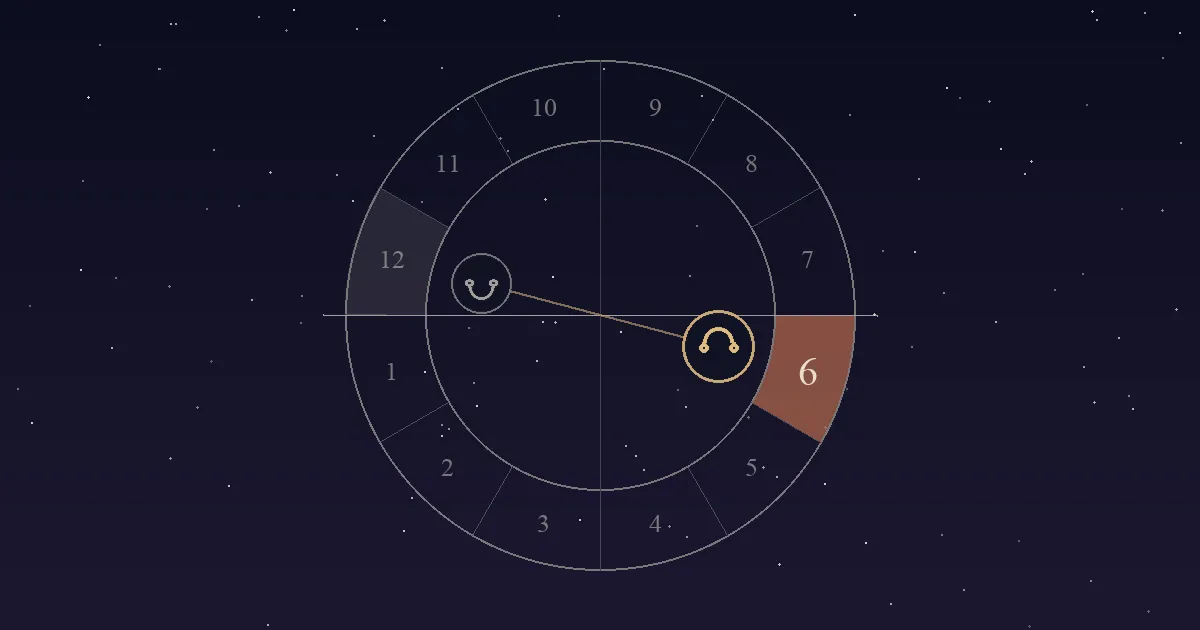
Is a 6th-house North Node a strong placement, or does it just mean a life of chores? The 6th is the house of the job you turn up to every day, the body you maintain and the small duties nobody thanks you for, so finding your "destiny point" there can feel like a letdown.
The sources disagree about whether this placement helps and about what it means. The Vedic texts are mostly warm about Rahu here, with a few hard lines, while the routine reading comes from the karmic astrologers of the 1970s. If your North Node is in the 6th house, your South Node is in the 12th, always.
Quick answer
With the North Node in the 6th house, the growth astrologers describe happens in daily work, routine, health habits and being useful in concrete ways. The South Node in the 12th pulls the other way, toward retreat and drift. Vedic texts rate Rahu well in this house, and modern astrologers read it as a lesson in structure.
| North Node house | 6th: daily work, routine, health habits, service, coworkers |
| South Node house | 12th: retreat, solitude, imagination, the private inner life |
| Natural sign of the house | Virgo |
| Vedic verdict | Phaladeepika: enemies and a disease, but also "wealthy and long-lived" |
| Our data point | A Pisces North Node lands in the 6th a little more often than a Virgo one (about 8.7% against 7.8% of modeled births with each node sign) |
How far is your node from your Descendant? Within a few degrees of it, a birth time that's slightly off can move the node into the 7th. Cast the chart from your recorded birth time and place and measure the gap.
Find the house your node falls in →Strong placement or a life of chores?
In Vedic astrology the North Node is Rahu, and the Indian texts are unusually warm about Rahu in the 6th. Mantreswara's Phaladeepika gives a mixed verse: the native "will be troubled by his enemies," "will suffer from a disease in the anus," and "will be wealthy and long-lived" (VIII.26, V. Subrahmanya Sastri's translation, 1950, p. 95). The Saravali goes further, with a condition attached: "Should Rahu be in the 3rd, 6th, or 11th from the Ascendant and be aspected by benefics all evils are destroyed, as though wind carries away a heap of cotton with it" (12.3–5). R. Santhanam, in a translator's note to the Brihat Parashara Hora Shastra, adds that Rahu and Ketu "give favourable results in the 3rd, 6th and 11th." The reason is that these texts count Rahu as a malefic, and malefics are read as doing well in the 6th, the house of obstacles and rivals. Western authors called the Dragon's Head a benefic instead.
The older Western books we checked give no verdict on the North Node in the 6th. Their medieval house lists were written for the Dragon's Tail, and the nearest William Lilly comes is a general rule. He wrote that he "ever found the ☊ equivalent to either of the Fortunes" (Christian Astrology, 1647, p. 83), ☊ being his sign for the Dragon's Head, and in a later chapter that "a fortune in the 6th or 12th, shewes good servants and profit by their labour" (p. 586). Put the two together and a Lilly reader could call a 6th-house Head a sign of good help and effort that pays. Lilly never wrote that sentence himself, so take it as our inference, not his rule.
The "chores" reading is modern. It comes mostly from Martin Schulman's Karmic Astrology (1975), the earliest full North-Node-by-house text we found. His 6th-house native spends most of his time in deep thought, likes to be left alone, and in his work is "an unusually poor organizer." The lesson, on p. 78, is to learn to "organize his thoughts, his work and his diet." Schulman's advice is practical: put the work in order and build habits you can keep. Modern astrologers read the North Node as a direction to practice, and in the 6th that can mean finishing one task before you start the next.
Does the placement mean illness? Some old texts say so. Besides the Phaladeepika's disease line, R. Santhanam's note to the Brihat Parashara Hora Shastra says "Rahu or Ketu in the 6th/8th will cause stomachial disorders" (note to ch. 17, vv. 3–5, p. 114). The book's other health rules for Rahu in the 6th are timing combinations that need several more conditions at once, such as the Ascendant's lord in the 8th. Schulman, too, expected part of this native's life to go to "coping with physical or mental illness, either in himself or others close to him." These are astrological predictions, not medical findings, and none of them is evidence that illness will follow. Schulman's diet line is the part you can act on. The 6th is the house of habits, and habits can change. Anything that feels like a symptom belongs with a doctor.
What the work looks like day to day
In the usual modern portrait, someone with a gift for the big picture keeps deadlines in their head instead of on paper, starts a fitness plan in January and loses it by March, and would rather design the system than run it. The South Node in the 12th makes retreat feel natural: a long sleep, a book, a private world. The North Node asks for something repeatable instead, like deadlines written down, meals at roughly the same time, and work that other people can see and check. Here the imagination from the 12th still has a use: the novel someone has carried around for years finally gets written in one set hour at the desk, three mornings a week.
The payoff is competence: becoming someone whose work others rely on, who knows a craft well enough to teach it, and who feels steadier for having a routine. The 6th is also the house of the people you work beside and the people who work for you, so the growth often shows in small things, like taking instruction without bristling, training a new hire properly, or noticing when a coworker is overloaded.
Usefulness has limits too. Covering every shift and fixing every problem is service with no routine around it, and it wears people out. The steadier version builds your own sleep, meals and days off into the schedule. At home it can be as plain as reliably doing your share of the chores, and the 6th is also the old house of small animals (Lilly's chapter for this house in his book on nativities is headed "Of Servants or small Cattle"), so feeding a pet at the same hour every day counts. Nor does the habit need to be perfect to work. A walk taken four days a week is still a routine. Routines can also go stale. When a habit stops solving the problem it was built for, the practical move is to change it rather than keep it out of loyalty.
As with Rahu, Vedic readings tend to favor Saturn in the 6th, though some texts attach illness predictions to it as well. The 6th house covers daily routines, and for this node the aim is habits you repeat until they take less effort.
Want to check today's sky against your own chart? A free account lists today's transit aspects to your natal planets.
List today's transits to your natal planets →The South Node in the 12th house: the retreat that feels like home
Retreat comes easily with this axis. The South Node sits in the 12th, the house of solitude, rest, imagination, spiritual practice and whatever happens out of view, and astrologers read it as the side you're already fluent in, while the 6th is where you're learning.
A South Node there makes those things easy, sometimes too easy. Modern astrologers describe the downside as escape: vanishing into daydreams, sleep, screens or an inner world when ordinary obligations stack up. One Reddit poster with this axis said they felt "very stuck" and that it was "apparent that it's my SN 12H." None of the 12th-house skills is bad. Stepping back and sensing what isn't said are real gifts. The axis suggests they work better alongside a 6th-house habit.
This is also where the old "hidden enemies" warning belongs. Guido Bonatti's 146 Considerations, in Henry Coley's translation, list the Dragon's Tail house by house, and for the 12th they give "damage sustained by great Cattle, or by means of hidden enemies" (Consideration 139; 1886 edition, p. 61). The livestock shows how old the list is. The enemies part often gets repeated online as a North Node line, but it was written for the Tail, so on this axis it belongs to your South Node. Someone with a 12th-house North Node has the opposite problem: they're so busy being useful that stopping feels like failing.
Nadal, Heisenberg, Reynolds, Streisand: the 6th holds under every check
Celebrity node lists are unreliable, because the node's house depends on the exact birth time and the house system. Each of these four has a birth time rated AA at Astro-Databank (from a birth certificate or record), and we cast every chart ourselves. Each one gives the 6th with either node, true or mean, in both Placidus and whole sign, and the house holds with the birth time moved 15 minutes either way.
- Rafael Nadal (AA), born 6:20 p.m., June 3, 1986, Manacor, Spain: North Node at 29°22′ Aries.
- Werner Heisenberg (AA, birth certificate), born 4:45 p.m., December 5, 1901, Würzburg, Germany: North Node at 13°21′ Scorpio.
- Debbie Reynolds (AA, birth certificate), born 5:49 p.m., April 1, 1932, El Paso, Texas: North Node at 26°11′ Pisces.
- Barbra Streisand (AA), born 5:08 a.m., April 24, 1942, Brooklyn, New York: North Node at 12°01′ Virgo.
We leave their careers out of it, since four charts can't show what a placement does. Streisand's node is in Virgo, the sign modern astrologers pair with the 6th, and Reynolds's is in Pisces, the sign paired with the 12th.
A Pisces North Node in the 6th, and other mixed signals
How do you make sense of a Pisces North Node in the 6th? Pisces is paired with the 12th, so the node seems to be arguing with its own house. It isn't, really. The node spends about a year and a half in each sign, so your birth date usually settles the sign (on the day the node changes sign, the birth time decides), while the house comes from your birth time and place. A Pisces node can land in the 6th as easily as a Virgo one, and in our birth model it does so slightly more often. A Pisces North Node sat in the 6th in about 8.7% of births with that node sign, and a Virgo node in about 7.8%. Pisces lies south of the celestial equator, so at U.S. latitudes it spends a little longer below the horizon each day.
A Pisces node in the 6th learns to bring trust and imagination into ordinary work, and a Libra node in the 6th builds the same habits through cooperation with coworkers. Modern astrologers pair Virgo with the 6th, so with a Virgo North Node in this house, sign and house both point at practice and attention to detail.
6th or 7th: why whole sign usually moves it forward
Two apps can honestly disagree about this node. In our birth model, 400,000 simulated U.S. births from 1960 to 2024 with birth times drawn from CDC data and places spread across U.S. counties, whole sign moved about half of Placidus 6th-house North Nodes (49.3%) forward into the 7th. The reason is the Descendant: the 6th ends there, and a whole-sign chart counts the whole sign holding your Descendant as the 7th.
Two more checks before you trust the label. On a Placidus chart, about 1 in 10 modeled 6th-house North Nodes (10.3%) sits in an intercepted sign, one with no house cusp in it, and intercepts gather in the houses next to the horizon. The birth time matters more than people expect. A recorded time that's 30 minutes off in one direction moves the node's Placidus house in about 1 modeled birth in 4 (25.1%), and an hour off does it in about half. A date that's one day wrong, at the same clock time, changes it in only about 3 charts in 100 (3.4%), since a day later the node has barely moved and the sky has turned only about 4 minutes further. The true node and the mean node, the two ways software computes the point, are never more than about 2 degrees apart and put the node in different houses in only about 3% of modeled births.
When the transiting North Node crosses your 6th
The transiting North Node, the one moving through the sky now, travels backward through the zodiac at about a year and a half per sign and comes back to your 6th roughly once every 18.6 years. In Placidus it enters your 6th when it moves backward across your Descendant. Whole-sign houses change at the sign boundary instead, so there it spends about a year and a half in your 6th, and the note below uses whole sign. Astrologers treat that stretch as a time to repair routines, health habits and working arrangements. The guide to the node's 2026 to 2028 pass through Aquarius covers the current window sign by sign.
Transit note, October 2026
The transiting North Node has been in Aquarius since July 26, 2026 and moves on into Capricorn on March 26, 2028 (US Eastern dates). In whole-sign houses that puts it in the 6th house for Virgo risings, with the South Node in their 12th. From March 26, 2028 the same transit passes to Leo risings. Each rising sign gets about a year and a half of this once every 18.6 years. It is a passing transit, not the birth placement this page is about.
The sign behind the house
A Virgo node and a Pisces node can both sit in the 6th and handle the same workday very differently. If you only know the house, the free lookup finds your North Node sign from your birth date.
Get your node sign from your birth date →Keep reading
- · Good health or health problems? Every source contradicts the next, and Jupiter in the 6th house explains why.
- · The Moon placement the internet treats worst gets a calm reading: Moon in the 6th house, feelings on a schedule.
- · A benefic in the workday and the case for the office romance: Venus in the 6th house.
FAQ
Is a 6th-house North Node a strong placement, or just a life of chores?
In Vedic astrology it counts as a strong one: the Phaladeepika says Rahu in the 6th makes the native 'wealthy and long-lived', and the Saravali says Rahu here, with a benefic aspect, destroys 'all evils'. Western tradition has no old verdict on the Head in the 6th. The routine reading comes from modern karmic astrology, mainly Martin Schulman (1975), who saw it as a lesson in organizing your thoughts, work and diet. So chores are part of the picture, and in his reading they're the skill being built.
My North Node is in the 6th house and I hate routine. Is that the point?
It fits the modern reading. The North Node is read as the direction that feels least natural, and with the South Node in the 12th, drifting, daydreaming and retreating come easily. Plenty of people dislike schedules for practical reasons too, so don't take the dislike as proof of anything. Start with one habit that fixes a problem you already have, such as writing down the deadlines you keep forgetting, and keep it for a month before you add another.
Is Rahu in the 6th house the same thing as a 6th-house North Node?
It's the same point in the sky, read by two different systems. Vedic astrology calls the North Node Rahu, uses the sidereal zodiac and usually whole-sign houses, so a Vedic chart can put it one house away from a Western one. The readings differ too: Indian texts count Rahu as a malefic that does well in the 6th, while Western authors such as William Lilly called the Dragon's Head a benefic. This page uses the Western tropical chart with the true node and quotes the Vedic verses as history, with no remedies.
Does a North Node in the 6th house predict health problems?
Some old texts do predict illness. The Phaladeepika's verse for Rahu in the 6th names a disease of the anus, and R. Santhanam's note to the Brihat Parashara Hora Shastra links Rahu or Ketu in the 6th or 8th with stomach disorders. These are centuries-old predictions, not medical evidence, and the same Vedic texts rate the placement well overall. Astrologers read the house as habits, which you can change, and anything that feels like a symptom belongs with a doctor.