Birth Chart
Sun in the 3rd House: The Goddess House, Elder Siblings and the Hours After Midnight
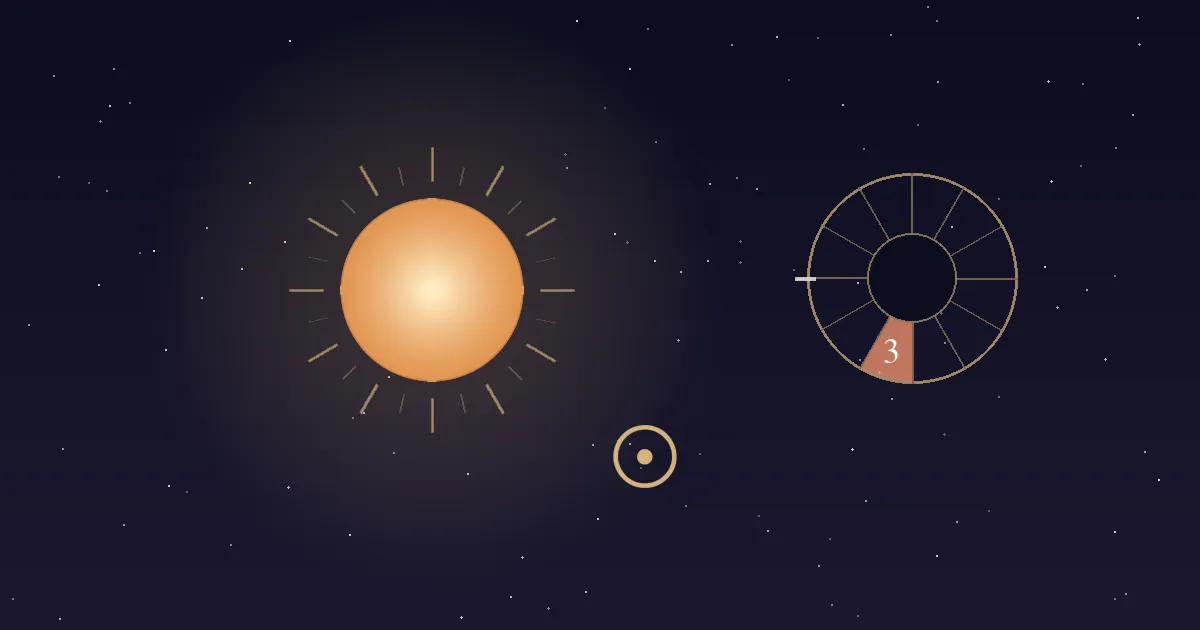
A cadent house, the Moon's joy, a strong spot in Vedic astrology: a 3rd-house Sun gets three different verdicts depending on who you read, and most summaries only hand you one of them. So was the good news or the bad news the real reading?
This page answers that from the texts the claims come from. It also uses the placement as a clock. In Placidus houses, a Sun in the 3rd means you were born in the first stretch of the night after solar midnight, and in our model of 2024 U.S. births only about 6% of babies arrived in that window.
Quick answer
The Sun in the 3rd house puts your sense of self into talking, learning, writing and the people you grew up beside. The Indian classics rate it well, and the "opposite its joy" worry misreads the Greek scheme. The real classical caution concerns elder siblings. On a Placidus chart it marks a birth soon after solar midnight.
| Arena | Siblings, neighbours, short trips, speech, writing, early schooling |
| House type | Cadent; the Moon's joy ("the Goddess") in the Hellenistic scheme |
| Vedic view | An upachaya (growth) house where the Sun does well; Brihat Jataka's translator: "The Sun is good in the 3rd" |
| The real caution | Elder siblings (Parashara 14.14); siblings in general (Saravali 30.4) |
| Time of birth (Placidus) | The first sixth of the night after solar midnight, roughly 12:45 to 2:45 a.m. on most U.S. clocks |
| Share of U.S. births | About 6% in 2024 (our estimate from CDC birth-time data) |
A 3rd-house Sun sits just past the bottom of the chart, and the line it crossed there moves with every few minutes of birth time. In our model, half of U.S. births fall within 30 minutes of a Sun house change, so check yours with the real time and place before you read on.
See whether your Sun is in the 3rd or the 4th →Is the 3rd a good house for the Sun?
Mostly yes, and the oldest Indian verdict is blunt about it. In V. Subrahmanya Sastri's translation of Brihat Jataka (XX.2), a 3rd-house Sun "will possess a good intellect and great strength", and the translator adds in his note: "The Sun is good in the 3rd." Saravali (30.4) calls the native "valorous, strong", "very learned" and someone who "will conquer his enemies". Phaladeepika (VIII.2) says "strong, brave, wealthy and liberal", then adds "but inimical towards his relations".
The reason is structural. Vedic astrology files the 3rd, 6th, 10th and 11th as upachaya houses, houses of growth, where a hot, forceful planet like the Sun is expected to improve with age and effort. That's why a placement Western sites call minor gets praised in Indian ones. The Western "minor house" label comes from a different idea, cadence: houses that fall away from the four angles were read as weaker for action. Both can be true at once. The 3rd won't put your name in lights the way a 10th-house Sun is said to, and it was never meant to.
The Goddess house, and why it isn't a demotion
The worry that bothers people most is a Hellenistic one. Each of the seven traditional planets had a "joy", a house where it was said to rejoice, and the Sun's is the 9th. Its opposite, the 3rd, is the Moon's. Vettius Valens uses the joys as chapter titles in his Anthologies (in Mark Riley's translation, II.8 is headed "The IX Place of the God Sun" and II.14 "The III Place. The Place of the Goddess Moon"), and Firmicus Maternus gives the same pair: the 3rd is Dea, the Goddess, and the 9th, diametrically opposite, is Deus. One caution before the quotes: these authors counted houses by whole signs, and Valens often counted his places from the Lot of Fortune, so their 3rd isn't always the Placidus 3rd your app shows.
Nothing in either text says the Sun suffers in the Moon's house. If anything the old authors gave the combination a religious turn. Valens says that if the Sun shares the 3rd with a Moon just past new, the native "will be a priest or priestess of the great goddess and will have an unsurpassable livelihood". Firmicus, in Book III of the Mathesis (Bram's 1975 translation), says a 3rd-house Sun in its own sign or a benefic's makes "pious worshippers of the gods" who build temples (III.5.15).
Firmicus is also the one place the bad reputation could come from, and it's worth quoting whole. III.5.14 opens: "The Sun in the third house indicates an evil death; it also makes the natives sickly, but respectable and serious in counsel." In the same breath he says they "will carry on public business, be administrators of states, or managers of the imperial treasury" when Jupiter and Mercury help, and that they "will marry and have children late in life". So the one harsh ancient verdict sits in a paragraph that also promises public office. It is a single author's mixed reading, not a tradition, and it says nothing about the joys. If you want the Moon's side of this house, the Moon in its joy in the 3rd has it, and the Sun's own good house is across the chart in the 9th, where the Sun rejoices.
Elder siblings, younger siblings and who gets noticed
This is the warning with real textual support, and it's narrower than most pages make it. In R. Santhanam's translation of the Brihat Parashara Hora Shastra, chapter 14 verse 14 reads: "The Sun in the 3rd will destroy the preborn." Santhanam's note adds that the sage Bhrigu says the Sun here "will not allow the native to retain his elder brothers". Saravali's version is broader, "will lose co-born", with no age attached. Firmicus has a related line that applies to the Sun on any angle, not the 3rd: it "weakens all older brothers or makes the native the first born" (III.5.11).
Read literally, that's a grim line about older brothers and sisters. We'd read it as a question about comparison: does growing up beside a sibling shape how you speak up and where you look for recognition? Think of the younger child who ends up the visible one, the sibling who sets the family's pace, or the only child who never had an elder to measure against. If you have healthy elder siblings, you're in good company. A one-planet rule was never how these texts expected a chart to be judged.
The modern 3rd also covers the siblings you choose, the neighbours and classmates of a childhood. A Sun here tends to want to be known among them, which is a different ambition from wanting to be known by strangers.
A night birth: the hours just after solar midnight
Here's what the chart quietly records. In Placidus houses the Sun's house is simply which sixth of the day or of the night you were born in. At solar midnight the Sun crosses the bottom of the chart, and for the next sixth of the night it sits in the 3rd, then the 2nd, then the 1st just before sunrise. At the equinoxes each sixth lasts two hours by the sundial. In winter the nights stretch and so does the 3rd; in June it shrinks.
We wanted to know what that means for real babies. The CDC's 2024 natality file records the clock time of every U.S. birth but not the town, so we simulated 400,000 births from its time-of-day pattern (by month, weekday and type of delivery), placed them by state birth totals and county population, and found the Sun's Placidus house for each with Swiss Ephemeris. In that model about 6% of 2024 births had the Sun in the 3rd, against 8.3% if births were spread evenly through the day. The middle 80% of them were born between about 12:45 and 2:45 a.m. by the clock. That clock time runs ahead of the Sun: daylight saving and time-zone edges put the typical U.S. clock about an hour ahead of solar time.
Two numbers from the same calculation say something about who these babies are. Only about 10% of 3rd-house Suns were born by a cesarean with no trial of labor, the birth-certificate category that's mostly planned deliveries, against 23% of all births, because those deliveries cluster in the morning. And 27% were born on a Saturday or Sunday, against 21% of all births. The small hours belong to labor that starts on its own schedule.
There's one more traditional consequence. With the Sun below the horizon you have a night chart, and in Hellenistic sect doctrine the Moon, not the Sun, leads a night chart. That fits a house the Greeks gave to the Goddess. On a whole-sign chart, which counts from the rising sign instead of the clock, the same birth can put the Sun in the 4th. The FAQ below has the numbers, and if yours moved, read why a 4th-house Sun gets called a late bloomer.
Talking, writing and the people you see every week
A 3rd-house Sun wants to be known for its ideas and for how well it explains them. The 3rd is the house of the near: the commute, the group chat, the cousin you text every day, the local paper, the class you're taking. A Sun here tends to build its identity in that ring of people and information rather than in grand public settings. Stephen Arroyo's rule for any Sun, in his Chart Interpretation Handbook (1989, p. 125), is that "whatever house the SUN is in, it is there that one most immediately experiences one's essential self". For the 3rd, that means thinking out loud, explaining things and being the person who knows how something works.
Alan Leo put the same idea in older language in How to Judge a Nativity (1928 printing, p. 161): the Sun here "bestows magnanimity of mind, with some pride", seeking "honour and fame through mental qualifications". Pride of mind is the shadow side. A 3rd-house Sun can treat a disagreement as a contest of who knows more, and it often needs to be heard before it can listen.
Compare the quieter version. Saturn in the 3rd is the person who says less than they know; the Sun is the one who says it, sometimes before checking.
At work the house splits three ways, and it helps to know which one you are. The teacher wants the other person to understand. The persuader wants them to agree, which points to sales, law and pitching. The reporter wants the story out first, which points to journalism, editing, podcasts and translation. All three run on pride in knowing, so the trap is the same: a 3rd-house Sun can mistake being right for being heard, and a job that rewards explaining things well for the hundredth time keeps that in check.
In love the reading is plain. A partner who can't hold a conversation won't last, and long silences tend to feel like distance even when nothing is wrong. Firmicus, for what it's worth, added that these natives "will marry and have children late in life" (III.5.14), the only marriage line in the old passages we read for this placement. A chart reading usually leaves the love question to the 7th house and Venus anyway; a 3rd-house Sun just wants the relationship to include a lot of talking.
The birth placement doesn't change, but the sky keeps moving across it. A free account lists today's transits to your natal planets.
Read today's transits to your natal planets →Transit note, October 2026
The Sun entered Libra on September 22, 2026 and moves into Scorpio on October 23, 2026 (US Eastern dates). In whole-sign houses that stretch puts the transiting Sun in the 3rd house for Leo risings. From October 23, 2026 until November 22, 2026 it is the turn of Virgo risings. Every rising sign gets about a month of the Sun in its 3rd house once a year, so this is a yearly season, not the birth placement this page is about. That one depends on the time of day you were born.
Born with the Sun in the 3rd: three rated charts
These birth times are rated AA (from a birth record) or A (from the person or family) at Astro-Databank, and we computed the Placidus houses ourselves with Swiss Ephemeris. Each Sun sits well inside the 3rd, at least 45 minutes of clock time from either edge. We're stating the placement, not claiming it made anyone who they are.
Paul Cézanne (AA, born 1:00 a.m. on January 19, 1839 in Aix-en-Provence) has the Sun at 28° Capricorn in the 3rd, and in the whole-sign 3rd as well. Stephen King (A, born 1:30 a.m. on September 21, 1947 in Portland, Maine) has the Sun at 27° Virgo in the 3rd on both systems, the house astrologers give to writing. Francis Ford Coppola (AA, born 1:38 a.m. on April 7, 1939 in Detroit) has the Sun at 16° Aries in the Placidus 3rd, but the whole-sign 4th, a good example of why the house system matters.
Notice the clock. All three were born between 1:00 and 1:40 in the morning, which is what the arithmetic above predicts.
When their Sun lands in your 3rd house
In synastry this is the overlay of easy conversation: the other person's Sun lights up your 3rd, so they're the one you talk to, swap links with and think more clearly around. It suits friendships, siblings and working pairs as well as couples, and it can feel more like a best friend than a grand romance. It's one overlay among many, so read it alongside the rest of the comparison, which the free synastry chart walkthrough lays out.
The Goddess side
The 3rd is the Moon's house of joy, and in a night chart the Moon leads. Find your Moon and rising signs from your birth date, time and place.
Find your Moon and rising signs →Keep reading
- · Stephen Arroyo argued that the sign carries the real energy and the house comes second. Our houses guide boils that down to signs as the how and houses as the where, then walks through all twelve.
- · Where does the Sun's house fit once the whole chart is open? A step-by-step method for reading a birth chart starts with the Big Three and brings in the houses at step three.
FAQ
Is the 3rd house a weak spot for the Sun because it sits opposite the Sun's joy?
Not in the texts that define the joys. Vettius Valens titles the 9th 'the place of the God Sun' and the 3rd 'the place of the Goddess Moon', so the 3rd belongs to the Moon's joy, not to a penalty for the Sun. Firmicus and the Indian classics judge a 3rd-house Sun on other grounds, and the Indian texts mostly rate it well.
Does the Sun in the 3rd house mean you will outshine your brothers and sisters?
The classical warning is narrower than rivalry. Parashara's line is about elder siblings (the Sun in the 3rd 'will destroy the preborn'), while Saravali just says 'will lose co-born' without naming an age. Neither text promises that you'll outshine anyone. We'd read it as a question about comparison: how growing up beside a brother or sister shaped the way you speak up and look for recognition. Plenty of people with this placement have no elder siblings at all.
Why do some charts put a 3rd-house Sun in the 4th house instead?
Because they count houses by whole signs. In our model of 2024 U.S. births, a Placidus 3rd-house Sun stays in the whole-sign 3rd only 46% of the time and lands in the whole-sign 4th 44% of the time. Neither chart is broken. Placidus follows the time of night; whole-sign counts signs from the rising sign, and the old authors quoted on this page used whole signs.