Birth Chart
Sun in the 2nd House: Why the Money Readings Never Quite Fit, What the Old Texts Actually Feared, and the Hour You Were Born
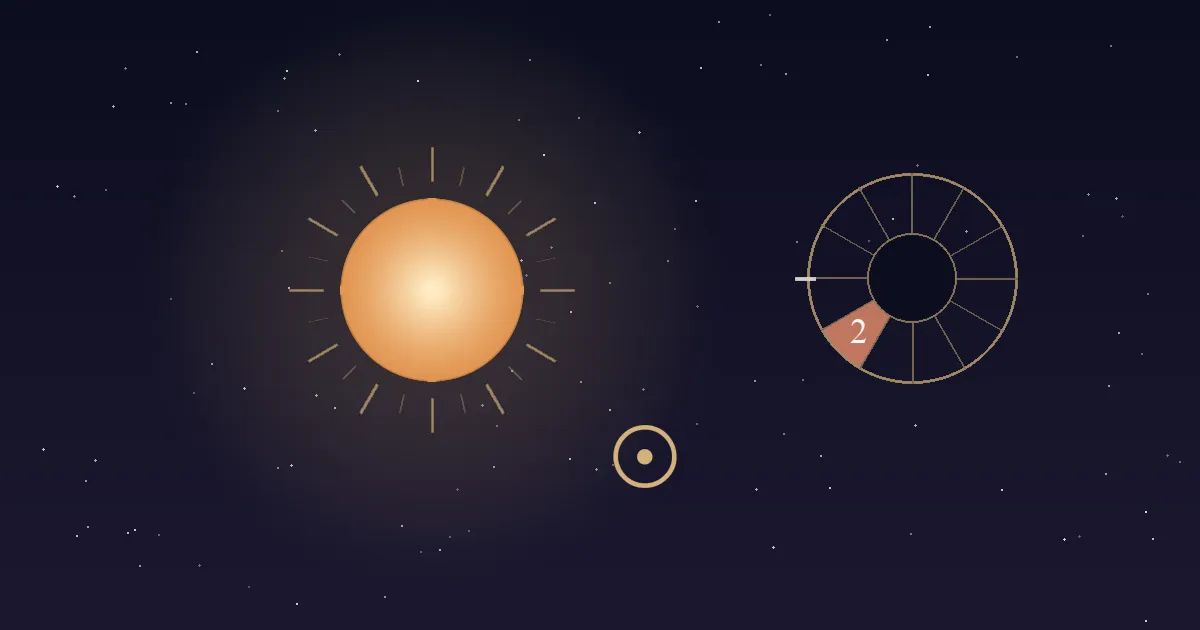
When we checked in October 2026, the top Google result for this placement wasn't an astrology site. It was a reader on Reddit saying their 2nd-house Sun description didn't fit them, because their life isn't about money. That confusion is a fair place to start. Most write-ups turn this house into a bank statement, and plenty of people with the placement don't recognise themselves in it.
In Placidus houses, the Sun's house also tells you which part of the night or day you were born in. A 2nd-house Sun means the small hours, with the Sun well below the horizon and dawn still a couple of hours away. And the old money verses, read in full, threaten loss from outside far more than bad habits.
Quick answer
In Placidus houses, a 2nd-house Sun means you were born deep in the night, roughly two to four hours before sunrise. The usual reading ties your sense of self to what you earn, own and value. The old texts linked it to money lost to outside forces, but they disagree on whether it makes you rich or poor.
| House type | Succedent, below the horizon: a night birth |
| Old names | "Gate of Hades" (Valens), "Gate of Hell" (Firmicus), one of the houses that don't see the Ascendant |
| Vedic reading | Wealth, family and the face; the Sun is the karaka (significator) of the father |
| Sundial time (Placidus) | About 2 to 4 a.m. at the equinoxes (local solar time) |
| U.S. births, 2024 | About 6%, most between 2:54 and 4:49 a.m. on the clock (our estimate from CDC data) |
The Sun crosses a whole house in about two hours, and in our model half of U.S. births fall within 30 minutes of a house change. If your chart came from a guessed or rounded birth time, the house may not be yours. Check it with the time on your birth certificate first.
Find your Sun's house in a free birth chart →Why so many 2nd-house Sun descriptions feel slightly off
The 2nd house has carried money for two thousand years, and the habit sticks. Robert Hand, in Horoscope Symbols (1981), says the old money-and-movable-property reading "works well enough in practical horoscope delineation, but it is clearly oriented toward fortunetelling," and reads the house more broadly as what you value and how you relate to what you own. Some people with this placement are careful savers. Others are fiercely loyal to a craft, a set of principles or a handful of objects, and money is just one of the things they measure themselves by.
Stephen Arroyo puts the general rule plainly in his Chart Interpretation Handbook (1989, p. 125): "Whatever house the SUN is in, it is there that one most immediately experiences one's essential self and creative essence." For the 2nd, that means your sense of self tends to run through tangible things: what you can make, earn, keep and stand behind. If the money line in your reading felt wrong, swap the word "money" for "what I'd defend as mine" and read it again.
The money fear, read in the old texts
The worry isn't invented. The ancient authors gave this house grim names. Vettius Valens calls it "the Gate of Hades" and says "in this Place the benefics do no good" (Anthologies II.15, Riley translation). Firmicus Maternus calls it the Gate of Hell and puts it among four houses he treats as feeble because they don't aspect the Ascendant (Mathesis II.17). On the Sun itself, though, Firmicus is milder than his house name: "The Sun in the second house will make the natives seek a livelihood through their own efforts. They will be agreeable and respectable throughout their lives," before adding that they'll be "anxious and fearful" all their lives (III.5.12, Bram's 1975 translation).
The Indian classics are harsher, and they contradict each other. Brihat Jataka (XX.1) says the native will be "immensely rich but will be deprived of his wealth by a king." Phaladeepika (VIII.2) says "devoid of learning, modesty and riches." Saravali (30.3) has money lost "through royal displeasure, or through thieves." Read side by side, the loss mostly comes from outside: a ruler, the state, a thief. These texts describe bad luck with authorities more than a person who can't manage a budget.
The most useful verse turns the whole question on one condition. In the chapter on combinations for poverty, the Brihat Parashara Hora Shastra (ch. 42, vv. 16 to 18, Santhanam translation) says: "The Sun in the 2nd in aspect to Saturn will cause penury while the Sun so placed if be not aspected by Saturn will give riches and fame." So the same text that's quoted as a warning also promises riches and fame, depending on a single aspect. Whatever your Vedic reading says, it shouldn't rest on the house alone. The Sun's sign matters too: Ptolemy has it exalted in Aries and in its fall in Libra, and it rules Leo. One more caution: all of these authors counted houses by whole signs, and Valens reads much of his Gate of Hades chapter through the Lot of Fortune and its ruler, so none of them was describing a modern Placidus 2nd.
Born in the small hours: what the 2nd house says about your birth time
In Placidus houses, the system most Western apps use, the Sun's house tells you which sixth of the day or night you were born in. The night after sunset is cut into six equal parts, the 6th, 5th and 4th houses before solar midnight and the 3rd, 2nd and 1st after it. The 2nd is the middle of those last three: the stretch of night that ends about one sixth of the night before sunrise. At the equinoxes, every house is two hours long, so by sundial time the 2nd runs from about 2 to 4 a.m. In June at New York's latitude a night house shrinks to about an hour and a half; in December it stretches to about two and a half.
Clocks muddy this. Most Americans live west of their time zone's meridian, and daylight time adds another hour for most of the year, so a clock rule like "2 to 4 a.m. means the 2nd" is right for only about half of U.S. births. The house belongs to sundial time, so the exact answer needs your birth time and birthplace.
To see how many people that covers, we simulated 400,000 births from the CDC's 2024 natality data, which records the clock time of every birth but not the place. We spread them across the country by state birth totals and county population, then found each Sun's Placidus house with Swiss Ephemeris. In that model about 6% of American babies born in 2024 had the Sun in the 2nd house, against 8.3% if birth times were spread evenly. That makes it the least common Sun house in our estimate, narrowly: the 1st and 3rd sat at about 6.3%. Most 2nd-house Sun babies were born between 2:54 and 4:49 a.m. on the clock. Part of the reason is that planned deliveries rarely happen in the small hours: only about 9.5% of 2nd-house Sun births were cesareans with no trial of labor (the birth-certificate category that mostly means a planned delivery), against 23% of all births.
Two more patterns stood out. More than a quarter of 2nd-house Sun babies (27%) were born on a Saturday or Sunday, against 21% of all births, probably because weekends have fewer scheduled deliveries while spontaneous labor keeps its own hours. And season matters: 4.8% of June and July births had a 2nd-house Sun, against 7.3% in December and January, when the nights are long. An hour or so later, and you'd be reading about a 1st-house Sun that gets called confident and often feels watched. An hour or two earlier puts the Sun in the 3rd, the house Hellenistic astrologers called Goddess.
A tight month for money often lines up with a particular transit. A free account shows today's transits as aspects to the planets in your birth chart.
Compare today's sky with your chart →Pride, earning and the feeling of never having enough
One Reddit poster with a Virgo Sun in the 2nd summed up the modern version: however much they build, they don't feel secure. Read astrologically, that's the Sun doing its job in this house: if you measure yourself by what you've saved, even a healthy balance can feel disappointing. That's a different problem from being short of money, and a raise rarely fixes it.
The flattering side is real too. People with this placement often take quiet pride in paying their own way, in knowing what things are worth and in owning a few good things for a long time. Firmicus's "seek a livelihood through their own efforts" fits that well. A useful test: when a month goes badly, does it feel like a bad month or a verdict on you?
At work, this reading favors jobs where what you make or know has a clear price: a trade, a business of your own, valuation, finance, anything that pays for skill you can point to. In love, the same placement tends to want a partner who respects what you've built and talks about money plainly, early. Arguments with this Sun in the 2nd are often about spending and security, and they go better when you name the number instead of the feeling. Vedic astrology also reads the 2nd as speech and family wealth, so some Vedic readings add a forceful way of speaking and a strong pull toward the family's money.
If the never-enough feeling is the part you recognise, compare Saturn in the 2nd, the placement most tied to feeling short with enough in the bank. A 2nd-house Moon turns buying into comfort when you're low. The 2nd also sits opposite the 8th, other people's money, and what modern astrologers read in an 8th-house Sun is the shared-money side of the same axis.
Four rated charts with the Sun in the 2nd
All four times are rated AA (from a birth record) at Astro-Databank, and the Placidus houses come from our own Swiss Ephemeris run. Each Sun below stays in the 2nd even if the recorded time is off by 40 minutes or more. These are placements, nothing more; they don't explain anyone's life.
Leonardo DiCaprio (AA, birth certificate) was born at 2:47 a.m. in Los Angeles. His Sun at 18°40' Scorpio is in the 2nd in both Placidus and whole-sign houses. Simone de Beauvoir (AA) was entered in the Paris register at "quatre heures et demie du matin", half past four in the morning, which puts her Sun at 17°31' Capricorn in the 2nd in both systems. Charles de Gaulle (AA, birth certificate) was born at 4:00 a.m. in Lille, with his Sun at 29°50' Scorpio in the 2nd.
George Clooney (AA) shows how much the house system matters. Born at 2:58 a.m. in Lexington, Kentucky, he has the Sun at 15°33' Taurus in the Placidus 2nd, but whole-sign houses put it in the 3rd. All four births fall between about 2:45 and 4:30 in the morning by the clock, which is the pattern the geometry predicts.
Placidus 2nd, whole-sign 3rd: checking which house you have
In whole-sign houses the Sun's house is just the count of signs from your rising sign to your Sun sign. A whole-sign 2nd-house Sun means the sign rising was the one before your Sun sign. Across U.S. births in 2024, a Placidus 2nd-house Sun was in the whole-sign 2nd 48% of the time and the whole-sign 3rd 45% of the time, so with this placement the rising sign is usually one or two signs behind the Sun sign. If you've seen both numbers in different apps, both can be correctly calculated; they measure different things.
Transit note, October 2026
The Sun entered Libra on September 22, 2026 and moves into Scorpio on October 23, 2026 (US Eastern dates). In whole-sign houses that stretch puts the transiting Sun in the 2nd house for Virgo risings. From October 23, 2026 until November 22, 2026 it is the turn of Libra risings. Every rising sign gets about a month of the Sun in its 2nd house once a year, so this is a yearly season, not the birth placement this page is about. That one depends on the time of day you were born.
When two apps disagree about your Sun's house, the house system is almost always why, and our birth chart guide makes the case for picking one system and sticking with it.
When someone's Sun lands in your 2nd house
In synastry, another person's Sun in your 2nd house is read as them shining a light on what you value and what you own. It can feel steadying, someone who makes your money or your skills seem more real, and some astrologers warn it can also feel possessive, as if your things became partly theirs. Talk about money early with that person; the overlay can't tell you whether your habits match.
Your rising sign decides the count
The whole-sign house of your Sun depends on your rising sign. The free lookup gives your Sun, Moon and rising in one go.
Get your Sun, Moon and rising →Keep reading
- · The benefic in the same house, and the attracting-versus-keeping question: Venus in the 2nd, and whether it makes anyone rich.
- · For the sign the Sun rules, and why a Leo Sun reads louder in any house: the Leo profile.
- · Money is one of twelve life areas in the chart, and a tour of all twelve houses covers the other eleven.
FAQ
Why do I never feel financially secure with the Sun in the 2nd house?
Astrologers read the Sun's house as the place where you look for proof of who you are, so with the Sun in the 2nd the proof tends to be material: savings, skills you can sell, things you've bought with your own money. If the balance is standing in for self-worth, even a healthy one can feel thin. The old texts add a different worry, loss from outside (a ruler, the state, thieves), which is about bad luck, not about how you handle money. Naming what the balance is standing in for usually helps more than a bigger number.
Does the Sun in the 2nd house tie your pride to what you earn?
Often, in modern readings. The Sun describes identity, and the 2nd describes what you own and what you value, so the usual picture is someone who takes pride in being self-supporting and in owning good things. Firmicus said much the same in the fourth century: these natives seek a livelihood through their own efforts. The risk is a bad month at work starting to feel like a verdict on you as a person, and it helps to say out loud that those are two different things.
What does the Sun in the 2nd house say about money from your father's side?
In <em>How to Judge a Nativity</em> (1928 printing), Alan Leo linked the Sun as a significator of money to money from the father or his side of the family, from superiors and from official posts. Vedic astrology also reads the 2nd as family wealth. Treat both as an astrological theme to look at, not a forecast of an inheritance. A birth chart can't tell you what anyone will leave you.