Birth Chart
North Node in the 2nd House: How It Shows Up, Starting With Money You Earn Yourself
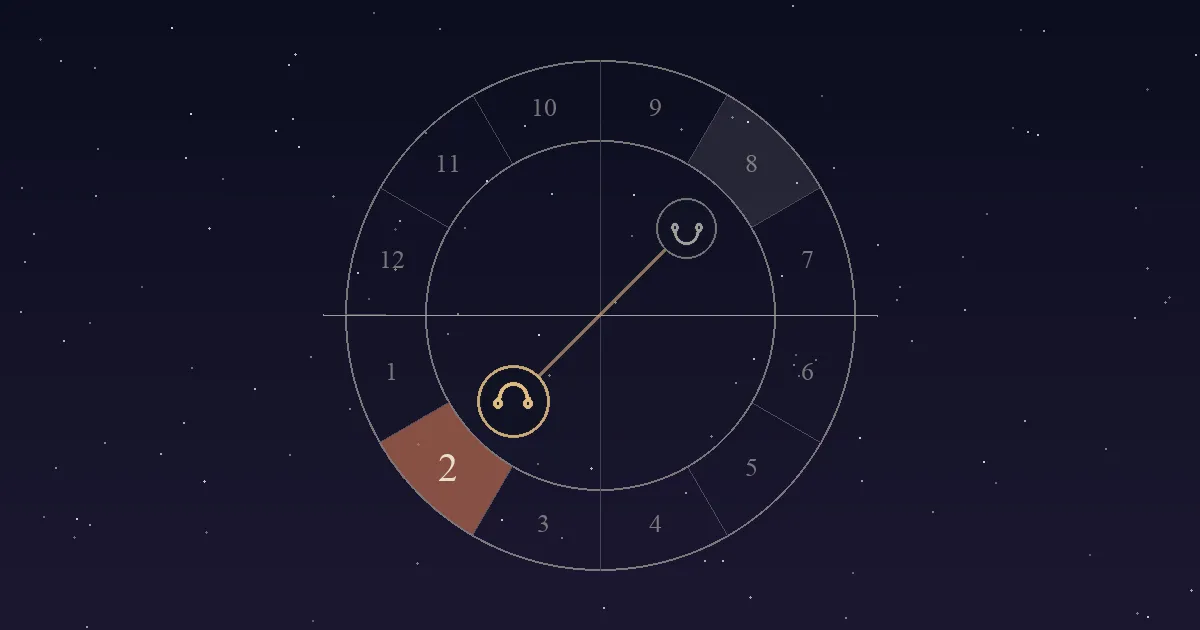
What does this placement look like in an ordinary week? In modern astrology it's about building your own income, skills and judgment. That can mean learning to name your price, or deciding what matters to you without waiting for someone else's approval. The old books said less about it than people assume, and most of what they did say concerns the other end of the axis.
It comes down to whose money and whose judgment you lean on. The 2nd house holds what you earn, own and can do with your own hands. Its partner across the chart, the 8th, holds money and power that reach you through other people. With the North Node in the 2nd, astrologers read the 2nd as the direction to grow in and the 8th as the comfortable habit.
Quick answer
With the North Node in the 2nd house, astrologers read growth as coming from earning, owning and valuing things on your own terms. In practice it comes down to ownership: is the income, the skill or the savings in your name, or does your security rest on someone else's? The reading is about self-reliance. It doesn't predict your bank balance.
| North Node house | 2nd: earned income, possessions, skills, self-worth |
| South Node house | 8th: shared money, debt, legacies, intimacy |
| Natural sign of the house | Taurus |
| How often | About 1 in 12 modeled U.S. births, like every other house |
| Source most pages miss | An 1886 footnote by W. C. Eldon Serjeant: with the Tail in the 8th, the Head sits in "the 2nd House (that of wealth)", so the native's own money is little harmed |
| Traditional line on this axis | Bonatti: the Tail in the 8th brings "increase of the native's" estate, at an opponent's expense in a lawsuit |
The turning sky carries a point through the 2nd house in about two hours on average and then across the 2nd-house cusp into the 1st, so the clock matters more than the calendar here. In our modeled births, a recorded time 30 minutes off put the North Node in a different Placidus house about 1 time in 4. A date one day off, at the same clock time, did it about 3% of the time. Check the house on a chart cast from your recorded birth time.
See which house holds your North Node →How does a 2nd-house North Node actually show up?
Mostly as a choice that keeps coming back between two kinds of security. One is something you built: a wage, a skill people pay for, savings, a thing you bought and kept. The other comes from someone else, like a partner's salary, a parent's help, a loan, the group's budget, or simply another person's opinion of what you're worth. A North Node in the 2nd is read as a steady push toward the first, especially at the moments when the second would be easier.
Say you're choosing between two jobs. One has the bigger title. The other has a smaller title and a client list that would follow you if you left. The 2nd-house reading would have you weigh the client list closely, since you built it and it leaves with you. The title alone doesn't tell you which job gives you more independence. The same logic covers setting a price for your work instead of waiting for an offer, or opening an account in your own name after years of a joint one. Values belong to the 2nd as well: what you enjoy, what you're willing to pay for, and what you'd keep without needing everyone else to approve. Martin Schulman, whose 1975 book Karmic Astrology reads the nodes house by house, put it in one line. The person "cannot expect to grow through other people's efforts for if he wishes to cross the bridge, he must pay the toll out of his own pocket" (Vol. 1, p. 67).
None of that says how much money will come. Two old texts quoted further down do predict gains, but an old prediction is not evidence that it will happen. The modern reading is about who controls the work. You might earn less after changing jobs and have more say over your hours and clients. Our guide to what each of the twelve houses covers sets the 2nd beside the rest of the wheel.
Money you earn versus money you share
The axis is easiest to see as two kinds of money. 2nd-house money has your name on it: pay, fees, what you sell, what you own outright. 8th-house money passes through a relationship, such as a spouse's income, a joint account, debt, tax, insurance, an inheritance or an investor's cash. Neither kind is better. They feel different, because 8th-house money always comes with someone else's terms attached.
With the North Node in the 2nd, the reading is that the second kind comes naturally and the first takes deliberate work. Someone might run a company's budget with ease and still freeze when asked for their own rate. Someone else might marry into comfort and find, years later, that they want a paycheck of their own. A cushion of your own is less common than it sounds, too. The Federal Reserve's survey of household finances found that in 2025, 63% of adults would cover a surprise $400 expense with cash, savings or a card paid off at the next statement, down from 68% in 2021 (Economic Well-Being of U.S. Households in 2025). That figure covers all adults, whatever their charts. In the 2nd-house reading, a reserve like that is the lesson in its most concrete form.
Does that mean turning down help? No. The reading asks that your security not rest only on someone else's terms. A joint account can stay joint while you keep an income, a skill or some savings in your own name, and you can still talk openly with a partner about who pays for what. Modern astrologers pair the 2nd house with Taurus and often borrow that sign's pace as well: patience, physical comfort, and the ability to enjoy a quiet stretch without stirring up the kind of intensity the 8th supplies.
The values side matters as much as the cash. Here it starts with a plain question: what is an hour of your time worth, and what are you willing to spend it on? If the nodes are new to you, start with what the North Node means in a chart.
Quoting a new rate or weighing a big purchase this week? A free ZodiScope account lists today's transit aspects to the planets in your birth chart.
See today's transits to your birth chart →The South Node in the 8th house: a talent for other people's resources
Modern astrologers read the South Node as the habit you lean on too heavily, and with a 2nd-house North Node it sits in the 8th. There that means being good with other people's money and other people's moods: managing, merging, reading what a partner needs, knowing where the power sits in a room. Those are real abilities. The trouble starts when they replace building anything of your own, so that feeling secure always depends on staying close to whoever holds the purse.
Guido Bonatti's reading of this half of the axis is about money, and it's a kind one. His 111th Consideration, in Henry Coley's translation, says that if the Dragon's Tail "be in the eighth it denotes the decay and loss of their estate or substance, and increase of the native's" (The Astrologer's Guide, 1886 reprint, pp. 47–48). "Their" means the native's opponents. Bonatti was writing about lawsuits, so the gain is a gain against rivals. The 1886 editor, W. C. Eldon Serjeant, added a footnote that reads the axis directly: with the Tail in the 8th, "the Querent or Native has the Dragon's Head in the 2nd House (that of wealth) and therefore but little damage could accrue to the Querent or Native through loss of his or her actual personal money" (pp. 61–62). That's the editor talking, not Bonatti, but it names the 2nd as the house of wealth and says outright that the Head sits there.
William Lilly worked one example from this side. In a sample nativity in Christian Astrology (1647, Book III, the chapter "Of Marriage"), he finds the South Node in the 8th along with a weak ruler of that house, and warns that people who owe money to the native's wives "shall endeavour either upon pretences to keep it back." It's one chart, but it shows how the old rule worked: the Tail's house is where things leak, and with the Tail in the 8th the leak is in money that comes through a partner. The opposite placement raises a different worry, whether an 8th-house node predicts death, and the page on the 8th-house North Node and the old death question checks it against the texts.
Schulman's warning and the Vedic verse on wealth through a ruler
Serjeant's footnote is the only traditional Western line we found on the Head itself in the 2nd. The North Node by house, read as a life direction, is a 20th-century idea, and Schulman's book is the house-by-house version this page draws on. His 2nd-house chapter carries a warning worth keeping: "that which is dishonorably obtained is highly difficult to preserve" (p. 67). He frames the axis in past lives. Leave that framing out and the direction is still plain: away from living off what others hold and toward "establishing his own value systems."
Vedic astrology calls the North Node Rahu and reads it far more darkly. Mantreswara's Phaladeepika, the one classic we found that gives Rahu in all twelve houses, says a person with Rahu in the 2nd will be dubious or insincere in speech, will suffer disease in the mouth or face, and "will be tender-hearted, will get wealth through his sovereign, will be wrathful and happy" (VIII.25, V. Subrahmanya Sastri's translation, 1950, p. 94). The verse predicts wealth through a sovereign and also trouble with speech, but it doesn't say one causes the other. The Brihat Parashara Hora Shastra points the other way, and only when three things line up: Rahu in the 2nd, Mars in the 11th, and the rulers of the 2nd and 11th in the 6th, 8th or 12th. Then "the native will lose his wealth on account of royal punishments" (ch. 13 v. 8, Santhanam's translation), which Santhanam puts in modern terms as fines and penalties from the government. Rahu in the 2nd alone doesn't meet that rule.
The small-hours gap: why the Sun rarely joins it here
A 2nd-house North Node turned up in about 1 birth in 12 in our model, the same as every other house. The model is 400,000 simulated U.S. births from 1960 to 2024, built from CDC birth-time data and spread across U.S. counties; none of them are real birth records. Busy and quiet birth hours don't pile the node into any one house, because it can sit in any sign at any hour. The Sun is different, because its Placidus house is a time of day, and the 2nd is the small hours, roughly 2 to 4 a.m. by sundial time. There's more on birth timing and the Sun in the 2nd on its own page.
Among modeled births with the North Node in the 2nd, only 6.4% also had the Sun there, the lowest of all twelve houses. Across the whole model, the Sun and the North Node shared a house in 9.1%. The Sun sat within 10 degrees of a 2nd-house North Node in 4.3%, also the lowest. In the model the cause is the birth clock: few U.S. babies are born in the small hours. We applied the 2024 CDC hour-of-day pattern to every year from 1960, so treat these as figures for the modern birth timetable.
Why look at it at all? A Sun close to either node marks a birth in eclipse season, since eclipses happen only when the Sun is near the nodes, and many astrologers read a Sun on the North Node as identity and growth direction pulling the same way. In the 2nd house that pairing is unusually rare. Robert De Niro has it. Born at 3:00 a.m. in Brooklyn, he has the Sun at 23°30′ Leo in the 2nd, about 8 degrees from his North Node and close to the line with the 3rd house.
De Niro, Mitchell and Wood: one house, two node signs
All three birth times carry an AA or A rating from Astro-Databank. The 2nd holds in Placidus and in whole sign, with the true node and the mean node, and with the time moved 15 minutes either way. The charts illustrate the placement; they don't describe what it did in anyone's life.
- Natalie Wood, actress (birth certificate on file at Astro-Databank, Rodden AA): born 11:16 a.m., July 20, 1938, San Francisco. North Node at 24°43′ Scorpio in the 2nd.
- Robert De Niro, actor (Astro-Databank rating A): born 3:00 a.m., August 17, 1943, Brooklyn. North Node at 15°56′ Leo in the 2nd, with the Sun in the same house.
- Joni Mitchell, singer-songwriter (rating A): born 10:00 p.m., November 7, 1943, Fort Macleod, Alberta. North Node at 11°12′ Leo in the 2nd.
De Niro and Mitchell were born less than three months apart, inside the same Leo stretch of the node, yet one arrived before dawn and the other late in the evening. Both have Cancer rising. A given sign rises about four minutes earlier each day, so the sign rising around 3 a.m. in mid-August is rising by late evening in early November, and the node lands in the same house. Wood's chart makes a different point. Modern astrology links the 2nd with Taurus, which makes the house and the sign easy to blur, and a Taurus North Node has its own page. Wood's node sits in Scorpio, the sign opposite Taurus, and it's still in the 2nd. Sign and house are separate settings.
Is it really the 2nd? Whole sign and the true node
The house system changes this placement more often than people expect. In our modeled births, a Placidus 2nd-house North Node kept the same house number in whole-sign houses 47.5% of the time, and in 45.3% the whole-sign chart moved it on to the 3rd. In whole-sign houses the rule is simple: a 2nd-house North Node is in the sign right after your rising sign, as with De Niro and Mitchell's Leo node behind a Cancer Ascendant.
The node itself has two versions. ZodiScope uses the true node, which wobbles around the smoothed mean node but never gets more than about 2 degrees from it. In our model the two fell in different houses in only about 3% of charts. So if two apps disagree about your 2nd-house node, the house system is the usual reason, not the node.
When the moving North Node crosses your 2nd
The moving North Node travels backward through the zodiac, and in whole-sign houses it spends about a year and a half in each house of your chart once every 18.6 years. Astrologers read its pass through the 2nd as a time to sort out income and what you own, and the node's run through Aquarius has its own page.
Transit note, October 2026
The transiting North Node has been in Aquarius since July 26, 2026 and moves on into Capricorn on March 26, 2028 (US Eastern dates). In whole-sign houses that puts it in the 2nd house for Capricorn risings, with the South Node in their 8th. From March 26, 2028 the same transit passes to Sagittarius risings. Each rising sign gets about a year and a half of this once every 18.6 years. It is a passing transit, not the birth placement this page is about.
Which sign is your node in?
You've checked the house. The sign is the other half of the reading, and astrologers read a Leo node in the 2nd differently from a Scorpio one. The free North Node calculator finds the sign from your birth date, plus your birth time if you were born on a day the node changed sign.
Look up your North Node sign →Keep reading
- · Spending when you're upset, and the old split verdict on wealth: Moon in the 2nd house.
- · Good at attracting money, worse at keeping it? Venus in the 2nd house takes that problem apart.
- · Earning big and netting ordinary, plus the grim old name of the money house: Jupiter in the 2nd house.
FAQ
Does a North Node in the 2nd house mean I'll end up wealthy?
Two old texts do predict a gain, each with strings attached. The Phaladeepika gives Rahu in the 2nd 'wealth through his sovereign' in the same verse as trouble with speech, and Bonatti's Consideration 111 gives the native an increase of estate at an opponent's expense in a dispute. The Brihat Parashara Hora Shastra, on the other hand, puts Rahu in the 2nd inside a wealth-loss combination when two other conditions are met. An old prediction is not evidence that it will happen. Modern astrologers read the placement as learning to earn and value things yourself, which says nothing about the size of the account.
Why does leaning on a partner's money feel easier with a 2nd-house North Node?
Because the South Node sits in the 8th, the house of shared and borrowed resources, and the South Node is read as the familiar groove. Being good at merged finances, or at sensing what the person with the money wants, is a real skill. The reading only flags it when it stands in for building anything of your own. The usual modern advice is a small, concrete step, like an account or an income in your own name.
Does a 2nd-house North Node point to a particular line of work?
Not to one job. The house is about earning through your own skills and owning the results, so astrologers tend to see it in work where you can put a price on what you do: a trade, a craft, freelancing, sales, a small business, or any role where your own output is easy to see. The placement doesn't name a profession, and a fuller career reading also looks at the 6th and 10th houses. A salaried job fits too, once you know the going rate for your work and ask for it.
Why is it so rare to have the Sun and the North Node together in the 2nd house?
The Sun's house follows the time of day, and a 2nd-house Sun means a birth in the small hours, roughly 2 to 4 a.m. by sundial time. Few U.S. babies are born then. In our model of 400,000 simulated U.S. births from 1960 to 2024, only 6.4% of 2nd-house North Nodes had the Sun in the same house, and 4.3% had it within 10 degrees of the node, both the lowest of the twelve houses. The node itself lands in the 2nd about as often as in any other house.