Birth Chart
North Node in the 8th House: What the Old Texts Say About Death, and Where the Money Comes In
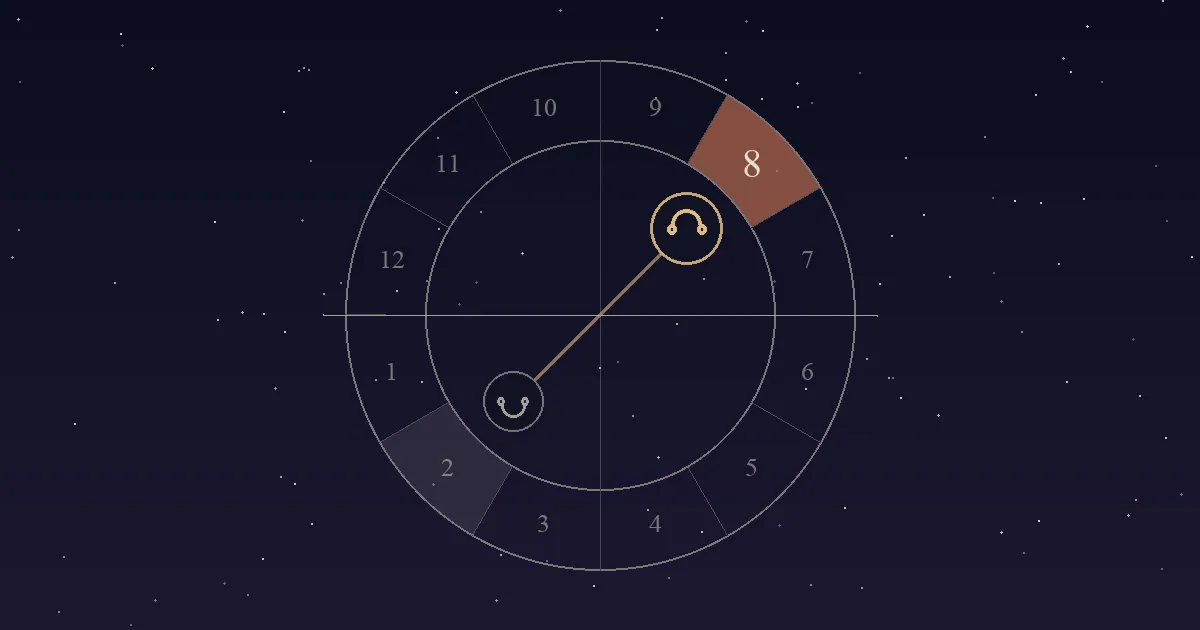
The 8th is the old house of death, so the first thing many people want to know about a North Node here is whether it predicts one. The Western texts don't make it a sign of early death. One Vedic verse does, and another Vedic rule says malefics do well in the 8th.
The 8th is also the house of other people's money: a spouse's income, debt, investment, legacies. Modern readings put the North Node's lesson there, in shared resources, intimacy and accepting help. The clearest financial warnings in the old books concern the South Node opposite it, in the 2nd.
Quick answer
Astrologers read a North Node in the 8th house as growth through shared money, trust and depth with other people: joint finances, investment, intimacy, letting someone else carry part of the load. The South Node sits in the 2nd, where the habit is holding tight to what's yours. The Western texts don't make it a death sign.
| North Node house | 8th: shared money, debt, investment, intimacy, legacies |
| South Node house | 2nd: your own money, possessions, self-worth |
| Natural sign of the house | Scorpio |
| Our data point | Among modeled births with an 8th-house North Node, the Sun is within 10 degrees of the South Node in 4.3%, the lowest of the twelve houses |
| Old reading of the other end | The Tail in the 2nd: money trouble in four old sources; Lilly blames "the Querent's owne folly" |
| A death sign? | Not in the Western texts; one Vedic verse says "short-lived", another gives a favorable general rule for malefics in the 8th |
An 8th-house node on a chart cast for the wrong time can easily turn out to be a 7th or a 9th. In our modeled births, a recorded time an hour off put the North Node in a different Placidus house about half the time, and even 15 minutes off did it about 1 time in 8. A wrong date at the same clock time mattered far less, because the node itself barely moves in a day.
Find the house your North Node really sits in →Does a North Node in the 8th house mean death?
Not in the Western tradition. None of the Western texts we read, from al-Biruni in 1029 to William Lilly in 1647 to Martin Schulman in 1975, treats the North Node in the 8th as a death sign, and Ptolemy doesn't place the nodes in houses at all. Lilly's verdict on the Dragon's Head was that "I ever found the ☊ equivalent to either of the Fortunes" (the two benefics, Jupiter and Venus), and that joined with the malefics it would "lessen their malevolent signification" (Christian Astrology, 1647, p. 83). If anything, the old Western view puts a helpful point in a hard house.
The fear has two other roots. One is the house. The 8th meant death and the estates of the dead in the old texts, so every planet placed there gets asked the question; Saturn's 8th-house page weighs the same early-death worry for a planet the old books really did fear. The other root is Vedic, where the North Node is called Rahu. Mantreswara's Phaladeepika says that "if Rahu occupy the 8th house, the person born will be short-lived" (VIII.26, V. Subrahmanya Sastri's translation, 1950, p. 95). That's one verse in one tradition, and an old prediction is not evidence of what will happen. The tradition also argues with itself: the Saravali's general rule is that "Malefics are auspicious in evil Houses, i.e. 6th, 8th and 12th" (30.86–87), and Vedic astrology counts Rahu as a malefic. al-Biruni had already spotted the deeper split in 1029. He reported that "many astrologers" called the ascending node "warm and beneficent" (Book of Instruction, §383), and then that "according to the Hindus" it was "in general maleficent" (§384).
Which planet in the 8th brings sudden death is a question people put to every 8th-house placement. Our model can't answer it either way: it counted how often the placement occurs, not how anyone's life ended. What the old Western rules do give this axis is a money reading, and it sits at the other end.
Money that comes through other people
The 8th is the house of money with someone else's name on it as well as yours: a spouse's income, joint accounts, loans and debt, tax, insurance, investors, legacies. Modern astrologers read an 8th-house North Node as learning to share that ground well. That means merging resources without losing track of them and accepting help or capital. A joint account means another person's choices can affect your money, and the modern reading asks how you handle that dependence and what terms you agree to. This placement doesn't promise a wealthy spouse. In a modern reading it might mean learning to sign a joint lease, take an investor's money or ask for a loan while keeping a say in the terms.
Schulman's chapter in Karmic Astrology (Vol. 1, 1975) is blunt about what resisting costs. Until the shift is made, he says, the person "can expect his current life to be one financial tug of war after another," and the lesson is "that possessions are for the purpose of use" (p. 85). He gives the upside too: once the person stops letting their energy scatter, they "can become a veritable dynamo in the business world." Schulman frames all of it as karma carried over from past lives. You can use his account to look at your own money habits without accepting that explanation.
Inheritance is part of the 8th house's general territory, but the node texts quoted on this page don't tie it to the North Node. Read the placement as the house where shared money is the lesson, and leave a windfall out of the forecast. Our rundown of all twelve houses shows how far the 8th reaches beyond death and money, and the main North Node guide explains what the two nodes are.
Planning a shared lease or a loan? A free account shows today's transit aspects to your natal planets.
Check today's transits to your natal planets →The South Node in the 2nd house: what the old books say about losing money
The old astrologers said more about the Dragon's Tail in the 2nd than about anything else on this axis, and with a North Node in the 8th, the Tail always sits there. All four sources below tie it to loss or lack of money, and two of them, Lilly and Cardan, blame the person's own folly or neglect.
- Lilly: "if he be in the second, he denotes consumption of Estate by the Querent's owne folly or not thriving, by his owne proper neglect" (Christian Astrology, Book II, pp. 172–173). This sits in a horary chapter, about questions put to an astrologer, so Lilly wrote it for questions, not birth charts.
- Guido Bonatti, Consideration 139, which he applies "both in Nativities and Questions": the Tail "in the 2nd, destruction, and loss of money and substance" (Henry Coley's translation, The Astrologer's Guide, 1886 reprint, p. 61).
- Cardan, in the aphorisms printed in the same volume: "the Dragon's Tail in the Second, signifies that the Native shall squander away his substance or Estate foolishly" (no. 26, pp. 78–79).
- The Phaladeepika, from the Indian side, on Ketu (the South Node) in the 2nd: it "makes the native devoid of learning and riches" (VIII.28, p. 96).
Modern astrologers keep the house and soften the verdict. They read the South Node in the 2nd as a strong attachment to what's yours: your money, your things, your way of doing it, your sense of being self-made. Schulman's line for this axis is that the person's karma "is to overcome the extreme possessiveness of his past incarnations" (p. 82). Both men describe money trouble: Lilly predicts "consumption of Estate", and Schulman's "financial tug of war" is a struggle over it. There's no sign Schulman was reading Lilly. The opposite placement has the reverse problem, building money of your own, covered on the page for the North Node in the 2nd and learning to name your price.
Trust, intimacy and the fear of losing what you have
Why does fear of loss loom so large with this placement? The South Node in the 2nd prizes holding on, and the 8th asks for the reverse: letting other people close enough to affect your money, body and plans. Intimacy is part of the 8th's modern meaning, and modern karmic writers make it central to this placement, though the traditional node sources say nothing about it.
A practical version looks like this. Before moving in with a partner, you tell them the real number on your debt, agree on who pays which bills, and keep the right to say no to a purchase you don't want. That's trust with terms, and it's what the modern reading asks for. It doesn't ask you to give up your own account or your own judgment. The 2nd-house skills stay useful; they just stop being the only safety you allow. It also means accepting that a partner may value money differently, and letting that change your view now and then.
The same goes for accepting care when you're ill, or letting yourself grieve a loss instead of buying something to fill the gap. Schulman gives the placement both possibilities: it "can regenerate or degenerate the individual" (p. 85). His wording doesn't say which one a given person will get. Modern astrologers often compare the 8th house with Scorpio, but a Scorpio North Node is a separate placement, and how astrologers interpret a Scorpio North Node has its own page. Not sure of your node sign? A date-only node lookup usually settles it, and a birth time covers the days the node changes sign.
A small-hours number: the Sun rarely sits on the South Node here
Our model holds 400,000 simulated U.S. births from 1960 to 2024, built from CDC birth-time data and spread across U.S. counties; none of them are real birth records. In it, the North Node landed in the 8th in about 1 birth in 12, the same as every other house. The node moves too slowly to follow the daily clock, so the busy birth hours don't crowd it into any one house. The Sun's house is tied to the hour, so a Sun within 10 degrees of a 2nd-house South Node favors early-morning births, when the Sun is in or close to the 2nd. Few U.S. babies are born in those hours. So among 8th-house North Nodes, the Sun was within 10 degrees of the South Node in only 4.3% of modeled births, the lowest of any house, against 5.9% across all twelve.
Measured the same way, the other end of the axis is more common: the Sun sat within 10 degrees of an 8th-house North Node in 6.7% of these births. That combination favors afternoon births, and afternoons are much busier for births than the early morning. Counted by house instead, the Sun shared the 8th with the North Node in 10.8%. The model applies the 2024 hour-of-day pattern to every year, so both figures reflect today's birth timetable. Births with the Sun near either node are eclipse-season births, which is why astrologers single them out.
Diane Keaton comes close to the rare case. Born at 2:49 a.m. in Los Angeles, she has the Sun in the 2nd house along with her South Node, but 14.6 degrees apart, just outside the 10-degree orb we used.
An 8th-house North Node needn't be in Scorpio
The node is in the 8th in each chart below by every test we ran: Placidus or whole sign, true node or mean node, and a birth time moved 15 minutes either way. Treat them as examples of the placement in well-timed charts, nothing more.
- Gisele Bündchen, model (birth certificate quoted at Astro-Databank, Rodden AA): born 5:00 p.m., July 20, 1980, Três de Maio, Brazil. North Node at 20°25′ Leo in the 8th.
- Diane Keaton, actress (AA; the certificate is hard to read, and the 2:49, 2:52 and 2:59 a.m. readings all give the 8th): born January 5, 1946, Los Angeles. North Node at 29°57′ Gemini in the 8th.
- Barbara Walters, TV journalist (Astro-Databank rating A, time from her in an interview): born 6:50 a.m., September 25, 1929, Boston. North Node at 12°54′ Taurus in the 8th.
- Mark Wahlberg, actor (AA): born 7:15 a.m., June 5, 1971, Boston. North Node at 16°43′ Aquarius in the 8th.
- George Washington, first U.S. president (AA): born 10:00 a.m., February 22, 1732, Westmoreland County, Virginia. North Node at 26°47′ Sagittarius in the 8th.
Not one of these nodes is in Scorpio, the sign modern astrology pairs with the 8th: the birth date usually settles the sign, and the time and place settle the house. Keaton's true node sits at 29°57′ Gemini, a few arcminutes from Cancer, and her mean node is at 29°14′ Gemini, so both versions keep it in Gemini and in the 8th. ZodiScope uses the true node. It never strays more than about 2 degrees from the mean node, and in our model the two gave different houses in only about 3% of charts. Placidus and whole sign are a bigger source of disagreement, putting the North Node in different houses in 53% of the births we modeled.
The transit, and a short note on synastry
The moving North Node travels backward through the signs, and in whole-sign houses it spends about a year and a half in each house of your chart once every 18.6 years. There's a separate page on Aquarius node transits by house.
Transit note, October 2026
The transiting North Node has been in Aquarius since July 26, 2026 and moves on into Capricorn on March 26, 2028 (US Eastern dates). In whole-sign houses that puts it in the 8th house for Cancer risings, with the South Node in their 2nd. From March 26, 2028 the same transit passes to Gemini risings. Each rising sign gets about a year and a half of this once every 18.6 years. It is a passing transit, not the birth placement this page is about.
A partner's North Node in your 8th house is a different placement. That's synastry, a comparison of two birth charts, and astrologers read the overlay as a bond that pulls both people toward trust and shared resources. It needs your accurate birth time and place, since your houses are the frame; the other person's node needs only a birth date unless it falls near one of your cusps. Your own 8th-house node doesn't name a partner. How a synastry overlay is read takes it from there.
Start with the signs
Before any house overlay, there's the sign-level match. Enter two birth dates and compare Sun, Mercury, Venus and Mars signs, with no birth time or account needed.
Compare two birth dates →Keep reading
- · Fears about mothers, death and psychic gifts, each answered: Moon in the 8th house.
- · Joint accounts, debts and the fine print of a shared life: Venus in the 8th house.
- · Inheritance luck or a life of crises, and the scale of the money people inherit: Jupiter in the 8th house.
FAQ
Does a North Node in the 8th house mean an early death?
Not in the Western tradition. Al-Biruni, Lilly and Martin Schulman never treat the North Node in the 8th as a death sign, and Lilly counted the Dragon's Head among the fortunes. The worry comes from the 8th house's old link with death and from one Vedic verse, the Phaladeepika's 'short-lived' for Rahu in the 8th. The Saravali's general rule says malefics are auspicious in the 8th, so the Vedic texts don't agree with each other. An old verse is not evidence about anyone's lifespan, and our birth model measured how often the placement occurs, not how long anyone lived.
Will a North Node in the 8th house bring money through marriage or inheritance?
The node texts don't promise it. Shared money, a spouse's income, debt and legacies all belong to the 8th house in general, so astrologers read this node as learning to handle money that involves other people. That can mean a joint account, a business partner's investment or a loan as easily as an inheritance. The old texts that discuss money on this axis talk about the South Node in the 2nd and describe financial loss, which Lilly and Cardan blame on the person's own folly or neglect. None of them promises a windfall from someone else.
Why does fear of loss come up so often with a North Node in the 8th house?
Because the South Node sits in the 2nd, the house of what's yours, and the South Node is read as the place you hold on to. The 8th asks for the opposite: letting other people close enough to affect your money, plans and feelings. That trade can feel like risk, so the fear is part of the pattern astrologers describe. Schulman called the lesson learning 'that possessions are for the purpose of use'.
Did the old astrologers say the South Node in the 2nd loses money?
Yes, and they said more about that than about anything else on this axis. With a North Node in the 8th the Dragon's Tail always sits in the 2nd, and Lilly, Bonatti, Cardan and the Phaladeepika all tie it to loss or lack of money, with Lilly and Cardan blaming the person's own folly or neglect. Lilly's line comes from a chapter on horary questions, not birth charts. These are traditional predictions, not findings about anyone's finances. Modern astrologers soften the verdict and read the 2nd-house side as a strong attachment to what's yours: your money, your things, your sense of being self-made.