Birth Chart
Moon in the 2nd House: When Money Is a Mood
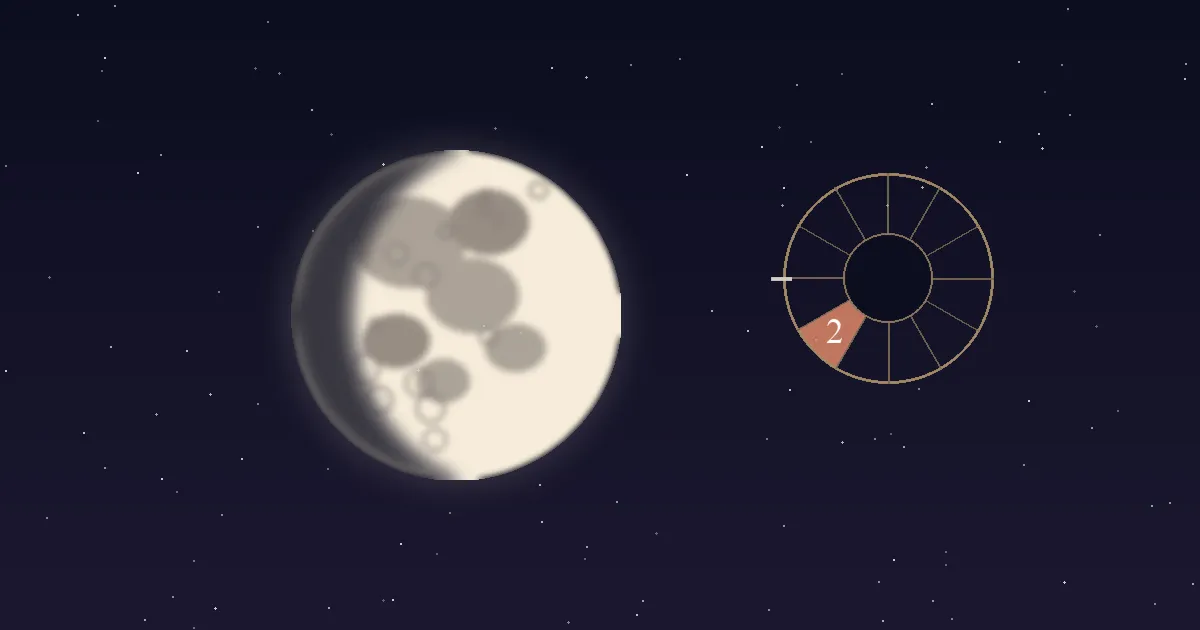
Some people's bank balance is a spreadsheet. For a Moon in the 2nd house it's a mood ring. Money in, money out, and how safe you feel are one system with this placement, which is why the searches around it split between "does it give wealth" and a much quieter question people type at midnight: why do I buy things when I'm sad?
Both questions get real answers here, along with what the money-and-mood link actually does to a life, and how the earliest surviving delineation of this placement split its verdict clean down the middle depending on whether you were born by day or by night. If houses are new territory, start with the twelve houses explained and come back.
Quick answer
Moon in the 2nd house links emotional security to money and possessions. Income tends to fluctuate rather than hold steady, spending follows feeling, and material comfort genuinely soothes. The placement favors gains that build gradually, especially through food, home, care, and public-facing work. Security is the need underneath every money decision.
| Arena | Succedent 2nd house: income, possessions, self-worth |
| Money pattern | Wave-shaped income, mood-linked spending, gradual accumulation |
| Comfort wiring | Buying and feeding as emotional regulation |
| Natural-sign echo | Taurus turf, where the Moon is exalted; see the steady Taurus Moon |
| Old-text verdict | Firmicus: generous by night, harsh by day (details below) |
| Watch for | Comfort purchases doing a feeling's job |
House placements need an exact birth time; a date alone can't produce them. The free birth chart calculator places every planet in its house on a real chart wheel in about a minute.
See which house your Moon is in →The three signatures of a 2nd-house Moon
The 2nd house holds what you own and what you earn: income, possessions, and by modern extension the sense of self-worth that sits underneath both. The Moon is the fastest-moving body in the chart and the symbol of needs, care, and fluctuation. Where she lands is where life refuses to hold still, and here that means the material layer. Money arrives in tides with this placement: a strong quarter, a thin one, a windfall, a dry spell. People with steady salaries still feel the tide as swings in how secure the same number feels from week to week.
The second signature is that possessions carry feeling. A 2nd-house Moon's belongings are not inventory, they're memory storage: the mug that must not break, the jacket that holds a whole year in it, the childhood object that will never be thrown out. Decluttering advice bounces off this placement because for them an object genuinely is the feeling it's attached to.
And the third: tradition assigns the Moon the caretaking trades (feeding people, housing people, tending people, facing the public), and astrologers read a 2nd-house Moon as earning most naturally through them. If your paycheck comes from making people feel looked after, your Moon is on the clock.
Emotional spending: the pattern nobody prices in
Here's the placement's real story, the one that shapes daily life more than any wealth prediction. When feeling low, a 2nd-house Moon reaches for the material lever: the online order, the nicer groceries, the small luxury that says you're safe, you're cared for. It works, briefly, which is the problem. Soothing that costs money teaches the budget to absorb your bad weeks.
Psychology has an interesting footnote for this placement. Across seven studies, Carter and Gilovich (2012) found that experiential purchases sit closer to people's sense of self than material ones: experiences show up in life stories and feel more like "the true self" than objects do. The study wasn't about astrology or emotional spending, but it hands this placement a genuinely useful correction: if what you're hunting is self (being fed, held, at home in the world), objects are the weaker store for it than the experiences this Moon tends to skip as unjustifiable.
The working fix is boring and effective: name the mood before the purchase, delay it a day, and keep a stocked list of free comforts that suit your Moon sign specifically. A Cancer Moon in its home sign needs the blanket and the group chat; a Sagittarius Moon needs to get out of the house. Sign-accurate soothing is cheaper than retail-accurate soothing.
The wealth question, with the fourth-century split verdict
Firmicus Maternus's Mathesis, the fourth-century Latin manual whose Moon-in-houses chapter survives, gives this placement two opposite readings and lets your birth hour pick between them. Born at night: the Moon in the 2nd "will make the native famous and involved in well-known activities," and "they gain a greater income over a period of time" (Bram translation). Born by day, the same placement "diminishes the inheritance in various kinds of loss." One house, two verdicts, and the hinge is sect, the day/night distinction modern astrology mostly forgot.
Filter out the ancient fatalism and a durable shape remains: this placement's money grows over a period of time. Not the lottery placement, not the salary-ladder placement, but the compounding one: savings that build because comfort demands a cushion, a side income from a care skill, the slow conversion of "I need to feel safe" into actual assets. The failure mode is the same curve inverted, where every dip in mood becomes a dip in the balance.
For scale, the Federal Reserve's latest Survey of Consumer Finances puts median U.S. family net worth at $192,900. Whether a 2nd-house Moon lands above or below that line is decided by income, geography, and luck far more than by the Moon. What the Moon decides is the texture: how the number feels, how it moves, and what you do at 11pm when it feels too small.
Roughly two days a month, the transiting Moon crosses your 2nd house, and many people with this placement can find their spending spikes on a calendar. ZodiScope shows the live Moon moving through your houses, so the pattern stops being invisible.
Track the Moon through your chart →Food, comfort, and the body
The 2nd follows the 1st the way your possessions follow your person, and the Moon rules nourishment. The combination makes food a load-bearing comfort for this placement: cooking as decompression, feeding people as love, eating as the fastest route back to feeling okay. None of that is pathology. It becomes a problem only when it's the only route, which is the same single-lever trap as the spending pattern, wearing an apron.
Underneath both runs self-worth, the 2nd house's modern layer. With the Moon here, net worth and self-worth correlate more tightly than is comfortable: flush months feel like being a better person, thin months feel like a character flaw. Worth untangling once, deliberately, because the correlation is an artifact of the placement, not a fact about you. The person is not the balance. Your chart just files them in the same drawer.
The sign changes the currency
What "security" means here is set by the Moon's sign. A few worked contrasts rather than a full tour:
- Taurus Moon in the 2nd: the placement's showcase. The Moon is exalted in the 2nd house's own natural sign, so the security drive gets patience and follow-through. Slowest to spend emotionally, best at actually building the cushion.
- Gemini Moon in the 2nd: security through options. Multiple income streams, money apps, a spreadsheet that soothes. The fluctuation is loudest here because novelty itself gets bought.
- Depth-seeking Scorpio Moon in the 2nd: money is privacy. Hidden savings, undisclosed accounts, an emergency fund nobody knows exists. Feels safest when nobody can see the number, whatever the number is.
- Sponge-like Pisces Moon in the 2nd: the porous wallet. Generous past its means when moved, vague about where it all went. Needs automated savings precisely because the feelings can't be trusted with the transfer button.
The other eight run on the same logic, each sign a different definition of "enough." The sign-by-sign Moon guide has all twelve styles, and the Moon sign lookup below finds yours from birth details if you don't know it.
Reading it against the neighbors
Placements sharpen by contrast. A 2nd-house Venus enjoys money; the Moon needs it, which is a different relationship entirely. Jupiter in the 2nd house expands the earning and the leaking at once; the Moon just makes both tidal. Old readings of the Sun in the money house worried about money taken by rulers or thieves, a different concern from the Moon's need to feel secure. And directly across the wheel sits the 8th house, other people's money, where this placement's opposite number lives: a Moon in the 8th feels safest inside merged resources, while the 2nd-house Moon needs assets with its own name on them. If your birth time puts your Moon near the boundary of the 1st, the 1st-house Moon page covers that cusp honestly.
What counts as enough for your Moon
The sign sets the currency of a 2nd-house Moon. Enter your birth date, time and place to see your Moon sign next to your Sun and rising, free.
Look up your Moon with your Sun and rising →Keep reading
- · The other money mood: a 2nd-house Mars spends on impulse where this Moon spends for comfort.
FAQ
Does Moon in the 2nd house give wealth?
It describes how money moves through your life, not how much of it there will be. The signature is fluctuation: income that arrives in waves, spending that tracks mood, and material comfort that matters more to your wellbeing than it does for most people. Firmicus Maternus's fourth-century reading gives the generous version (gains that build over time) specifically to night births; his day-chart verdict runs the other way. For an actual wealth verdict, astrologers weigh the 2nd-house ruler, the Moon's sign and aspects, and Jupiter's condition together, never one placement alone.
Why do I spend money when I'm upset if my Moon is in the 2nd house?
Because this placement wires spending into the comfort system. The 2nd house governs possessions and material security; the Moon is the need for soothing. Put together, buying something becomes a fast way to change how you feel, which works for an evening and compounds into a pattern. The practical fix isn't shame, it's substitution and delay: keep a list of non-purchase comforts that actually work on your Moon sign, and give any emotional purchase a 24-hour cooling period. The urge usually passes with the mood that raised it.
What does Moon in the 2nd house mean for a woman?
The searches ask this constantly because Vedic sites read the Moon partly as a significator of women and family life, and some promise wealth through marriage or the mother's line for women with this placement. Western astrology reads the placement the same way for everyone: security feelings anchor to money and possessions, income tends to fluctuate, and the mother's relationship with money often leaves a visible imprint on how you save and spend. Whatever your gender, the useful question is whose money habits you inherited, because with the Moon here you almost certainly inherited someone's.
Is the Moon strong or weak in the 2nd house?
House strength and sign dignity are separate dials. By the common house-type scheme the 2nd is succedent, the middle tier: steadier than a cadent placement, less commanding than an angular one. The Moon has no essential debility here, and a 2nd-house Moon that happens to fall in Taurus (the sign of the Moon's exaltation) is widely counted among the placement's best versions, since the dignity and the house's money themes then pull in the same direction. Strength in practice depends on the Moon's sign, phase, and aspects, which a full chart shows in one look.