Birth Chart
Mars in the 11th House: The Friend Who Takes Over, and Why "Good Placement" Doesn't Feel Like It
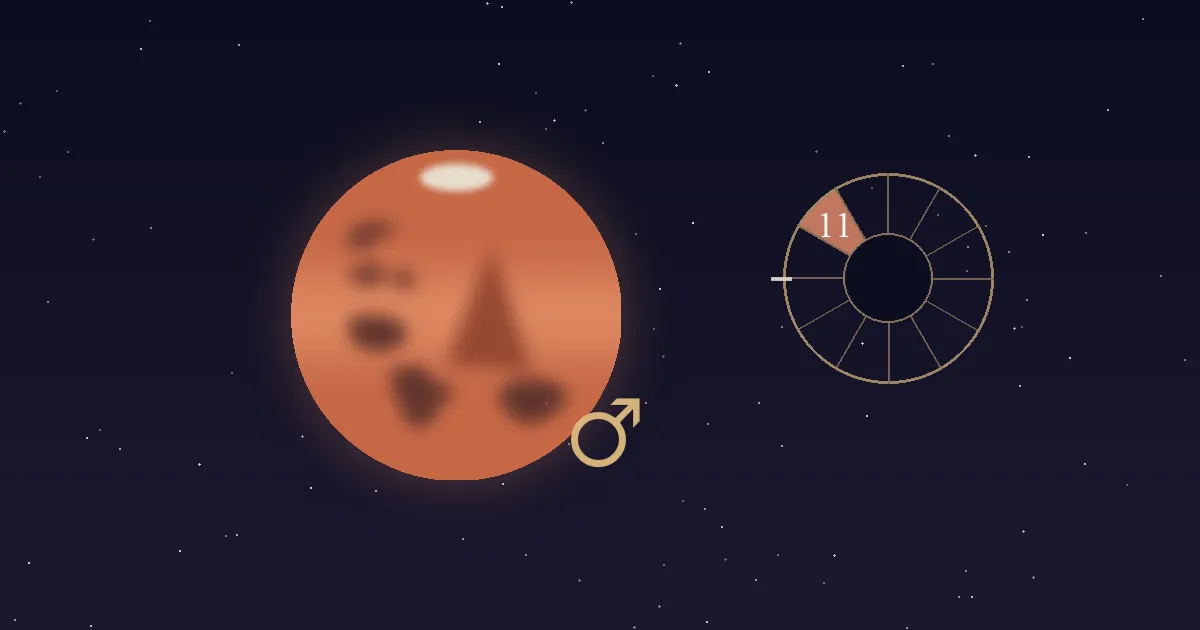
You know this person. They joined the group chat and within a month they were running it. They turned the book club into a schedule, the friends' trip into an itinerary, the neighborhood complaint into a petition with their name at the top. Everyone is grateful and a little tired.
From the inside it's stranger. Every textbook and every Vedic guide calls this one of the better places for Mars: gains, popularity, goals achieved. And yet a forum thread on the placement that is still getting replies after five years opens with a person asking why it feels unlucky when every description says it's good. That gap is what this page is about.
Quick answer
Mars in the 11th house puts your drive into friends, groups, causes, and long-range goals. You lead the collective, compete inside it, and reach what you aim for, then aim again. The tradition rates it favorable: Firmicus promised income and popularity. The cost is fallouts, because Mars gains by fighting. It is not on the Vedic manglik list.
| Arena | Succedent 11th house: friends, groups, allies, causes, hopes, gains |
| Fighting style | Organized and collective; the drive recruits, then commands |
| Ancient name | Valens: the Good Daimon, where a malefic "cannot do any evil" |
| Firmicus's verdict | "Many good things: increase in income and popularity"; no day/night split |
| Vedic note | Labha, the house of gains; an upachaya house where Mars improves with age |
| The dissonance | "The books say good, I don't feel it": answered below |
The 11th shares a cusp with the 10th, and a rounded clock time can put Mars in the 10th (career) or the 12th (the hidden house), which read nothing alike.
Check 10th, 11th or 12th, free →The friend who takes over: what this Mars does in a room full of equals
The 11th is the house of people who are neither family nor rivals nor lovers: friends, colleagues, allies, the audience, the movement. Mars is the planet that wants to win. Put them together and the drive attaches to the collective. It gives more to the group than anyone else does (the energy, the organizing, the willingness to send the awkward email), and it needs the group to notice. The Tumblr observation lists that rank for this placement say these natives "gain a lot of energy from time spent with friends" and "thrive when they know they are actively being compared to other people." Same trait, two angles. The friend group is where the drive lives, so the friend group is where the scoreboard is.
At its best this is the organizer every group needs and rarely thanks, the one who turns a complaint into a campaign. One AstrologyWeekly reply puts the type in a line: Mars here "is usually a person that is against the system and wants to stand up for people that need help." Causes suit this placement better than clubs, because a cause gives the fight a direction that isn't a friend's face.
At its worst it's the fallout. Mars gains things by fighting for them, and inside a friendship a fight has no referee. So the pattern this placement knows too well: the group you built turns on you, or you turn on it, over a decision that in hindsight didn't matter. The same Tumblr list notes these natives "rarely divulge their depth and vulnerability," which is the other half of the problem. A friend who competes with you and never shows you the soft part is a rival with a nicer name. The people who age well with this Mars learn to let one or two friends off the scoreboard entirely, and it is the hardest thing the placement asks. The house across the wheel, Mars in the 5th house, runs the drive through romance and play, which is where the difference between "friends" and "lovers" turns out to be who you're allowed to compete with.
"Increase in income and popularity": what the tradition actually promised
Nearly every Mars-in-house entry in the old books comes with a threat attached. This one doesn't. Firmicus Maternus (Mathesis III.4, around 334 CE, in Bram's 1975 translation) opens the 11th-house entry with: "Mars in the eleventh house indicates many good things: increase in income and popularity with the people." That's the whole base reading, and it's unusual for him to give Mars no day-versus-night split, which he does for nine of the other eleven houses. He adds one technical route to the very top: "Often he bestows the marks of highest office if, while he is thus located with the waning Moon, Jupiter is in trine aspect or in conjunction with them. In that case the indication is for judges with the power of life and death." Judges: the 11th's Mars gets its authority from the community, and the community hands it a gavel.
Two centuries earlier, Vettius Valens named this place the Good Daimon and wrote in the Anthologies that "if malefics are in conjunction with the Good Daimon, they cannot do any evil" (Riley's translation). That is the important line for a Mars reader: one of the few houses where the ancient tradition says the malefic is disarmed rather than merely tolerated. Lilly, in 1647, gave Mars no line here at all and simply noted that "Jupiter doth especially rejoyce in this House," which is the joys doctrine: the 11th is Jupiter's joy, the way the 6th is Mars's. So Mars here is a guest in Jupiter's room, and Lilly's line says nothing about Mars, and that silence is its own verdict from a man who had warnings for Mars in the 1st, 7th and 9th. If you have a strong Jupiter as well, Jupiter in the 11th house owns this room; Mars is a tenant with good references.
The Vedic tradition agrees from a different direction. The 11th is labha, the house of gains, and Vedic pages lead this placement with "wealth gains" and "ambition." It's also an upachaya house, one of the four where a malefic planet's results improve as the native ages. The tradition doesn't say Mars here is easy at twenty. It says the return comes later, and that matters for the next section. The house is not on the manglik list in any version of that doctrine, so no marriage-matching worry attaches to this placement.
Transit note, September 2026
Transiting Mars is in Cancer from August 11, 2026 until September 28, 2026. In whole-sign houses that is the 11th house for Virgo risings, who get a live preview of what this natal placement feels like for about six weeks. When Mars moves on into Leo, the 11th-house transit passes to Libra risings. If your chart uses Placidus, the timing can differ by a week or two either side; the free birth chart prints your Placidus cusps so you can check.
Transiting Mars crosses your 11th house for about six weeks every two years, and this placement feels it as the month the group project either launches or blows up. ZodiScope's live overlay puts the dates on your own chart.
See Mars crossing your houses →"Every book says it's good. I don't feel it." The dissonance, answered
A 2021 AstrologyWeekly thread on this placement, still collecting replies, opens with a poster asking whether Mars in the 11th is "an unlucky placement in natal chart," adding that they'd "read many descriptions where it was mentioned as quite good placement, but honestly... I rarely feel that" (thread, 2021 onward). The replies run the whole spectrum: "There is no such thing as any planet being unlucky in any house"; another citing a belief that Mars here has "a bad effect on the health and emotional state"; and the one that is actually right, that "any planet in any house is supportive or undermining depending upon the ASPECTS it makes."
The textbooks describe outcomes, and Firmicus wasn't wrong about them. But Mars gets things by pushing, and in the 11th the person you push past is usually a friend. Get the promotion in the 10th and your rivals were rivals anyway. Get your way in the 11th and the fallout has a face you know. The books print the gains. "I don't feel it" is the reader reporting the cost. And the Vedic upachaya rule is the other half of the answer: this house pays late. The friend who was pushed at twenty-five is, in the reports people give, often the one who calls first at forty, once the drive has learned where to point.
The 11th is the friendship house, and friendship in America is in measurable decline. The Survey Center on American Life's 2021 study found that 12% of Americans report having no close friends, up from 3% in 1990, while only 13% have ten or more. A planet that runs on the group has less group to run on than it did forty years ago. That isn't a cause of loneliness. It's a reason this placement notices it. The Moon in the 11th house page takes the same statistic personally, from the feeling side. Mars takes it as a recruitment problem.
Three charts with recorded birth times, including one schism
The famous names passed around for this placement mostly have no recorded birth time. These three are rated AA or A on Astro-Databank (certificate on file, or time from the person or family), computed in Placidus with Swiss Ephemeris, each with Mars at least four degrees from the nearest cusp.
- Sigmund Freud (6 May 1856, 18:30, Příbor; AA): Mars at 3° Libra, its detriment, in the 11th. He founded the Wednesday Psychological Society, the circle that became the psychoanalytic movement, and then lived through its schisms as Adler and Jung broke away. A group built by one person's drive, and then the fallouts, is this placement's biography in one life. In whole-sign his Mars moves to the 12th, the house of hidden things, which is a decent description of the unconscious too.
- Oprah Winfrey (29 January 1954, 04:30, Kosciusko; A): Mars at 23° Scorpio, its own sign, in the 11th. The audience as an army: the book club, the network, the "you get a car" studio. Firmicus's "popularity with the people" line has rarely had a cleaner illustration. Also a 12th-house Mars in whole-sign.
- Dolly Parton (19 January 1946, 20:25, Sevierville; AA): Mars at 20° Cancer in the 11th, retrograde (she was born inside the December 1945 to February 1946 loop), and Placidus and whole-sign agree. The Imagination Library, which mails free books to children, is the collective-cause reading, drive spent on a group that will never be able to compete back. Mars in Cancer, its fall, is the gentle version of this house, and it's the one whose cause outlived every fallout.
The rejections: Jimi Hendrix circulates as an 11th-house Mars and his AA time puts Mars 0.7° before the 11th cusp, in the 10th; Paul McCartney, Roger Federer and Mitt Romney all compute to the 11th but sit 1.9°, 1.6° and 2.1° from a cusp, which is inside the error of a rounded birth time, so none is claimed here. Freud and Winfrey make the broader point: Mars lands in a different house under Placidus than under whole sign in a little over half of charts, on a 20,000-birth simulation we ran for this series. If you've been told two different houses by two apps, that offset is the reason, and the chart here prints the system it used next to the result.
Their Mars in your 11th: the friend who pushes you
When someone's Mars falls in your 11th house, they push you toward your goals and into your social life. This is the friend who signs you up for the race, the partner who makes you go to the party, the colleague who volunteers you for the committee you secretly wanted. It reads as a friendship overlay even inside a romance, which is why couples with this placement between them often describe each other as "my best friend" first and mean it.
The way it sours is the fallout pattern the natal placement knows: their drive in your friendship house can mean fights over your friends, competition with your circle, or the sense that they've taken over a part of your life that used to be yours. In a composite chart the same house reads as a couple whose shared identity is a project or a cause, and who fight when the project stalls.
The sign sets the volume
- · Aquarius, the 11th's own sign, so sign and house pull the same way: the organizer of organizers, detached in method and fierce about the cause, who reverses course abruptly when a rule stops making sense.
- · Aries or Scorpio, Mars at home: the version that takes over the room by the second meeting; Aries by speed, Scorpio by outlasting everyone.
- · Capricorn, Mars exalted: the treasurer who becomes the chair, drive with a plan and a long horizon, cold when a goal isn't worth the climb.
- · Libra, Mars in detriment: the organizer who can't stop negotiating the rules of the group, which is a fair sketch of Freud and the committees that left him.
- · Taurus, the other detriment: slow to join, immovable once in, the member who outlasts three leadership changes.
- · Cancer, Mars in fall: the quieter organizer who leads by doing everyone's share; Parton is the example above.
Where this Mars competes with a friend, Venus in the 11th house falls in love with one, and the Moon's version is the person who can't feel a thing until the group is in the room.
Which Mars is running the group?
Every line on this page gets louder or quieter with the sign. The dated table shows every window Mars spent in yours, back to 1930.
Check your Mars sign and its dated table →Keep reading
- · The same argument, one to one instead of in front of the group: Mars in the 3rd house.
- · When a cause hardens into a creed: Mars in the 9th house.
- · Freud's own Mars sign, the detriment that organises rather than charges: Mars in Libra.
- · Where the anger goes once the group is gone: Mars in the 12th house.
FAQ
Why does Mars in the 11th house feel unlucky when every book calls it good?
Run the chart-condition checklist before deciding the books lied. Sect first: a day birth makes Mars the harsher planet in the chart, so the fallouts run hotter than the gains. Sign second: Libra, Taurus or Cancer here frustrate the drive, while Aries, Scorpio or Capricorn deliver the textbook. Aspects third: a square from Saturn reads as blocked goals and lost friends, a trine from Jupiter reads as the promised income. And one more: the books describe the outcomes, and the outcomes tend to arrive late in this house. If the goals are landing and the friendships aren't, the placement is working as written, and the missing piece is what you do with the people you outran.
Does Mars in the 11th house turn friendships into competitions?
Often, and the person with the placement usually enjoys it more than their friends do. Two things keep it healthy. Give the competition an arena that isn't the friendship itself: a sport, a shared project, a fundraising target, somewhere with a finish line and a referee. And say the contest out loud; a rivalry both people have named is a game, and one only you know about is a grievance waiting to happen. The friends who stay are the ones who can take a challenge without hearing an attack, and this placement finds out which ones those are early.
What does Firmicus mean by 'increase in income and popularity' for Mars in the 11th house?
Two things, and they're worth separating. 'Income' in a fourth-century Roman manual meant what the community gave you rather than a salary, so the modern reading is money that arrives through people: the referral, the venture built with friends, the audience that turns into a business. 'Popularity with the people' is the older sense of being known and liked by the crowd rather than by the powerful, which is why the placement suits organizers and performers better than courtiers. Neither promise is unconditional in the way a summary makes it sound: Firmicus attaches his highest honors to a specific configuration, and every reading in his book assumes the rest of the chart cooperates.
Is Mars in the 11th house bad for elder siblings?
The claim comes from Vedic astrology, where the 11th house signifies the elder sibling and Mars in it is read as rivalry or friction with them. Blog snippets say these natives 'compete with their elder siblings,' and that is the honest size of it: competition, not harm. The 11th is also an upachaya house in that system, one of the places where a malefic's results improve with age, so the sibling rivalry that ran hot at fifteen usually settles into something warmer by thirty-five. Western astrology has no elder-sibling reading for this house at all, and Lilly's houses chapter gives Mars no line here.