Lunar Cycles
Full Moon May 2026: The Rare Double Moon — Scorpio Flower Moon & Sagittarius Blue Moon
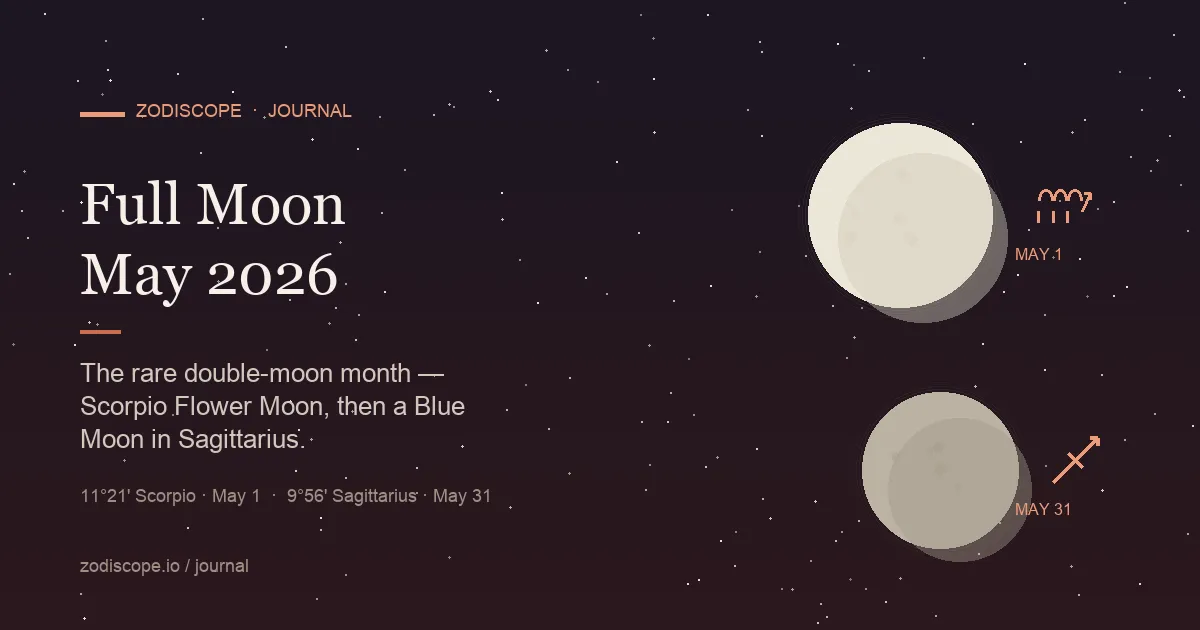
Most months have one full moon. May 2026 has two. The Flower Moon already lit up Scorpio on May 1; a much rarer Blue Moon closes out the month from Sagittarius on May 31. The last time a single calendar month carried two full moons was August 2023, and after May 31, 2026, you'll be waiting years for the next one.
That's the headline. The more useful read is the shape of the month between them: a 30-day arc from water-sign depth to fire-sign expansion — the rare chance to excavate something on May 1 and replace it with a clearer philosophy by May 31. This guide is built around that arc: exact times in your timezone, the houses each moon activates by rising sign, and a step-by-step way to figure out which of the two will actually move the needle in your chart. (Spoiler: it's almost never the one your sun sign would suggest.)
Want to see exactly which house each May full moon is activating in your chart? Generate your free birth chart on ZodiScope and pull up your house overlay — the math is done for you.
Try the free birth chart calculator →The two full moons of May 2026: exact times
Both peak times below are the moment the Moon is exactly opposite the Sun in the ecliptic — the astrological "full moon" instant. Visually, the Moon looks full for about a day on either side, but the chart-level energy is sharpest within ~12 hours of peak.
Full Moon #1: Flower Moon in Scorpio — May 1, 2026
Peak: 17:23 UTC · 1:23 PM EDT · 10:23 AM PDT · 6:23 PM BST · 11°21' Scorpio · Micromoon
The traditional "Flower Moon" name comes from Northern Hemisphere agriculture — the full moon that lines up with mid-spring bloom. Astrologically, this one falls on the Taurus–Scorpio axis: the Sun is in early Taurus (security, body, what you own), the Moon is in mid-Scorpio (intimacy, shared resources, what you're not saying out loud). The usual one-liner is "birth, death, rebirth" — Renee Watt at Astrology.com leaned on that framing in her read of this exact lunation. The piece that framing misses is the close square from Saturn in Aries: this isn't a soft, mystical death-and-rebirth. It's a deadline. Something gets named, restructured, and held to a real-world standard — or it doesn't.
Full Moon #2: Blue Moon in Sagittarius — May 31, 2026
Peak: 08:45 UTC · 4:45 AM EDT · 1:45 AM PDT · 9:45 AM BST · 9°56' Sagittarius · Micromoon (Blue Moon)
The Blue Moon. Same calendar month, second full moon — a quirk of the 29.5-day lunar cycle catching the front edge of a long month. This one falls on the Gemini–Sagittarius axis: the Sun in late Gemini (the data, the close-range chatter, the specifics), the Moon in early Sagittarius (the meaning, the long view, the bigger frame). Where May 1 forces you to excavate something, May 31 demands you zoom out and locate it inside a bigger story. The trap: a Sagittarius full moon makes everything feel bigger and more decisive than it really is. The release is real; the urge to launch off the back of it is the part to push back on.
Why this matters: a Blue Moon month is rare
A calendar-month Blue Moon happens roughly every 2.5 to 3 years. Recent history:
- August 31, 2023 — the previous calendar-month Blue Moon (also a supermoon, the inverse of this year's micromoons).
- May 31, 2026 — the next one, this one.
- After 2026 — the cycle skips ahead by years. There isn't another monthly Blue Moon in 2027 or 2028.
That 2.5-year cadence is what makes this a useful checkpoint, not just a calendar quirk. Whatever cycle began for you around the August 31, 2023 Blue Moon is closing on May 31, 2026 — a clean 33 months. If you kept any kind of journal in late summer 2023, that's the file to pull. The astrological weight isn't in the rarity itself; it's in the fact that you're getting two complete lunar peaks inside a single 30-day stretch, which compresses an entire emotional cycle into half its usual length.
Both are micromoons — what that actually means
The Moon swings between perigee (closest, ~363,300 km) and apogee (farthest, ~405,500 km) once a month. A full moon near apogee is a micromoon: about 5% smaller and 10% dimmer than average. Both May 2026 full moons fall near apogee, with the May 31 Blue Moon being the more distant of the pair.
In practice, this means the volume is turned down. If a supermoon is a scream, a micromoon is a whisper. Don't expect external fireworks — expect internal shifts that require quiet to actually notice. That's an interpretive convention, not a measurable effect, but it lines up with how most practitioners read these placements and it makes the rising-sign breakdown below the more important part of the article.
Stop guessing which moon is "for you." See how today's transits land on your specific birth chart with a personalised daily read inside ZodiScope.
See today's transits on your chart →Where each full moon hits — by rising sign
Full moons activate houses, not signs. Whatever house holds 11° Scorpio in your chart is where May 1 lit up; whatever house holds 9°–10° Sagittarius is where May 31 will land. The fastest way to map this without pulling up your full chart is to use your rising sign — most horoscope columns get this wrong (they use the sun sign), which is why generic full-moon horoscopes feel like they're written for someone else. Use the rising-sign read below, not your sun.
Aries rising
Scorpio Flower Moon hits your 8th house — shared finances, joint property, the parts of intimacy that don't show up on Instagram. Sagittarius Blue Moon hits your 9th — travel plans, study, the bigger philosophical project. The arc is "settle the deep entanglements, then go wider."
Taurus rising
Scorpio Flower Moon hits your 7th — partners, contracts, the person sitting opposite you. Sagittarius Blue Moon hits your 8th — shared money, debt, inheritance, intimacy. A month-long descent through your relationship axis. Hard to skim.
Gemini rising
6th house, then 7th — health and daily routine on May 1, partnerships on May 31. The thread is "what's the unsustainable habit, and which relationship is propping it up?"
Cancer rising
5th house, then 6th. Romance, creative output, and play on May 1 — work routines and health on May 31. The Moon rules your chart, so you'll feel both more sharply than most.
Leo rising
4th, then 5th. Home and family on May 1 — creativity, kids, romance on May 31. A move from "what's holding me up" to "what am I making with it."
Virgo rising
3rd, then 4th. Communication, siblings, short trips on May 1 — home base on May 31. Watch for a sibling conversation or local logistics issue that resurfaces near month-end.
Libra rising
2nd, then 3rd. Money and self-worth on May 1 — voice and communication on May 31. The progression is "settle the value question first; speak with confidence after."
Scorpio rising
May 1 is your full moon. Scorpio rising means Scorpio is at the start of your 1st house, so the Flower Moon falls on your Ascendant — your face to the world. This will feel personal. May 31 then activates your 2nd — money, what you call yours.
Sagittarius rising
12th, then 1st. The Flower Moon falls in your hidden 12th — dreams, what you've been suppressing — and the Blue Moon falls on your Ascendant. May 31 is yours. Expect a public moment of "this is who I'm becoming."
Capricorn rising
11th, then 12th. Community, friends, networks on May 1 — and a quieter, retreating mood on May 31. End-of-cycle energy. Don't force any new starts at month-end; the next new moon (June 14 in Gemini) is the place for that.
Aquarius rising
10th, then 11th. Career and public role on May 1 — community and chosen family on May 31. Often a quiet announcement or visible recognition lands in early May; collaboration around it on the Blue Moon.
Pisces rising
9th, then 10th. Beliefs, study, travel on May 1 — career and reputation on May 31. The cleanest of the twelve arcs: "what I believe is true → what I'm willing to build publicly."
If you don't know your rising sign, this is the placement to find first — it's the one most horoscope columns silently get wrong. Our rising sign guide covers why. It requires an exact birth time and place — once you have them, the free Big 3 calculator returns your rising sign in seconds.
How to actually work the 30-day arc
Most full-moon articles end with a list of crystals to charge and journaling prompts that could be written for any moon in any year. Here is something more specific: the four-step way to read a double-full-moon month if you're using astrology as a practical tool rather than as decoration.
- Find your houses, not your signs. 11° Scorpio and 9°–10° Sagittarius are in different houses for each of the 12 rising signs. The rising-sign read above is your shortcut.
- Look up what's already in those houses in your natal chart. A full moon doesn't add anything new — it lights up what was already there. If you have a personal planet (Sun, Moon, Mercury, Venus, Mars) within 5° of either full moon's degree, that's the placement getting activated. Open your birth chart and check.
- Read the arc, not the events. The Scorpio moon is a reveal. The Sagittarius moon is a release. People often do step 1 well (notice what surfaces on May 1) and then skip step 2 (act on what they've learned by May 31). The arc is the point.
- Don't fight a Blue Moon by launching. A Sagittarius full moon will make every half-formed plan feel like a calling, especially the morning after — that's the Sagittarius signature, not a verdict on the plan. Blue Moons close out cycles. The June 14, 2026 new moon in Gemini is your actual launch window; sign the contract then, not on May 31.
What's around these moons in the May 2026 sky
Lunations don't happen in a vacuum. Two of the 2026 transits we've already covered are still very much in motion through May:
- Saturn in Aries is forming a hard square to the Scorpio Flower Moon — adding a "what's actually mine to carry, what isn't" tension to anything that comes up on May 1.
- Saturn and Neptune are still close after their February conjunction at 0° Aries — 0° is the "Great Beginning" degree of the zodiac, which makes both May lunations the first real stress-tests of that new 36-year cycle.
- Mercury is moving through Taurus and into Gemini across May — slowly, and not retrograde. The first Mercury retrograde of 2026 has already ended (it ran February through March), and the next one doesn't begin until June 29.
- Venus is in Gemini for most of May, which softens the Blue Moon — a friendlier-than-usual Sagittarius full moon.
A note on who's actually tracking this
For context: a 2024 Pew Research survey found 30% of U.S. adults consult astrology, tarot, or fortune tellers at least yearly. About 27% say astrology can affect people's lives, essentially flat with the 29% Pew measured in 2017. The share is highest among women 18–49 (43%) and LGBTQ+ adults (about half), and lowest among atheists and White evangelicals. Worth knowing — but not the point of this article. The point is the chart-level read above.
Want a personalised read of both May 2026 full moons against your chart — the houses, the aspects, and which one your personal planets sit closest to? Sign up free for ZodiScope and pull up your full chart in seconds.
Get your free ZodiScope chart →Keep reading
- · Reading the wrong horoscope for your chart? Read what is my rising sign — and why most horoscopes are calibrated to the wrong placement. (Same fix that makes the per-rising read above actually land.)
- · The other big retrograde in 2026: Mercury retrograde 2026 — dates & the year of water signs. The first round already ended; the next is in June.
- · The slow background transit driving the whole 2026 mood: Saturn conjunct Neptune 2026 — the once-in-36-years reset that already happened.
- · Want to read where each moon lands in your chart yourself? Start with the 12 houses in your birth chart, explained.
- · The natal placement the May 1 Flower Moon lights up: Moon in Scorpio meaning — the high-resolution emotional radar.
- · The natal placement the May 31 Blue Moon lights up: Moon in Sagittarius meaning — the peregrine Moon that runs on Jupiter.
- · The rising sign whose modern ruler is currently squaring it for 20 years (and the chart this lunation hits hardest): Scorpio rising meaning — the Mars-and-Pluto ascendant.
- · The ascendant whose chart ruler is the greater benefic — for the Blue Moon read: Sagittarius rising meaning — the only ascendant ruled by Jupiter alone.
- · The element behind the Flower Moon: What are the water signs? — Cancer, Scorpio, Pisces and why 2026 is the most water-flavored year in over a decade.
- · The element behind the Blue Moon: What are the fire signs? — Aries, Leo, Sagittarius and the 2026 fire year (Saturn in Aries + Jupiter in Leo).
- · How Moon signs pair: moon sign compatibility — the element framework and the dignity layer no listicle covers.
- · The other half of this month, in reverse: New Moon May 2026 — the Taurus super new moon on May 16, what to plant in the still point between these two full moons.
- · Back to all journal articles.
FAQ
When exactly is the full moon in May 2026?
May 2026 has two full moons. The first is the Flower Moon on May 1, 2026 at 17:23 UTC (1:23 PM EDT / 10:23 AM PDT) at 11°21' Scorpio. The second is a Blue Moon on May 31, 2026 at 08:45 UTC (4:45 AM EDT / 1:45 AM PDT) at 9°56' Sagittarius. Both fall in the same calendar month because the lunar cycle is about 29.5 days, shorter than May's 31.
What sign is the May full moon in?
The Flower Moon on May 1 is in Scorpio at 11°21'. The Blue Moon on May 31 is in Sagittarius at 9°56'. Astrologically, those are the placements that matter — they're what your transits and synastry charts use. (Astronomically, the May 1 moon is technically in the constellation Libra; the constellation boundaries and the zodiac signs no longer line up, which is a separate conversation.)
What is a Blue Moon, and why does May 2026 have one?
The modern "calendar" definition of a Blue Moon is the second full moon in a single calendar month. Since the lunar cycle is roughly 29.5 days and most months have 30 or 31, you can occasionally fit two full moons in one month. The previous one was August 31, 2023. After May 31, 2026, the next monthly Blue Moon is years away. It's not visually blue — the name just denotes the rarity.
Why are both May 2026 full moons called micromoons?
A micromoon is a full moon that occurs near apogee — the point in the Moon's orbit where it's farthest from Earth. The Moon's distance varies by about 14% between perigee and apogee, so a micromoon appears roughly 5% smaller and about 10% dimmer than an average full moon. Both May 2026 full moons fall near apogee, with the May 31 Blue Moon being the more distant of the two.